- What GBP Actually Signals to AI Platforms
- From Local Pack Era to AI Recommendation Era
- The Seven Signals AI Platforms Use Beyond GBP
- Why ChatGPT and Perplexity Skip GBP-Only Businesses
- The Off-GBP Footprint Audit
- When a Perfect GBP Coexists With Zero AI Citations
- Industry Patterns: Restaurants vs. Lawyers vs. Medical vs. HVAC
- Why Your Website Matters Again
- The 90-Day Playbook to Extend Beyond GBP
- The Off-GBP Signal Stack Matrix
- The Off-GBP Visibility Cheat Sheet
- Frequently Asked Questions
What GBP Actually Signals to AI Platforms
A Google Business Profile is a structured listing inside Google’s local business graph that consolidates a business’s name, address, phone, hours, services, categories, photos, posts, and reviews into one Google-owned record. GBP signals were designed for Google Search and Google Maps: they drive local pack placement, Maps recommendations, and the knowledge panel beside a brand-name query. In the local pack era, optimizing the Google Business Profile was the highest-impact local visibility activity because Google weighted those signals heavily and the local pack sat above organic results for most high-intent searches. This pattern matters now because the single most important shift in local visibility happens in the first scroll of every AI answer, not on the second page of Google.
The move to AI search has decoupled local visibility from GBP optimization. ChatGPT, Perplexity, Claude, and Google AI Overviews are the four engines most likely to intercept a local recommendation query before a searcher ever reaches Google’s local pack, and they do not weight GBP signals the way Google’s local algorithm does. ChatGPT and Perplexity do not query the Google local graph at all in most contexts. Claude operates the same way. Google AI Overviews can read GBP data, but Overviews pulls from a much wider retrieval graph, with the Google Business Profile serving as one input among many rather than the dominant signal it once was.
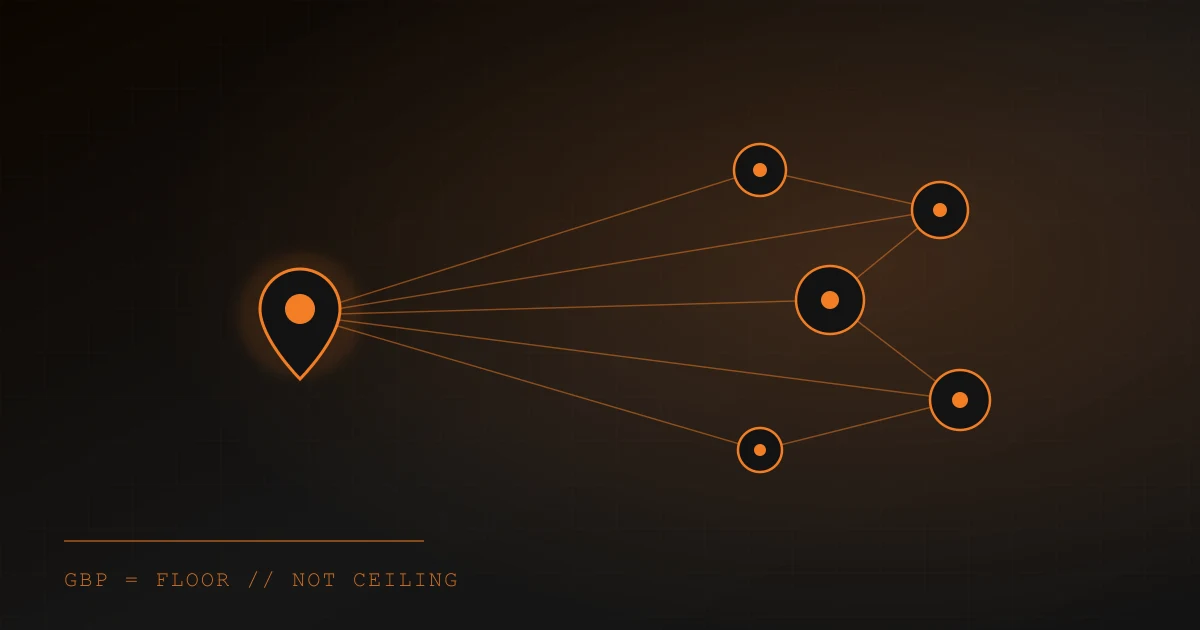
The GBP Visibility Floor: in the local pack era, Google Business Profile was the ceiling of local visibility for most businesses; in the AI recommendation era it is the floor, necessary to confirm a business exists, but insufficient to surface in the systems that intercept search intent before the local pack ever loads. Markets fill fast. Check your territory availability.
The practical consequence is that Answer Engine Optimization can no longer treat the Google Business Profile as the endpoint of local visibility work. A complete, claimed, and current GBP is now a prerequisite, a baseline that confirms the business operates where it claims to. The AI platforms making recommendations score businesses against a layered signal stack that extends far past GBP, and a brand that has only optimized its profile is invisible to those platforms for the exact local recommendation queries that would have triggered the local pack a few years ago. The first finding is the one most owners resist: a flawless profile is the price of entry, not the win.
For the underlying mechanics of how AI systems pick which brands to surface, read our analysis of how AI platforms choose businesses to cite. Questions on your own footprint? Email support@theanswerengine.ai and we will point to the gaps.
The ShiftFrom Local Pack Era to AI Recommendation Era
The local pack era ran roughly from 2010 through 2023. During that period the dominant local visibility surface was the three-pack of listings at the top of Google results for queries with local intent. The local pack was driven mostly by GBP signals: proximity to the searcher, relevance of categories and services, and prominence measured through reviews, citations, and inbound links. A well-optimized Google Business Profile could deliver most of a small business’s discoverability, and an entire SEO sub-discipline grew up around GBP optimization.
The AI recommendation era began with the broad rollout of generative answer interfaces in late 2023 and accelerated through 2024 and 2025. By early 2026, a meaningful share of local recommendation queries (best plumber in Pasadena, divorce attorney near me, family dentist accepting new patients) are answered by an AI-generated response before the user scrolls to traditional results. That recommendation set is driven by retrieval and ranking against a different signal graph than the local pack used. The Google Business Profile is part of that graph in some contexts, but the graph spans review platforms, citation directories, owned-domain schema, named-author bylines, earned media, industry directories, and community discussion.
Google AI Overviews still weight GBP signals in some local contexts. ChatGPT and Perplexity weight them far less. Claude weights them less still. A business optimized only for the Google local pack is in a transitional position: visible in some AI contexts, invisible in others, and trending toward broader invisibility as more recommendation traffic moves to non-Google AI surfaces. The fix is not to abandon GBP but to extend the signal footprint beyond it. Claim your free strategy call before your market fills.
The structural change inverts the optimization priority order. In 2018 the right sequence for a local business was claim GBP, optimize GBP, build citation consistency, accumulate Google reviews, then expand to a website if budget allowed. In 2026 the sequence flips: claim and maintain the Google Business Profile as a baseline, then immediately invest in the off-GBP footprint, because that broader footprint is what produces AI citations. Dollars spent on additional GBP optimization past a baseline produce diminishing returns in an environment where the profile is no longer the primary recommendation surface. Reach an AEO specialist directly at (213) 444-2229.
The Signal StackThe Seven Signals AI Platforms Use Beyond GBP
The off-GBP footprint is the sum of every retrievable signal a business produces outside its Google listing. The Off-GBP Footprint: independent reviews, owned-domain schema, named-author content, earned media, industry directories, and community mentions together form the actual surface AI platforms score when choosing who to cite, and a missing category is a larger problem than a partially developed one. AI recommendation systems evaluate seven independent categories, defined below. Want this mapped for your business? support@theanswerengine.ai.
1. Independent Review Platforms
Independent review platforms are third-party sites that host customer reviews outside Google: Yelp, BBB, Trustpilot, Capterra, G2, Avvo, Healthgrades, Angi, and category equivalents. AI systems weight these heavily because they represent independent validation that the business operates as it claims. AI platforms cross-reference review patterns across multiple platforms to build a consensus picture of reputation that is more reliable than a single-platform base. A business with 500 Google reviews and zero presence elsewhere produces a weaker AI consensus signal than a business with 100 reviews each on Google, Yelp, BBB, and an industry platform. Aggarwal et al. (KDD 2024) found that quoted, specific testimonial language lifts citation likelihood by 37 percent, which is why review text, not just star count, matters.
2. Citation Directory Consensus
Citation consensus is the alignment of a business’s name, address, and phone across the dozens of directories that AI training pipelines and live retrieval systems ingest. Inconsistent NAP data is read by AI systems as evidence of either inactive operation or low-quality information, both of which cut citation probability. Citation consensus is foundational rather than impressive: it cannot make a business look authoritative, but inconsistent citations can disqualify an otherwise strong candidate from AI recommendation.
3. Schema Markup on Your Own Domain
Schema markup is machine-readable structured data added to a website that tells AI crawlers exactly what a business is. LocalBusiness schema, Service schema for each offering, FAQPage schema on key pages, and Person schema on author pages form an entity graph AI systems use to confirm identity and scope. A GBP listing is not a substitute for owned-domain schema, because the profile record lives entirely inside Google’s walled graph while owned-domain schema is independently crawlable. GEO-SFE (2026) measured a 43 percent citation lift for content structured as lists and tables, the formats schema reinforces. Call (213) 444-2229 to pressure-test your schema.
4. Named-Author Content With Credentials
Named-author content is writing attributed to a real, credentialed person rather than an anonymous brand. AI platforms weight authorship heavily as an expertise signal: content with a named expert, a linked bio page, and external profile references carries meaningfully more citation weight than anonymous brand copy. Chen et al. (2025) documented a systematic AI bias toward earned, attributed sources over self-published brand content, which makes the named byline one of the highest-impact assets a local business owns. For most local businesses the named author is the owner or lead practitioner, and Person schema on the bio page makes that identity machine-readable.
5. Earned Editorial Coverage
Earned editorial coverage is independent media mention that the business did not pay for or publish itself: trade publications, local news, and industry blogs. AI platforms treat earned coverage as evidence that independent editors found the business credible enough to feature, which is structurally stronger than self-described claims on a brand’s own properties. Expert quote services, proactive outreach, and guest contributions are the practical mechanisms for building earned coverage at scale. Book a free 30-minute call to map an earned-media plan.
6. Industry-Specific Directories
Industry-specific directories are the authoritative listing sites AI systems weight for a given category: Avvo and Justia for attorneys, Healthgrades and Zocdoc for medical, HomeAdvisor and Angi for home services, G2 and Capterra for B2B software. Presence on the right industry directory often outperforms presence on a generic review platform, because AI models are trained to treat category directories as authoritative sources for that specific category. We work with one business per market. See if your territory is still open.
7. Community Mentions on Forums and Discussion Platforms
Community mentions are unprompted references on Reddit, Quora, Nextdoor, and category forums. AI platforms weight these as community validation: when a model sees real users discussing a business positively in a thread, it registers organic reputation. Community mentions cannot be manufactured ethically, and AI systems are increasingly sharp at detecting astroturfing, but they can be earned through consistent service and active participation by named team members. Check where you stand with a free Blind Spot scan.
For a deeper read on how these categories combine into a single trust evaluation, see our framework on E-E-A-T for AI search and the anatomy of an AI citation.
AI Search Is Replacing the Map Pack. Is Your Business Listed Where It Counts Now?
ChatGPT and Perplexity now recommend local businesses directly, bypassing Google Maps entirely. Most local businesses are invisible in AI search even when they rank first in the Map Pack. Free Blind Spot Report, 48-hour turnaround.
Run Free Local AI Visibility Scan →Why ChatGPT and Perplexity Skip GBP-Only Businesses
ChatGPT and Perplexity have become substantial local recommendation surfaces in 2026, with many users now defaulting to one or both for queries that historically triggered the Google local pack. Neither platform queries Google Maps or the Google local graph directly when generating recommendations. Their retrieval systems pull from web pages, structured directory listings, review platforms, editorial coverage, and schema-marked content across the open web. A business with a perfect GBP but no website, no third-party reviews, no editorial mentions, and no schema markup has almost nothing for these models to retrieve, score, or cite.
The Retrieval Asymmetry: ChatGPT and Perplexity do not see Google’s local pack, they retrieve from the open web, which renders a business optimized only inside Google’s walled local listing functionally invisible to the engines now answering local recommendation queries. Ready to act? Book a free strategy session.
The retrieval architecture is the key. ChatGPT’s training data and live browsing are not built around a Google-Maps-style local index. Perplexity’s retrieval graph is similarly general-web. When either platform receives a query like “recommend a good pediatric dentist in Glendale,” it does not query the local pack, it searches its trained associations and live sources for businesses that match the category and location, then synthesizes a recommendation from whatever it can find. A business that does not exist meaningfully outside GBP simply does not appear in the retrieval set, which is the retrieval asymmetry in practice rather than theory.
Google AI Overviews sits in a different position. Because Overviews is a Google product, it can incorporate GBP signals more directly than ChatGPT or Perplexity. Even so, Overviews pulls from a wider retrieval graph than the traditional local pack, and our audit data consistently shows that businesses with strong off-GBP footprints surface in Overviews more often than businesses with strong GBP and weak off-GBP signals. The Google-owned platform still rewards the broader signal stack, just less starkly than the non-Google platforms do. Email support@theanswerengine.ai for a platform-by-platform read on your category.
The behavioral implication for owners is direct. Past the point where the Google Business Profile is claimed, complete, and current, the next marginal dollar produces meaningfully more AI citation lift when spent on independent review presence, schema markup, named-author content, or earned media than on additional GBP work. The optimization budget needs to follow the signal weight, and the signal weight has moved off the profile.
→ Check if AI search recommends your local businessThe Audit MethodThe Off-GBP Footprint Audit
An off-GBP footprint audit is a structured inventory of every signal a business produces outside its Google Business Profile that contributes to AI recommendation. The audit covers the seven categories above and produces a presence-or-absence record plus a quality score for each. The method is straightforward, takes three to five hours for a single-location business, and outputs a fix list ranked by AI citation impact. The off-GBP footprint is the unit of measurement. Prefer we run it for you? Grab a free 30-minute slot.
Step One: Inventory Independent Review Platforms
Search the business name on Yelp, BBB, Trustpilot, and the industry review platforms for the category. For each platform, record whether a profile exists, whether it has been claimed, the review count, the average rating, and the recency of the latest review. A claimed, populated profile with steady review velocity is a positive signal. A missing profile or a stale unclaimed profile is a gap.
Step Two: Audit Citation Directory Consensus
Use a citation tracking tool or a manual search to verify NAP consistency across Apple Maps, Bing Places, Foursquare, Data Axle, Localeze, Yelp, BBB, Yellow Pages, and industry equivalents. Any mismatch, even an abbreviated street name or a missing suite number, counts as an inconsistency that AI consensus systems can flag. NAP consistency is binary: either every citation matches exactly or the consensus signal degrades.
Step Three: Audit Schema Markup on the Owned Website
If the business has no website on a domain it owns, that is the single largest gap in the footprint. If a website exists, use Google’s Rich Results Test or the Schema.org validator to confirm LocalBusiness schema, Service schema for each offering, FAQPage schema on key pages, and Person schema on author pages. Missing or invalid schema is high-impact, because schema is the most direct mechanism for making business data machine-readable to AI crawlers. Talk it through with us at (213) 444-2229.
Step Four: Inventory Authored Content
Catalog every piece of content on the website. For each, record whether it has a named author, whether the author has a bio page on the same domain, whether the bio page links to external profile references, and whether the bio page implements Person schema. Anonymous content is an expertise gap. Content with named authors but no bio page or external references is a partial expertise signal.
Step Five: Inventory Earned Media
Search Google News, relevant trade publications, and local outlets for mentions of the business or its named team members. Record the publication, date, context, and whether the mention links back to the business website. Earned mentions that include a link compound the signal value because they create both an editorial citation and a domain-level authority signal.
Step Six: Inventory Industry-Specific Directories
Identify the three to five highest-authority directories for the category. For each, confirm a profile exists, the data is complete, and it is consistent with the GBP and citation directory NAP data. Industry directories are often the highest-impact off-GBP signal for regulated industries where AI platforms weight category-specific authoritative sources heavily. One client per city. See if your market is available.
Step Seven: Inventory Community Mentions
Search Reddit, Quora, Nextdoor, and category forums for unprompted mentions of the business. Community mentions cannot be optimized directly, they are a lagging indicator of organic reputation, but presence or absence is a meaningful audit signal, and active named-team-member participation can build community presence over time.
The ParadoxWhen a Perfect GBP Coexists With Zero AI Citations
The most counterintuitive pattern we encounter in 2026 is the business with a flawless Google Business Profile (fully complete, hundreds of high-quality reviews, weekly posts, full category coverage, frequent photos, consistent local pack visibility) that nonetheless generates zero AI citations across ChatGPT, Perplexity, and Google AI Overviews for high-intent category queries in its service area. This is not a rare edge case. It is a common configuration, especially for service businesses that invested heavily in local SEO over the past five years and treated GBP optimization as the primary lever. This analysis draws on the GEO and AEO research corpus (Aggarwal et al. 2024, Zhang et al. 2026, GEO-SFE 2026, Chen et al. 2025) and our own citation-lab audits of local businesses across regulated and consumer categories. See your own picture with a free Blind Spot scan.
The mechanism behind the paradox is simple. GBP signal weight is contained inside Google’s walled local graph and does not propagate to the broader AI retrieval graph that ChatGPT and Perplexity operate against. When the off-GBP footprint is absent (no independent reviews, no schema-marked website, no named-author content, no editorial mentions, no industry directory presence) AI models have nothing to retrieve when asked for category recommendations. The GBP work, however excellent, produces no citation lift in the AI surfaces that increasingly intercept the query.
When we run side-by-side citation tests on two competitors in the same category and city, one with a perfect GBP and a thin off-GBP footprint, the other with a baseline GBP and a developed off-GBP footprint across reviews, schema, content, and earned media, the second business consistently wins AI citations on non-Google platforms and frequently wins them in Google AI Overviews as well. The off-GBP signal stack is doing the work of AI visibility.
The remediation is not to undo the GBP work. The Google Business Profile investment continues to produce local pack visibility, which still drives real-world traffic. The remediation is to add the off-GBP signal stack on top of the existing GBP foundation: claim independent review profiles, build or upgrade a schema-marked website, attribute content to named experts with credentials, pursue earned media, and establish presence on the industry directories that matter for the category. The 90-day playbook below sequences this work for maximum citation impact. Schedule a free call to start the sequence.
By IndustryIndustry Patterns: Restaurants vs. Lawyers vs. Medical vs. HVAC
GBP performance in the AI era is not uniform across industries. Different categories produce different AI citation patterns because AI platforms are trained to weight different source types per category. An owner planning the off-GBP investment needs the specific pattern for the relevant industry to allocate budget correctly.
Restaurants and Consumer Retail
Restaurants retain meaningful AI surface time from GBP signals because AI models cross-reference Google reviews and Maps data for consumer food and retail. Yelp remains heavily weighted. OpenTable, Resy, TripAdvisor, and city food media (Eater, Infatuation) carry real signal weight, and local food-blog coverage compounds the lift. For restaurants, the off-GBP priority is Yelp, the major reservation platforms, and local food media, in that order.
Lawyers and Legal Practices
Legal categories depend more on independent platform consensus than consumer categories, because AI models weight regulated-industry sources heavily for trust. Avvo and Justia are foundational. State bar listings, Martindale-Hubbell, and Super Lawyers carry weight. Named bylines on practice-area content with attorney credentials are weighted heavily because expertise is treated as a prerequisite in legal categories. For attorneys, the priority is Avvo, Justia, state bar, named-author practice content, and earned legal-trade coverage. Email support@theanswerengine.ai for a category-specific plan.
Medical and Healthcare Practices
Medical practices face the same regulated-industry weighting with a different platform stack. Healthgrades and Zocdoc are foundational. Vitals, Doctor.com, and category platforms (Psychology Today, RealSelf) carry weight. AI platforms are cautious about medical citation accuracy, so the trustworthiness pillar (primary-source linking, current credentials, transparent organizational data) is weighted heavily. For medical practices, the priority is Healthgrades, Zocdoc, named-physician content with credentials, and the category platforms that map to the service mix.
HVAC, Plumbing, and Home Services
Home services usually require GBP plus active presence on the home-services stack for consistent AI recommendation. Angi and HomeAdvisor are foundational. Yelp carries real weight. Nextdoor recommendations register as community signals. BBB accreditation is meaningful, and state contractor license verification compounds trustworthiness. For home services, the priority is Angi, HomeAdvisor, Yelp, BBB, Nextdoor presence, and license verification on the website. Reach us at (213) 444-2229.
The unifying principle is that GBP is the floor in every industry, but the ceiling sits at different platforms by category. The off-GBP investment maps to the platforms AI systems weight most heavily for the specific industry rather than following a generic local SEO checklist. Because territory is exclusive, we onboard one business per market. Claim your category before a competitor does.
→ Check if AI search recommends your local businessThe Owned DomainWhy Your Website Matters Again
For roughly a decade the conventional wisdom for small local businesses was that a website mattered less than GBP optimization, because the local pack drove most visibility and a simple listing could substitute for an owned-domain presence. That wisdom is now broken. In the AI recommendation era, a real website on a domain the business owns is one of the highest-impact off-GBP assets available, and businesses without one are at a measurable disadvantage in AI citation rates regardless of GBP strength.
The Schema Twin: a schema-marked website on an owned domain is the independently crawlable counterpart of a GBP listing, and unlike the profile record it propagates to non-Google retrieval systems that never read Google’s local graph. Lock yours in: book a free build review.
The mechanism is direct. AI platforms retrieve from schema-marked content on owned domains as a primary source of structured business data. A GBP listing is not crawled as a website, it is a structured record inside Google’s walled graph that non-Google AI platforms do not consistently access. A schema-marked website with LocalBusiness, Service, FAQPage, and Person schema produces a parallel structured record that is independently crawlable and weights as evidence in the AI citation graph. The schema twin propagates where the GBP signal cannot.
Beyond schema, the website is where named-author content lives. Author bylines, expertise demonstrations, credential statements, case studies, and proprietary research all sit on the owned domain. None of these can be replicated on GBP, where posts are short-form and not weighted by AI platforms as authored content. A business publishing regular content under named expert authorship on a schema-marked website produces a continuous stream of expertise and authoritativeness signals. A business posting only on GBP produces none of them. Reach out anytime at support@theanswerengine.ai.
What a Citation-Ready Website Includes
A minimal citation-ready website for a local business includes a clear homepage with business identity and service summary, a dedicated page per service with Service schema, an About page with named team members and Person schema, a Contact page with consistent NAP and LocalBusiness schema, FAQPage schema on the homepage and main service pages, blog content under named expert authorship updated at least monthly, and visible last-updated dates on key content. The Recency Discount: content and listings without a verifiable last-updated signal are down-weighted by AI retrievers, which treat undated business data as potentially stale and therefore lower-confidence. The implementation cost is moderate, and the citation lift from schema-marked content is substantial.
For a deeper read on earning citations through owned-domain optimization, see how to get featured in Google AI Overviews.
The PlaybookThe 90-Day Playbook to Extend Beyond GBP
A 90-day structured effort produces measurable AI citation gains for most local businesses. The work is sequential rather than simultaneous, because the signal categories have dependencies: schema markup must exist before named-author content carries full weight, and a citation-ready website must exist before earned-media outreach is fully productive. The playbook below sequences the work by dependency and impact. The Consensus Premium: AI recommendation engines weight breadth of independent verification over depth of single-platform optimization, so a business cited across four authoritative platforms outranks a business with a flawless profile on one.
Days 1 to 30: Foundation
The first 30 days focus on signals entirely within the business’s control. Audit and confirm GBP completeness as a baseline. Claim every existing unclaimed profile on the category’s independent review platforms. Verify NAP consistency across the top 20 citation directories. If no website exists, build a minimal citation-ready version. If one exists, audit and implement LocalBusiness, Service, FAQPage, and Person schema. Add named bylines to all existing content and build author bio pages with Person schema. By day 30 the on-domain foundation should be structurally complete. Call (213) 444-2229 if you want a second set of eyes.
Days 31 to 60: Platform Expansion
The second phase targets the third-party platform layer. Establish or activate profiles on the category platforms that matter most (Avvo, Healthgrades, Angi, G2, Capterra, Clutch, or equivalents). Begin proactive review acquisition on the four to six independent platforms with the highest AI signal weight for the category. Submit at least two expert quote responses per week through reporter-source services. Begin outreach to two or three trade publications or local outlets for guest contribution or expert commentary. By day 60 the off-GBP platform footprint should be measurably broader than the day-1 baseline.
Days 61 to 90: Content and Tracking
The third phase focuses on publication and citation tracking. Publish three to five long-form pieces on the website under named expert authorship, each with full schema and primary-source linking. Distribute one or two high-value articles to independent publications through guest posting or licensing. Set up AI citation tracking with monitoring tools or a structured manual spot-check for the top 20 category queries in the service area. By day 90 the business should have a measurable AI citation baseline, a structurally complete off-GBP footprint, and a clear picture of which categories are producing the most lift.
Earned-media placements pursued in days 31 to 60 usually publish weeks after outreach, producing lift in months three and beyond. Review velocity built in days 31 to 60 compounds into review-base depth over the following six months. Content published in days 61 to 90 is indexed and weighted on a multi-week to multi-month cycle. The day-90 metrics understate the trajectory, so track citations weekly past day 90 and expect the curve to steepen through month four. We work with one business per market. Check if yours is still open.
The Off-GBP Signal Stack Matrix
| Signal Category | Common Gap | Tactical Fix | Citation Impact |
|---|---|---|---|
| Independent Reviews | Reviews concentrated only on Google | Claim and activate 4+ independent platforms; build steady velocity | Very High |
| Citation Consensus | Inconsistent NAP across listings | Audit top 20 directories; lock a canonical format | Medium-High |
| Schema Markup | No website or no structured data | Build citation-ready site; validate via Rich Results Test | Very High |
| Named-Author Content | Anonymous brand content | Add bylines and bio pages with Person schema | High |
| Earned Media | No coverage outside owned and paid channels | Use expert quote services; pursue trade-pub outreach | High |
| Industry Directories | Missing from category platforms | Claim 3-5 highest-authority directories for the category | Very High |
| Community Mentions | No community presence | Active named-team participation; deliver service worth discussing | Medium-High |
| GBP (Baseline) | Unclaimed, incomplete, or stale | Claim and complete fully; treat as floor not ceiling | Medium (Floor) |
- Treat GBP as the floor, not the ceiling. Claim it, complete it, keep it current, then stop treating extra GBP work as the highest-impact activity.
- Build or upgrade a website on a domain you own. A GBP listing is not crawled as a website by non-Google AI platforms.
- Implement LocalBusiness schema site-wide. Include name, address, phone, hours, geo coordinates, and area served.
- Add Service schema for each offering and FAQPage schema on key pages, the highest-impact citation surfaces on a local site.
- Claim profiles on 4+ independent review platforms plus the category-specific directories for your industry.
- Lock NAP consistency across the top 20 directories. Even small variations degrade citation consensus.
- Attribute every piece of content to a named expert with credentials, external references, and Person schema.
- Pursue earned media in trade and local publications through expert quote services and proactive outreach.
- Maintain visible last-updated dates. AI platforms apply a recency discount to undated content.
- Set up AI citation tracking and re-audit quarterly against ChatGPT, Perplexity, Claude, and Google AI Overviews.
The Bottom Line: Your Google Business Profile is the floor of AI visibility, not the ceiling. Whether AI platforms recommend you, recommend a competitor, or skip your category depends on the off-GBP signal stack you build on top of it. Start with the gap, not the guess: run a free Blind Spot scan.
Frequently Asked Questions
Is Google Business Profile still important in the AI search era?
Google Business Profile remains essential, but its role has shifted from the local visibility ceiling to the local visibility floor. In the local pack era a well-optimized GBP could deliver most of a business’s discoverability. In 2026, AI platforms such as ChatGPT, Perplexity, Claude, and Google AI Overviews pull from a far wider signal set, so a brand that has only optimized its GBP is functionally invisible to those platforms. GBP is necessary but no longer sufficient. Need a read on your own gaps? Call (213) 444-2229.
Why do ChatGPT and Perplexity rarely surface GBP-only businesses?
ChatGPT and Perplexity do not query Google Maps or the local pack directly. Their retrieval systems pull from web pages, review platforms, independent media, structured directory listings, and schema-marked content. A business with a perfect GBP but no website, no third-party reviews, no editorial mentions, and no schema markup on an owned domain has almost nothing for these models to retrieve. AI recommendation relies on cross-source consensus, and GBP is only one source.
What signals do AI platforms use beyond Google Business Profile?
AI platforms weight a layered stack: independent review platforms (Yelp, BBB, Trustpilot, Capterra, G2, industry directories), citation consensus across directories, independent editorial coverage, schema markup on the business’s own site (LocalBusiness, Service, FAQPage, Person), named-author bylines with credentials, and unprompted community mentions on Reddit, Quora, and forums. Breadth of independent presence predicts AI recommendation more reliably than depth on any single platform. Book a free 30-minute mapping call.
Can a business with a perfect Google Business Profile have zero AI citations?
Yes, and it is one of the most common patterns we see in audits. A business can have a 100 percent complete GBP, hundreds of reviews, weekly posts, and full category coverage, yet generate zero citations in ChatGPT, Perplexity, or Google AI Overviews for high-intent local queries. GBP signal weight is largely contained inside Google’s local pack ecosystem and does not propagate to the broader AI retrieval graph. When the off-GBP footprint is empty, AI models have nothing to retrieve, score, or cite.
How does the role of GBP differ by industry?
Restaurants and consumer retail still get meaningful AI surface time from GBP signals because models cross-reference Google reviews and Maps data for those categories. Lawyers, financial advisors, and medical practices depend more on independent platform consensus (Avvo, Justia, Healthgrades, Zocdoc) because AI models weight regulated-industry sources more heavily for trust. HVAC, plumbing, and home services usually require GBP plus active presence on Angi, HomeAdvisor, and Yelp. GBP is the floor in every industry, but the ceiling sits at different platforms by category. Email support@theanswerengine.ai for your category map.
What is an off-GBP footprint audit and how do I run one?
An off-GBP footprint audit inventories every signal a business produces outside its Google Business Profile that contributes to AI recommendation. It covers seven categories: independent review platforms, citation consensus, owned-domain schema markup, named-author content with credentials, earned media, industry-specific directories, and community mentions. You run it by searching your name, address, and phone across each category, recording presence and quality, and ranking the gaps by AI citation impact. The output is a prioritized fix list. Prefer we run it? Start with a free Blind Spot scan.
Related Reading
How AI Platforms Choose Businesses to Cite
The framework AI systems actually use to decide which brands earn citation chips in generated answers.
Anatomy of an AI Citation
A line-by-line breakdown of what makes a single AI citation work, and how to engineer content for it.
E-E-A-T for AI Search: The 2026 Trust Stack
The trust stack AI platforms use to decide which brands to cite, and how to build each pillar.
How to Optimize Your Google Business Profile for AI
Get the baseline right first: the GBP signals ChatGPT, Gemini, and Perplexity actually read.