- What Google AI Overviews Are and Why They Changed Search
- The CTR Impact: Why Being Cited Beats Ranking First
- Who Gets Cited: Source Patterns in 2026
- Step 1 — Write Snippet-able Content Google Can Extract
- Step 2 — Deploy Schema Markup That Signals AIO Readiness
- Step 3 — Build E-E-A-T Signals Google Trusts
- Step 4 — Restructure Headings as Questions
- Step 5 — Earn Independent Citation Signals
- Featured Source Tier by Content Type
- Step 6 — Track AIO Visibility and Iterate
- 2026 AIO Playbook Cheat Sheet
- Frequently Asked Questions
What Google AI Overviews Are and Why They Changed Search
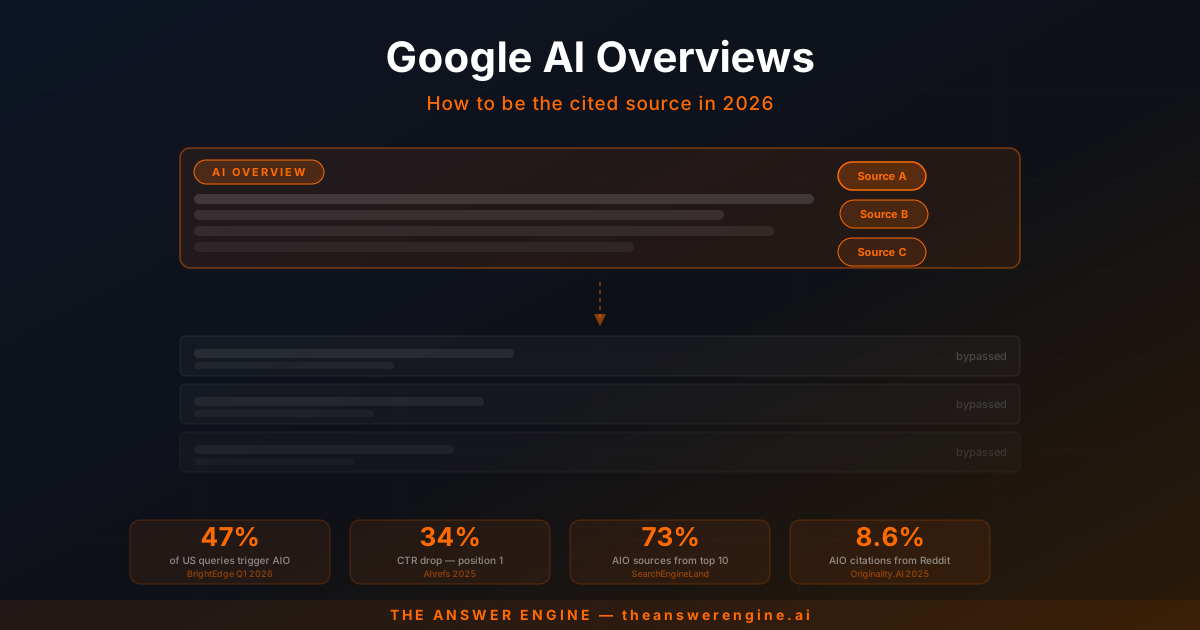
Google AI Overviews (formerly Search Generative Experience, or SGE) launched publicly in May 2024. By the end of 2025 they had become the default presentation layer for the majority of informational and how-to queries in the United States. By Q1 2026, BrightEdge data puts AIO trigger rate at 47% of all US searches. The feature does not replace the organic results. It appears above them, drawing the eye and the click before a user ever reaches position 1.
An AI Overview synthesizes an answer from multiple sources and presents it as a structured, AI-generated response at the top of the SERP. Below the synthesized answer, small citation chips appear, each linking back to a source page that Google has determined is authoritative enough to support the answer. Those citation chips are the real prize. A brand cited inside an AIO receives both visibility and a click path from users who engaged with the AI answer and want to read more. Brands not cited are simply invisible at the top of the page. Markets fill fast. Check your territory availability.
Google AI Overviews represent the largest structural change to the search results page since AdWords. The organic blue links have not disappeared, but for the first time since 2001, something else is consistently above them. The brands that adapt their content strategy to earn citations inside that something else will define the next decade of search visibility.
The shift is not temporary. Google has invested enormous infrastructure in AI Overview generation, the feature is expanding to more query types and more countries, and competitor AI search products from Perplexity and Microsoft have pushed Google to accelerate deployment. Businesses optimizing only for traditional organic ranking are now optimizing for the second-most visible position on the page. Understanding how AIO citation works is not optional for brands with meaningful search traffic at stake. Your first step: free AERO Blind Spot Scan.
For context on how this connects to the broader replacement of traditional search interfaces, read our analysis of whether Google AI Overviews are replacing search as we know it.
→ Get your free AI citation score — 48-hour turnaroundThe StakesThe CTR Impact: Why Being Cited Beats Ranking First
The numbers are stark. Ahrefs data from 2025 shows a 34% average drop in click-through rate for the organic number-one result when a Google AI Overview is present on the same SERP. Authoritas research puts the range at 30 to 40%, varying by query type. Informational queries, where AI Overviews are most prevalent, see the steepest drops because the AIO often fully satisfies search intent without requiring a click to any organic result.
What this means practically: a page that earned 1,000 clicks per month from a given keyword before AI Overviews started appearing may now earn 600 to 700 clicks from the same position, for the same query volume, simply because the AIO above it captures the attention and the intent satisfaction that used to reach the organic result. The traffic did not disappear. It was intercepted by the AI answer box above. Reach out: support@theanswerengine.ai.
The citation offset. Brands cited within an AI Overview do not fully recover the lost organic CTR, but they recover a meaningful portion of it. AIO citation links receive clicks from users who engaged with the AI answer and wanted the primary source. That click is a higher-intent visit than the median organic click, because the user has already read and processed the AI answer and is seeking confirmation or depth. Citation visibility and organic ranking together outperform organic ranking alone, even accounting for the AIO CTR discount.
The strategic implication is direct: businesses should be pursuing AIO citation as a separate, parallel goal alongside traditional organic ranking. Ranking first without earning an AIO citation in an AIO-dominated SERP is a losing position. Earning an AIO citation even from a position outside the top three can partially compensate for CTR loss on other keywords. The two goals use related but distinct optimization tactics. This playbook covers both. Call us at (213) 444-2229 today.
→ Get your free AI citation score — 48-hour turnaroundCitation PatternsWho Gets Cited: Source Patterns in 2026
Search Engine Land analysis of AIO citation patterns shows that 73% of cited sources already rank in the top 10 organic results for the triggering query. Strong organic ranking is the single most reliable predictor of AIO citation. But the remaining 27% of citations go to sources outside the top 10, including Wikipedia, Reddit, Quora, .edu domains, .gov domains, industry associations, and statistical roundup pages from authoritative publishers. This is the market to compete in for brands that have not yet achieved top-10 status. Lock in your exclusive territory now.
The content types that earn disproportionate AIO citations include: FAQ pages with structured question-and-answer pairs, numbered how-to guides with clear step labeling, definition-first content that opens a section with a direct 40-to-60-word answer, statistical roundups that aggregate data with sourced citations, and comparison tables that structure decision-relevant information clearly. Long-form narrative prose without structural signposting is significantly underrepresented in AIO citations relative to its prevalence in organic search results.
Reddit’s outsized AIO share. Originality.AI data from 2025 shows that 8.6% of AIO citations come from Reddit specifically, despite Reddit representing a fraction of the web by page count. Google AI Overviews cite Reddit because Reddit content reflects real-world user experience and carries authentic community consensus signals that editorial content cannot replicate. For brands that have earned genuine Reddit mentions in relevant communities, those mentions contribute directly to AIO citation probability. Get your free AI readiness report.
Source authority, measured by E-E-A-T signals rather than raw domain authority, is the second strongest predictor of AIO citation after organic ranking. Wikipedia, .edu domains, and major trade publications are cited at rates far exceeding their organic visibility because Google assigns them high source trust. For brand content to compete with these sources, it needs to demonstrate the same trust signals: named authors with credentials, current dates, primary source citations, and organizational schema that ties the content to a verifiable entity.
For a foundational understanding of how AI platforms broadly decide which sources to cite, read our analysis of how AI platforms choose businesses to cite. Ready to act? Book a free strategy session.
→ Get your free AI citation score — 48-hour turnaroundStep 1Step 1: Write Snippet-able Content Google Can Extract
The single most actionable change most brands can make to improve AIO citation probability is restructuring existing content around “snippet-able” paragraphs. A snippet-able paragraph directly answers a specific question in 40 to 60 words, in plain language, without requiring context from the surrounding text to be understood. Google’s AI Overview generation extracts these paragraphs because they are self-contained answer units that the AI can incorporate into a synthesized response without distorting the meaning. Drop us a line at support@theanswerengine.ai.
The structure is consistent across successful AIO sources. A section heading poses or implies a question. The first paragraph opens with a direct, complete answer to that question. Subsequent paragraphs elaborate, add nuance, and provide evidence. The opening paragraph is the snippet candidate. Everything after it is depth content that earns the click from users who want more than the AI answer. Both layers serve distinct purposes and both need to be written intentionally.
What Makes a Paragraph Snippet-able
Snippet-able paragraphs share identifiable characteristics. They open with the subject of the question, not a transition phrase or context setter. They state the answer in the first sentence, not the last. They avoid pronouns that require external context to resolve (not “it improves” but “schema markup improves”). They include one specific, verifiable claim. And they are complete thoughts: a reader who encounters only that paragraph has their question answered, even without reading anything else on the page. Speak to an AEO specialist: (213) 444-2229.
The 40-60 word target is not arbitrary. Google’s AIO generation system has a practical limit on how much text it extracts from a single source for a single answer point. Paragraphs shorter than 40 words often lack enough information to be useful as standalone citations. Paragraphs longer than 80 words are frequently truncated in ways that lose nuance or accuracy. The 40-60 word range is the practical sweet spot where your paragraph is likely to be extracted and used intact.
Auditing Existing Content for Snippet-ability
Most brand content pages were written for human readers moving linearly through an article, not for AI extraction systems pulling isolated paragraphs. This means most existing content requires restructuring rather than replacement. A practical audit looks for pages ranking in positions 5 through 20 for informational queries and evaluates whether the opening paragraph of each section directly answers the section question. Pages where sections open with throat-clearing, context-setting, or transitions (rather than direct answers) are the highest-priority candidates for restructuring. One client per city. See if your market is available.
→ Get your free AI citation score — 48-hour turnaroundStep 2Step 2: Deploy Schema Markup That Signals AIO Readiness
Schema markup communicates content structure to Google’s systems in a machine-readable format. For AI Overview citation purposes, three schema types are most directly relevant: FAQPage, HowTo, and Organization. Each tells Google something different about your content and increases the probability that the right content gets extracted for the right type of query. Check where you stand: free Blind Spot Scan.
FAQPage schema is the highest-impact single schema addition for AIO citation. It wraps your question-and-answer pairs in explicit structured data that Google’s AIO generation system can directly parse. Pages with correctly implemented FAQPage schema are estimated to have a 20 to 30% higher chance of AIO inclusion for question-intent queries than equivalent pages without schema. The implementation is straightforward: each Question and Answer pair in your content gets a matching structured data object. Validate every implementation in Google’s Rich Results Test before publishing.
HowTo Schema for Procedural Queries
HowTo schema structures step-by-step content in a format Google specifically recognizes for procedural query responses. When a user searches “how to get featured in Google AI Overviews,” Google’s AIO generation is more likely to extract and display structured steps from a page with HowTo schema than from a page with the same content in unstructured prose. Each step needs a name, a description, and optionally an image. The schema does not need to be exhaustive; it needs to accurately represent the actual steps in your content. Schedule a free 30-min call.
Organization schema as an E-E-A-T anchor. Organization schema at the site-wide level is often overlooked in AIO optimization discussions, but it plays a meaningful role. It ties every piece of content on your domain to a named, verifiable organization with a logo, URL, and description. This entity association is how Google connects individual article authority to organizational authority. Without it, your content is authorless in the entity graph, which reduces Google’s confidence in citing it for answers where source identity matters.
Schema Implementation Priorities
For brands starting from scratch, implement in this order: Organization schema site-wide first (one implementation, maximum baseline impact), then FAQPage schema on every page with question-and-answer pairs (high AIO citation impact per page), then HowTo schema on procedural guide pages (targeted impact for how-to query types). Article schema with datePublished and dateModified is worth adding throughout but has lower direct AIO impact than the first three. BreadcrumbList schema aids crawlability and click-path understanding but does not directly influence citation probability. Email support@theanswerengine.ai for a custom strategy.
For a deeper technical guide to schema markup and AI citation, see our dedicated breakdown on how to get cited in Google Gemini, which covers the full schema stack in detail.
→ Get your free AI citation score — 48-hour turnaroundStep 3Step 3: Build E-E-A-T Signals Google Trusts
Experience, Expertise, Authoritativeness, and Trustworthiness (E-E-A-T) are the qualitative signals Google uses to determine whether a source is appropriate to cite in a response that users will read and potentially act on. These signals are not a checklist. They are a holistic assessment of whether a source demonstrates real-world credibility that can be verified independently of what the source says about itself.
The Experience component, added to the original E-A-T framework in late 2022, specifically addresses whether the author has first-hand experience with the subject matter. For a plumbing company writing about pipe repair, experience is inherent. For a marketing agency writing about AI search, experience requires explicit demonstration: data from actual client campaigns, case studies with measurable outcomes, and commentary on real-world implementation challenges. Generic informational content that could have been written by anyone without domain experience is a weak E-E-A-T signal regardless of how well it is structured. Secure your territory before a competitor does.
Practical E-E-A-T Implementation
Named author bylines with credentials are the single highest-impact E-E-A-T addition for most brand content. An article attributed to “Staff Writer” or published without an author carries essentially no Expertise signal. An article attributed to “[Name], [Title], [X] years in [field]” with a link to an author bio page creates a verifiable expertise claim. The bio page itself should link to external references of the author’s work: press mentions, speaking engagements, publications, or professional profiles.
Publication dates matter more than most brands realize. Google AI Overviews strongly favor recently updated content for time-sensitive queries. An article published in 2022 with no update date will lose AIO citations to a 2025 article on the same topic, even if the 2022 article has higher organic authority. Displaying a visible “Last Updated” date and actually updating the content (not just the timestamp) is a concrete AIO citation factor. Audit your top content pages for stale dates and schedule quarterly refreshes. See your AI visibility score — free.
External Citations as Trust Anchors
Citing primary sources within your content is both an E-E-A-T signal and a practical content quality marker. When your article references BrightEdge Q1 2026 data rather than saying “most searches now trigger AI Overviews,” you are making a verifiable claim that Google can cross-reference. Content with specific, sourced statistics consistently outperforms equivalent content with vague, unsourced claims in AIO citation rates. Link to the primary source when available. If the primary source is paywalled, cite the publication and date. The specificity itself is the signal.
→ Get your free AI citation score — 48-hour turnaroundStep 4Step 4: Restructure Headings as Questions
Google’s AI Overview generation is significantly influenced by the alignment between a search query and the heading structure of candidate pages. A page with the section heading “Schema Markup Benefits” is structurally less aligned with the query “how does schema markup help with Google AI Overviews?” than a page with the heading “How Does Schema Markup Help You Appear in Google AI Overviews?” Both pages may contain identical information. The question-format heading gives Google a direct content-to-query match that the flat noun phrase does not.
This is not a superficial change. Heading structure communicates content organization to Google’s crawlers and AI systems. When a heading directly matches the semantic structure of a user query, the system has higher confidence that the following paragraph is the appropriate answer to extract. Question-format headings reduce ambiguity in the extraction process and increase the probability that the content beneath them gets cited for the matching query type. Contact us at support@theanswerengine.ai.
The Conversion Pattern
Converting existing flat headings to question format follows a consistent pattern. “Benefits of FAQ Schema” becomes “What Are the Benefits of FAQ Schema for AI Overviews?” “Reddit and AI Citations” becomes “Why Does Reddit Appear So Often in Google AI Overview Citations?” “Content Update Frequency” becomes “How Often Should You Update Content to Stay Cited in AI Overviews?” The informational content beneath each heading does not change. The heading becomes a query match trigger rather than a topic label.
Match query syntax, not just topic. The most effective question headings use the same question words users actually type: “how,” “what,” “why,” “when,” and “does.” Avoid question headings that start with “Is it true that” or “Can we consider” because real users do not phrase queries that way. Google Search Console keyword data shows you exactly how users are phrasing queries that lead to your pages, which is the ground truth for heading restructuring. Reach us at (213) 444-2229.
Step 5: Earn Independent Citation Signals
Content structure and schema markup are necessary but not sufficient for consistent AIO citation. Google’s AIO system uses the same source trust hierarchy as its broader ranking systems: sources that are cited, referenced, and mentioned by independent authoritative parties are more trustworthy than sources that self-certify their own authority. Building a citation footprint across independent platforms is the off-page component of AIO optimization. We work with one business per market. Check if yours is still open.
The relationship between traditional organic ranking and AIO citation is the most direct path: 73% of AIO-cited sources are already in the top 10 organic results. Everything that improves organic ranking (quality content, relevant backlinks, E-E-A-T signals) improves AIO citation probability. But the additional layer of independent citations accelerates this because it builds source trust signals that operate separately from the link graph.
Press Mentions and Editorial Coverage
A brand mentioned in an industry trade publication becomes a verifiable entity in Google’s source trust model. When an AIO generation system encounters multiple authoritative sources mentioning your brand in relevant contexts, it has a stronger basis for citing your content as an authoritative source on related topics. Press mentions create entity consensus: independent verification that your brand is recognized within its category. For a detailed breakdown of this mechanism, read our guide on how press mentions help AI recommend you. Find your gaps with a free AERO scan.
Reddit and Community Platform Presence
Reddit’s 8.6% share of AIO citations (Originality.AI, 2025) is not a coincidence. Google specifically treats Reddit content as representative of real-world user consensus, and it has indexed Reddit at scale for years. When your brand earns authentic recommendations in relevant subreddits, those recommendations contribute to Google’s entity model of your brand. A subreddit thread where community members recommend your content or product is a source Google can and does cite. For more on this mechanism, see our guide on how Reddit mentions boost AI search visibility.
Independent citations compound. Each independent mention of your brand or content in an authoritative external source adds to the entity consensus that Google uses to evaluate source trustworthiness. A single press mention helps. Ten press mentions across ten different publications, combined with community mentions and expert quote features, creates a mutually reinforcing citation network that substantially elevates your content’s perceived authority for AIO purposes. The effect is non-linear: the marginal value of each additional independent citation increases as the overall citation footprint grows. Schedule a free call to see where you stand.
For businesses with limited press relationships, expert quote services like Help a Reporter Out, Qwoted, and Source Bottle provide access to journalists actively seeking industry sources. Each published quote creates a crawlable mention on an independent authoritative platform. Even a single expert quote feature per month compounds significantly over a 12-month period into a meaningful independent citation footprint.
Featured Source Tier by Content Type
| Content Type | AIO Citation Likelihood | Key Requirement | Schema to Add |
|---|---|---|---|
| FAQ page with structured Q&A | Very High | 40-60 word answers, direct phrasing | FAQPage |
| Step-by-step how-to guide | Very High | Numbered steps, clear outcomes | HowTo |
| Statistical roundup with sources | High | Sourced statistics, current date | Article |
| Definition or explainer post | High | Direct definition in first paragraph | Article + FAQPage |
| Comparison or decision-support table | Medium-High | Structured rows, factual criteria | Table markup |
| Long-form thought leadership | Medium | Snippet-able sections, question headings | Article |
| Case study or client story | Low-Medium | Generalizable conclusions, sourced data | Article |
| Brand or product page | Low | Not typically an AIO source type | Organization + Product |
Step 6: Track AIO Visibility and Iterate
Optimizing for AIO citation without measuring AIO citation is optimization without feedback. The challenge is that standard rank tracking tools measure organic position, not AIO presence or citation status. A page can hold a stable position-4 organic ranking while the AIO above it cycles through different cited sources every week. Without AIO-specific tracking, those citation wins and losses are invisible.
Several rank tracking platforms have added AIO presence detection to their reporting as of 2025 and 2026. Semrush, Ahrefs, and Similarweb all report AIO trigger rates for tracked keywords. More specialized tools like Authoritas and Quantum Metric offer AIO citation detection that shows whether your domain is being cited inside the AIO for a given keyword, not just whether an AIO exists on that SERP. The distinction matters: knowing an AIO is present tells you about CTR risk; knowing whether you are cited tells you about citation opportunity captured or missed. Call (213) 444-2229 for a free consultation.
The Iteration Cycle
Effective AIO optimization runs on a quarterly audit cycle. Each quarter, review the pages that are ranking in positions 5 through 20 for informational queries (the citation opportunity zone), assess whether schema markup is complete and validated, refresh statistics and update publication dates, check whether section headings are question-formatted and whether opening paragraphs are snippet-able, and verify whether independent citation signals have grown. Pages that complete this audit cycle consistently tend to show improving AIO citation rates within two to three quarters.
Google Search Console is an underused AIO signal source. While GSC does not directly report AIO citation status, it reports click-through rate at the query level. A sudden CTR drop for a keyword without a corresponding ranking drop is a reliable indicator that an AI Overview has started appearing for that query. Monitoring CTR trends in GSC is a practical way to identify AIO-active queries in your keyword set without paying for a specialized tool. Claim your market territory — one client per area.
For a complete framework on tracking AI search visibility across platforms including Perplexity, ChatGPT, and Google, read our guide on how to track AI search visibility. And for businesses starting to assess overall AI readiness, check whether your business is ready for Google AI Mode with our preparedness framework.
→ Get your free AI citation score — 48-hour turnaroundIs Your Content Invisible Inside Google AI Overviews?
Get a free Blind Spot Report showing exactly where your content stands for AIO citation: which pages are closest to earning citations, which signals are missing, and what your competitors are getting cited for that you are not.
Get Your Free Blind Spot Report2026 Google AI Overviews Playbook: Cheat Sheet
- Write 40-60 word snippet-able paragraphs that open every major section with a direct, self-contained answer to the section question. This is the single highest-impact structural change for AIO citation probability.
- Implement FAQPage schema on every page with question-and-answer pairs. Validate in Google’s Rich Results Test. Pages with FAQPage schema have an estimated 20-30% higher AIO inclusion rate for question-intent queries.
- Add HowTo schema to every step-by-step guide. Include named steps, descriptions, and (optionally) images. This is the highest-impact schema for procedural query types, which are among the most AIO-saturated query categories.
- Implement Organization schema site-wide to anchor all content to a named, verifiable entity. This is the E-E-A-T foundation that ties individual page authority to organizational authority in Google’s entity graph.
- Add named author bylines with credentials to all content. Anonymous or staff-attributed content is a weak E-E-A-T signal. Named experts with verifiable credentials increase the probability that Google treats your content as a citable source.
- Display and maintain current publication dates. Stale content loses AIO citations to fresher competitors even when it has stronger authority signals overall. Audit top pages quarterly and update statistics and dates substantively, not just cosmetically.
- Convert flat H2 headings to question format that matches how users phrase actual queries. Use Google Search Console keyword data to find exact phrasing. Heading-to-query alignment is a direct AIO extraction signal.
- Cite primary sources with specifics (publication name, date, data point) rather than vague attribution. Sourced claims signal factual verifiability, which is an E-E-A-T component that directly influences AIO citation suitability.
- Earn press mentions in trade publications and industry media. Independent editorial mentions build entity consensus that elevates your content’s perceived authority in Google’s source trust hierarchy.
- Build authentic Reddit presence in relevant communities. Reddit’s 8.6% share of AIO citations reflects Google’s deliberate integration of community consensus signals. Authentic community mentions compound over time and cannot be manufactured at scale.
- Set up AIO-specific tracking using tools that detect AIO presence and citation status at the keyword level. Monitor Google Search Console CTR trends as a free proxy signal for AIO-active queries in your keyword set.
- Run a quarterly content audit cycle on pages in positions 5-20 for informational queries. These are the highest-probability AIO citation opportunities and benefit most from systematic optimization.
Frequently Asked Questions
What percentage of Google searches now trigger an AI Overview?
As of Q1 2026, BrightEdge data shows that approximately 47% of US Google searches trigger an AI Overview. The rate is highest for informational and how-to queries, where AI Overviews appear in over 60% of searches. Commercial and transactional queries see lower but growing rates. The share has expanded significantly since the initial launch in May 2024 and continues to grow as Google refines its coverage to additional query types and countries. Book a free 30-minute strategy call.
Does being cited in Google AI Overviews require being in the top 10 search results?
Not always, but it helps significantly. Search Engine Land data shows that 73% of AIO citations come from pages already ranking in the top 10 organic results. However, roughly 27% of cited sources rank outside the top 10 or are not ranking for the queried keyword at all. Strong E-E-A-T signals, FAQPage schema, and highly structured definitional content can earn AIO citations even for pages with moderate organic rankings, particularly when competing against weakly structured top-10 pages.
How does schema markup help get featured in Google AI Overviews?
Schema markup signals the structure and intent of your content to Google’s systems in machine-readable format. FAQPage schema makes your question-and-answer pairs directly parsable for AIO extraction. HowTo schema surfaces your step-by-step content as a structured candidate for procedural AI Overview responses. Organization schema reinforces E-E-A-T by associating your content with a named, verifiable entity. Pages with FAQPage schema are estimated to have a 20 to 30% higher chance of AIO inclusion than equivalent unstructured pages. Email support@theanswerengine.ai to get started.
What content format does Google AI Overviews prefer to cite?
Google AI Overviews strongly favor snippet-able content: concise definitional paragraphs of 40 to 60 words that directly answer a specific question in self-contained language. Content with question-led H2 headings, numbered or bulleted lists, and clear factual claims with cited sources performs significantly better than long-form prose without structural signposting. Statistical roundups, comparison tables, and step-by-step guides are among the most-cited content types in AIO responses across all query categories.
How much does a Google AI Overview reduce click-through rate for organic results?
Ahrefs data from 2025 shows that the presence of a Google AI Overview reduces click-through rate for the number-one organic result by approximately 34%. Authoritas research puts the range at 30 to 40% depending on query type. Informational queries, where AI Overviews are most prevalent, see the steepest CTR drops because the AIO often fully satisfies search intent without requiring a click to any organic result. Being cited within the AIO partially offsets this traffic loss by placing your source link directly inside the AI answer. (213) 444-2229
What role does E-E-A-T play in earning Google AI Overview citations?
Experience, Expertise, Authoritativeness, and Trustworthiness are the core signals Google uses to evaluate whether a source is appropriate to cite in an AI Overview. Practical signals include: named author bylines with credentials, publication dates kept current, external links to primary sources, organizational schema markup, and third-party citations of the author or brand in independent publications. Content from anonymous or undated sources is significantly less likely to earn AIO inclusion regardless of topical relevance or organic ranking position.
→ Get your free AI citation score — 48-hour turnaround→ Get your free AI citation score — 48-hour turnaroundYour Competitors Are Claiming AI Search Territory Right Now
2,900 businesses/month search for ways to improve their AI search visibility. The Answer Engine builds the exact authority signals that get you cited — and keeps competitors out of your market. Free blind spot scan. One business per market.
Get Your Free Blind Spot Report →