- What E-E-A-T Means in 2026 (Definition-First)
- Why E-E-A-T Determines AI Citation, Not Just Ranking
- Experience: The Most Underweighted Pillar
- Expertise: Named Authors Beat Anonymous Pages
- Authoritativeness: The Off-Page Stack
- Trustworthiness: The Citation Floor
- The Trust Stack Audit (Decision Matrix)
- Building E-E-A-T at Scale: 30/60/90 Roadmap
- The Trust Stack Cheat Sheet
- Frequently Asked Questions
What E-E-A-T Means in 2026 (Definition-First)
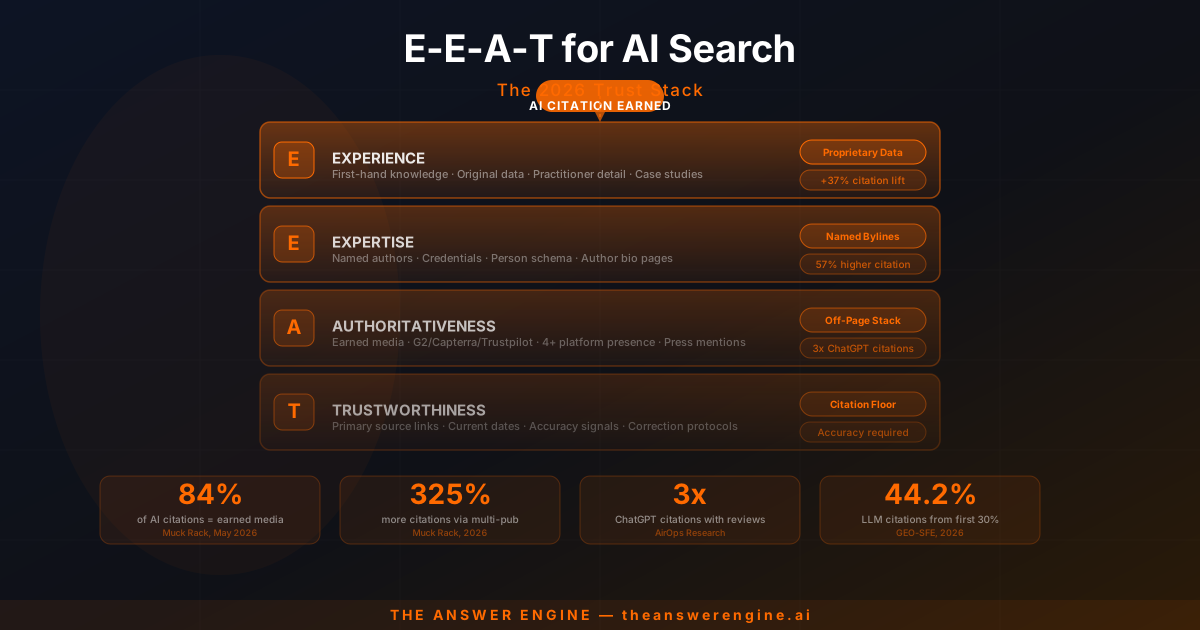
E-E-A-T is a credibility framework with four independently-weighted layers: Experience, Expertise, Authoritativeness, and Trustworthiness. Google introduced E-A-T in its Search Quality Rater Guidelines in 2014 and added the second “E” for Experience in late 2022, reflecting a shift toward rewarding first-hand, practitioner-level knowledge over aggregated secondhand content. In 2026, E-E-A-T is no longer a Google-specific quality signal applied in ranking. It is the trust stack that ChatGPT, Google AI Overviews, Perplexity, and Microsoft Copilot use to decide which brands earn citations in AI-generated answers. Markets fill fast. Check your territory availability.
The transition from ranking signal to citation framework matters for how brands should prioritize their optimization work. Traditional SEO treated E-E-A-T as one of many factors contributing to page authority. The AI citation model treats E-E-A-T as a filter: content that passes the trust evaluation gets cited, content that fails does not, regardless of how topically relevant or well-written the content is. The trust stack must be built before content quality can be fully leveraged. Your first step: free AERO Blind Spot Scan.
The Trust Stack: AI platforms evaluate four independently-weighted layers — experience, expertise, authoritativeness, and trustworthiness — and a missing layer is the single most common reason a high-ranking page never earns a citation. Claim your free call before your market fills.
Each pillar contributes distinct signals to the trust evaluation. Experience is demonstrated through first-hand knowledge, original data, and case studies that could not have been written by someone outside the field. Expertise is established through named credentials, author identity, and schema markup that ties content to a verifiable human or organizational source. Authoritativeness is built through the off-page citation graph: who else is referencing your brand and content across independent platforms. Trustworthiness is the citation floor: the baseline of accuracy signals, primary source linking, and factual consistency that all cited sources must meet. A brand that excels at three pillars and neglects the fourth will consistently underperform in AI citation. Reach out: support@theanswerengine.ai.
For a foundational understanding of how AI platforms use these signals in practice, read our analysis of how AI platforms choose businesses to cite. Call us at (213) 444-2229 today.
→ Get your free AI citation score — 48-hour turnaroundThe StakesWhy E-E-A-T Determines AI Citation, Not Just Ranking
The stakes around E-E-A-T have escalated because AI-generated answers now intercept search intent before organic results are ever seen. Google AI Mode cites sources 76.3% of the time but mentions brand names only 37.6% of the time, according to 2026 measurement data. Google AI Overviews show 61% brand mentions and 84.9% source citations across the four major AI search engines. Only 14% of marketers currently track AI citation visibility, while 43% name AI optimization a top priority for 2026. The monitoring gap is the first problem. The credibility gap is the second. Get your free AI readiness report.
The brand that ranks first organically but fails the AI trust evaluation is invisible at the top of the modern search results page. The brand ranked fifth organically but scoring well across all four E-E-A-T pillars earns a citation chip inside the AI answer that sits above every organic result. This is not a theoretical concern. We see this pattern consistently when auditing brands in competitive categories: the organic ranking distribution does not predict the AI citation distribution, because the two systems weight inputs differently. AI citation is disproportionately influenced by trust signals that organic ranking partially ignores. Ready to act? Book a free strategy session.
The monitoring gap is an opportunity. Only 14% of marketers currently track AI citation visibility. For brands that begin measuring now, the competitive intelligence advantage is substantial. Every category has brands currently being cited that are not aware of the citations, and brands that are being bypassed by AI answers that are not aware of the bypass. Visibility into the citation landscape is the prerequisite for everything else in this guide. Drop us a line at support@theanswerengine.ai.
Chen et al. (2025) documented systematic bias in AI citation patterns toward earned media over brand-owned content. The research confirmed what practitioners have observed empirically: content that appears on the brand’s own domain, no matter how well-crafted, earns fewer AI citations than the same content distributed through independent editorial channels. This means the E-E-A-T optimization effort must extend beyond the brand website to the full off-page presence, including earned coverage, third-party profiles, and community mentions. Speak to an AEO specialist: (213) 444-2229.
→ Get your free AI citation score — 48-hour turnaroundPillar OneExperience: The Most Underweighted Pillar
Experience is the youngest pillar in the E-E-A-T framework, added by Google in December 2022 to distinguish between content written from first-hand practitioner knowledge and content aggregated from secondary sources. The distinction matters for AI citation because AI platforms have become increasingly capable of detecting whether content reflects real-world engagement with a topic or surface-level synthesis. Content that demonstrates genuine first-hand experience earns citation signals that secondhand summaries cannot replicate. Check where you stand: free Blind Spot Scan.
First-hand experience signals take several forms. Original data from proprietary research or client campaigns is the strongest: a statistic that only your organization could have produced because only your organization ran the underlying analysis. Case studies with named outcomes, specific dates, and traceable metrics are the second tier. First-person accounts of implementation challenges — what went wrong, how you diagnosed the problem, what the fix cost — carry experience signals because they contain the kind of granular detail that only someone who did the work would know. Generic “best practice” content without any of these specifics registers as low-experience regardless of how accurate the information is. Schedule a free 30-min call.
What First-Hand Knowledge Looks Like in Practice
A concrete test for experience signals: read your top content pages and ask whether any paragraph could have been written by someone who has never done the work. If every paragraph passes that test — if nothing in the article requires first-hand knowledge to write accurately — the Experience pillar is effectively absent. The fix is not to fabricate experience but to extract it: interview subject matter experts within your organization, document actual client outcomes with specific numbers, and add practitioner commentary that goes beyond what a researcher could have found in secondary sources. Email support@theanswerengine.ai for a custom strategy.
Original data earns the strongest Experience signal. Aggarwal et al. (KDD 2024) found that quotations embedded in content produce a 37% citation lift and statistics a 22% citation lift compared to equivalent prose without those elements. Original data from your own research or client work compounds this advantage because no competing source can produce the same statistic. A proprietary dataset, even a small one, creates a category of citable content that belongs exclusively to your brand. Questions? Call (213) 444-2229.
Building the Experience Layer When You Are Starting Fresh
Brands that do not yet have published original research can build Experience signals progressively. A survey of 50 to 100 clients or prospects produces proprietary data within weeks. A documented case study from a current client engagement adds first-hand specificity. A series of practitioner commentary posts where named internal experts reflect on real project challenges demonstrates applied experience without requiring a formal research budget. The Experience pillar does not require years of published research to activate — it requires one genuine first-hand data point that competitors cannot reproduce. Secure your territory before a competitor does.
→ Get your free AI citation score — 48-hour turnaroundPillar TwoExpertise: Named Authors Beat Anonymous Pages
Expertise is the pillar most directly addressed by a single tactical change: replacing anonymous authorship with named, credentialed bylines. AI platforms evaluate Expertise partly by looking for identifiable human sources attached to content — people whose credentials can be independently verified and whose output can be cross-referenced against their professional history. Content published without a named author is content without a verifiable expertise claim. The AI system cannot confirm that the content was written by someone qualified to write it. Book your free consultation here.
The research on this point is consistent. Zhang et al. (2026) found that definition-first content earns 57% higher citation probability than content that does not lead with structured definitions. But the definition-first format is most effective when combined with named authorship: a definitional paragraph attributed to a named expert with verifiable credentials earns meaningfully more citations than the same paragraph attributed to no one. The content quality and the author identity work as compounding signals, not substitutes. Contact us at support@theanswerengine.ai.
Implementing Named Author Signals Correctly
A minimal viable named author implementation includes: the author’s full name, their title and area of expertise, years of experience in the relevant field, a link to an author bio page on the same domain, and at least one external reference that confirms the author’s professional identity (a LinkedIn profile, a press mention, or a speaking engagement listing). The author bio page should link outward to the author’s published work on external platforms. This cross-referencing creates a verifiable identity web that AI systems can evaluate independently of what the brand says about its own authors. Reach us at (213) 444-2229.
Person schema is the machine-readable layer of Expertise. Implementing Person schema on author bio pages makes the author identity parsable for AI crawlers and structured data processors. The schema should include the author’s name, job title, organization affiliation, and at minimum one sameAs reference pointing to a verified external profile. Without Person schema, named bylines improve human reader trust but contribute less to the machine-readable Expertise signal that AI citation systems are evaluating. We work with one business per market. Check if yours is still open.
When Organizations Are the Author
Some content categories are best attributed to an organizational author rather than an individual: research reports, industry benchmarks, and policy positions, for example. When organizational authorship is the right choice, the Expertise signal depends on the organization’s own credibility indicators: how long it has been operating, whether its research has been cited by other publications, and whether named individual experts are identified elsewhere on the site as contributors to the research. Pure anonymous brand authorship — content that has neither a named individual nor a credentialed organization behind it — is the weakest possible Expertise signal in the 2026 trust stack. Find your gaps with a free AERO scan.
→ Get your free AI citation score — 48-hour turnaroundPillar ThreeAuthoritativeness: The Off-Page Stack
Authoritativeness is built off the brand’s own domain. It is the aggregate of how many independent, authoritative sources reference the brand and its content across the open web — the off-page citation graph that tells AI platforms whether the brand is recognized by its category peers or exists only as a self-declared authority. Every company with zero AI citations shares one structural trait: an off-page presence that either does not exist or is dominated by competitor signals on the same third-party platforms. Send your questions to support@theanswerengine.ai.
The Off-Page Footprint: every company with zero AI citations shares one structural trait — an off-page presence that either does not exist or is dominated by competitor signals on the same third-party platforms (AirOps, 2026). Call (213) 444-2229 for a free consultation.
The mechanism is direct. When an AI system evaluates whether your brand is an authoritative source on a topic, the evaluation includes signals from outside your domain: how many independent publishers have cited your content, whether your brand appears in structured review platforms that aggregate social proof, and whether community platforms show unprompted mentions from users who engaged with your product or content. Brands that have invested only in their own-domain content have no off-page authority layer — and AI systems treat that absence as evidence against authority. Claim your market territory — one client per area.
The Earned Media Premium
The Earned Media Premium: content cited by independent publishers earns 5x more AI citations than identical content published only on the source brand’s own domain (Muck Rack, May 2026). Run your free AI Blind Spot Scan.
Earned media drives 84% of AI citations across major platforms (Muck Rack, May 2026). Distributing identical content across multiple independent publications produces up to 325% more AI citations than keeping that content exclusively on the brand’s own domain. The mechanism is authority inheritance: when an independent publisher cites or republishes your content, the AI system registers the citation as evidence that an external authority has validated the content’s accuracy and relevance. Authority Inheritance — when a brand inherits credibility from the publishers that cite it — compounds over time: each new earned citation strengthens the brand’s position in the authority graph and makes future citations more likely. Book a free 30-minute strategy call.
Review Platforms as Authority Anchors
Brands with profiles on G2, Capterra, and Trustpilot have 3x higher citation rates from ChatGPT than brands without those profiles (AirOps research). The citation lift from review platform presence is not primarily about the reviews themselves — it is about the entity disambiguation. A brand with a claimed, populated profile on G2 is a verifiable entity that AI systems can cross-reference. The same brand without a G2 profile is an ambiguous name that the AI system cannot confirm is the same entity referenced in other sources. Entity disambiguation across multiple authoritative platforms is the first layer of the off-page Authoritativeness stack. Email support@theanswerengine.ai to get started.
Brands with active presence across 4 or more third-party platforms see a 2.8x citation likelihood increase compared to brands with presence on fewer than 2 platforms. The diversity of platform presence matters because it signals category breadth: a brand referenced in review databases, trade publications, expert directories, and community platforms has demonstrated relevance across multiple independent context types, which is a stronger authority signal than deep presence in only one platform category. (213) 444-2229
→ Get your free AI citation score — 48-hour turnaroundPillar FourTrustworthiness: The Citation Floor
Trustworthiness is the citation floor: the minimum set of accuracy and transparency signals that all cited sources must meet before any other pillar can be meaningfully evaluated. A source that scores well on Experience, Expertise, and Authoritativeness but fails Trustworthiness will be excluded from AI citation because AI platforms are acutely sensitive to the reputational risk of citing inaccurate or deceptive sources. The Trustworthiness pillar is less about building an advantage and more about removing a disqualifier.
The core Trustworthiness signals are: factual accuracy with verifiable primary source citations, transparency about organizational identity and potential conflicts of interest, current publication and modification dates displayed visibly, clear correction protocols when errors are found, and absence of known misinformation associations in the brand’s content history. Each of these signals can be evaluated by AI systems through a combination of structured data parsing, cross-reference checking against known authoritative sources, and historical analysis of the domain’s content patterns.
Primary Source Linking as a Trust Signal
Linking to primary sources rather than paraphrasing statistics without attribution is the highest-impact single action for improving the Trustworthiness pillar. When your article states that “earned media drives 84% of AI citations” and links to the Muck Rack research underlying that claim, you are giving AI systems a chain of verification they can follow. A statistic cited without a source cannot be cross-referenced. A statistic with a live, crawlable link to the original research is a verifiable claim that strengthens the AI system’s confidence in your content as an accurate source worth citing.
Stale content is a Trustworthiness signal, not just an SEO problem. An article dated 2023 with no visible update date signals to AI systems that the content may not reflect current conditions. For topics where accuracy is time-sensitive — AI search statistics, market data, regulatory information — stale content is a functional accuracy risk. AI platforms apply a recency discount to content without current modification dates. Auditing your top content pages for stale dates and updating them substantively (not just changing the timestamp) is one of the highest-ROI Trustworthiness fixes available.
Correction Protocols and Transparency
Brands that publicly correct errors in their content when those errors are identified build a Trustworthiness signal that is visible across the web: the correction itself is evidence of accountability. A blog post with a visible correction notice and updated statistics is more trustworthy to an AI citation system than the same post without a correction, because the correction demonstrates that the source prioritizes accuracy over self-preservation. Establishing a clear internal process for catching and correcting content errors is not just editorial hygiene — it is an active component of the Trustworthiness pillar that compounds over time as the correction history builds.
→ Get your free AI citation score — 48-hour turnaroundThe AuditThe Trust Stack Audit (Decision Matrix)
The trust stack audit maps each E-E-A-T pillar to its most actionable signals and the tactical fix for each gap. We recommend running this audit quarterly against your top 20 content pages and any pages that rank in positions 5 through 20 for target informational queries. Pages with gaps in two or more pillars are the highest-priority optimization targets.
E-E-A-T Trust Stack: Pillar-by-Pillar Audit Matrix
| Pillar | Primary Signal | Common Gap | Tactical Fix | Citation Impact |
|---|---|---|---|---|
| Experience | Original data, case studies, first-hand practitioner detail | All content could have been written by a non-practitioner | Publish proprietary survey or client data; add practitioner commentary to existing posts | High |
| Expertise | Named author with credentials, Person schema, external profile links | Anonymous authorship, no bio page, no Person schema | Add named bylines to all content; build author bio pages; implement Person schema | High |
| Authoritativeness | Earned media, third-party platform profiles, community mentions | Off-page presence absent or competitor-dominated | Claim G2/Capterra/Trustpilot profiles; pursue press placements; use expert quote services | Very High |
| Trustworthiness | Primary source links, current dates, correction protocols, accuracy signals | Unsourced statistics, stale dates, no update visibility | Add primary source citations; display “Last Updated” dates; audit for factual accuracy quarterly | Medium-High |
| Off-Page Breadth | 4+ platform presence, entity disambiguation | Presence on fewer than 2 third-party platforms | Map all platforms where category competitors appear; claim and populate missing profiles | High |
| Content Structure | Definition-first sections, 44% of citations from first 30% of content | Best claims buried mid-article or in the conclusion | Move key definitional paragraphs to section openings; use question-format H2 headings | Medium-High |
Building E-E-A-T at Scale: 30/60/90 Roadmap
Building E-E-A-T for AI citation is a sequential process, not a simultaneous one. The four pillars have dependency relationships: Trustworthiness must be established before Authoritativeness can be built on it, and Expertise signals must be present before earned media will meaningfully amplify them. A 30/60/90 day roadmap sequences the work in order of dependency and impact.
Days 1 to 30: On-Page Foundation
The first 30 days focus on signals that are entirely within the brand’s control and can be implemented without external partnerships. Audit all content for named authorship and add bylines to every page currently published without one. Build author bio pages for all named experts and implement Person schema across those pages. Implement Organization schema site-wide. Audit the top 30 content pages for primary source citations and add sourced links for every statistics claim that is currently unsourced. Update visible publication dates on any page that has been substantively revised but not visibly dated. By day 30, the on-page trust foundation should be structurally complete.
Days 31 to 60: Off-Page Footprint
The second 30-day phase targets the off-page Authoritativeness layer. Claim or create profiles on G2, Capterra, and Trustpilot as applicable to the brand category. Identify 3 to 5 additional third-party platforms where category competitors appear and establish presence on each. Submit 5 to 10 expert quote responses per week through Help a Reporter Out, Qwoted, or Source Bottle. Begin active outreach to at least 2 trade publications for guest contribution or expert commentary placement. By day 60, the off-page footprint should be measurably broader than at the baseline measurement taken at day 1.
The 60-day off-page push compounds past day 60. Expert quote placements go live on an irregular schedule after submission. Press relationships built in the second month produce placements in the third month and beyond. The off-page work done in days 31 to 60 will produce citations that appear weeks after the outreach, so the metrics at day 60 understate the actual trajectory. Track new platform citations weekly and expect the growth curve to steepen in the third month.
Days 61 to 90: Content Distribution and Citation Tracking
The third phase focuses on maximizing the distribution of existing content across independent channels and establishing measurement infrastructure. Distribute 3 to 5 high-value articles to independent publications through guest posting, content licensing, or republication agreements. The Muck Rack research confirms that distributing across multiple publications increases AI citations by up to 325% — this phase is where that leverage is activated. Simultaneously, set up AI-specific citation tracking using available monitoring tools or manual spot-checks for target queries. By day 90, the brand should have a baseline measurement of AI citation rates, a functioning off-page footprint, and a clear picture of which pillar is contributing the most traction.
→ Get your free AI citation score — 48-hour turnaroundIs Your Brand’s Trust Stack Ready for AI Citation?
Get a free Blind Spot Report showing where your brand stands across all four E-E-A-T pillars: which signals are missing, which gaps are costing you the most AI citations, and what your competitors’ off-page footprint looks like compared to yours.
Get Your Free Blind Spot ReportThe Trust Stack Cheat Sheet: 12 Actions That Build E-E-A-T for AI Citation
- Add named author bylines to every content page. Anonymous authorship is a structural Expertise deficit. A named expert with verifiable credentials and a bio page linked to external profiles is the minimum viable Expertise signal for AI citation readiness.
- Implement Person schema on all author bio pages. Schema markup makes the author identity machine-readable for AI crawlers. Include name, job title, organization affiliation, and at least one sameAs reference to a verified external profile such as LinkedIn.
- Implement Organization schema site-wide. Organization schema anchors all content to a named, verifiable entity and is the E-E-A-T foundation that connects individual page authority to organizational authority in the AI system’s entity graph.
- Claim or create profiles on G2, Capterra, and Trustpilot. Brands with profiles on all three major review platforms see 3x higher ChatGPT citation rates. These profiles serve as entity disambiguation anchors that AI systems use to confirm your brand is a real, recognized organization in its category.
- Expand to 4 or more third-party platforms. Active presence across 4 or more platforms of any type produces a 2.8x citation likelihood increase. Map the platforms where category competitors appear and prioritize closing the gaps.
- Publish original data from proprietary research or client outcomes. First-hand data that no other source can reproduce is the strongest Experience signal available. Even a small survey of 50 to 100 clients produces citable proprietary statistics.
- Distribute content across multiple independent publications. Publishing only on the brand’s own domain leaves 325% of potential AI citations on the table. Guest posting, content licensing, and republication through independent editorial channels activates the Earned Media Premium that drives 84% of AI citations.
- Link every statistics claim to its primary source. Unsourced statistics are an accuracy risk that lowers the Trustworthiness score. A live link to the original research makes claims verifiable and gives AI systems a chain of evidence to follow when evaluating citation suitability.
- Display and maintain current “Last Updated” dates. Stale content without visible update dates receives a recency discount from AI citation systems. Audit top content pages quarterly, update statistics and examples substantively, and ensure the modification date reflects the actual update.
- Move the most citable claims to the first 30% of each article. GEO-SFE research shows 44.2% of all LLM citations come from the opening sections. Definition-first content that leads with its most valuable claim earns 57% higher citation probability than content that buries key claims in the middle.
- Use expert quote services to build earned media regularly. Help a Reporter Out, Qwoted, and Source Bottle provide access to journalists actively seeking expert sources. One published expert quote per week compounds into a meaningful independent citation footprint over 90 days.
- Set up AI citation tracking and run a quarterly audit. Only 14% of marketers currently track AI citation visibility. Brands that measure citation rates — using AI-specific monitoring tools or manual spot-checks — have the feedback loop necessary to identify which trust stack investments are producing traction and which need adjustment.
Frequently Asked Questions
What is E-E-A-T and why does it matter for AI search in 2026?
E-E-A-T stands for Experience, Expertise, Authoritativeness, and Trustworthiness — a credibility framework originally developed by Google to evaluate content quality and now operating as the trust stack AI platforms use to decide which brands to cite in generated answers. In 2026, E-E-A-T functions as a citation filter: content that passes the trust evaluation gets cited, content that fails does not, regardless of topical relevance or writing quality. A brand that scores poorly on any single pillar is structurally disadvantaged in AI citation. All four pillars must be built deliberately because AI citation systems evaluate them independently.
How does earned media affect AI citation rates?
Earned media drives 84% of AI citations across major platforms, according to Muck Rack data from May 2026. Distributing content across multiple independent publications can increase AI citations by up to 325% compared to publishing exclusively on the brand’s own domain. The effect occurs because AI platforms treat third-party editorial mentions as independent verification of a brand’s authority — a signal that self-published content on the brand’s own domain cannot produce. Content cited by independent publishers earns 5x more AI citations than identical content published only on the source brand’s domain, making earned media the highest-leverage single investment in the Authoritativeness pillar.
What are the most important third-party platforms for AI citation signals?
Review platforms carry disproportionate weight in AI citation. Brands with profiles on G2, Capterra, and Trustpilot have 3x higher citation rates from ChatGPT than brands without those profiles, according to AirOps research. Beyond review platforms, active presence across 4 or more third-party platforms of any type increases citation likelihood by 2.8x. The specific platforms matter less than the diversity of the off-page footprint: AI systems use breadth of independent presence as a proxy for real-world category authority, and a brand visible across multiple platform types is harder to dismiss as a self-declared authority than one visible only on its own domain.
Why do named author bylines improve AI citation probability?
Named author bylines improve AI citation probability because they transform anonymous content into attributable expertise. AI platforms evaluate the Expertise pillar of the trust stack partly by looking for identifiable human credentials attached to content — people whose qualifications can be independently verified. An article attributed to a named expert with verifiable credentials, an author bio page, and external profile references carries a substantially stronger Expertise signal than content published without attribution. Person schema markup reinforces this signal by making the author identity machine-readable for AI crawlers and structured data processors.
What percentage of LLM citations come from the beginning of an article?
GEO-SFE research from 2026 shows that 44.2% of all LLM citations come from the first 30% of content — the introduction and opening sections. This finding has a direct structural implication for how content should be organized for AI citation: the most citable, self-contained claims must appear at the top of each section rather than buried in the middle. Zhang et al. (2026) found that definition-first content earns 57% higher citation probability than content that does not lead with structured definitions. Moving key definitional paragraphs to section openings is a structural repositioning of existing content, not a content quality improvement, and its effect on citation rates is measurable within a single quarter.
How long does it take to build meaningful E-E-A-T signals for AI citation?
A structured 90-day effort produces measurable AI citation gains for most brands. The first 30 days should focus on on-page signals: named author bylines, Person schema, Organization schema, and current publication dates across all key content. Days 31 through 60 should target the off-page footprint: review platform profiles, expert quote placements, and earned media outreach. Days 61 through 90 should focus on content distribution across multiple publications and establishing AI citation tracking infrastructure. Citation rates do not shift overnight, but the 90-day window is sufficient to produce a baseline measurement and identify which pillar investments are generating the most traction for the specific brand category.
→ Get your free AI citation score — 48-hour turnaround→ Get your free AI citation score — 48-hour turnaroundYour Competitors Are Claiming AI Search Territory Right Now
2,900 businesses/month search for ways to improve their AI search visibility. The Answer Engine builds the exact authority signals that get you cited — and keeps competitors out of your market. Free blind spot scan. One business per market.
Get Your Free Blind Spot Report →