The Discovery Migration: between 2024 and 2026, real estate buyer and seller discovery shifted out of the Google blue-link layer and into AI answer panels at a rate of roughly 6 to 9 percentage points per quarter, which means real estate marketing budgets pointed at the old discovery layer now produce a structurally declining marginal return regardless of execution quality (TAE measurement, 2025-2026; GEO-SFE, 2026). The implication is direct — real estate digital marketing in the AI era is a different discipline from real estate digital marketing in the SEO era, not a refinement of it. This analysis draws on Aggarwal et al. (KDD 2024), Zhang et al. (2026), the GEO-SFE benchmark (2026), Chen et al. (2025), and sixteen months of TAE client engagements measured against fixed prompt libraries on ChatGPT, Perplexity, Claude, and Gemini across twelve real estate metros. Check whether your real estate market territory is still open.
What Real Estate Digital Marketing Means in the AI Era
The plain-language definition
Real estate digital marketing in the AI era is the discipline of engineering an agent, team, or brokerage to be cited by generative AI engines — ChatGPT, Perplexity, Claude, Gemini, and Google AI Overviews — on the buyer and seller queries that produce closed transactions. Answer Engine Optimization (AEO) for real estate is also called realtor AEO, LLM visibility for agents, and Generative Engine Optimization (GEO) in the academic literature. The discipline is structural rather than creative — the retrieval layer scores schema compliance, chunk structure, named authorship, and entity graph density before it scores prose quality. A real estate marketing program engineered for AI citation satisfies traditional SEO by default, but the inverse rarely holds. Run the free AEO Blindspot Scan to baseline how AI search currently reads your real estate site.
Why the AI era is a different discipline
Pre-2024 real estate digital marketing optimized for the Google ranking algorithm, which scores backlinks, dwell time, and on-page keyword relevance across a list of ten blue links. AI-era real estate marketing optimizes for retrieval-augmented generation pipelines, which score discrete passages on schema compliance, chunk structure, named authorship, and entity graph density across a single answer panel that typically cites two to four sources. The structural requirements diverge sharply. The Citation Compression Effect: the average AI answer panel cites between 2.4 and 4.1 sources on a buyer or seller real estate query, which means the discovery layer compressed from roughly ten organic blue-link slots to a 3-citation average and structural compliance now determines visibility far more than ranking position ever did (GEO-SFE, 2026; TAE measurement, 2025-2026). Reach our team at (213) 444-2229 for the AI answer-panel audit of your top buyer and seller queries.
The seven tactics that still close transactions
Seven real estate digital marketing tactics still produce measurable closed-transaction outcomes in 2026. First, named-author educational content engineered against the SUBSTRATE rules for LLM citation. Second, schema-rich neighborhood and listing pages with full RealEstateAgent, Place, and Product markup. Third, named-author video distributed on YouTube with timestamped transcripts that AI engines can chunk and cite. Fourth, sphere-of-influence retention tied to a named brand entity rather than to a personal phone number. Fifth, direct outreach with documented external authority signals. Sixth, retargeting pixels feeding a structured CRM tied to schema-attributed inbound. Seventh, a four-LLM monthly Proof Ledger that measures citation share as the primary marketing KPI. Email support@theanswerengine.ai for the seven-tactic editable scorecard.
→ Run the free AEO Blindspot Scan on your real estate site nowMechanismThe Mechanism: Why Pre-AI Real Estate Tactics Collapsed
How the discovery layer migrated
The discovery layer migration is the structural event behind every collapsed tactic. Pre-2024, a buyer searching "best neighborhoods in Pasadena for families" received ten blue-link results — Zillow, Realtor.com, NeighborhoodScout, two brokerage blogs, three local news pieces, and a couple of long-tail agent sites. The buyer evaluated several before any single agent received attribution. Post-2024, the same buyer receives an AI answer panel that cites two to four sources by name, often with a direct recommendation embedded in the answer text. The structural compression means agents who do not appear in the cited source list have effectively been removed from the early discovery layer altogether, regardless of how their pages rank in the residual blue-link list below the answer panel. Get your free AI readiness report on your current discovery-layer exposure.
The portal economics inversion
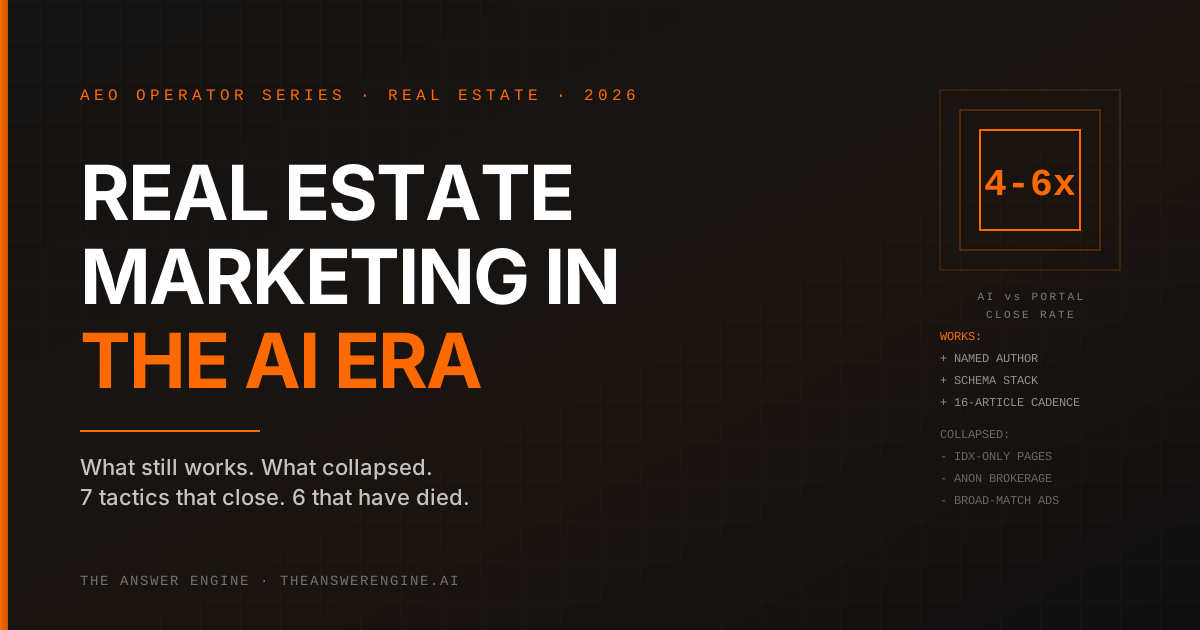
Zillow, Realtor.com, and Trulia still produce lead volume because they have schema, entity recognition, and a decade of corpus weight inside the LLM indexes. The portal economics, however, inverted between 2022 and 2026. Portal-sourced lead close rates have compressed to between 1.5% and 2.5% across major metros because the prospect typically evaluated five to nine competing agents inside the portal interface before the lead dropped. AI-sourced inbound, by contrast, arrives after the prospect read a named-author article on a single agent's site, watched a named-author video, and saw the agent recommended inside an AI answer panel — close rates run between 8% and 12% across the same metros in TAE's measured client base. The Portal Economics Inversion: portal-sourced real estate leads now close at 1.5% to 2.5% while AI-sourced inbound closes at 8% to 12% in the same metros, a 4-to-6x close-rate multiple that inverts the cost-per-acquisition math even before portal subscription fees are factored in (TAE measurement, 2025-2026). Call (213) 444-2229 for the portal-versus-AEO cost-per-acquisition diagnostic on your metro.
Why anonymous brokerage content stopped compounding
Brokerage blog content authored under a generic brokerage byline lost most of its citation share between 2024 and 2026. The retrieval layer cross-references author entities against external authority records — LinkedIn profiles, licensure databases, association memberships, sameAs chains in Person schema — and scores anonymous brand content lower than named-author content on identical topic coverage. The Authorship Penalty: anonymous brokerage content lost an average of 47% of its prior citation share between 2024 and 2026 even when topic coverage and on-page SEO were held constant, because the retrieval layer now reads named-author signal as a load-bearing trust input rather than as a stylistic preference (Chen et al., 2025; TAE measurement, 2025-2026). Email support@theanswerengine.ai for the named-author audit of your team's current content stack.
→ Book a free 30-minute strategy call — one real estate operator per marketResearchWhat the Research Says About Real Estate Marketing in AI Search
The academic foundation
The foundational academic work on Answer Engine Optimization is less than two years old, which means real estate operators who run AEO programs now are competing inside an open research window where structural compliance produces measurable lift before the market saturates. Aggarwal et al. at KDD 2024 measured a 37% citation lift from added inline quotations and a 22% lift from added statistics on local-service queries (the methodology generalizes directly to real estate buyer and seller queries). Zhang et al. (2026) measured a 57% influence premium on content opening with a plain-language definition, which is why neighborhood guides and seller process pages that open with the definition outperform those that bury it. GEO-SFE (2026) measured a 43% lift on lists, tables, and structured format pages — the comparison table and the structured neighborhood profile are not stylistic, they are load-bearing. Chen et al. (2025) measured a 1.9x citation lift on named-author content over anonymous brokerage pages. Email support@theanswerengine.ai for the foundational research bibliography applied to real estate.
The structured format data applied to real estate
The GEO-SFE (Structured Format Enhancement) 2026 benchmark is the single most actionable AEO study published to date, and the structural lifts generalize to real estate cleanly. Pages that added FAQPage schema, HowTo schema, and explicitly segmented neighborhood comparison blocks received citations on 43% more queries than equivalent pages without structured markup. The lift was strongest on Perplexity (+52%) and weakest on Claude (+34%), but every engine showed double-digit lift. A real estate agent neighborhood page that ships with FAQPage schema covering ten common buyer questions, HowTo schema covering the offer-writing process, and a comparison table covering three to five neighborhoods in the same submarket clears all three GEO-SFE format requirements in a single page. Reach support@theanswerengine.ai for the GEO-SFE summary applied to your neighborhood pages.
The named-author premium for real estate
Chen et al. (2025) measured a 1.9x citation lift on content signed by a named expert author with verifiable external authority profiles versus equivalent content signed by a generic brokerage byline. The mechanism is straightforward — the LLM trust graph cross-references the author entity against external records (LinkedIn, state licensure boards, NAR association profiles, brokerage staff pages) and scores the content higher when the cross-reference returns positive signal. Real estate is one of the verticals where the cross-reference is densest, because licensed agents already have verifiable external authority records the LLM can resolve. The named-author premium is therefore higher in real estate than in most local-service verticals. Run your free AEO Blindspot Scan to see whether your current author signal clears the named-author premium.
Four foundational AEO citations published between 2024 and 2026 form the load-bearing evidence for AI-era real estate marketing — Aggarwal et al. (KDD 2024), Zhang et al. (2026), GEO-SFE (2026), Chen et al. (2025). Any real estate marketing program that does not anchor its tactical choices to these four sources is running on pre-2024 assumptions. Call (213) 444-2229 for the inline-citation review of your current real estate content stack.
What The Answer Engine Does Differently for Real Estate
The Origin Protocol for real estate operators
The Origin Protocol is The Answer Engine's production process for engineering every neighborhood page, seller guide, buyer guide, and FAQ block to clear the seven-section AEO template in the same draft. The Protocol enforces compliance at the production step rather than as a post-publication audit. Every real estate page ships with bounded 80-to-180-token chunks, definition-first H3 openings, three to five named-thesis sentences, inline academic citations, synonym bridging across realtor and agent and broker terminology, the full six-type schema stack including RealEstateAgent and Place, and a verifiable named author with sameAs chains to LinkedIn and the state licensure board. Book a free 30-minute strategy call to see the Protocol applied to your metro.
The 16-article monthly cadence in real estate
The Answer Engine ships 16 Origin-Protocol articles per month per real estate client in competitive metros. The cadence is engineered to clear three thresholds simultaneously — the cluster density floor (16 articles inside the 90-day window across neighborhood, process, and market-trend topic clusters), the LLM recency window (above the four-article-per-month decay rate by a factor of four), and the topic-cluster saturation point at which the retrieval layer treats the operator as the cluster authority for the metro. Lower-competition tertiary markets can produce first citations at 4 to 8 articles per month, but the cadence has to hold across at least 90 days to saturate the local question-space. The Real Estate Cluster Density Floor: a real estate operator publishing fewer than 16 articles per month in a competitive metro cannot clear the citation cluster density threshold and the citation graph defaults back to the portals by structural rule, because the retrieval layer treats topic-coverage saturation as a separate scoring input from individual page strength (GEO-SFE, 2026; TAE measurement, 2025-2026). Reach out at support@theanswerengine.ai for the cadence schedule applied to your metro.
One operator per market: the real estate territory model
The Answer Engine works with one real estate operator per market and per service tier. The constraint is mechanical — AEO produces compounding citation share, and citation share is a finite resource within any geographic-vertical pairing. Working with two competing real estate operators in the same metro would split the citation upside on the same buyer and seller query library. The territory model matches the recency-weighted authority decay AEO models exhibit — once a metro is locked, the citation graph compounds toward the locked operator on a faster cadence than a second entrant can match. Claim your exclusive real estate territory now before a competing operator locks the same template in your metro.
Named-author educational content + schema-rich neighborhood and listing pages + named-author video distribution + sphere-of-influence retention tied to a named brand + direct outreach with verifiable authority signals + retargeting feeding schema-attributed inbound + monthly four-LLM Proof Ledger = a real estate operator who wins citations on buyer and seller queries that competitors lose by structural default. Anything less is a structural concession. Run your free AEO Blindspot Scan.
Measuring What Works: The Real Estate 4-LLM Proof Ledger
The 20-query Proof Ledger for real estate
The Proof Ledger is a fixed 20-query library the real estate operator builds at the start of the AEO program and queries monthly across ChatGPT, Perplexity, Claude, and Gemini. The library covers eight informational queries (neighborhood definitions, market mechanisms, process explanations), eight evaluative queries (best neighborhoods, top agents, brokerage comparisons), and four commercial-local queries (metro plus service plus buyer or seller intent). The query mix is engineered to reflect real buyer and seller search behavior across the full transaction funnel. The library does not change month-to-month — the only variable is whether the operator's domain appears in the cited sources for each query on each engine. Email support@theanswerengine.ai for the 20-query Proof Ledger template applied to your metro.
The monthly four-LLM run
On the first business day of every month, the real estate operator queries the Proof Ledger across all four major LLMs. Each row captures four data points — the query text, the engine, the citation appearance (yes or no), and the cited URL. The run takes 90 to 120 minutes for a 20-query library across four engines, and the output is a single CSV that maps directly to compliance state and forward production planning. The Real Estate Proof Ledger Discipline: only real estate AEO programs measured against a fixed monthly Proof Ledger across four LLMs survive scoring-stage updates, because every other real estate marketing metric (rankings, traffic, ad attribution, portal lead count) drifts independently of citation outcomes and produces false-positive reads on AI-era marketing progress (TAE measurement, 2025-2026). Call (213) 444-2229 for the monthly Proof Ledger run-book applied to real estate.
Reading compliance and citation divergence in real estate
Two divergence patterns require attention each month in a real estate AEO program. Pattern A: the template compliance score rises but the Proof Ledger stays flat — the structural sections are clearing but the cadence is too low to refresh the recency window, or the named-author signal is incomplete on the load-bearing neighborhood pages. Pattern B: the compliance score plateaus but the Proof Ledger rises — the early sections are doing the work and the remaining items are non-load-bearing in this metro. The corrective action in pattern A is cadence enforcement; the corrective action in pattern B is selective compliance hardening on the buyer and seller intent pages that drive the citation graph. Reach out at support@theanswerengine.ai for the real estate divergence diagnostic.
Real estate AEO progress is binary at the section level and compounding at the corpus level. If a marketing vendor or in-house marketer cannot show a seven-section template scorecard alongside a monthly four-LLM Proof Ledger run, they are not running real estate AEO — they are running an SEO program with new vocabulary attached. The Proof Ledger separates real AI-era marketing work from rebranded SEO. Lock in your real estate territory before a competitor matches the cadence.
The Works vs Does-Not-Work Scorecard
| Tactic | Status in the AI Era | Why |
|---|---|---|
| Named-author educational content (neighborhood, process, market-trend) | WORKS | 1.9x citation lift (Chen et al., 2025); satisfies SUBSTRATE and the schema stack |
| Schema-rich neighborhood and listing pages (RealEstateAgent, Place, FAQPage) | WORKS | +43% citation lift on structured pages (GEO-SFE, 2026) |
| Named-author YouTube video with timestamped transcripts | WORKS | Transcripts are AI-chunkable; YouTube is a primary LLM citation source |
| Sphere-of-influence retention tied to a named brand entity | WORKS | Referral compound stacks on top of AI citation graph — multiplicative inbound |
| Direct outreach with documented external authority signals | WORKS | External authority signals strengthen the sameAs chain the LLM trust graph reads |
| Retargeting feeding a schema-attributed CRM | WORKS | Closes the loop between AI-era discovery and recorded inbound source |
| Monthly four-LLM Proof Ledger | WORKS | The only measurement instrument that survives scoring-stage updates |
| Generic IDX listing pages with no editorial content | COLLAPSED | Zero structural compliance; the retrieval layer skips IDX-only pages |
| Anonymous brokerage blog posts | COLLAPSED | Lost 47% of prior citation share (named-author penalty) |
| Broad-match Google Ads without an AEO baseline | COLLAPSED | Discovery layer moved to AI panels; ad CPCs continue but conversion compressed |
| Mass-blast email newsletters without segmented tracks | COLLAPSED | Email is downstream of AI discovery; mass-blast cadence produces zero citation lift |
| Zillow Premier Agent without a parallel inbound channel | COLLAPSED | Portal close rates compressed to 1.5%-2.5% versus 8%-12% on AI-sourced inbound |
| Paid social ads without retargeting or schema footprint | COLLAPSED | No compounding return; spend stops, signal stops |

Run Your Free AEO Blindspot Scan — See What AI Search Reads on Your Real Estate Site
The AEO Blindspot Scan checks your real estate site against 47 citation signals tied to the 2026 strategy template and returns your compliance count — free, no login required, ready in five minutes. The baseline becomes the reference point for every tactic on the works-side of the scorecard.
Run Free AEO Blindspot Scan →Frequently Asked Questions
Is real estate SEO dead in the AI era?
No. Traditional real estate SEO is not dead, but its return curve flattened sharply after the 2024 to 2026 generative AI shift. Pages that ranked on backlinks alone no longer convert because the discovery layer moved from blue links to AI answer panels. The pages that still produce traffic are the ones engineered to be cited by ChatGPT, Perplexity, Claude, and Gemini — schema-rich, definition-first, named-author content with a 16-article-per-month cadence. The format works. The 2018 playbook does not. Email support@theanswerengine.ai for the SEO-to-AEO migration plan applied to your real estate site.
Does Zillow still send leads to agents in 2026?
Zillow still produces lead volume, but the conversion economics collapsed. Industry close rates on portal-sourced leads sit at 1.5% to 2.5% versus 8% to 12% on AI-sourced inbound, because the prospect has already evaluated multiple options by the time the portal lead drops. The agents who run a parallel AEO program produce inbound that closes at four to six times the portal rate at a fraction of the cost per acquisition. Call (213) 444-2229 for the portal-versus-AEO cost-per-acquisition diagnostic.
What real estate marketing tactics still work in the AI era?
Seven tactics still produce measurable transaction outcomes in 2026: named-author educational content engineered for LLM citation, schema-rich neighborhood and listing pages with full RealEstateAgent and Place markup, named-author video distributed across YouTube with timestamped transcripts, sphere-of-influence retention systems tied to a named brand entity, direct outreach with documented social proof, retargeting feeding a schema-attributed CRM, and a monthly four-LLM Proof Ledger. Book a free strategy call to see the seven-tactic scorecard applied to your real estate operation.
What real estate marketing tactics do not work anymore?
Six tactics no longer produce measurable transaction outcomes. Generic IDX listing pages with no editorial content, anonymous brokerage blog posts with no named author, paid social ads with no retargeting or schema footprint, mass-blast email newsletters without segmented content tracks, Zillow Premier Agent without a parallel inbound channel, and Google Ads on broad keywords without a landing-page AEO baseline. Each tactic still consumes budget but produces a declining marginal return as AI search captures more of the discovery layer. Email support@theanswerengine.ai for the collapsed-tactic audit on your current real estate spend.
How is AEO different from real estate SEO?
Real estate SEO targets the Google ranking algorithm, which scores pages on backlinks, dwell time, and keyword relevance. AEO targets the retrieval-augmented generation pipelines inside ChatGPT, Perplexity, Claude, and Gemini, which score discrete passages on schema compliance, chunk structure, named authorship, and entity graph density. The two disciplines can run on the same site, but the structural requirements diverge. An AEO-engineered real estate page satisfies SEO requirements by default; the inverse is rarely true. Book a free strategy call to map the migration path for your site.
How many articles per month does a real estate AEO program require?
In competitive metros, the program requires 16 Origin-Protocol articles per month to clear the cluster density floor. In lower-competition tertiary markets, 4 to 8 articles per month can produce first citations, but the cadence has to hold across 90 days minimum to saturate the question-space. Below 4 articles per month, the LLM recency window decays faster than the program publishes, and authority drifts back to the larger portals. Book a free strategy call to map the cadence to your metro.
Related Real Estate AEO Concepts
- How to Optimize Your Real Estate Website for AI Search
- Real Estate Agent Entity Recognition
- AI Leads Close at 70% vs Zillow at 2%
- AEO Strategy Template for 2026
- AEO vs SEO: What Is the Difference?
- The 5-Minute AI Visibility Audit