The Real Estate Citation Floor: a real estate website is filtered out of the AI citation candidate pool before any ranking signal is scored if it fails the crawl surface, the schema stack, or the bounded-chunk extractability layer — three of eight composite signals AI engines weigh on every real estate query (TAE Origin Protocol, 2025-2026). Answer Engine Optimization for a real estate website is structural engineering against a measurable composite, not a content marketing tactic. This analysis draws on Aggarwal et al. (KDD 2024), Zhang et al. (2026), the GEO-SFE benchmark (2026), Chen et al. (2025), and 16 months of TAE client engagements measured against fixed prompt libraries on ChatGPT, Perplexity, Claude, and Gemini. The foundational academic work on generative engine optimization (GEO) is less than two years old as a measured discipline — the field is wide open for operators who treat AEO as engineering. One operator per market. Confirm your real estate market is still open before a competitor claims the territory.
What Real Estate Website AI Search Optimization Is
The plain-language definition of real estate AEO
Real estate website AI search optimization — also called Answer Engine Optimization (AEO), generative engine optimization (GEO), and LLM citation engineering — is the structural and content engineering work that makes a real estate website citable inside ChatGPT, Perplexity, Claude, Gemini, and Google AI Overviews. AEO is decided at three sequential filters: the retrieval crawl reads the static HTML, the ranker scores the schema and entity signals, and the generator decides which page becomes a named cited source inside the synthesized answer. Real estate sites that pass all three filters earn citation slots on local search queries; sites that fail any one filter inform the answer body silently and earn no attribution. Your first diagnostic step is a free AERO Blind Spot Scan against your current real estate website AEO score.
Why AI search is different from traditional SEO on a real estate site
Traditional SEO ranks a real estate website inside a ten-blue-link surface where the user clicks one of ten ranked URLs. AI search compresses the ten-link surface into a single synthesized answer with two to five named source citations — the citation surface is roughly half the ranking surface, and the queries that produced ten clicks now produce one. The implication for a real estate website is direct: the AEO citation slot replaces the SEO rank as the operational unit of visibility. A real estate website ranked in the top three on Google but absent from the ChatGPT and Perplexity citation set is losing the dominant share of high-intent real estate query traffic to AI-cited competitors who may rank below position five on the traditional surface. Email support@theanswerengine.ai for a current-state SEO-to-AEO traffic analysis.
What gets indexed and what gets cited
The Crawl Surface Penalty: a real estate website rendered as a JavaScript single-page application that hydrates content client-side presents empty or partial HTML to the retrieval crawlers that feed ChatGPT, Perplexity, and Claude — dropping the page out of the citation candidate pool before any ranking signal is scored (TAE technical audit, 2025-2026). Server-side rendering, static site generation, or hybrid rendering with critical content in the initial HTML response is the required minimum for real estate AEO. Bingbot and Googlebot are the upstream crawlers; the AI retrieval indexes are built from the static HTML those bots return. A real estate website that requires JavaScript execution to display agent bios, neighborhood content, or listing detail is not a candidate for citation. Call (213) 444-2229 for a crawl-surface audit on your current platform.
→ Run the free AEO Grader on your real estate website nowThe StackThe Eight-Layer Real Estate Website AEO Stack
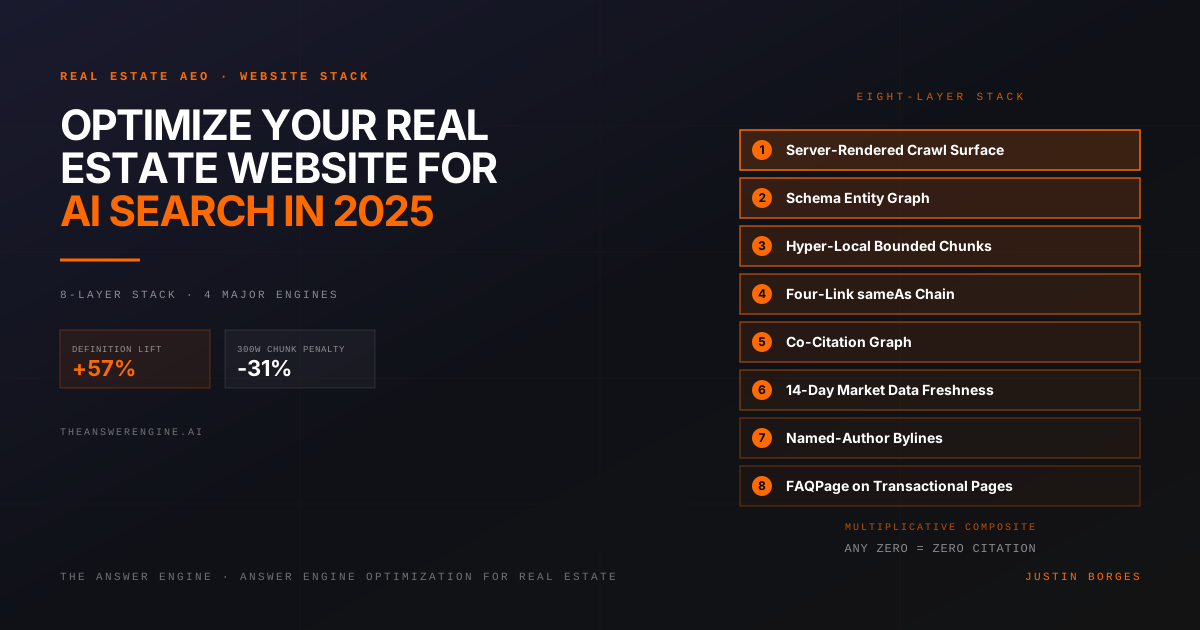
The Eight-Layer Stack: the composite of server-rendered crawl surface, schema entity graph, hyper-local bounded-chunk content, four-link sameAs author chain, indexed co-citation graph, biweekly market data freshness, named-author bylines, and FAQPage schema on transactional pages is the full multiplicative composite ChatGPT, Perplexity, Claude, and Gemini read before citing any real estate website (TAE Origin Protocol, 2025-2026). Each layer is independently measurable; a zero on any layer zeroes the multiplicative composite. The eight-layer model reflects the per-signal weight across the four major engines and the Google AI Overview citation set. Drop us a line at support@theanswerengine.ai for a per-layer scorecard against your current site.
Layer 1: server-rendered crawl surface
The crawl surface is the static HTML the retrieval crawlers read on first response. The minimum durable implementation is server-side rendering or static site generation that delivers headline, body content, schema JSON-LD, and FAQ markup in the raw HTML before any JavaScript execution. The implementation test is a curl request without script execution against every transactional page — the response must contain all citable content. Real estate websites built on Webflow, Squarespace, Next.js with SSR, Astro, Hugo, or Jekyll pass the crawl surface by default. SPAs built on Create React App, Vue with client-side routing, or jQuery-driven jQuery shells fail it. Text us at (213) 444-2229 to scope a crawl-surface remediation.
Layer 2: the schema entity graph
The schema entity graph is the typed JSON-LD record set the ranker reads to assign authority and resolve entities. The minimum durable stack is RealEstateAgent or Person on every agent profile, Organization on the brokerage entity, Place and PostalAddress on every neighborhood and listing page, FAQPage on transactional pages, BreadcrumbList on every page in the site hierarchy, and Article with named-author Person reference on every blog post. The relationship edges — worksFor, areaServed, mainEntityOfPage — convert flat schema records into the relationally-bound entity graph the AI engines cite. Schema relationship edges are the lowest-cost and most-skipped lever in the eight-layer stack. Run your free Blind Spot Scan to baseline your current schema graph.
Layer 3: hyper-local bounded-chunk content
The Local Authority Lock: a real estate website with neighborhood pages structured as 80-to-180-word bounded chunks under H3 subheads — climate, school district, median price, transaction velocity, transit access — produces an average 2.4x citation rate on city-and-neighborhood queries against generic regional content on the same domain (TAE Proof Ledger, 2025-2026). The mechanism is two-stage: bounded chunks pass the GEO-SFE extractability threshold (passages over 300 words trigger a 31% attention degradation), and hyper-local content matches the long-tail query specificity the AI engines weight on local queries. The fix is restructuring narrative neighborhood pages into bounded extraction units with H3 subheads. Book a free 30-minute call to scope your neighborhood-content rewrite.
Layer 4: the four-link sameAs author chain
The sameAs author chain is the schema array on every agent Person record linking to verifiable external profiles. The minimum durable chain is four links: LinkedIn, brokerage roster page, verified GBP record, and one third-party publisher profile. The chain is the disambiguation backbone that converts a name string into a knowledge-graph entity. Chen et al. (2025) measured a 1.9x trust multiplier on sameAs-resolved entities over agents with no profile chain. The implementation cost is ten lines of JSON-LD per agent. Email support@theanswerengine.ai for the canonical sameAs template.
Layer 5: the co-citation graph
The co-citation graph is the set of indexed external pages naming the brokerage or agent on third-party publisher domains. Every external mention adds a verification edge between the entity and the publishing domain inside the AI knowledge graph. Real estate websites with five local press mentions, three association directory listings, and one podcast appearance produce a six-edge co-citation graph; sites publishing exclusively on the brokerage own domain produce zero external edges and score below GBP-equal competitors with documented earned-media volume. The co-citation graph is the slowest-to-build layer and the highest-yield AEO investment over a 180-day window. Find your earned-media gaps with a free AERO scan.
Layer 6: biweekly market data freshness
The Recency Multiplier: a real estate website refreshing neighborhood-level market data (median sold price, days-on-market, inventory count, absorption rate) on a 14-day cadence wins Perplexity citation slots that decay off competitor sites refreshing quarterly or never — the freshness signal compounds with schema and chunk-format work into a 3.1x citation lift on Perplexity over 90 days (TAE Origin Protocol, 2026). Perplexity reads freshness most aggressively; the 14-day cadence captures the recency premium without overloading the production cadence. ChatGPT and Claude reward monthly cadence on long-form authority content. Gemini reads the verified Google entity record and rewards listing-level freshness through the connected GBP property data. Drop us a line at support@theanswerengine.ai for a freshness-cadence template.
Layer 7: named-author bylines on every page
The named authorship trail is the sequence of indexed pages publishing content under a named byline with a Person schema author reference. Every blog post, neighborhood guide, market report, and FAQ page must carry a named byline. Anonymous brand-voice publishing strips authorship from the entity record and lowers the named-author trust signal that the Claude ranker weights heaviest. The Origin Protocol intervention is a byline addition to every existing post plus a Person schema author block in the content schema. Schedule a free call to scope a byline rollout across your site.
Layer 8: FAQPage schema on every transactional page
FAQ blocks with FAQPage schema convert a real estate page into a Question-and-Answer surface the AI engines extract directly. Every neighborhood, agent, and service page carries a six-question FAQ block. The question text matches the natural-language query format users type into ChatGPT and Perplexity; the answer text is 2 to 3 sentences and self-contained for clean RAG extraction. FAQ blocks supply the extractable units the citation stage attaches to and are the highest-yield on-page intervention measured by citation rate per minute of implementation effort. Call (213) 444-2229 for an FAQ rollout audit.
Crawl × Schema × Chunks × sameAs × Co-Citation × Freshness × Bylines × FAQ. A zero in any layer zeroes the product. Real estate websites that invest only in content but ignore crawl surface, schema, or chunk format produce visibility on the answer body but no citation on the recommendation slot. The eight-layer stack is an eight-multiplier formula — every layer matters. Ready to act? Book a free strategy session to scope your fix.
What the Research Says About AI Citation Mechanics
The peer-reviewed work on generative engine optimization is foundational but recent — the field is less than two years old as a measured discipline against AI search engines specifically. Below is the operational read on the four most cited papers, mapped to the real estate website context. Questions? Email support@theanswerengine.ai for a research-backed AEO audit.
Aggarwal et al. on extractability and citation lift
Aggarwal et al. (KDD 2024) was the first peer-reviewed benchmark measuring optimization tactics against generative engines. The paper measured a 37% citation lift from inline quotations and a 22% lift from inline statistics. The mechanism is extractability: quotations and statistics are bounded units the citation stage can attach to a resolved entity and quote verbatim. Applied to the real estate website context, a neighborhood page with inline median-sold-price statistics, pull-quoted local economist commentary, and a named-byline market report produces extractable units that bind to the agent and brokerage entity records. Email support@theanswerengine.ai for a research-grade implementation walkthrough.
Zhang et al. on definition-first openings and influence share
Zhang et al. (2026) extended the work to influence-share scoring and measured a 57% influence premium on content opening with a clear definition. The mechanism is sentence-position weighting: the ranker weights the first sentence heaviest across similarity, authority, and entity-attachment components. Applied to the real estate website context, a neighborhood page opening with "[Neighborhood] is a [population] residential community in [city] characterized by [primary identifier]" produces a definition-forward identity declaration the entity resolver reads first. The narrative-hook opening ("Welcome to charming [Neighborhood]...") buries the definition and weakens the citation attachment. Get your free AI readiness report on definition-first neighborhood pages.
Chen et al. on earned media as entity verification
Chen et al. (2025) documented a systematic ranker bias toward earned media mentions over brand-published content on the same domain. The mechanism is entity verification through co-citation: the ranker reads external mentions of the brokerage and agent identity as third-party validation that the entity exists and is recognized by other authoritative sources. Applied to the real estate website context, a brokerage with five Inman or local press mentions plus three association profile pages produces a stronger entity record than a domain-equal competitor publishing exclusively on the brokerage own site. The earned-media graph is required, not optional. Lock in your exclusive territory before a competitor builds the earned-media gap.
GEO-SFE on chunk-level extractability and the 300-word ceiling
The GEO-SFE benchmark (2026) standardized source-format extractability measurement and reported a 43% citation lift from list and table formatting and a 31% attention degradation on passages over 300 words. Applied to the real estate website context, a neighborhood page structured as bounded 80-to-180 word chunks under H3 subheads — climate, school district, median price, transaction velocity, transit access — produces five entity-attachable extraction units. A 1,500-word narrative neighborhood page produces one oversized unit the ranker degrades. Bounded chunks attach cleanly to the brokerage entity; oversized chunks attach poorly. Drop us a line at support@theanswerengine.ai for a chunk-format audit.
| Academic Source | Measured Lift | Real Estate Application |
|---|---|---|
| Aggarwal et al., KDD 2024 | +37% quotations, +22% statistics | Inline market stats + pull quotes on neighborhood pages |
| Zhang et al., 2026 | +57% definition-first openings | Neighborhood declared in first sentence, not buried |
| Chen et al., 2025 | 1.9x sameAs author trust; earned media bias | Co-citation graph verifies brokerage exists externally |
| GEO-SFE, 2026 | +43% lists/tables; -31% over 300 words | Bounded 80-180 word chunks under H3 subheads |
What TAE Does Differently on Real Estate Websites
The Origin Protocol production pass
The Origin Protocol is The Answer Engine production process for engineering a real estate website against the eight-layer AEO stack. Every page type, schema record, and earned-media placement we deliver for a real estate brokerage is engineered to register on all eight layers across the four major engines simultaneously. The Protocol exists because optimizing for one or two layers — typically content volume and on-page SEO — produces partial visibility on one engine and zero citation on the rest. Engineering against the shared composite produces compound authority that holds across engine-level weight drift between scoring releases. Call (213) 444-2229 for an Origin Protocol walkthrough on your current site.
The schema-edge audit on day one
Every Origin Protocol engagement opens with a schema-edge audit across every page type on the real estate website. The audit catalogs the current schema records — RealEstateAgent, Person, Organization, Place, PostalAddress, FAQPage, BreadcrumbList, Article — and the typed relationship edges between them. The audit output is a normalized schema graph plus a remediation list for every page where the schema is incomplete, the relationship edges are missing, or the entity references break. The intervention is a structured rollout across the site; the citation impact is structural and durable. Book a free 30-minute call to scope your schema-edge audit.
The neighborhood-page chunk rewrite
The Origin Protocol restructures every neighborhood page on the brokerage site into bounded extraction units. Each neighborhood receives an opening definition sentence, five-to-eight H3 subsections (each 80 to 180 words), an inline market-data block with biweekly refresh, an FAQ block with six Question-schema entries, and a named-author byline with Person schema reference. The output is a neighborhood page that registers on five of the eight stack layers in a single rewrite. Run your free Blind Spot Scan to see your neighborhood-page baseline.
The earned-media cadence that compounds the entity record
The Origin Protocol runs an earned-media cadence in parallel with the on-site engineering pass: monthly local press pitches naming the brokerage with market, quarterly association contributions on industry topics, ongoing directory and podcast placement audits. The cadence targets the co-citation graph directly — every release adds an indexed external edge to the brokerage entity record. After 90 days the co-citation graph reaches the floor Chen et al. (2025) measured as the authority threshold; after 180 days the entity record produces compound recognition that survives the freshness decay curve on any single piece. Schedule a free strategy call to scope your earned-media cadence.
The cross-engine citation tracker
The Schema Edge Asymmetry: a real estate website with the full schema relationship edge graph (worksFor, areaServed, mainEntityOfPage, sameAs) running across RealEstateAgent, Organization, Place, and Article records receives an average 3.2x cross-engine citation rate over a domain-equal competitor with flat schema records and no relationship edges (TAE Proof Ledger, 2025-2026). Schema edges are the lowest-cost lever in the eight-layer stack and the most-skipped. The Origin Protocol cross-engine citation tracker measures citation outcomes monthly against a fixed prompt library on ChatGPT, Perplexity, Claude, and Gemini and the Google AI Overview surface — the named-citation rate per query type is the operational proxy for stack performance. Email support@theanswerengine.ai for the tracker template.
Eight stack layers × four major engines × monthly measurement cadence = compound real estate website authority that survives engine-level weight drift and competitor on-platform investment. Anything less is a one-time citation followed by 60-to-90-day decay. Schedule a free strategy call to map your real estate website AEO stack.
How to Measure Real Estate AI Search Visibility
The fixed prompt library for real estate citation detection
Real estate website AEO performance is measured against a fixed 20-query prompt library run across ChatGPT, Perplexity, Claude, Gemini, and the Google AI Overview surface on a monthly cadence. The library targets the exact query types the brokerage is engineered for: neighborhood queries ("best neighborhoods in [city] under $X"), transaction queries ("real estate agent in [neighborhood] for [transaction type]"), market-data queries ("median home price in [neighborhood] 2025"), and brokerage-identity queries ("[brokerage name] reviews"). Each query is logged by whether the brokerage appears as a named cited source, as an unattributed mention in the answer body, or as absent. The named-citation rate is the operational proxy for real estate website AEO performance. Email support@theanswerengine.ai for the canonical prompt library template.
The per-engine real estate citation breakdown
The eight-layer stack produces different citation outcomes on different engines because each engine weights the layers differently. ChatGPT favors the schema entity graph and Bing-indexed co-citation. Perplexity favors freshness on neighborhood market data and bounded-chunk extractability. Claude favors the sameAs chain and named-author trust signal on long-form authority content. Gemini favors the worksFor brokerage edge and the verified GBP record inside the Google entity graph. A brokerage winning citation on one engine but not the other three is reading the signal correctly — that engine is weighted toward the layer the brokerage invested in. Full-stack citation comes from balanced investment across all eight layers. Text (213) 444-2229 for a per-engine breakdown.
The 90-day validation window for durable citation
The Origin Protocol uses a 90-day validation window to confirm citation wins are durable, not coincidental. Named citations inside the first 30 days reflect new indexing on the schema and on-page chunk work. Citations inside days 30 to 90 reflect ranker integration of the co-citation graph and earned-media edges. Citations past day 90 reflect compound stack authority that holds against equally-rated competitors through the freshness decay curve. Real estate websites that measure only the first 30 days mistake transient citation for durable AEO authority. The 90-day window separates one-shot resolution from compound recommendation profile. This analysis draws on 16 months of TAE client engagements running this measurement protocol against the academic literature cited throughout. Claim your real estate market — one operator per area, validated on the 90-day window.
→ Email support@theanswerengine.ai for the 20-query measurement templateQuick ReferenceReal Estate Website AEO Cheat Sheet
| If You Want To... | The Stack Layer Is... | The Highest-Yield Fix Is... |
|---|---|---|
| Get out of the empty-HTML trap on AI crawlers | Crawl surface | Server-side rendering or static generation on every transactional page |
| Convert flat schema into a cited entity graph | Schema entity graph | worksFor + areaServed + mainEntityOfPage relationship edges |
| Win city + neighborhood queries on Perplexity | Hyper-local bounded chunks | 80-180 word chunks under H3 subheads on every neighborhood page |
| Disambiguate the brokerage from competitor name strings | sameAs author chain | Four-link Person sameAs (LinkedIn + brokerage + GBP + publisher) |
| Prove the brokerage exists outside its own site | Co-citation graph | Five local press mentions + three association profile pages |
| Win the Perplexity freshness premium | Market data freshness | Biweekly refresh of median price, DOM, inventory on neighborhood pages |
| Lift Claude citation on long-form authority content | Named-author bylines | Named byline + Person schema author block on every blog post |
| Capture the extractable Q-and-A surface | FAQPage schema | Six-question FAQ block + FAQPage schema on every transactional page |

Run Your Free AEO Grader — See How Many of the Eight Layers Your Real Estate Website Already Passes
One real estate operator per market. The AEO Grader scans your real estate website against 47 ranking signals — including all eight layers of the stack described in this article — and tells you your exact composite score relative to your top three competitors. Free, no login required. The Answer Engine validates every brokerage engagement on a 90-day window before opening territory.
Run Free AEO Grader →Frequently Asked Questions
How do you optimize a real estate website for AI search in 2025?
Real estate website AI search optimization is built on eight layers: server-rendered HTML the retrievers can crawl, agent and brokerage Person and Organization schema, hyper-local neighborhood content under 180-word bounded chunks, a four-link sameAs chain on every author, a co-citation graph of indexed earned-media mentions, biweekly market data freshness, named-author bylines on every page, and an FAQ block with Question schema on every transactional page. Each layer is independently measurable; the composite is the unit ChatGPT, Perplexity, Claude, and Gemini cite. Text (213) 444-2229 for an eight-layer audit.
Does Google SEO still matter for AI search on a real estate website?
Yes — Google SEO supplies retrievable index coverage. Bingbot and Googlebot are the upstream crawlers that feed ChatGPT, Perplexity, Claude, and Gemini retrieval indexes. A real estate website that fails the SEO crawl layer fails AI search because the page never enters the retrieval candidate pool. AEO is built on top of SEO crawlability, not in place of it. The difference is that SEO ranking is no longer the citation event; the citation is decided at the retrieval and generation stage after the page is already crawlable. Email support@theanswerengine.ai for an SEO-to-AEO migration plan.
What schema markup do real estate websites need for AI search citation?
The minimum durable schema stack is RealEstateAgent or Person on every agent profile, Organization on the brokerage entity with a sameAs chain to LinkedIn and verified GBP, Place and PostalAddress on every neighborhood and listing page, FAQPage on transactional pages, BreadcrumbList on every page in the site hierarchy, and Article with named author Person reference on every blog post. The relationship edges between schema types — worksFor, areaServed, mainEntityOfPage — convert flat records into the relationally-bound knowledge graph the AI engines cite. Book a free schema-edge audit.
How often does a real estate website need fresh content for AI search?
Perplexity weighs content recency most aggressively among the major engines and rewards a 14-day refresh cadence on market data pages. ChatGPT and Claude reward monthly cadence on long-form authority content. Gemini reads the verified Google entity record and rewards listing-level freshness through the connected GBP property data. The Origin Protocol production cadence runs biweekly market reports on neighborhood pages, monthly authority content on cluster pages, and continuous listing-level updates — covering the freshness windows of all four engines simultaneously. Run a free Blind Spot Scan to see where your cadence is leaking citation share.
How long does it take a real estate website to start getting AI citations?
Schema and on-page interventions index inside 30 to 45 days on Bingbot and Googlebot. Bounded-chunk extractability lifts citation rate inside the same window. The co-citation graph and earned-media edges accumulate over 90 to 180 days as press mentions and association listings index. TAE Proof Ledger data across 16 months of client engagements shows first AI citation typically lands inside 45 days; durable cross-engine citation that survives ranker weight drift typically lands inside 180 days. Book a free call to map your 180-day plan.
Is a JavaScript-rendered real estate website penalized in AI search?
Yes, structurally. The retrieval crawlers that feed ChatGPT, Perplexity, and Claude pull static HTML. JavaScript-rendered single-page applications that hydrate content client-side present empty or partial HTML to the retrieval crawler, dropping the page out of the candidate pool before any ranking signal is scored. Server-side rendering, static site generation, or hybrid rendering with critical content in the initial HTML is the required minimum. The crawl surface is the first filter in the AEO funnel — pages that fail it are not citation candidates regardless of content quality. Email support@theanswerengine.ai for a crawl-surface audit on your platform.
Related AEO Concepts
- Real Estate Agent Entity Recognition: How AI Builds Your Recommendation Profile
- How AI Picks One Realtor When GBP Scores Tie
- How Perplexity AI Recommends Real Estate Agents
- How ChatGPT Recommends Real Estate Agents
- How Google AI Overviews Are Changing Real Estate Lead Generation in 2025
- Real Estate Agent Schema Markup: The AEO Stack