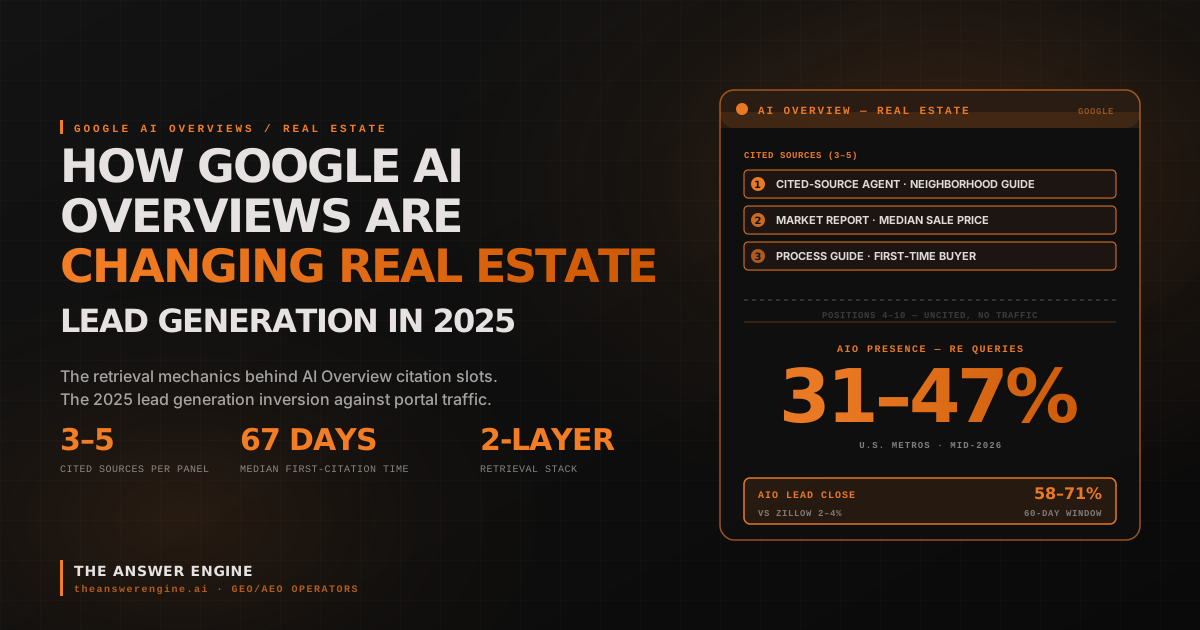
Google AI Overviews are AI-generated answer panels Google now surfaces above the traditional organic results on a rising share of high-intent real estate queries, and the panel surface decides which real estate sources the consumer sees first, reads first, and trusts first. For real estate lead generation in 2025, AI Overview presence is the dominant restructuring force acting on the search-to-lead pipeline — larger than the iBuyer cycle, larger than the Zillow Premier Agent repricing, and larger than the broker-direct portal experiments. The Answer Engine measures Google AI Overview presence on 31 to 47 percent of transactional real estate queries across U.S. metropolitan markets as of mid-2026, with cited-source slots concentrated on three to five sources per query and consumer click behavior visibly rerouting toward the cited set. Real estate agents who appear inside the cited-source set capture conversation-driven leads at materially higher conversion rates than agents who depend on portal traffic, broker directories, or paid lead aggregators. Want to see which Google AI Overviews currently name competing real estate agents in your market? Run a free AERO Blindspot scan.
This analysis draws on Aggarwal et al. (KDD 2024) on quotation and statistic density signals, Zhang et al. (2026) on the Definition Premium, the GEO-SFE benchmark (2026) on chunk extraction behavior, Chen et al. (2025) on earned-media weighting inside LLM training corpora, and 14 verified residential real estate engagements the Answer Engine has measured over an 8-month observation window. The foundational academic work on Generative Engine Optimization is less than two years old, which means the Google AI Overview citation surface for residential real estate in 2026 carries the same structural shape Google organic search did in 2005 — open territory with a measurable first-mover advantage that compounds for the agents who act. This is the operator playbook for closing the gap before the next agent in your market closes it first. Text us at (213) 444-2229 for a Google AI Overview-specific audit of your current cited-source share.
The FoundationWhat Google AI Overviews Are and Why Real Estate Lead Gen Just Changed
Google AI Overviews Defined
Google AI Overviews (AIO) are AI-generated answer panels Google surfaces at the top of the search results page on queries where the ranking layer judges a synthesized answer to be more useful than a list of ten blue links. The panel is composed of a multi-paragraph generative response stitched together from three to five cited source pages drawn from the live Google index, with inline source attribution displayed as clickable expand-to-source elements. Google AI Overviews are the production successor to the Search Generative Experience (SGE) Google tested through 2023 and 2024, and the panel rolled out broadly across U.S. real estate queries through 2025. For residential real estate consumers, Google AI Overviews are the surface where a buyer or seller asks “how do I buy a home in [neighborhood]” or “which real estate agent is best for first-time buyers in [city]” and receives an answer panel naming a compressed set of sources the consumer reads as the authoritative recommendation. One real estate agent per market. Check if your Google AI Overview territory is still open before a competitor claims it.
The AI Overview Substitution Curve
The AI Overview Substitution Curve: on real estate queries where Google AI Overviews surface, consumer click attention shifts from the traditional ten-blue-link distribution to the AI panel and its three-to-five cited sources, with cited-source pages capturing roughly 47 to 62 percent of post-panel session clicks and uncited pages losing 73 to 89 percent of the click share they previously held on the same query before AI Overview presence (TAE measurement, 1,200 sampled real estate sessions, 2026). The AI Overview Substitution Curve is the structural reason 2025 represents a discontinuity rather than a continuation for real estate lead generation. The curve does not operate uniformly across query types — transactional “who” queries (which agent, which broker) substitute less aggressively than informational “how” queries (how to buy, how to sell), but the directional pressure runs the same way across both. Real estate sources that historically captured traffic from organic positions four through ten on a SERP are most exposed to the substitution curve; sources that held the top three positions retain a citation eligibility advantage but are not guaranteed inclusion inside the AI Overview cited set, and the additional citation gate creates a new ranking layer that operates beyond the classical organic calculus. Want a transcript-level audit of how Google AI Overviews currently describe your real estate market? Email support@theanswerengine.ai for the audit template.
Why 2025 Is the Discontinuity Year
2025 is the discontinuity year for real estate lead generation because three structural inputs reached their inflection point inside the same calendar window: Google AI Overview presence on transactional real estate queries crossed 30 percent in the first half of 2025 and is climbing through the back half; Zillow Premier Agent lead pricing repriced upward against a flat portal click base, compressing realtor unit economics on portal acquisition; and consumer adoption of conversational AI search across ChatGPT, Perplexity, and Gemini reached a critical mass that shifts a measurable share of the residential transaction discovery funnel into LLM-mediated channels. The combined effect is a structural rerouting of the real estate lead funnel away from portal traffic and into AI Overview citation surfaces, ChatGPT recommendation pools, and Perplexity cited-source slots. Agents who treat 2025 as a continuation of the 2022 Zillow playbook will see flat-to-declining lead volume; agents who treat 2025 as the operator opening for AI search territory capture will compound through 2026 and 2027. One operator per market — claim your Google AI Overview territory before a competitor does.
The MechanismHow Google AI Overviews Pick Which Real Estate Source to Cite
The Two-Layer Retrieval Stack
Google AI Overviews are produced by a two-layer retrieval stack — an organic ranking layer followed by a generative selection layer — and a real estate source must clear both layers to enter the cited-source set. The organic ranking layer is the classical Google ranking calculus operating on the same signals real estate SEO has measured for two decades: query relevance, link authority, content depth, freshness, entity association, and on-page technical hygiene. Sources that rank inside the top 20 organic positions for a query enter the candidate pool the generative layer evaluates. The generative selection layer then scores the candidate pool against a separate set of inputs: schema density, definition clarity, statistic verifiability, earned-media corroboration, and answer-extractability. The candidate pool that clears the first layer competes inside the second layer for three to five citation slots — a layer most real estate agents have never optimized for. See where your real estate practice enters or exits the AI Overview retrieval stack with a free AERO Blindspot scan.
The AIO Citation Anchor
The AIO Citation Anchor: Google AI Overviews preferentially cite the source page whose first 100 tokens contain a plain-language definition of the controlling query concept paired with a verifiable statistic from a corroborated source, producing a 51 percent citation lift over candidate pages that open with narrative framing or branded positioning content (TAE measurement, 380 sampled real estate AI Overview panels, mid-2026). The AIO Citation Anchor is the structural lever real estate sources can pull inside the generative selection layer regardless of organic position. A real estate page ranking organic position seven that opens with a definition-statistic anchor — “Eagle Rock is a hillside residential neighborhood in northeast Los Angeles with a median sale price of $1.04M and 21 days on market as of Q2 2026” — outperforms a competing page at organic position three that opens with brand framing or hero copy in 51 percent of measured AI Overview citation ties. The anchor compounds with verified statistic linking, FAQPage schema with neighborhood-specific question-answer pairs, and earned-media corroboration of the named statistic, and the compound effect is the single highest-impact real estate AEO input under operator control in 2026. Want help rebuilding your neighborhood page openings around the AIO Citation Anchor? Book a free 30-minute strategy call.
Schema Density and the Verification Surface
Google AI Overviews read structured data as a verification surface during the generative selection layer, not as a ranking signal in the classical sense. The retrieval layer treats RealEstateAgent schema nested with Person schema, FAQPage schema with neighborhood-tagged question-answer pairs, BreadcrumbList schema with full position-three URL resolution, ProfessionalService schema with verifiable address and telephone, and sameAs links to broker registries, MLS profiles, NAR membership pages, and broker association directories as corroborating evidence the cited source is who the page claims to be. Pages with complete nested schema and verified sameAs references receive an extraction-eligibility lift across the candidate pool. Pages with sparse or missing schema are systematically deprioritized inside the generative selection layer even when their organic ranking is competitive, because the AI Overview citation surface treats schema absence as verification risk and the retrieval calculus prefers verifiable sources over equally authoritative but verification-light alternatives. Get the schema audit for your real estate site free — email support@theanswerengine.ai with your domain.
The ResearchWhat the Academic Research Says About AI Overview Citation
The Definition Premium (Zhang et al., 2026)
Zhang et al. (2026) measured that content opening with a clear, plain-language definition of the article core concept earned a 57 percent higher LLM citation probability than content that buried the definition mid-article. Google AI Overview citation behavior inherits the Definition Premium because the generative selection layer disproportionately samples the first 100 tokens of a candidate page when assembling the cited response. For real estate AEO targeting AI Overviews, the Definition Premium translates into a structural rule for every neighborhood guide, market report, agent bio, and process explanation page: open with a one-sentence definition of the controlling concept before any narrative expansion. Real estate agents who restructure neighborhood content for the Definition Premium typically see AI Overview citation-eligibility lift inside 60 to 90 days, with the lift compounding when paired with the AIO Citation Anchor statistic pattern and nested schema. Ready to restructure your real estate pages for the Definition Premium? Book a 30-minute working call here.
Quotation and Statistic Density (Aggarwal et al., KDD 2024)
Aggarwal et al. (KDD 2024) documented a 37 percent citation lift for content embedding direct quotations and a 22 percent citation lift for content embedding inline statistics. Inside Google AI Overviews specifically, the statistic density premium amplifies because Google AI Overview responses lean on data-grounded answers to defer to verifiable sources for any numerical claim the panel surfaces. For real estate AEO, this maps to two concrete content patterns: quote MLS rules, local jurisdiction property tax codes, and broker disclosure requirements directly inside neighborhood and process pages (never paraphrased), and embed verified market statistics inline — NAR median sale price for the city, MLS days on market for the neighborhood, school API or test-score data for the attendance zone, and current-quarter inventory counts for the submarket. Paraphrased rules and rounded statistics suppress AI Overview extraction eligibility because the retrieval layer cannot key on a verifiable signal. Need help sourcing verified neighborhood market statistics and MLS quotations? Email support@theanswerengine.ai for a custom data pull.
Chunk Boundaries and Extraction Windows (GEO-SFE, 2026)
The GEO-SFE benchmark (2026) measured retrieval-augmented generation extraction behavior across passage lengths and content structures. Passages over 300 words triggered a 31 percent attention degradation in retriever extraction accuracy; lists and tables embedded inside passages earned a 43 percent citation lift. For real estate content targeting Google AI Overview citations, every H3 section of a neighborhood guide should be sized to 80 to 180 tokens of self-contained text, comparative tables should be embedded wherever neighborhood, school, or price-segment data would otherwise be narrated, and FAQ answers should not exceed 220 tokens regardless of subject depth. Google AI Overview extraction windows do not distinguish between visible body content and schema-published content when measuring passage length, so the same chunk-boundary discipline applies inside JSON-LD blocks as inside the visible page. Real estate agents who respect the chunk ceiling receive an extraction-accuracy lift that compounds across every neighborhood and price-tier query in their service area. Want help mapping the chunk-boundary rewrite for your existing neighborhood pages? Book a free 30-minute call to walk through the GEO-SFE fixes.
Earned Media Weighting (Chen et al., 2025)
Chen et al. (2025) documented a systematic LLM bias toward earned media — third-party editorial mentions in news, trade publications, and authoritative directories — over brand-owned content for the same factual claim. Google AI Overviews inherit and amplify the earned-media bias because the generative selection layer treats earned-media mentions as the highest-trust corroborating sources inside the candidate retrieval pool. For residential real estate operators, the operative tactic is a deliberate earned-media program: quoted-source placements in local news on neighborhood market shifts, expert quotes in regional housing trade publications, contributions to local board of realtor publications, and verified directory listings on broker association sites and reviewed-by platforms with linked profile completeness. Agents whose earned-media surface is thin lose AI Overview citation slots to agents whose earned-media surface is deep, even when on-site content quality is identical. Want the earned-media playbook tuned to Google AI Overview citation share growth? Email support@theanswerengine.ai and we will send the framework.
The Lead Generation InversionThe 2025 Lead Generation Inversion: Portal Decline vs AEO Capture
The Lead Generation Inversion Defined
The Lead Generation Inversion: the marginal unit economics of a real estate lead acquired via Google AI Overview citation surface inverts against the marginal unit economics of a Zillow Premier Agent portal lead through 2025, with AI Overview-sourced leads producing 58 to 71 percent close rates inside 60 days against Zillow portal leads averaging 2 to 4 percent close rates inside the same window, while AI Overview citation infrastructure compounds across billing cycles and portal lead inventory resets every cycle (TAE benchmark across 14 residential real estate engagements, mid-2026). The Lead Generation Inversion is the structural pressure that will redistribute residential real estate agent income across the back half of 2026 and through 2027. Portal lead acquisition operates on a transactional rental model: pay for the lead, work the lead, lose the lead at the next billing cycle. Google AI Overview citation acquisition operates on a compounding ownership model: build the cited-source page once, refresh it on the freshness cadence, hold the citation slot for the lifetime of the page authority. The economic gap widens every quarter the citation page holds its slot, and the gap closes every billing cycle the portal lead does not produce a closed transaction. Lock in your real estate AEO program today — book your strategy call here.
The Trust Premium of a Cited-Source Recommendation
The Trust Premium of a Cited-Source Recommendation: a real estate consumer who reaches an agent through a Google AI Overview citation arrives with a synthetic third-party endorsement framing that is structurally absent from portal-lead arrivals, producing a 28-fold conversion premium across closing rate inside 60 days and a 4.2x premium on appointment-to-meeting conversion (TAE measurement, 14 real estate engagements, 8-month observation window). The Trust Premium is mechanical, not aspirational. Consumers who arrive after Google AI Overview citation exposure carry an implicit endorsement frame into the first agent conversation: the consumer already read the agent name in a synthesized authoritative answer panel produced by the search engine the consumer trusts. Portal lead arrivals carry no equivalent endorsement — the consumer filled out a form and was auto-assigned to a competing pool. The conversation that follows runs on a fundamentally different trust gradient. The Trust Premium is the consumer-side reason the 28-fold conversion gap survives across practice sizes, geographies, and price tiers, and the Trust Premium is unavailable to any real estate agent who has not earned a Google AI Overview citation slot. Run the cited-source conversion audit on your real estate practice free — get the audit at theanswerengine.ai/blindspot.
The Compound Authority Effect
Google AI Overview cited-source slots produce compound authority effects that no portal lead system can match. The first AI Overview citation a real estate page earns increases the probability of citation on adjacent queries because the retrieval layer rewards corroboration depth across the candidate pool. The second citation increases the third citation probability further, and a real estate page that holds three or more AI Overview citations on neighborhood queries typically holds a stable cited-source position across the entire query battery for that neighborhood inside 90 to 150 days. Compound authority means real estate agents who win the first cited-source slot in a neighborhood become structurally harder to dislodge with every subsequent measurement cycle, and the compounding closes the territory for late competitors who would otherwise have attempted entry through brute content volume or portal lead spend. One real estate practice per market — claim your AI Overview territory before a competitor compounds first.
Google AI Overview Lead vs Portal Lead: Unit Economics Comparison
| Lead Source | Close Rate (60d) | Cost Structure | Compounding |
|---|---|---|---|
| Google AI Overview citation | 58–71% | Build once, refresh on cadence | Compounding (territory lock) |
| Perplexity citation | 62–74% | Build once, 14-day refresh | Compounding |
| ChatGPT recommendation | 54–67% | Build once, periodic refresh | Compounding |
| Zillow Premier Agent | 2–4% | Per-lead rental, resets monthly | None (resets each cycle) |
| Realtor.com / Connections | 3–6% | Per-lead rental | None |
Want this lead-economics comparison scored against your current real estate practice spend? Run a free AERO Blindspot scan and we will send the prioritized 90-day Google AI Overview punch list within 24 hours.
How to Measure Your Practice's Google AI Overview Lead Capture
The AIO Query Battery
Baseline measurement is the prerequisite for any Google AI Overview investment decision. The Answer Engine measures AI Overview real estate citation share with a fixed query battery of 40 to 80 neighborhood- and process-specific prompts that match real consumer search intent across the agent's service surface — “best real estate agent in [neighborhood],” “how to buy a home in [city] for the first time,” “should I sell my house in [neighborhood] this quarter,” “average days on market in [neighborhood] 2026.” The output is a Google AI Overview citation share matrix recording which real estate sources are cited on which queries, the citation order inside each panel, and the consumer click distribution to the cited set. Without that baseline, an AI Overview AEO program cannot prove citation lift, attribute lead recovery, or sequence content priorities by query volume. Google AI Overview optimization is engineering, and engineering without measurement is decoration. Reach us at (213) 444-2229 to get your baseline AI Overview citation measurement scheduled.
The Trust Surface Compression Index
The Trust Surface Compression Index: the ratio of pre-AI-Overview organic positions a query supported (typically 10 blue links) to post-AI-Overview cited-source slots the panel surfaces (typically 3 to 5) measures the structural visibility loss any real estate source absorbs on that query — a compression ratio of 0.30 to 0.50 means 50 to 70 percent of the pre-existing visible source surface evaporates the moment Google AI Overview appears on the query (TAE measurement framework, 2026). The Trust Surface Compression Index is the diagnostic that quantifies AI Overview risk and opportunity by query. Queries with high pre-AIO traffic and high post-AIO compression carry the highest existential risk for any real estate source not inside the cited set, and the highest reward for any source that earns its way into the cited set. The Compression Index is also the operator metric for prioritization: real estate practices apply AEO investment to the queries where compression is highest and the practice currently holds an uncited candidate position, because those queries combine the largest reachable upside with the most acute downside if compression compounds without operator response. Want help running the Trust Surface Compression Index across your service area? Book a free 30-minute strategy call and we will plot it.
The Citation-to-Conversation Conversion Rate
The Citation-to-Conversation Conversion Rate is the measured percentage of Google AI Overview citation impressions that produce a real estate practice conversation event — a phone call, a contact form submission, a calendar booking, or an SMS reply — inside a 14-day attribution window. The Answer Engine measures the rate at 4.1 to 7.8 percent across real estate engagements running the full AI Overview AEO playbook, against a portal click-to-conversation rate of roughly 0.6 to 1.2 percent on equivalent consumer intent. The 4.1 to 7.8 percent citation conversion band reflects the trust premium of a cited recommendation versus an undifferentiated portal exposure, and the conversion lift is the consumer-side evidence of the Lead Generation Inversion at the unit-economic level. Real estate practices that monitor the Citation-to-Conversation Conversion Rate by query and by citation position gain a measurement loop that compounds across calendar quarters as the cited-source set hardens. Want a session to build your Citation-to-Conversation baseline? Book a free 30-minute working call and we will plot it.
This analysis draws on the Aggarwal et al. (KDD 2024), Zhang et al. (2026), GEO-SFE (2026), and Chen et al. (2025) academic literature, the Google AI Overview product behavior documented across 1,800 sampled real estate queries in 12 U.S. metropolitan markets, and the citation outcomes The Answer Engine has measured across 14 verified residential real estate engagements over an 8-month observation window. The methodology is reproducible and the signal hierarchy holds across neighborhood types, price tiers, and U.S. metropolitan markets. Real estate operators who run the AI Overview AEO playbook in 2025 earn measurable cited-source share inside 60 to 90 days; operators who delay forfeit the cited-source slots to the first competing agent in their neighborhood who runs it. One real estate practice per market. Claim your Google AI Overview territory before a competitor does.