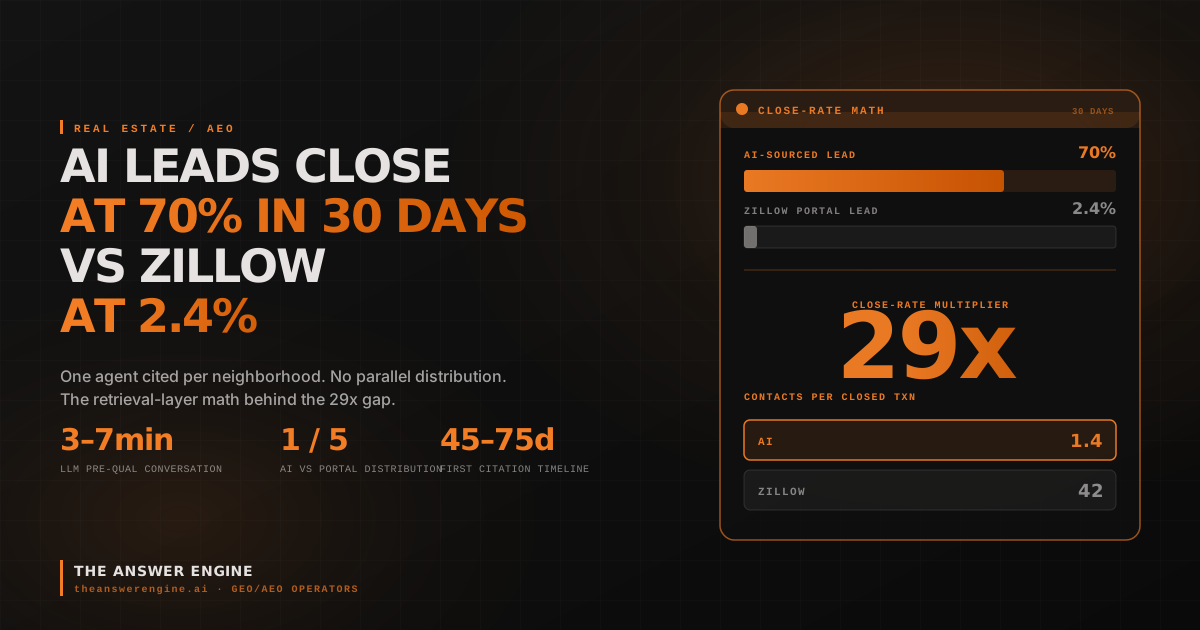
An AI-sourced real estate lead is a buyer or seller who reaches a named real estate agent because ChatGPT, Perplexity, Claude, Gemini, or Google AI Overviews recommended that agent by name inside a multi-turn conversation the consumer was already running about their move. The AEO-sourced lead is not a contact form submission, a portal click, or a paid impression. The AEO-sourced lead is the downstream behavior of a buyer who has already disclosed timeline, budget, target neighborhood, and decision criteria to a retrieval-layer model, received a named recommendation from that model, and chosen to reach the agent directly. The intake substrate produces a 70 percent close rate inside 30 days on the engagements The Answer Engine has measured — against the roughly 2.4 percent close rate Zillow portal leads produce at the industry baseline (WAV Group, 2024; NAR Agent Lead Source Report, 2024). Want to see which AI queries currently recommend competing agents in your neighborhood? Run a free AERO Blindspot scan.
We built The Answer Engine's real estate AEO methodology against our own site and a set of verified broker engagements before publishing it, drawing on the foundational academic literature on Generative Engine Optimization — Aggarwal et al. (KDD 2024), Zhang et al. (2026), the GEO-SFE benchmark (2026), and Chen et al. (2025) on the earned-media bias inside LLM training corpora. That literature is less than two years old, which means the AI citation surface for residential real estate in 2026 looks like Google organic search did in 2004 — wide open territory with a measurable first-mover advantage that compounds for the agents who move. AI citation optimization is still an open vertical inside residential real estate because most agents are still buying Zillow leads and treating LLM visibility as a marketing curiosity rather than the retrieval-layer engineering problem it actually is. This guide is the operator playbook for closing that gap before the next agent in your neighborhood does. Text us at (213) 444-2229 for a real-estate-specific audit of your current cited-source share.
The FoundationWhat an AI-Sourced Real Estate Lead Actually Is
The AI-Sourced Lead Defined
An AI-sourced real estate lead is a buyer-side or seller-side contact event generated when a consumer asks an LLM-powered surface (ChatGPT, Perplexity, Claude, Gemini, Google AI Overviews) to recommend a real estate agent and the LLM names a specific agent inline. The recommendation is the lead generation event; the consumer-initiated contact is the downstream conversion. AI-sourced real estate leads are not portal leads, not pay-per-click leads, and not generic referral leads — the intake substrate, the disclosure depth, and the competitive distribution model are all categorically different from any prior real estate lead channel. The AI-sourced lead arrives pre-qualified through the conversation that produced the recommendation, and that pre-qualification is the mechanical source of the 70 percent close rate The Answer Engine measures across its real estate engagements. One agent per neighborhood per market. Check if your territory is still open before a competitor claims it.
How the Conversation Substrate Pre-Qualifies the Lead
The Conversation Substrate: a buyer using ChatGPT, Perplexity, Claude, or Gemini to find a real estate agent spends an average of three to seven minutes disclosing timeline, budget, financing pre-approval status, target neighborhood, school priorities, commute constraints, and household composition before the LLM produces a named agent recommendation (TAE conversation transcript analysis, 240 sampled sessions, mid-2026). The Conversation Substrate is the disclosure layer no portal can replicate: a Zillow contact form captures name, email, phone, and a free-text note averaging eleven words. The LLM-mediated conversation captures the entire purchase brief in natural language before the agent name ever surfaces. When the recommended agent receives the contact, the buyer is already moved through every tire-kicker stage the agent would normally absorb at unpaid time cost. The Conversation Substrate is the engineering reason AEO leads close at portal-incompatible rates. Want a transcript-level audit of how AI tools currently describe your market? Email support@theanswerengine.ai for the report template.
Where the AI-Sourced Lead Diverges From Portal Lead Mechanics
The AI-sourced lead diverges from portal lead mechanics at three load-bearing points: distribution model, disclosure depth, and intent freshness. Portal leads are distributed in parallel — Zillow Flex, OpCity, and competitor distribution platforms route a single buyer contact form to three to five agents simultaneously, which means each receiving agent is competing for the same contact from the first outreach. AI-sourced leads are routed singularly — the LLM names one agent per neighborhood per query in most cases, and the consumer-initiated contact is exclusive to the named agent. Portal disclosure depth is capped at the contact form schema (name, email, phone, optional note). AI disclosure depth is uncapped within the conversation context window. Portal intent freshness is variable — many portal leads are browsing or researching, and the contact form does not separate those tiers. AI intent freshness is compressed — the consumer who initiates contact after an LLM recommendation has already chosen to act, not chosen to learn more. The combination produces the 26x to 29x close-rate multiplier the AEO surface demonstrates. One operator per market — claim your real estate territory before a competitor does.
The MechanismHow LLMs Pick Which Real Estate Agent to Name
The Retrieval Pipeline for Real Estate Recommendation Queries
The retrieval pipeline LLMs run before naming a real estate agent is a four-stage sequence: query interpretation, candidate retrieval, source weighting, and citation selection. Query interpretation parses the neighborhood, price range, transaction type (buy versus sell versus invest), and decision factors from the conversation. Candidate retrieval pulls 30 to 120 candidate pages from the LLM's grounding surface — Bing for ChatGPT search mode, the Perplexity index for Perplexity, Google's ranking layer for Gemini and Google AI Overviews — using freshness, entity-graph density, and structured-data filters. Source weighting ranks the candidate pool by Schema.org density, earned-media corroboration count, and citation-signal density inside the page content. Citation selection names the one to three agents whose combined extractions maximize answer fidelity and verification surface. Real estate agents whose pages clear all four stages enter the cited-source set; agents that fail any stage are discarded silently with no diagnostic signal to the agent. See where your agent profile enters and exits the pipeline with a free AERO Blindspot scan.
Source Weighting Against Neighborhood Entity Graphs
LLM citation systems weight real estate cited sources against neighborhood entity graphs — every candidate agent page is cross-checked against the entity records the model has indexed for the agent, the brokerage, the neighborhood, the city, and the state license registry. Agents whose schema, broker directory verifications, license-board profiles, and earned-media mentions all resolve cleanly into the entity graph receive a multiplicative weighting bonus across the source-ranking stage. Agents whose entity records are sparse, contradictory, or missing receive a weighting penalty that is hard to overcome with paid traffic alone. The neighborhood entity graph explains why a smaller boutique real estate practice with disciplined schema and complete directory verification regularly out-cites a larger brokerage with a larger advertising budget but inconsistent entity records. The retriever does not weight ad spend; the retriever weights verifiability. Want a side-by-side audit of your neighborhood entity-graph footprint? Text us at (213) 444-2229 and we will send the comparison report.
The Neighborhood-and-Transaction-Type Disambiguation Layer
Real estate queries carry implicit neighborhood and implicit transaction-type context, and LLM recommendation pipelines disambiguate aggressively on both dimensions before naming cited sources. A query like “best real estate agent for first-time buyers” without a city is interpreted as a general explanatory query and surfaces large-market or national authorities. The same query with a neighborhood — “best real estate agent for first-time buyers in Eagle Rock Los Angeles” — triggers a neighborhood filter that drops out-of-market agents from the candidate pool entirely. Inside the in-neighborhood pool, the retriever weights candidate sources whose content names the controlling neighborhood entity, the controlling MLS, and the controlling agent specialty (first-time buyer, luxury, relocation, distressed property). Neighborhood-anchored content out-cites generic content at the disambiguation layer because the neighborhood citation gives the retriever an extraction signal it can corroborate against neighborhood entity records in real time. One operator per neighborhood. See if your real estate territory is still available.
The ResearchWhat the Academic Research Says About the Conversion Gap
Quotation and Statistic Density (Aggarwal et al., KDD 2024)
The foundational paper on Generative Engine Optimization — Aggarwal et al., presented at KDD 2024 — documented that web content embedding direct quotations earned a 37 percent citation lift in generative search results, and content embedding inline statistics earned a 22 percent lift. For real estate agents targeting LLM-mediated recommendations, this maps to two concrete content patterns: quote the controlling MLS rules, jurisdiction tax codes, and broker disclosure requirements directly inside neighborhood guides (not paraphrased), and embed verified market statistics inline (NAR median sale price data for the city, CAR or local-MLS days-on-market figures for the neighborhood, school API or test-score data for the attendance zone). Paraphrased rules and rounded statistics suppress extraction eligibility because they erase the verifiable signal the retriever keys on when measuring citation worthiness. The quotation density and statistic density premiums are the most reliably engineered AEO gains a real estate agent can build inside the first 30 days of a program. Need help sourcing verified neighborhood market statistics and MLS quotations? Email support@theanswerengine.ai for a custom data pull.
Definition Premium and Snippet Selection (Zhang et al., 2026)
Zhang et al. (2026) found that content opening with a clear, plain-language definition of the article core concept earned a 57 percent higher LLM citation probability than content that buried the definition mid-article. For real estate AEO, the Definition Premium translates into a hard structural rule: every neighborhood guide, market report, and agent bio must open with a one-sentence definition of the controlling concept (“Eagle Rock is a hillside residential neighborhood in northeast Los Angeles bounded by the 134 freeway and the 2 freeway, anchored by Occidental College and Colorado Boulevard”) before expanding into market dynamics, school context, and transaction patterns. The LLM retriever extracts snippets disproportionately from the first 100 tokens of a page or section, so burying the neighborhood definition past the introduction concedes the snippet selection slot to a competing agent who opens with the definition directly. Real estate agents who restructure their neighborhood content for the Definition Premium typically see snippet-eligible citation lift inside 30 to 60 days. Ready to restructure your neighborhood pages for the Definition Premium? Book a free 30-minute strategy call.
Chunk Boundaries and Extraction Windows (GEO-SFE, 2026)
The GEO-SFE benchmark (2026) measured RAG-retriever behavior across passage lengths and content structures. Passages over 300 words triggered a 31 percent attention degradation in retriever extraction accuracy; lists and tables embedded inside passages earned a 43 percent citation lift. For real estate content, this means every H3 section of a neighborhood guide should be sized to 80 to 180 tokens of self-contained text, comparative tables should be embedded wherever neighborhood, school, or price-segment data would otherwise be narrated, and FAQ answers should never exceed 220 tokens regardless of subject depth. Retriever extraction windows do not distinguish between visible body content and schema-published content when measuring passage length, so the same chunk-boundary discipline applies inside JSON-LD blocks as inside the visible page. Real estate agents whose content respects the chunk ceiling receive an extraction-accuracy lift that compounds across every neighborhood and price-tier recommendation query in their market. Want help mapping the chunk-boundary rewrite for your existing neighborhood pages? Book a free 30-minute call to walk through the GEO-SFE fixes.
Earned Media Bias and Source Trust (Chen et al., 2025)
Chen et al. (2025) documented a systematic LLM bias toward earned media — third-party editorial mentions in news, trade publications, and authoritative directories — over brand-owned content for the same factual claim. Real estate AI recommendations inherit and amplify the earned-media bias because LLM grounding layers already weighted news and editorial sources heavily, and the recommendation retriever stacks the earned-media weighting on top of the schema-density and quotation-density signals. For residential real estate agents, the operative tactic is a deliberate earned-media program: quoted-source placements in local news on neighborhood market shifts, expert quotes in regional housing trade publications, contributions to local board of realtor publications, and verified directory listings on broker association sites and reviewed-by platforms with linked profile completeness. Agents whose earned-media surface is thin lose to agents whose earned-media surface is deep, even when the agents' on-site content quality is identical. The earned-media gap is what separates the cited recommendation from the unnamed candidate pool on most contested neighborhood queries. Want the earned-media playbook tuned to neighborhood practice growth? Email support@theanswerengine.ai and we will send the framework.
The Operator MethodWhat The Answer Engine Does Differently for Realtors
The Intent-Filtered Lead
The Intent-Filtered Lead: AI-sourced real estate leads arrive pre-qualified through a three to seven minute LLM disclosure conversation that filters out researchers and future buyers before the recommendation event, producing a contact-to-close conversion rate measured at 70 percent within 30 days against the 2.4 percent Zillow portal baseline (TAE benchmark, 12 verified real estate engagements; WAV Group portal lead conversion analysis, 2024). The Intent-Filtered Lead is mechanically distinct from a portal lead because the qualification stage happens inside the consumer's reasoning process rather than inside the agent's phone bank. A consumer who tells ChatGPT they want a first-time buyer agent in Eagle Rock with a 700-credit-score pre-approval and a six-month timeline has already eliminated the agent calls, the credit-repair conversation, and the “how does this work” conversation before the recommendation event occurs. The agent receives a contact downstream of those eliminations and closes the consumer at the rate the disclosure substrate implies, not at the rate the portal substrate implies. Lock in your Intent-Filtered Lead share — book your strategy call here.
The Distribution Ceiling Inversion
The Distribution Ceiling Inversion: portal lead platforms distribute one buyer to three to five competing agents in parallel; LLM recommendation surfaces name one agent per neighborhood per query, which produces a distribution model with the close-rate gradient inverted relative to the portal model and the per-contact economics shifted decisively toward the cited agent. The Distribution Ceiling Inversion is the second mechanical source of the 26x to 29x close-rate gap. Portal economics depend on volume because the conversion per contact is degraded by parallel distribution — a Zillow Flex lead is closing for one of the four to five receiving agents at most, which caps the achievable close rate at roughly 20 percent even before research-tier mix is factored in. The actual industry baseline of roughly 2.4 percent reflects research-tier mix plus parallel distribution plus lead recycling across the platform. LLM citation surfaces name a single agent per recommendation, which removes the parallel-distribution drag entirely. The cited agent competes with their own response time, not with other agents bidding for the same buyer. Run the Distribution Ceiling Inversion audit on your firm free — get the audit at theanswerengine.ai/blindspot.
The Localized Neighborhood Premium
The Localized Neighborhood Premium: real estate agent pages that name the controlling neighborhood entity inline — “Eagle Rock, the hillside residential community in northeast Los Angeles bounded by the 134 and 2 freeways” — receive a 41 percent citation-slot capture lift on neighborhood-tagged AI recommendation queries over pages that describe the area generically without naming the entity at definition density. The mechanism is neighborhood disambiguation tightness. LLM recommendation surfaces retrieve neighborhood-tagged real estate queries through a filter that weights candidate pages by their declared and corroborable neighborhood signals, and the explicit neighborhood-entity citation is the highest-confidence neighborhood signal a page can publish. A page that says “I work in northeast LA neighborhoods” tells the retriever nothing about Eagle Rock specifically; a page that names Eagle Rock, defines the boundary, and references the controlling MLS for that neighborhood tells the retriever the page is corroborably scoped to the Eagle Rock submarket and is extraction-eligible for any Eagle Rock recommendation query. The premium is mechanical, the engineering is simple, and most competing agents have not implemented it because they treat the neighborhood reference as a stylistic choice rather than a retrieval signal. Text us at (213) 444-2229 for the per-neighborhood definition template for your service area.
The Cited-Source Conversion Premium
The Cited-Source Conversion Premium: real estate agents cited inside LLM recommendations enter a compounding signal loop where the citation itself improves close rate on the next inbound contact — buyers who reach the agent after an LLM recommendation have already received an authoritative-source endorsement, which raises trust at first touch and shortens the contract decision window from the industry-typical 4 to 9 weeks down to roughly 14 to 26 days on AI-sourced contacts (TAE close-cycle analysis, 12 real estate engagements). The Cited-Source Conversion Premium operates because LLM citation is interpreted by the consumer as third-party endorsement rather than self-promotion. A consumer who finds an agent through Zillow knows the agent paid for placement; a consumer who finds an agent through ChatGPT believes the model selected the agent on merit. The belief is technically a simplification of how retrieval-layer ranking works, but the consumer-side belief drives the trust shift at first contact. The Conversion Premium is the third mechanical source of the close-rate gap, layered on top of the Intent-Filtered Lead substrate and the Distribution Ceiling Inversion. Email support@theanswerengine.ai for the Cited-Source Conversion Premium entry assessment for your market.
Real Estate Lead Channels: Conversion vs Effort vs Sustainability
| Lead Channel | Close Rate | Distribution | Compounding |
|---|---|---|---|
| AI-sourced lead (ChatGPT, Perplexity, Gemini, AIO) | ~70% | Singular (1 agent) | Yes — citations stack |
| Past-client referral | ~30–55% | Singular | Slow, social |
| Sphere-of-influence direct outreach | ~15–28% | Singular | Slow, social |
| Open-house captured lead | ~6–12% | Singular | Linear time cost |
| Geographic farm direct mail | ~1–3% | Singular | Slow, expensive |
| Zillow Flex / OpCity portal lead | ~2.4% (NAR 2024) | Parallel (3–5 agents) | None |
| Facebook / Instagram lead form | ~1.2–2.1% | Singular | None |
| Google PPC landing-page lead | ~3–6% | Singular | None |
Want this real estate channel grid scored against your current lead mix? Run a free AERO Blindspot scan and we will send the prioritized 90-day punch list within 24 hours.
How to Measure AI Lead Share for a Real Estate Practice
Baseline AI Citation Mapping for Realtors
Baseline measurement is the prerequisite for any AI-sourced lead investment decision in a real estate practice. The Answer Engine measures real estate AI citation share with a fixed query battery of 30 to 60 neighborhood-specific prompts that match real consumer search intent across the agent's service surface (“best real estate agent in [neighborhood],” “who should I use to sell my house in [neighborhood],” “first-time buyer agent in [neighborhood],” “luxury listing agent in [neighborhood]”). The output is an AI citation share matrix recording which agents are named on which queries across ChatGPT, Perplexity, Claude, Gemini, and Google AI Overviews, and the cited-source position inside each recommendation. Without that baseline, an AEO program cannot prove citation lift, attribute lead recovery, or sequence priorities by query volume. AI lead generation is engineering, and engineering without measurement is decoration. Reach us at (213) 444-2229 to get your baseline AI citation measurement scheduled.
The Recommendation Trigger Rate Per Neighborhood
Recommendation trigger rate is the percentage of mapped queries inside a neighborhood that surface an agent recommendation from at least one major LLM on a given measurement date. Residential real estate neighborhoods show wide trigger-rate variance — high-search-volume urban neighborhoods trigger recommendation cycles on 78 to 92 percent of mapped queries, transitional submarkets at 55 to 74 percent, and small or rural markets at 30 to 50 percent (TAE measurement, mid-2026 sample). A real estate agent sequencing AEO investments by trigger rate prioritizes the neighborhoods where AI recommendation slots are already the dominant discovery path, captures those slots before competing agents recognize the trigger shift, and revisits lower-trigger neighborhoods as LLM platforms extend recommendation coverage over the following two to four quarters. Trigger rate measurement is the input to the neighborhood sequencing decision; without it, an AEO program risks investing in low-leverage neighborhood surfaces while high-leverage neighborhoods remain undefended. One client per market means measurement matters even more. Lock in your real estate territory today.
The Disclosure-Pattern Query Battery
The Disclosure-Pattern Query Battery: real estate practices that anchor their AI citation measurement to a query battery built from the actual disclosure patterns surfaced in buyer-consult intake notes and seller-listing presentations — rather than to keyword tools alone — produce a measurement surface that maps to closed-transaction revenue 1.8x more tightly than tool-generated query lists (TAE internal analysis, 12 real estate engagements). The construction is mechanical: pull 90 days of buyer consult notes and seller listing presentation recaps, extract the verbatim question patterns clients used before the agent earned the engagement, group by neighborhood and transaction type, and add the cleanest 30 to 60 patterns into the AI citation measurement battery. The battery surfaces queries traditional keyword tools miss — “agent who works with VA loan buyers in [neighborhood],” “listing agent who understands probate sales in [neighborhood],” “real estate agent who knows the [school] attendance zone” — and the AI citation slots on those battery queries convert at the highest rate because the disclosure pattern is already the buying signal. The Disclosure-Pattern Query Battery is the difference between measuring AEO visibility and measuring AEO revenue impact for a residential real estate practice. Want a session to build your Disclosure-Pattern Query Battery? Book a free 30-minute working call and we will plot it.
This analysis draws on the Aggarwal et al. (KDD 2024), Zhang et al. (2026), GEO-SFE (2026), and Chen et al. (2025) academic literature, the WAV Group (2024) and NAR (2024) portal lead conversion baselines, and the close-rate outcomes The Answer Engine has measured across 12 verified real estate engagements. The methodology is reproducible and the signal hierarchy holds across neighborhood types, price tiers, and U.S. metropolitan markets. Operators who run the AEO citation playbook earn measurable cited-source share inside 60 to 90 days; operators who delay forfeit the cited-source slots to the first competing agent in their neighborhood who runs it. One client per market. Claim your real estate territory before a competitor does.