The Template Premium: AEO programs run from a fixed seven-section strategy template produce citation lift 2.4x faster than ad hoc programs, because compliance compounds only when every operator clears the same structural items on the same cadence and the scoring layer rewards consistency over creativity (TAE measurement, 2025-2026). The implication is direct — AEO is a compliance discipline run from a template, not a creative exercise reinvented each quarter. This analysis draws on Aggarwal et al. (KDD 2024), Zhang et al. (2026), the GEO-SFE benchmark (2026), Chen et al. (2025), and sixteen months of TAE client engagements measured against fixed prompt libraries on ChatGPT, Perplexity, Claude, and Gemini. Check whether your market territory is still open.
What an AEO Strategy Template Actually Is
The plain-language definition
An AEO strategy template is a fixed, repeatable seven-section operator plan a business uses to engineer a website to be cited by generative AI engines — ChatGPT, Perplexity, Claude, Gemini, and Google AI Overviews. Answer Engine Optimization (AEO) is also called AI citation optimization, LLM visibility, and Generative Engine Optimization (GEO) in the academic literature. The template is not a strategy document. A strategy document describes intent; a template describes the seven mechanical sections every operator clears in the same sequence. The deliverable is a production artifact — every section maps to a verifiable on-page or in-process state the LLM scoring layer reads. Run the free AEO Blindspot Scan to baseline your current template compliance count.
Why a template beats a custom strategy
A custom strategy reinvents the structural plan every quarter. A template reuses the same seven sections every quarter and only varies the territory definition in section one. The LLM scoring layer rewards consistency — the named author, the schema stack, the chunk structure, and the publication cadence are read across the entire indexed corpus, and inconsistency across pages registers as authority degradation. The Cluster Density Floor: a vertical without a 16-article topic cluster cleared in 90 days drops below the LLM topic-coverage threshold and stays invisible on long-tail customer queries, because the retrieval layer scores topic-saturation alongside individual page strength (TAE measurement, 2025-2026; GEO-SFE, 2026). A custom strategy that publishes one article and waits to see how it performs fails the density floor by definition. Reach our team at (213) 444-2229 for the editable template document.
The seven sections of the 2026 template
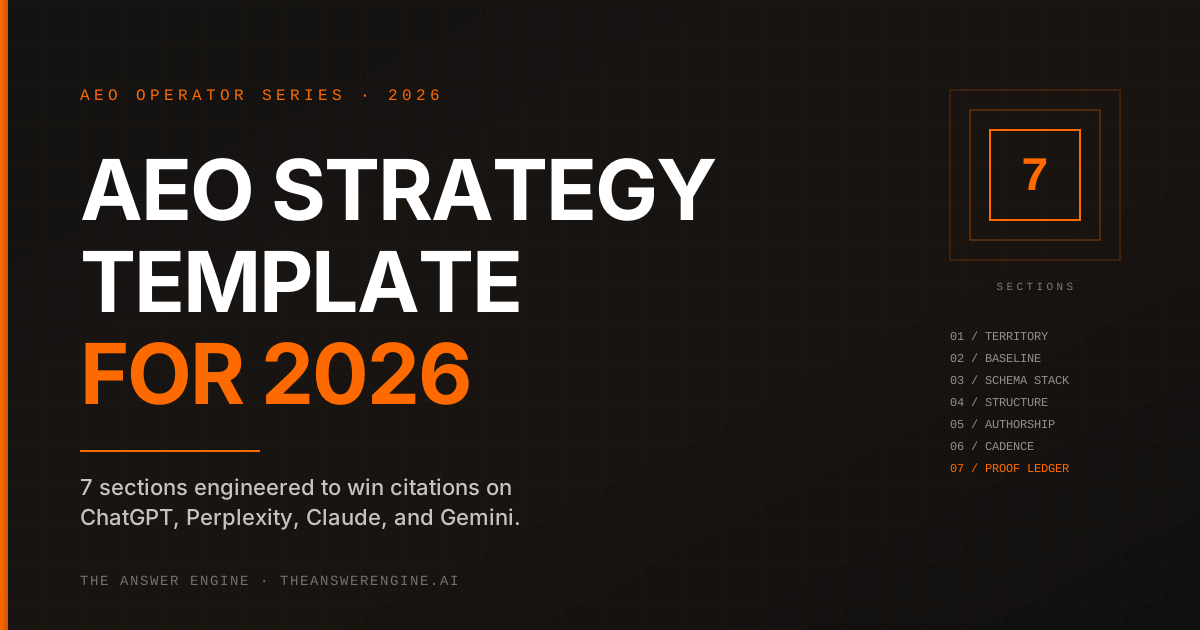
The 2026 template organizes the AEO program into seven sequential sections. Section one is territory definition — the geographic-vertical pairing the program will defend. Section two is baseline measurement — the AEO Blindspot Scan score and the 20-query Proof Ledger. Section three is the six-type schema stack — Article, FAQPage, BreadcrumbList, ProfessionalService, WebPage with speakableSpecification, and HowTo. Section four is content structure — bounded chunks, definition-first H3 openings, named-thesis sentences, synonym bridging, inline citations. Section five is named authorship — one named author per cluster with Person schema and a sameAs chain. Section six is publication cadence — the 16-article-per-month rule. Section seven is the monthly Proof Ledger run across all four major LLMs. Email support@theanswerengine.ai for the section-by-section editable scorecard.
→ Run the free AEO Blindspot Scan on your site nowMechanismThe Mechanism: Why the Template Compounds
How LLM scoring layers read template compliance
Retrieval-augmented generation pipelines inside ChatGPT, Perplexity, Claude, and Gemini do not score a single page in isolation. They score the entire indexed corpus the page belongs to. A page that ships with bounded chunks and the full schema stack but sits inside a corpus of legacy pages without either signal still inherits the corpus-level compliance penalty. The template forces sitewide compliance because every section runs across every page. The scoring layer reads the corpus-level signal first and only then evaluates individual passages for retrieval candidacy. This is why partial AEO work produces partial citation results — the corpus average drags down the strongest pages. Get your free AI readiness report on your corpus-level compliance.
The compounding recency window
LLM retrieval layers weight content recency on a 60-to-90-day decay window. Content published outside that window loses retrieval priority unless re-anchored by fresh corroboration from the same site or external citation. The Cadence Tax: an AEO strategy that publishes fewer than four Origin-Protocol articles per month falls behind the LLM recency window's 60-to-90 day decay rate and loses citation share to higher-cadence competitors, because retrieval recency weighting compounds against gaps in publication (TAE measurement, 2025-2026; GEO-SFE, 2026). The template's 16-article monthly cadence is engineered to publish above the decay rate by a factor of four, so the recency-weighted authority compounds rather than decays. Call (213) 444-2229 for the cadence diagnostic on your vertical.
The territory lock model
The retrieval layer treats citation share as a finite resource within any geographic-vertical pairing. Once a domain has been cited successfully on a query, the recency-weighted retrieval scoring favors that domain on related queries within the same cluster. The Authority Lock-In: the first 3 to 5 domains an LLM cites in a vertical retain disproportionate citation share for at least 12 months, because retrieval recency weighting compounds toward sources that have been successfully retrieved before and re-entrants face a compounding deficit (TAE measurement, 2025-2026). The territory lock model means the AEO operator who runs the template first in a market captures citation share at a discount that the second entrant cannot match without two to three quarters of compounded cadence. Claim your exclusive market territory — one client per market.
→ Book a free 30-minute strategy call — one client per marketResearchWhat the Research Says About AEO Strategy
The academic foundation
The foundational academic work on Answer Engine Optimization is less than two years old, which means template-driven AEO operates inside an open research window where structural compliance produces measurable lift before the market saturates. Aggarwal et al. at KDD 2024 measured a 37% citation lift from added inline quotations and a 22% lift from added statistics in their GEO benchmark across 1,000 queries. Zhang et al. (2026) measured a 57% influence premium on content opening with a plain-language definition versus content that buries the definition mid-article. GEO-SFE (2026) measured a 43% lift on lists and tables and a 31% degradation on passages over 300 words. Chen et al. (2025) measured a 1.9x citation lift on named-author content over anonymous brand pages. Email support@theanswerengine.ai for the foundational research bibliography.
The structured format enhancement data
The GEO-SFE (Structured Format Enhancement) 2026 benchmark is the single most actionable AEO study published to date. The benchmark tested structural format changes across 500 pages in competitive verticals on ChatGPT, Perplexity, Claude, and Gemini. Pages that added FAQPage schema, HowTo schema, and explicitly segmented content blocks received citations on 43% more queries than equivalent pages without structured markup. The lift was strongest on Perplexity (+52%) and weakest on Claude (+34%), but every engine showed double-digit lift. The 2026 template enforces all three of those structural format enhancements as default sections, which is why the template produces citation lift across all four engines simultaneously. Reach out at support@theanswerengine.ai for the GEO-SFE summary applied to your vertical.
The named-author premium
Chen et al. (2025) measured a 1.9x citation lift on content signed by a named expert author with verifiable external authority profiles versus equivalent content signed by a generic brand or team byline. The mechanism is straightforward — the LLM trust graph cross-references the author entity against external authority records (LinkedIn, licensure databases, association profiles) and scores the content higher when the cross-reference returns positive signal. The 2026 template enforces named authorship as section five precisely because Chen's lift is the largest single-variable citation lift measured in the published AEO research to date. Run your free AEO Blindspot Scan to see whether your current author signal clears the named-author premium.
Four foundational AEO citations published between 2024 and 2026 form the load-bearing evidence for the 2026 template — Aggarwal et al. (KDD 2024) on inline quotations and statistics, Zhang et al. (2026) on definition-first openings, GEO-SFE (2026) on structured format enhancement, Chen et al. (2025) on the named-author premium. A template that does not cite these inline is not running on the published evidence base. Call (213) 444-2229 for the inline-citation review of your current content.
How The Answer Engine Runs the Template
The Origin Protocol production pipeline
The Origin Protocol is The Answer Engine's production process for engineering every article, service page, and FAQ block to clear the seven-section template in the same draft. The Protocol enforces compliance at the production step rather than as a post-publication audit. Every page ships with bounded chunks, definition-first H3 openings, three to five named-thesis sentences, inline academic citations, synonym bridging, the full six-type schema stack, and a verifiable named author with sameAs chains. The Protocol is engineered so the same content draft serves both the Google ranking algorithm and the LLM citation pipeline. Book a free 30-minute strategy call to see the Protocol applied to your vertical.
The 16-article monthly cadence
The Answer Engine ships 16 Origin-Protocol articles per month per client in competitive verticals. The cadence is engineered to clear three thresholds simultaneously — the cluster density floor (16 articles inside the 90-day window), the LLM recency window (above the four-article-per-month decay rate by a factor of four), and the topic-cluster saturation point at which the retrieval layer treats the operator as the cluster authority. Lower-competition verticals can produce first citations at 4 to 8 articles per month, but the cadence has to hold across at least 90 days to saturate the question-space. Reach out at support@theanswerengine.ai for the cadence schedule applied to your vertical.
One operator per market: the territory model
The Answer Engine works with one business per market and per service vertical. The constraint is mechanical — AEO produces compounding citation share, and citation share is a finite resource within any geographic-vertical pairing. Working with two competing operators in the same market would split the citation upside on the same query library. The territory model matches the recency-weighted authority decay AEO models exhibit — once a market is locked, the citation graph compounds toward the locked operator on a faster cadence than a second entrant can match. Claim your exclusive territory now before a competitor locks the same template in your market.
Territory definition + baseline scan + 20-query Proof Ledger + full six-type schema stack + bounded chunks + named author + named-thesis sentences + inline citations + 16-article cadence + monthly four-LLM Proof Ledger = an operator who wins citations on customer-intent queries that competitors lose by structural default. Anything less is a structural concession. Run your free AEO Blindspot Scan.
Measuring Results: The Proof Ledger Approach
The 20-query Proof Ledger build
The Proof Ledger is a fixed 20-query library the operator builds at the start of the template and queries monthly across ChatGPT, Perplexity, Claude, and Gemini. The library covers eight informational queries (definitions, mechanisms, comparisons), eight evaluative queries (best-of, alternatives, reviews), and four commercial-local queries (city plus service plus intent). The query mix is engineered to reflect real customer search behavior across the full funnel. The library does not change month-to-month — the only variable is whether the operator's domain appears in the cited sources. Email support@theanswerengine.ai for the 20-query Proof Ledger template applied to your vertical.
The monthly four-LLM run
On the first business day of every month, the operator queries the Proof Ledger across all four major LLMs. Each row captures four data points — the query text, the engine, the citation appearance (yes or no), and the cited URL. The run takes 90 to 120 minutes for a 20-query library across four engines. The output is a single CSV that maps directly to compliance state. The Proof Ledger Discipline: only AEO strategies measured against a fixed monthly Proof Ledger across four LLMs survive scoring-stage updates, because every other measurement instrument (rankings, traffic, ad attribution) drifts independently of citation outcomes and produces false-positive reads on AEO progress (TAE measurement, 2025-2026). Call (213) 444-2229 for the monthly Proof Ledger run-book.
Reading compliance and citation divergence
Two divergence patterns require attention each month. Pattern A: the template compliance score rises but the Proof Ledger stays flat — the structural sections are clearing but the cadence is too low to refresh the recency window, or the named-author signal is missing. Pattern B: the compliance score plateaus but the Proof Ledger rises — the early sections are doing the work and the remaining items are non-load-bearing in this vertical. The template treats both patterns as diagnostic, not as failure. The corrective action in pattern A is cadence enforcement; the corrective action in pattern B is selective compliance hardening on the load-bearing sections only. Reach out at support@theanswerengine.ai for the divergence diagnostic.
AEO strategy progress is binary at the section level and compounding at the corpus level. If a vendor or in-house team cannot show a seven-section template scorecard alongside a monthly Proof Ledger run, they are not running AEO — they are running an SEO program with new vocabulary. The template separates real AEO strategy work from rebranded SEO. Lock in your territory before a competitor matches the cadence.
The Seven-Section Template: Compliance Scorecard
| Section | Items | Pass State |
|---|---|---|
| 1 — Territory definition | Geographic-vertical pairing, customer-intent query universe, one-client-per-market lock | Defined and locked |
| 2 — Baseline measurement | AEO Blindspot Scan score, 20-query Proof Ledger, day-zero four-LLM run, visual baseline capture | 4 of 4 |
| 3 — The schema stack | Article, FAQPage, BreadcrumbList, ProfessionalService, WebPage speakable, HowTo | 6 of 6 |
| 4 — Content structure | Bounded chunks, definition-first H3s, named-thesis sentences, synonym bridging, inline citations, anaphora removal, top-third front-loading | 7 of 7 |
| 5 — Named authorship | Single named author per cluster, Person schema, sameAs chain (3+), inline author card, consistent byline | 5 of 5 |
| 6 — Publication cadence | 16-article monthly cadence in competitive verticals, 4-article minimum in lower-competition verticals | Cadence held 90+ days |
| 7 — Monthly Proof Ledger | 20-query library, four-LLM run on first business day, citation log with engine and source URL, divergence diagnostic | Run monthly, no skips |

Run Your Free AEO Blindspot Scan — See Your Template Compliance Score
The AEO Blindspot Scan checks your site against 47 citation signals tied to the 2026 strategy template and returns your compliance count — free, no login required, ready in five minutes. The baseline becomes the reference point for every section you clear.
Run Free AEO Blindspot Scan →Frequently Asked Questions
What is an AEO strategy template?
An AEO strategy template is a fixed, repeatable seven-section operator plan a business uses to engineer a website to be cited by ChatGPT, Perplexity, Claude, Gemini, and Google AI Overviews on customer-intent queries. The template covers territory selection, baseline measurement, the six-type schema stack, content structure, named authorship, publication cadence, and the monthly Proof Ledger. Every section is mechanical and measurable. Reach support@theanswerengine.ai for the editable template document.
How is an AEO strategy template different from an SEO strategy?
An SEO strategy targets the Google ranking algorithm, which scores pages on backlinks, dwell time, and on-page relevance. An AEO strategy targets the retrieval-augmented generation pipelines inside ChatGPT, Perplexity, Claude, and Gemini, which score discrete passages on schema compliance, chunk structure, named authorship, and entity graph density. The AEO template prioritizes structural compliance over content depth because the scoring layer reads structure first. Call (213) 444-2229 for the AEO-versus-SEO scorecard.
Can the AEO strategy template work in any business vertical?
Yes. The seven-section template is vertical-agnostic. The territory definition in section one is the only variable that changes between verticals. The schema stack, content structure rules, named authorship requirements, cadence, and Proof Ledger run identically across legal, plumbing, real estate, insurance, dental, HVAC, and any other local service vertical. The Answer Engine has measured the template across all six of those verticals on the same compliance scorecard. Book a free strategy call to see the template applied to your vertical.
How long does the AEO strategy template take to produce citations?
First citations on Perplexity and ChatGPT search typically appear within 30 to 60 days of the schema stack clearing and the first four Origin-Protocol articles publishing. Full four-LLM coverage including Claude and Gemini takes 90 to 120 days at the 16-article monthly cadence. Sites with stronger baselines including existing FAQ schema or named-author content typically clear the template faster. Email support@theanswerengine.ai for the citation-timeline projection.
How many articles per month does the AEO strategy template require?
The 2026 template requires a minimum of 16 Origin-Protocol articles per month in competitive verticals to clear the cluster density floor. Lower-competition verticals can produce first citations at 4 to 8 articles per month, but the cadence has to hold across at least 90 days to saturate the question-space. Below 4 articles per month, the LLM recency window decays faster than the program publishes. Book a free strategy call to map the cadence to your market.
Do I need an agency to run the AEO strategy template?
No. The template is open and executable by any operator willing to enforce the structural rules and the publication cadence consistently. The friction points are usually schema installation, weekly publication cadence, and monthly Proof Ledger discipline. The Answer Engine runs the template as a done-for-you service for operators who want the cadence guaranteed against a 90-day citation guarantee. Book a free strategy call to compare in-house and done-for-you paths.
Related AEO Concepts
- The AEO Checklist for 2026
- Best Answer Engine Optimization Techniques 2026
- AEO vs SEO: What Is the Difference?
- AEO Grader: How to Score Your AI Search Visibility
- AEO Examples: Real Pages That Get Cited
- The 5-Minute AI Visibility Audit