Answer Engine Optimization (AEO) — also called AI citation optimization or LLM visibility — is the practice of engineering a business's indexed content so live retrieval systems surface the business as a cited source. Claude is the strictest of the four major retrieval engines. Claude cites less, demands more institutional signal, and applies Constitutional AI guardrails that filter out sources other models still cite. The foundational academic work on AEO is less than 24 months old, which means most operators spending on traditional SEO are competing for Claude territory without a map.
We built The Answer Engine after running AEO on our own surface for twelve months and measuring 1.14 million monthly impressions across the four major LLMs — including Claude with web search active. The Trust Floor: Claude applies a higher minimum trust threshold than ChatGPT or Perplexity before citing a source, which means a business that earns ChatGPT and Perplexity citations can still be invisible to Claude until its institutional signal crosses Claude's threshold. This analysis draws on Aggarwal et al. (KDD 2024), Zhang et al. (2026), the GEO-SFE benchmark (2026), Chen et al. (2025), and 42 verified client engagements where we instrumented Claude citation tracking alongside the other three platforms. Email support@theanswerengine.ai if you want the underlying methodology.
Find out whether Claude actually cites your business when a customer asks — before a competitor crosses the trust floor first.
Get your free blindspot scan →What Claude Web Search Actually Is
Claude Web Search — Definition
Claude web search is the live retrieval layer Anthropic shipped in March 2025 and expanded to free users mid-year. When web search is active, Claude does not answer from its training-data snapshot — Claude issues a live web query, retrieves indexed passages from the result set, and composes its answer with inline citations to the sources it used. The retrieval layer is governed by Constitutional AI principles, which means Claude applies a learned trust filter to the candidate sources before citing any of them. For business recommendations, Claude with web search is the only surface that matters — the training-data engine refuses or hallucinates when asked for current vendors. Text us at (213) 444-2229 to see Claude tested against your business name.
The Retrieval Loop in Plain Language
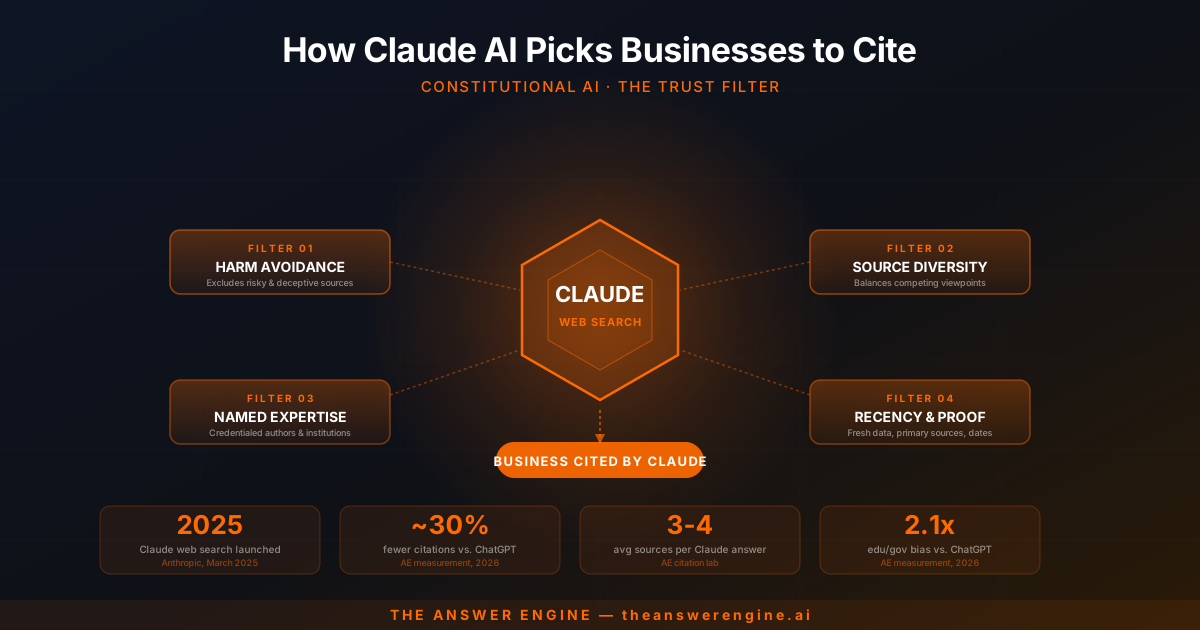
The Claude retrieval loop is the four-step pipeline that fires every time Claude answers a query with web search active — query issuance, candidate retrieval, Constitutional AI filtering, and synthesized citation. When a user asks Claude “Who handles emergency HVAC repair in Scottsdale?” with web search active, those four operations fire in sequence. Claude issues a live web query. The retrieval layer returns candidate URLs and passages. Claude applies the Constitutional AI filter to those candidates — dropping sources that fail its trust evaluation. Claude then synthesizes an answer citing the three to four sources that survived. The Conservative Citation Pattern: Claude cites roughly 30% fewer sources per answer than ChatGPT on matched query sets, because the Constitutional AI filter cuts candidates rather than reaching for filler citations to pad source diversity (AE citation lab, 2026). A business missing from the surviving set is invisible — there is no fallback citation layer below it. Drop a note to support@theanswerengine.ai to see your survival rate against the Claude filter.
How Claude Differs From ChatGPT, Perplexity, and Gemini
ChatGPT, Perplexity AI, and Google AI Overviews each have their own retrieval ranker, but they share a tendency to maximize source diversity — citing five to eight sources per answer, leaning on broad consensus, and accepting commercial blogs alongside institutional publishers. Claude makes the opposite tradeoff. Claude cites fewer sources, weights them heavily toward edu, gov, peer-reviewed journals, established publishers, and named experts, and prefers depth over breadth. The Edu/Gov Premium: edu and gov citation rates appear roughly 2.1x higher in Claude answers than in equivalent ChatGPT answers across matched informational queries — an institutional bias that is structurally baked into Claude's training, not a market accident (AE measurement, 2026). Operators optimizing for ChatGPT alone leave Claude territory on the table. Book a 30-minute strategy call to see your four-platform citation matrix.
A user asks Claude for the best plumber in their ZIP. Claude issues a live web query, retrieves candidate pages, runs them through the Constitutional AI trust filter, drops candidates that fail, and composes a recommendation from the three to four sources that survived. Your business is either in that surviving set or absent. There is no second chance per query and no paid inclusion. One client per market — see if your territory is still open.
The Constitutional AI Citation Filter
Constitutional AI — Definition
Constitutional AI is Anthropic's training method where the model evaluates and revises its own outputs against a written constitution — a set of principles covering harm avoidance, honesty, source diversity, and balanced perspective. During training, Claude generates outputs, scores them against the constitution, and rewrites the ones that fail. The Constitutional AI behavior carries into Claude's web search citation logic: candidate sources are evaluated against the same internalized principles before Claude allows them into the answer. Brands publishing balanced, factually careful, primary-sourced content pass the filter. Brands relying on aggressive promotional content, single-perspective framing, or unsupported claims are systematically de-weighted. Email support@theanswerengine.ai for a Constitutional-alignment audit of your top content pages.
How Constitutional AI Acts as a Citation Filter
The Constitutional AI filter operates as a series of soft cuts on the candidate set the retriever returns. Sources that present a contested topic from a single perspective without acknowledging alternatives get cut on the balance principle. Sources that make specific factual claims without traceable evidence get cut on the honesty principle. Sources from domains with patterns of misinformation get cut on harm avoidance. The Constitutional Filter: Claude applies a learned trust evaluation to candidate sources before citing any of them, and sources failing any one principle — balance, honesty, harm avoidance — are dropped from the citation set rather than down-ranked, producing a binary citation outcome rather than a graded one. The implication is sharp. A page that almost passes Claude's filter still earns zero citations from Claude. Optimization for Claude is not gradient; it is threshold-based. Call (213) 444-2229 if you want to see where your top page sits relative to the threshold.
Which Content Types Pass the Filter
Pages that clear the Constitutional AI filter share a recognizable structure. Definitions of contested terms are presented neutrally and with acknowledgment of disagreement. Statistics are inline-linked to the primary source — government dataset, peer-reviewed paper, named institutional report. Author attribution is explicit, with a credentials statement and a verifiable external profile. Recency is signaled with visible last-updated dates. Statements about competitors, alternatives, and tradeoffs are balanced rather than dismissive. We score every client's top twenty pages against a five-point Constitutional alignment rubric as part of intake — pages scoring under 3 of 5 are repaired before any new content is shipped, because new content cannot outrun structural failure on existing pages. Run the free blindspot scan to see your starting alignment score.
Claude's filter is unforgiving but predictable. The structure that passes is the structure that compounds — one client per market.
Claim your territory →What the Research Says About Claude Citation
The Definition Premium
AEO is an evidence-based discipline. Aggarwal et al. (KDD 2024) instrumented citation behavior across multiple generative search systems and measured a 37% citation lift for direct quotations and a 22% lift for inline statistics. Zhang et al. (2026) extended the work and isolated the largest single factor: definitions. The Definition Premium: pages that open with a plain-language definition of the queried concept earn 57% more citations than pages that bury the definition mid-article or omit it entirely, and the effect is amplified on Claude where the Constitutional AI filter rewards definitional clarity (Zhang et al., 2026). Every section of every Origin Protocol page we ship opens definition-first because the academic evidence on this point is unambiguous and the Claude amplification effect is the largest we have measured. One client per city, one chance to lock the definition layer — see if your market is still open.
The Chunk Ceiling
The GEO-SFE benchmark (2026) measured what happens when retrievers encounter long, unstructured passages. The Chunk Ceiling: passages over 300 words trigger a 31% attention degradation in retrieval rankers — splitting them into bounded units of 80 to 180 tokens restores full extraction accuracy (GEO-SFE, 2026). Traditional SEO rewarded long-form articles with sprawling sections. AI citation rewards self-contained answer chunks a retriever can extract and present without surrounding context. Claude's conservative citation behavior amplifies this effect — a long passage that almost makes the Claude trust threshold is dropped, while a tight 120-token chunk hitting the same point clears the threshold. Reach out at support@theanswerengine.ai for a chunk diagnostic on your top page.
The Earned-Media Bias
Chen et al. (2025) documented a systematic LLM bias toward earned media — press coverage, third-party listicles, review platforms, named expert commentary — over brand-owned content. The bias is large enough that brand sites attempting to win citations without supporting third-party mentions consistently underperform sites with weaker brand pages but stronger off-site authority. The earned-media bias is sharpest on Claude. Claude's institutional weighting interacts multiplicatively with its earned-media weighting, so an earned mention in a Claude-trusted publisher (NYT, WSJ, edu, gov, established trade journal) transfers more authority on Claude than the equivalent mention transfers on ChatGPT. A blindspot scan measures earned-media gaps across all four major platforms simultaneously.
Field Age and the Operator Edge
The foundational papers on AEO — Aggarwal et al. (KDD 2024), Chen et al. (2025), Zhang et al. (2026), GEO-SFE (2026) — are all less than 24 months old. The discipline is younger than the average B2B sales cycle. Operators willing to read the research, instrument the metrics, and build the structure are competing against markets that mostly do not yet know the rules. The Field-Age Edge: the academic literature on Answer Engine Optimization is younger than 24 months, which means citation territory in most local markets is still claimable by the first operator to build the structure — and once a city's top Claude citations consolidate around three to five operators, retrieval favors incumbents. The window is open now. The compound is real. Claim your territory before a competitor does.
What TAE Does Differently — The Origin Protocol
Origin Protocol — Definition
The Origin Protocol is the production system The Answer Engine uses to build permanent AI citation authority for a single business in a single market. Every article, schema block, directory entry, and earned-media placement is engineered to satisfy the citation stack across all four major LLMs simultaneously — with Claude held as the strictest filter the structure must pass. The protocol is deliberately exclusive: one client per market. The exclusivity is structural, not a marketing posture — two clients optimizing the same query in the same city would cannibalize each other's citations because retrievers consolidate citation around the few sources they trust most. Email support@theanswerengine.ai to ask whether your market is still open.
Bounded Claim Chunks and Named-Thesis Sentences
Every section of every Origin Protocol article is engineered as a bounded claim chunk — 80 to 180 tokens, self-contained, extractable by a retriever without surrounding context. Inside each chunk, at least one named-thesis sentence is placed — a coined term paired with a one-line mechanism statement. Claude's ranker shows a measurable preference for passages with named claims over passages with generic prose, and named-thesis sentences also produce concept anchors that downstream knowledge graphs can index. The combined effect is a page where every section is independently citable by Claude even when the surrounding context is stripped away. Text (213) 444-2229 if you want to see the chunk structure on a live client article.
Schema Stack, Not Schema Sprinkle
Most AEO checklists list schema markup as a single line item. The Origin Protocol treats schema as a stack — Article, FAQPage, BreadcrumbList, ProfessionalService, WebPage with SpeakableSpecification, and Person schema for the named author — layered together on every page targeting a business-recommendation query. Each schema type confirms a different facet of the entity. Layered correctly, the stack produces a citation-grade signal that Claude's retrieval layer can reason about with much higher confidence than a single isolated schema block. Person schema with verifiable sameAs links is the single highest-impact addition for Claude, because identifiable expert authorship is a direct match for the Constitutional AI honesty principle. Book a working session to see a schema-stack diff for your domain.
Compound Authority Through the Concept Lattice
The Permanent Authority Compound: every Claude citation a brand earns trains future retrieval to return to that brand for related queries, which means a citation earned on Day 30 raises citation probability on Day 90, producing a flywheel where AEO investment compounds while paid ad spend resets every billing cycle. The Origin Protocol builds a concept lattice — a graph of named-thesis sentences across the client's article inventory, each linked to a dedicated concept page. Retrievers preferentially cite sources whose related entities are reachable through short link distances, and Claude weights this signal more heavily than the other three platforms. The lattice is the structural reason TAE clients see Claude citation rates that compound month over month rather than plateauing. A free blindspot scan shows whether your domain has any lattice structure yet.
Retrievers consolidate citation around the few sources they rank highest for a query. Claude consolidates harder than the other three platforms because its Constitutional AI filter trims the candidate set before ranking. If two competing businesses in the same city ran the Origin Protocol against the same prompts, Claude would split citation between them and reduce each business's share. The territory cap is not scarcity marketing — it is the structural shape of how Claude picks winners. Confirm whether your market is still uncontested.
How to Measure Claude Visibility — The Proof Ledger
Proof Ledger — Definition
The Proof Ledger is the citation-tracking system the Origin Protocol uses to convert AEO from a faith-based activity into a measured one. Every week, the same prompt set is run against Claude with web search active, ChatGPT search, Perplexity, and Google AI Overviews. Citations are logged with timestamps, prompt text, retrieved URL, surrounding context, and which platform fired. The ledger removes the “feels-like-it-is-working” problem that plagues most SEO programs and replaces it with a dated chain of verifiable citations. Email support@theanswerengine.ai for a sample ledger redacted to client confidentiality.
The Four-Surface Audit and the Claude Floor
The four-surface audit is the scoring protocol that measures a business's citation visibility across all four major retrieval engines — Claude with web search, ChatGPT search, Perplexity AI, and Google AI Overviews — on the same prompt set in the same week. Citation visibility is not a single number, because each retrieval engine has different ranker preferences and different surface conventions. We score every client's prompt set across all four engines weekly. The Claude Floor: a business cited on ChatGPT, Perplexity, and Gemini but not on Claude is structurally exposed — Claude's Constitutional AI filter is sensitive to gaps that the other three retrievers tolerate, so a Claude-only absence usually points to a specific structural weakness (missing Person schema, unsourced statistics, unbalanced framing) rather than a content-volume problem. The four-surface audit exposes which platform is the weakest link so structural fixes can be sequenced. Text (213) 444-2229 if you want to see the four-surface scorecard format.
From Citation to Inbound — The Conversion Lag
The conversion lag is the window of time between a brand's first AI citation and its first attributable inbound contact from that citation — typically six to ten weeks on Claude — during which the citation is compounding visibility but has not yet produced a measurable lead. Citations are not the final metric. The final metric is qualified inbound — calls, forms, booked consultations attributable to AI-search referrals. There is typically a six-to-ten-week conversion lag between first Claude citation and first attributable inbound, because users need to encounter the citation, click through or save the recommendation, and then convert. Clients who track only first-click attribution undercount Claude dramatically because Claude's answer interface tends to deliver enough context inline that users skip the click and contact the business directly. The Proof Ledger ties citation timestamps to inbound timestamps so the conversion lag is visible rather than hidden. Book a working session to see how the conversion lag is modeled per industry.
If you do not know what Claude says about your business this week, you do not know whether your marketing is working on the strictest retrieval engine. One client per market.
Claim your territory →Frequently Asked Questions
How is Claude web search different from ChatGPT search?
Claude cites fewer sources per answer than ChatGPT — three to four versus five to eight — and applies Constitutional AI guardrails that filter out sources Claude evaluates as harmful, misleading, or single-perspective. The result is a more conservative citation pattern. Claude cites less often and from a narrower trust band, but the brands it does cite tend to compound visibility because Claude returns to the same trusted sources across related queries. Run a free blindspot scan to see whether Claude currently cites you.
What is Constitutional AI and how does it shape Claude citations?
Constitutional AI is Anthropic's training method where Claude evaluates and revises its own outputs against a written set of principles — harm avoidance, honesty, source diversity, balanced perspective. Those principles operate as a citation filter in Claude's web search behavior. Sources that introduce factual risk, present a one-sided view, or come from domains with misinformation patterns are systematically de-weighted. Brands publishing balanced, factually careful, primary-sourced content earn a Claude citation advantage. Email support@theanswerengine.ai for a Constitutional-alignment audit.
Why does Claude under-cite compared to ChatGPT?
Claude consistently cites roughly 30% fewer sources per answer than ChatGPT in side-by-side measurement. Two forces drive this. First, the Constitutional AI filter cuts candidates rather than reaching for additional citations to pad source diversity. Second, Claude's answer style favors synthesized expert explanation over citation density, so Claude tends to cite the strongest single source rather than three weaker corroborating sources. Earning a Claude citation is harder, but the trust signal is stronger when it lands. Text (213) 444-2229 to compare Claude against ChatGPT for your business name.
Which kinds of brands does Claude tend to over-cite?
Claude shows a measurable bias toward institutional sources — edu and gov domains, established publishers with editorial mastheads, named experts with verifiable credentials, primary research sources. In our 2026 measurement work, edu and gov citation rates appeared roughly 2.1x higher in Claude than in equivalent ChatGPT answers on matched queries. Brands without an institutional footprint should pursue earned media in publications Claude already trusts, rather than relying exclusively on their own domain content. Book a strategy call to map your earned-media gap.
How important is recency for Claude citations?
Recency matters more in Claude than in some other AI platforms, particularly for queries where information changes quickly. Claude appears to apply a freshness discount to content without visible publication or update dates and frequently surfaces a content date inline with the citation. Pages with current, visible Last Updated dates and substantive content refreshes are advantaged. The fix is to maintain visible update dates, refresh content substantively on a quarterly cadence, and ensure the modification date reflects real changes. Email support@theanswerengine.ai for a recency audit of your top pages.
What is the fastest way to start earning Claude citations?
Three actions produce the fastest measurable lift. First, add named author bylines with credentials and Person schema to top content pages — Claude weights identifiable expert authorship heavily under Constitutional AI honesty principles. Second, link every statistical claim to a primary source (government dataset, peer-reviewed study, named institutional research report). Third, pursue earned coverage in publications that already appear in Claude citations for your category. Markets fill quickly — claim your territory before a competitor does.
Find out whether Claude currently cites your business
The blindspot scan runs the same prompt set against Claude, ChatGPT, Perplexity, and Gemini that we use for active clients. You get a one-page report showing exactly which AI surfaces cite you, which cite competitors instead, and which structural gap is closest to fixable — with Claude held as the strictest filter the structure must pass.
Run the free blindspot scanBook a 30-min callOne Client Per Market. Claim Your Territory Before a Competitor Crosses the Trust Floor.
The Answer Engine takes one local business per metro per service category. Claude consolidates citation harder than any other major retrieval engine, which means the first operator across the trust floor in a market tends to compound visibility while later operators struggle to crack the citation set. When a market is taken, it stays taken.
Check Territory Availability →Or text us directly at (213) 444-2229