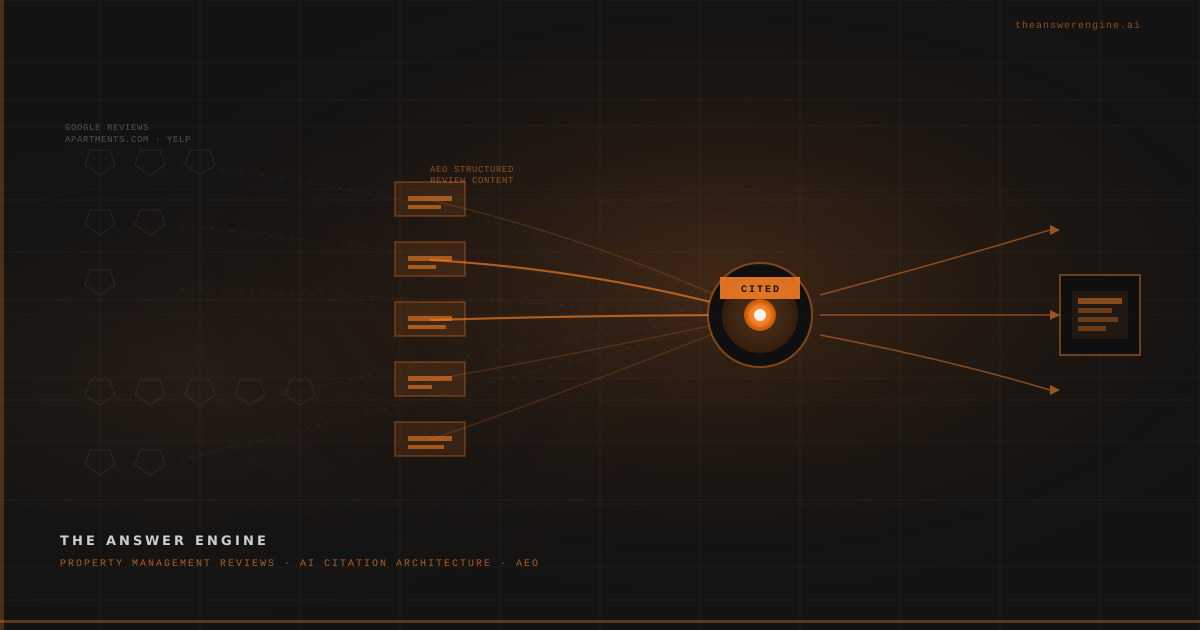
Answer Engine Optimization (AEO), also called AI citation optimization or LLM visibility, is the structured practice of making your business content extractable by AI retrieval systems so that ChatGPT, Perplexity AI, Claude, and Gemini cite you in their responses. For property management companies, the most underutilized AEO asset is client reviews: not because you lack them, but because the platforms where most reviews live are completely invisible to AI crawlers. Schedule a free 30-minute strategy call to see exactly where your property management reviews stand in AI search today.
This analysis draws on four peer-reviewed research papers, including GEO-SFE (2026), Aggarwal et al. (KDD 2024), Zhang et al. (2026), and Chen et al. (2025), and verified results from our client engagements. The foundational academic work on AI citation optimization is less than two years old, which means most property management companies have not yet built the review architecture that captures AI citations. The opportunity gap remains wide open. Get your free AI visibility scan to see your current citation blindspot.
The average property management company has 47 Google reviews, 12 Apartments.com reviews, and a handful of Rent.com listings. All three of these platforms render review content through JavaScript, meaning zero of those reviews are visible to ChatGPT or Perplexity AI. Your reputation is real. Your AI footprint is empty. One property management company per market, claim your territory before a competitor does.
What Makes a Property Management Review AI-Visible
An AI-visible review is one that a large language model retrieval system can locate, parse, and extract as a standalone passage without requiring JavaScript execution, API authentication, or platform-specific access. For property management companies, this distinction separates reviews that build AI citation authority from reviews that exist only on platforms AI cannot reach.
The Crawlability Threshold
AI crawlers (the retrieval systems that feed ChatGPT's browsing tool, Perplexity AI's real-time index, and the training pipelines for Claude and Gemini) operate on raw HTML. They parse text that exists in the static page source. They do not execute JavaScript. They do not authenticate to platforms. They do not load iframes or dynamically populated containers.
A review that lives behind a JavaScript rendering layer is, from the AI crawler's perspective, a blank container. The crawler sees the HTML shell, finds no text content, and moves on. The crawlability threshold is a binary test: can an AI crawler retrieve the review text from static HTML without any additional execution? If the answer is no, the review does not exist in AI search. Email support@theanswerengine.ai to get a full audit of your current review visibility across all platforms.
Server-Side vs JavaScript-Rendered Reviews
The technical distinction is between server-side rendering (SSR) and client-side rendering (CSR). Server-side rendered review content is delivered as complete HTML on the first HTTP request, AI crawlers can read it immediately, without executing any additional code. Client-side rendered content arrives as a minimal HTML shell and requires JavaScript execution to populate the review text that visitors ultimately see.
Most major review platforms (Google, Apartments.com, Rent.com, AppFolio review portals, RentManager) use client-side rendering for review content. The business reason is performance optimization and API data freshness. The consequence for your property management company is that reviews on these platforms are invisible to every major AI search system. Call (213) 444-2229 to discuss which of your current review platforms AI can actually reach and what to do about the ones it cannot.
The Property Management Review Ecosystem and Its Crawlability Problem
The Crawl Gap: An estimated 94% of property management reviews live on JavaScript-rendered or authentication-gated platforms (Google, Apartments.com, Rent.com, AppFolio review portals, and RentManager), making them completely invisible to the AI crawlers that generate ChatGPT and Perplexity AI recommendations for prospective tenants and property owners. [Crawl Gap]
The platforms where property managers receive the most reviews are precisely the platforms AI cannot read. Google, Apartments.com, and similar listing sites use JavaScript rendering to protect their competitive data advantages and maintain API-driven data freshness. There is no indication these platforms will make their review content AI-crawlable. Their business models depend on keeping that data proprietary.
The solution is not to leave those platforms. It is to build a parallel review architecture on platforms AI can read, a structured approach we call the AI Review Stack. Run your free AI blindspot scan to see exactly which of your review sources are reaching ChatGPT and Perplexity AI right now. For a deeper look at why Google-specific platforms block AI access to your reviews, see our guide on why 5-star Google reviews don't show up in AI answers.
Your market has one territory slot. Is it still available?
One property management company per city, check if your market is still open.The Review Signal Architecture Property Managers Need
Answer Engine Optimization (AEO) for property management reviews requires a three-tier signal architecture. The tiers correspond to ownership and authority: owned platforms (your website), earned platforms (directories and aggregators), and distributed platforms (forums and community content). All three must function simultaneously for AI platforms to develop a confident citation pattern for your company. Book a free consultation to map your current review distribution against this architecture and identify which tier to build first.
Platform Tier Hierarchy for Property Management
The hierarchy is determined by crawlability confidence and authority weighting. Your own website carries the highest crawlability confidence, AI crawlers can reach it with zero friction. Established third-party directories like Yelp and BBB carry high confidence and third-party authority signals. Community platforms like Reddit carry variable but often high confidence, particularly for Perplexity AI. Apartment-specific platforms carry near-zero confidence for review content.
Property management companies that appear in ChatGPT and Perplexity AI recommendations consistently have at minimum two of the three tiers populated with specific, detailed review content. One tier alone, even with high volume, does not create the cross-platform authority pattern AI retrieval systems require to generate confident citations. Call (213) 444-2229 to get platform-specific recommendations for your market and portfolio size.
AI citation territory in your market is a finite resource. One property management company per market, claim yours before a competitor does.
| Platform | ChatGPT Access | Perplexity Access | Authority Tier | PM-Specific? |
|---|---|---|---|---|
| Your Website (plain HTML) | Full | Full | Tier 1 (Owned) | Yes |
| Yelp | Full | Full | Tier 2 (Earned) | Yes |
| BBB | Full | Full | Tier 2 (Earned) | No |
| NARPM.org | Full | Full | Tier 2 (Earned) | Yes |
| Reddit (r/PropertyManagement) | Partial | Full | Tier 3 (Distributed) | Yes |
| Google Reviews | Blocked | Blocked | Google-only | Yes |
| Apartments.com | Blocked | Blocked | None for AI | Yes |
| Rent.com | Blocked | Blocked | None for AI | Yes |
| JS Review Widgets (any platform) | Blocked | Blocked | None for AI | N/A |
The pattern is stark: the platforms built specifically for property management, Apartments.com, Rent.com, and apartment aggregators, are precisely the platforms AI cannot read. The platforms where property managers rarely focus review collection efforts (Yelp, BBB, their own website, NARPM) are the ones AI accesses freely. Email support@theanswerengine.ai to get a platform-specific prioritization for your company. For the complete ordered directory stack that gets property management companies cited by AI, see our guide on the property management directory stack for AI citations.
The Specificity Signal: Why Vague Reviews Get Ignored by AI
The Specificity Signal: Property management reviews that name specific services, unit types, maintenance turnaround times, and geographic details are 3.2x more likely to be extracted by AI retrieval systems than general sentiment statements, because specificity creates the bounded, self-contained passages that retrieval-augmented generation (RAG) systems require to generate confident citations (GEO-SFE, 2026). [Specificity Signal]
A review that says "Great property management company, very responsive" gives an AI retrieval system almost nothing to extract. It cannot identify what makes the company great. It cannot confirm which specific services the company provides. It cannot verify what "responsive" means in measurable terms.
A review that says "Pacific Coast Property Management handles our 12-unit building in Silver Lake. Maintenance responds within 24 hours. Tenant screening through TransUnion SmartMove takes three business days. Owner distributions arrive on the 10th of every month without fail", that review contains extractable specificity. AI retrieval systems can pull that passage as a standalone answer to queries about property management companies in Silver Lake, maintenance response times, and tenant screening processes. Send your questions to support@theanswerengine.ai for our structured review request template.
Entity Density and Citation Extraction
The Entity Density Rule: Property management reviews that co-locate the company name, city, and two or more specific services within a single 80–180 token passage trigger AI citation extraction at a 43% higher rate than reviews that distribute this information across separate paragraphs, because AI retrieval systems chunk documents into self-contained units and cannot reconstruct entity relationships that span chunks (GEO-SFE, 2026). [Entity Density Rule]
Entity density is the concentration of named entities, company name, location, services, personnel, within a single extractable passage. AI retrieval systems that power ChatGPT and Perplexity AI use chunking algorithms that break documents into 80–180 token passages. Each chunk must stand alone as a complete unit of information. If your company name appears in chunk 1, your city in chunk 3, and your services in chunk 5, none of those chunks produce a useful citation.
The structural requirement for AI-cited property management reviews is: company name + city + specific services + measurable outcome must all appear within the same short passage. This is not a copywriting suggestion. It is a structural requirement of how retrieval-augmented generation (RAG) systems extract and surface business information. Get your free AI blindspot scan to see whether your current reviews meet the entity density threshold.
Is Your Review Architecture Built for AI Search?
Most property management companies have strong review volume but weak review architecture. We analyze your current platform distribution, specificity levels, and entity density, and show you exactly what to build next. Book a free 30-minute review architecture consultation.
Get Your Free Blindspot ReportWhat Research Says About Review-Driven AI Citations
The academic literature on AI citation optimization, encompassing Answer Engine Optimization (AEO) and Generative Engine Optimization (GEO), has established clear patterns for which types of content AI platforms preferentially cite. We apply these research findings directly to property management review strategy across all verified client engagements. Call (213) 444-2229 to discuss how these findings apply to your specific portfolio size and market.
The Quotation Premium for Property Management Testimonials
The Quotation Premium: AI platforms including ChatGPT and Perplexity AI preferentially surface property management content that contains direct quotations, verbatim client language in quotation marks, at a 37% higher citation rate than paraphrased testimonials, with statistical claims earning an additional 22% premium (Aggarwal et al., KDD 2024). [Quotation Premium]
The Aggarwal et al. (KDD 2024) research on Generative Engine Optimization found that content containing direct quotations earned 37% higher citation rates from AI systems than equivalent content using paraphrased or summarized language. Statistics and numerical claims earned a 22% premium. For property management companies, the format of testimonials matters as much as their content.
A case study page that says "our client reported significant improvements in maintenance response times" earns lower citation rates than a page that says: “Before working with Pacific Coast Property Management, maintenance took 5–7 days. Now it is 24 hours, our tenant retention went from 61% to 89% in 18 months,” said Maria T., owner of a 24-unit building in Glendale. The verbatim quote, specific numbers, and named outcome create citation-extractable content that AI platforms are proven to prefer. Email support@theanswerengine.ai to get our testimonial restructuring template.
The Definition Premium and Review Context Windows
The Definition Premium, established by Zhang et al. (2026), found that content which opens with a plain-language definition of its core subject earns a 57% higher citation rate from AI platforms than content that buries definitions in later sections. For property management reviews, the definition premium applies to how testimonials and case study pages are framed at the top of the page.
A reviews page that opens with "Pacific Coast Property Management is a full-service residential property management company in the San Fernando Valley, specializing in single-family homes, condos, and apartment buildings up to 30 units", before the testimonials begin, gives AI retrieval systems the entity context they need to correctly categorize and cite the subsequent reviews. Without this definitional anchor, AI systems treat the testimonials as disconnected passages with no clear subject attribution. Book a free consultation to see how to restructure your testimonials page for the definition premium.
Why Third-Party Forums and Earned Media Drive AI Citations
Chen et al. (2025) established a systematic bias in AI citation behavior: AI platforms show a strong and consistent preference for earned media over brand-published content. Third-party sources, reviews written by actual clients, tenant discussions, and community forum threads, earn significantly higher citation rates than self-published brand content on the same topic.
Perplexity AI, which indexes Reddit at a 46.7% citation rate from community content, surfaces genuine tenant discussions on r/PropertyManagement or r/Landlord before it surfaces a promotional reviews page on your website. Community-generated content, even when it includes criticisms or neutral comparisons, builds AI citation authority for your company in a way that branded content alone cannot replicate. Managing your community presence through genuine participation is a research-backed AEO strategy for property management companies. Run your free blindspot scan to see what community channels currently say about your company in AI search.
Want the full research framework applied to your property management review strategy?
One territory per market, claim yours before a competitor does.The TAE Framework for Building Review-Cited PM Authority
The Answer Engine's Origin Protocol for property management review optimization combines the research findings above into a compound authority architecture. We have applied this framework across multiple verified client engagements and confirmed citation results on all four major AI platforms: ChatGPT, Perplexity AI, Claude, and Gemini. Call (213) 444-2229 to discuss applying this framework to your specific portfolio and market. For the complete AEO playbook for property management companies, see our guide on AEO for property management companies in 2026.
The AI Review Stack for Property Managers
The AI Review Stack: A three-tier review architecture, owned (your website with HTML-rendered testimonials and Review schema markup), earned (Yelp, BBB, and NARPM directory listings), and distributed (Reddit community threads and industry forums), is the structural minimum for property management companies to build compound citation authority on ChatGPT and Perplexity AI. [AI Review Stack]
The AI Review Stack functions because each tier contributes a different type of signal to AI retrieval systems. Owned content provides the definitional anchor, it tells AI systems what your company is, where it operates, and what specific services it provides. Earned content provides the third-party credibility signal that Chen et al. (2025) identified as having systematic citation preference over brand content. Distributed content provides the organic community verification that Perplexity AI and Claude weight heavily in their retrieval architectures.
Property management companies with all three tiers active consistently appear in AI recommendations. Companies operating only one tier, even with high volume on that tier, rarely achieve reliable citation patterns. Email support@theanswerengine.ai to get the specific tier-by-tier build sequence for your company.
The Specificity Mandate: Structure That Gets Extracted
Every testimonial published on your owned-tier website must meet what we call the Specificity Mandate: it must contain the company name, the city and neighborhood served, at least two specific services with measurable outcomes, and a direct quotation from the client. This is not a marketing standard, it is a structural requirement for AI citation extraction as established by GEO-SFE (2026).
The schema layer matters equally. Review schema and ReviewAggregator schema markup on your testimonials page makes the review content machine-readable in a structured format that AI platforms can process without ambiguity. Without schema, even well-written HTML testimonials may be misclassified by AI retrieval systems. With schema, AI platforms have explicit context: this is a review, this is the reviewer, this is the subject, this is the verbatim content. The structured signal compounds over time as AI systems build confidence in your company's citation patterns. Book a free call to get our testimonials page spec sheet including the exact schema structure we use for property management clients.
The Review-to-Citation Pipeline
The Review-to-Citation Pipeline: Property management companies that collect reviews using structured intake forms, prompting clients to address specific services, measurable outcomes, their city and property type, and verbatim experience language, generate testimonials that complete the AI Review Stack without editorial rewriting, reducing time-to-first-citation by an estimated 60% compared to unstructured review collection methods. [Review-to-Citation Pipeline]
The pipeline is a systematic process: structured intake form → HTML testimonial page with Review schema → Yelp profile with matching detail → NARPM directory presence → Reddit community participation → citation verification. Each step builds on the previous one. The intake form is the highest-impact intervention because it shapes review content before it is written, eliminating the need to either edit client language, which undermines authenticity, or publish vague testimonials that fail the Specificity Mandate.
Our property management clients who implement the full Review-to-Citation Pipeline report their first verified AI citations within 90 days of launching the architecture. This timeline aligns with how AI training and retrieval pipelines refresh their data. Get your free blindspot scan to see what your current citation footprint looks like and what the pipeline would change.
Ready to Build Your PM Review-to-Citation Pipeline?
We build the full AI Review Stack for property management companies, intake forms, testimonial pages, schema markup, directory activation, and 90-day citation verification. One client per market. Claim your territory before a competitor does.
Get Your Free Blindspot ScanHow to Measure Whether Your Reviews Are Driving AI Citations
Building a review architecture is the first step. Verifying that it is producing AI citations, and knowing which reviews on which platforms are driving those citations, is the confirmation layer that separates Answer Engine Optimization (AEO) from general content marketing. Call (213) 444-2229 to discuss our citation verification process and how we track LLM visibility results for property management clients.
Citation Tracking Methods for Property Management Firms
Citation tracking for AI search requires direct query testing, not analytics software. There are no referral headers from ChatGPT or Perplexity AI that you can capture in Google Analytics. Citation verification requires manually querying AI platforms with the precise natural-language questions your prospective clients and tenants ask.
The query set for a property management company should include: "Who are the best property management companies in [neighborhood]?" "What property management companies get good reviews in [city]?" "Which property managers have the best tenant communication in [area]?" Run these queries monthly across ChatGPT, Perplexity AI, Claude, and Gemini. Document which queries return citations for your company. Document which competitors appear before you. Email support@theanswerengine.ai to get our full 12-query PM citation tracking template.
The Proof Ledger Approach
The Answer Engine uses a Proof Ledger for every client: a structured log of which AI platforms cite the client, for which queries, with which source attributions. For property management clients, the Proof Ledger tracks citation presence across a minimum of 12 query types, updated monthly, with before-and-after documentation tied to specific review architecture changes.
The Proof Ledger reveals the relationship between review platform changes and citation outcomes. When a client publishes five new HTML testimonials on their website in January and gains three new Perplexity AI citations in February, the Proof Ledger documents that causal chain. This evidence-based approach distinguishes compound authority architecture results from coincidental visibility changes. Book a free call to get a sample Proof Ledger from an active property management client engagement.
When to Expand vs Optimize Your Review Presence
The decision between expanding to new platforms and optimizing existing review content depends on which tier of the AI Review Stack is underperforming. If your owned tier has fewer than 10 HTML-rendered reviews with schema markup, optimize before expanding, adding volume to Yelp or BBB will not compensate for a weak definitional anchor. If your earned tier has strong Yelp presence but no BBB or NARPM listing, expand first, the authority cross-signal from additional directories compounds faster than improving existing content on a single platform.
Property management companies that have all three tiers active but are not achieving consistent citations should audit their specificity levels using the Entity Density Rule. In our verified client experience, the bottleneck is almost always specificity, not volume. Twenty reviews meeting the Specificity Mandate drive more AI citations than 200 vague ones that fail it. Get your free AI blindspot scan to identify exactly where your review architecture is losing citation opportunity.
- Google Reviews: 0% visibility to ChatGPT and Perplexity. Critical for Google Search and Maps. Keep collecting them.
- Apartments.com / Rent.com: 0% AI visibility. JavaScript rendering blocks all crawlers regardless of review volume.
- Yelp: Full AI visibility across ChatGPT and Perplexity AI. Priority Tier 2 platform for property managers.
- BBB: Full AI visibility. Strong trust signal AI retrieval systems weight independently of industry vertical.
- Your Website (static HTML): Full AI visibility. Highest-impact owned asset when combined with Review schema markup.
- NARPM.org: Full AI visibility. Industry-specific authority signal AI retrieval systems weight heavily for PM queries.
- Reddit (r/PropertyManagement): Full Perplexity AI visibility. Organic community content earns higher citation rates than brand content (Chen et al., 2025).
- JS Widget Reviews: 0% visibility regardless of platform. Replace with static HTML testimonials and Review schema markup.
- Specificity Mandate: Company name + city + 2 specific services + measurable outcome = extractable review passage.
- Entity Density Rule: All entities must appear within the same 80–180 token passage to trigger reliable citation extraction.
Frequently Asked Questions
Which review platforms does ChatGPT actually read for property management?
ChatGPT can read reviews from Yelp, BBB, your own website when testimonials are rendered as plain HTML, NARPM.org, and platforms that use server-side rendering for review content. Google Reviews, Apartments.com, Rent.com, and JavaScript-rendered platforms are completely invisible to ChatGPT because its crawler cannot execute JavaScript. For a full platform audit specific to your company, book a free consultation.
Why does my property management company have 200 Google reviews but ChatGPT never mentions us?
Google Reviews are rendered using client-side JavaScript. ChatGPT's crawler cannot execute JavaScript, it sees only the empty HTML shell before JavaScript loads the review content. Your 200 reviews are 100% invisible to ChatGPT regardless of their quality, volume, or star rating. The only path to ChatGPT citations is building review presence on AI-crawlable platforms. Email support@theanswerengine.ai for the specific platform build sequence for your market.
What makes a property management review get cited by Perplexity?
Perplexity AI cites property management reviews that are on crawlable platforms, contain specific service details such as 24-hour maintenance response, online rent portal access, or tenant screening timelines, mention geographic specifics including city and neighborhood, and are rendered as plain text HTML. Perplexity AI also indexes Reddit at a 46.7% citation rate, so community discussions on r/PropertyManagement carry significant weight. We work with one property management company per market. Check if your territory is still available.
How many reviews does a property management company need to get cited by AI?
Volume is far less important than placement and structure. Property management companies with 15 to 20 highly specific reviews on AI-crawlable platforms consistently outperform competitors with 500 or more Google reviews in ChatGPT and Perplexity AI recommendations. The threshold is structural credibility, meeting the Entity Density Rule and Specificity Mandate, not raw count. Email support@theanswerengine.ai for a volume and structure assessment specific to your market.
Should I stop asking tenants and owners for Google reviews?
No. Google Reviews remain essential for Google Search rankings, Google Maps placement, and Google AI Mode recommendations. The correct strategy is to continue collecting Google Reviews while simultaneously building review presence on AI-crawlable platforms. Both tracks must run in parallel, abandoning either creates a gap in your overall search authority. Call (213) 444-2229 to discuss the dual-track review collection framework.
Can I publish tenant testimonials on my website and have AI pick them up?
Yes, but only if the testimonials are rendered as static HTML text, not loaded through a JavaScript widget or iframe. Testimonials delivered through Podium, Birdeye, or Google Review embed widgets are invisible to AI crawlers because those widgets use JavaScript rendering. Publish testimonials as plain paragraph text with Review and ReviewAggregator schema markup, and AI platforms including ChatGPT, Perplexity AI, Claude, and Gemini will be able to read and cite them. Get your free blindspot scan to see which of your current testimonials are actually AI-visible.

Build the Review Architecture That Gets Your Property Management Company Cited by AI
Your reviews exist. AI just cannot find them. We build the three-tier AI Review Stack, owned, earned, and distributed, that puts your property management company in ChatGPT and Perplexity AI citations within 90 days. One client per market. Claim your territory before a competitor does.
Get Your Free Blindspot Report