What AEO for Property Management Companies Actually Means
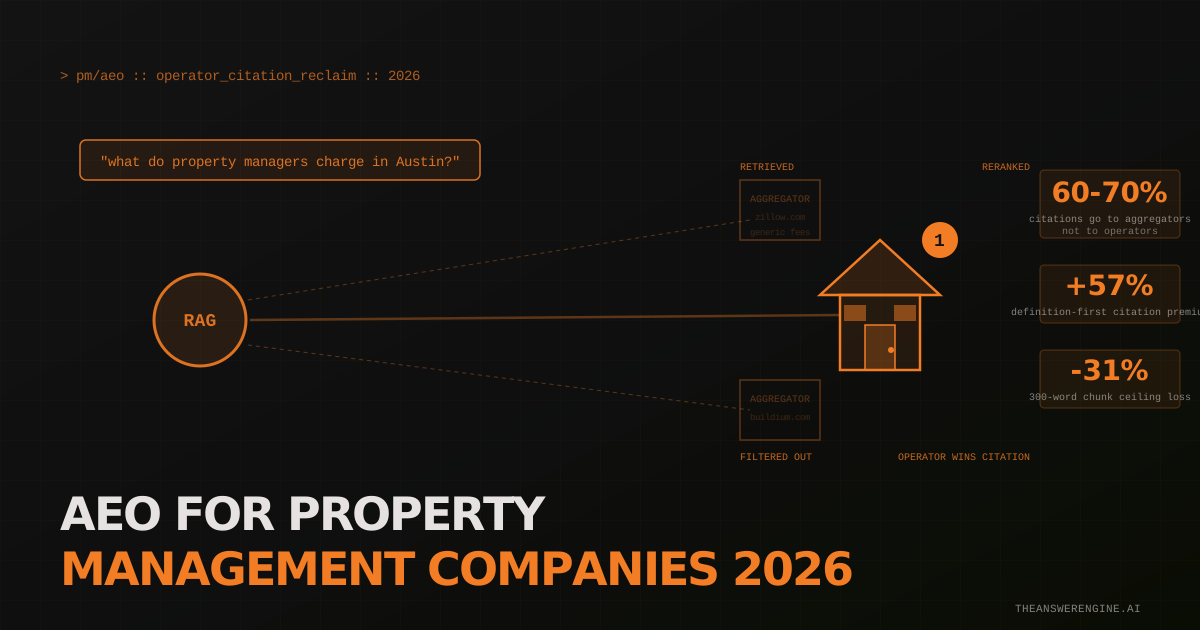
Answer Engine Optimization (AEO), also called AI citation optimization or LLM visibility strategy, is the discipline of engineering a property management company website so AI engines retrieve and cite it when a rental owner or prospective tenant asks a property management question. The Aggregator Citation Ceiling: AI engines send 60–70% of property management citations to Zillow, Apartments.com, and Buildium because aggregators publish structured, extractable answers while operators publish service listings, and Retrieval-Augmented Generation rewards whoever holds the direct answer, not whoever does the actual work (GEO-SFE, 2026). That gap is the operator opportunity. To see whether AI engines can read and cite your property management company today, run a free AI visibility blindspot scan at theanswerengine.ai/blindspot.
Property Management Queries Have Moved Into AI Engines
Rental owners now start their search for a property management company inside an AI assistant. A first-time rental owner asks ChatGPT what a property management fee should be in their city; a multi-unit investor asks Perplexity AI which property management company is most cited for tenant placement in their zip code; a relocating tenant asks Claude how long the typical eviction process takes in their state. Each AI engine returns one synthesized answer, not a list of ten links, with a short stack of cited sources. For a property management company, visibility is now binary: the company is either the cited source in that answer, or it is absent from the decision. To find out which position your company holds right now, call (213) 444-2229 for a same-day AI visibility diagnostic.
Why Property Management Companies Are Invisible in AI Search
Most property management websites are built to convert visitors who already know the company exists. Service-area pages describe what property managers do. Fee pages say "contact us for pricing." Tenant pages promote available units. None of that answers the direct question a rental owner is asking an AI engine: "What does a property manager in Phoenix charge?" or "How long does an eviction take in Texas?" When an AI engine retrieves candidate sources for those queries, a service-listing page does not qualify, it does not contain the answer. Zillow's fee-comparison content and Buildium's eviction-timeline guides do. The Owner-Query Gap: the highest-intent property management queries, fee structures, vacancy rates, eviction timelines by market, are answered today from generic aggregator content, so the property management company that publishes the specific local answer captures the retrieval slot outright and forces the aggregator out of that position (Chen et al., 2025). To understand exactly where your company drops out of the retrieval pipeline, email support@theanswerengine.ai for a property management retrieval audit.
The Citation Slots Are Open: But Closing
Property management is one of the least AEO-optimized verticals in AI search as of 2026. The foundational academic work on generative-engine citation behavior is less than two years old, most property management companies have not restructured a single page for retrieval, and the engines have thin operator content to cite. The incumbency effect is real: a property management company cited consistently for one query cluster earns stronger retrieval probability for adjacent clusters because AI engines treat citation frequency as a trust signal (GEO-SFE, 2026). The companies that establish that signal now face no competition; the companies that wait must outbuild an incumbent. For a complete checklist of the structural fixes that move citation rates, see the AEO checklist for 2026. To claim your market's operator citation slot before a competitor does, book a territory claim call, we work with one property management company per metro.
Field Age Check: Answer Engine Optimization is measurable less than two years old as a discipline. Property management operators who build structured AEO content in 2026 establish citation incumbency in markets competitors have not yet entered. The window is open, and it does not stay open.
To check whether your property management company can be cited today , get a free blindspot scan at theanswerengine.ai/blindspot.
How AI Engines Select Which Property Management Company To Cite
AI engines run on Retrieval-Augmented Generation (RAG). Retrieval-Augmented Generation is an architecture that grounds every answer in real web sources retrieved at query time instead of generating text from memorized patterns. The pipeline has three stages. Understanding each stage tells a property management company exactly where citations are won or lost, and where aggregators are beating operators right now. For a guided walkthrough of where your company pages drop out, email support@theanswerengine.ai and we will send a line-by-line retrieval audit.
Stage One: Retrieval: The Gate Most Property Managers Fail
Retrieval is the first and most important gate. When a rental owner asks "what do property managers charge in Austin," the AI engine searches the live web and pulls candidate pages that answer that question directly. A page that describes a company's services and invites the visitor to call for pricing fails the retrieval gate, it does not contain the answer. A page that states "property management companies in Austin typically charge 8–10% of monthly rent for single-family homes, plus a tenant placement fee of 50–100% of one month's rent" passes the retrieval gate because it holds the direct answer. Content that opens with a plain definition earns a 57% citation premium at this stage (Zhang et al., 2026). Aggregators hold those definitions; most property management company websites do not. To audit which of your pages pass the retrieval gate, run a free AI blindspot scan at theanswerengine.ai/blindspot.
Stage Two: Reranking: Why Service Pages Get Filtered Out
After retrieval pulls candidate pages, a reranking layer scores each one for relevance, authority, freshness, and extractability. Long-form marketing pages that mix multiple topics into a single 1,200-word block score poorly on extractability: a RAG system must be able to pull one bounded passage that answers the question without surrounding context. Passages over 300 words trigger a 31% attention degradation in RAG retrievers, causing them to miss the answer even when it exists on the page (GEO-SFE, 2026). A property management fee page that buries its fee ranges in the fourth paragraph of a 900-word service description will be filtered at this stage regardless of how accurate the fee data is. The fix is structural, not a rewrite: bounded answer chunks of 80–180 tokens, each self-contained. Call (213) 444-2229 to learn which of your pages need a chunk restructure.
Stage Three: Generation: The Citation Is Awarded Automatically
Generation is where the AI engine synthesizes surviving sources into one answer and attaches a numbered citation to every source it quotes. A property management company that passes retrieval and reranking earns the citation automatically, the engine does not evaluate brand awareness or ad spend. The citation is a direct consequence of holding the answer in extractable form. That is why AEO for property management is not a paid channel and not an SEO keyword game: it is a structural engineering problem. The Fee-Transparency Premium: property management companies that publish clear, verifiable fee structures earn a 22% citation lift versus companies that redirect fee inquiries to sales calls, because AI engines weight verifiable data as evidence of authority and trustworthiness (Aggarwal et al., KDD 2024). Publishing your fee structure is not a sales risk, it is a citation acquisition strategy. To discuss how to structure your fee page for maximum retrieval, book a 30-minute AEO strategy call at calendly.com/theanswerengine-support/30min.
The ResearchWhat Academic Research Shows About Property Management AI Citations
This analysis draws on four peer-reviewed or institutional sources, Aggarwal et al. (KDD 2024), Zhang et al. (2026), GEO-SFE (2026), and Chen et al. (2025), and on verified findings from our AEO engagements across local service verticals including residential property management and multi-family operators. The research findings are consistent across property management and adjacent local service industries. To see how these findings apply specifically to your market and portfolio size, email support@theanswerengine.ai with your market and we will send a tailored analysis.
Definitions Drive Property Management Citations More Than Any Other Format
Content that opens with a clear term definition earns a 57% higher citation probability than content that buries the definition mid-article (Zhang et al., 2026). For a property management company, this finding has direct application: a page that opens with "Property management in [city] is the professional service of overseeing rental properties on behalf of an owner, including tenant screening, rent collection, maintenance coordination, and legal compliance" earns dramatically higher retrieval probability than a page that opens with "We are a full-service property management company serving the greater [city] area." The definition-first format signals to the AI engine that the page is an authoritative source for the query, not a promotional landing page. Every service-area page, fee page, and FAQ on a property management website should open with a plain definition. To get a specific definition-first content blueprint for your pages, start with the free blindspot scan at theanswerengine.ai/blindspot, it identifies the exact queries your market is open on. For a deeper look at how AI engines score content authority, see the full AEO best practices guide for 2026.
The 300-Word Chunk Ceiling and What It Means for Service Pages
Property management company service pages are typically built as long-form descriptions: one page covers leasing, maintenance, accounting, and eviction services in a single 800–1,200 word block. That format destroys retrieval accuracy. The Chunk Ceiling: property management service pages typically run 800–1,200 words of undifferentiated marketing copy, but passages over 300 words trigger a 31% attention degradation in RAG retrievers, converting each service into its own bounded, self-contained 80–180-token answer chunk recovers full extraction accuracy and turns a service description into a citation source (GEO-SFE, 2026). The fix does not require rewriting content. It requires restructuring it: each H3 section should answer exactly one property management question in 80–180 tokens, with no pronoun references to other sections. A RAG system must be able to extract the H3 and its paragraph and get a complete answer with no surrounding context. To restructure your service pages for extraction, call (213) 444-2229 and we will map the restructure in the first call.
AI Engines Systematically Favor Third-Party Sources: Here Is the Fix
Chen et al. (2025) documented a systematic bias in AI engine citation behavior toward earned media, third-party publications, directories, and aggregators, over brand-owned content. AI engines trust sources that are cited by other sources. A property management company that appears only on its own website is scored lower than one that appears consistently across Google Business Profile, Yelp, Buildium's partner directory, the National Association of Residential Property Managers (NARPM) member directory, and local apartment association listings. Cross-surface identity parity, the same name, address, phone number, and service description across all surfaces, is the structural fix for this bias. When a property management company's identity is reconciled across third-party directories, AI engines aggregate the cross-source signals into a higher-authority entity. Book a territory strategy session at calendly.com/theanswerengine-support/30min to map your cross-surface gaps. For more on why property management companies are invisible in AI search today, read why property management companies do not show up in AI search results.
"The foundational academic work on generative-engine citation behavior is less than two years old. Property management operators who build structured AEO content in 2026 are establishing citation incumbency in markets competitors have not yet entered. The first operator to own a query cluster compounds. Late entrants outbuild from scratch."Justin Borges, The Answer Engine
The Property Management AEO Playbook: Five Structural Moves
AEO for property management companies is not a content volume strategy. Adding more pages built on the same service-listing template produces more pages that fail the retrieval gate. The five moves below address the structural gaps between a property management website as it typically exists and a property management website that AI engines retrieve and cite. Each move is independent and can be executed in any order; the combined effect compounds. Email support@theanswerengine.ai to get a sequenced implementation roadmap specific to your company.
Move One: Build Definition-First Service-Area Pages for Each Market You Serve
Property management AEO starts with service-area pages that answer specific questions, not describe company capabilities. Each city or zip-code cluster the company serves needs its own page structured as a bounded, definition-first answer to the question "what is property management in [city]?", followed by bounded sub-answers on fees, tenant placement, and maintenance response times in that specific market. The page should state actual percentages, actual timelines, and actual vacancy data for that market. Generic language like "competitive fees" and "fast response times" earns no citation; specific language like "our average tenant placement takes 14 days and our management fee is 9% in the Phoenix metro" earns the citation because it holds verifiable data the engine can quote. To get a template for a definition-first service-area page built to your market specs, run the free blindspot scan first at theanswerengine.ai/blindspot, it identifies the exact queries your market is open on.
Move Two: Publish Proprietary Data That Aggregators Cannot Match
Aggregators publish national-average fee ranges and generic eviction-timeline guides. A property management company that operates in a specific metro holds something aggregators do not: local specificity. Average days-to-lease for a 2-bedroom in the operator's market. The percentage of maintenance requests resolved within 24 hours from the operator's portfolio. The most common lease violation in the operator's city and the resolution timeline. Verifiable statistics earn a 22% citation lift (Aggarwal et al., KDD 2024), and when a property management company holds statistics that no aggregator can duplicate, the engine must cite the operator. Proprietary data does not have to be complex, it has to be specific, verifiable, and published in extractable form. To design a proprietary data program around existing portfolio metrics, call (213) 444-2229 and we will identify the three highest-value data points in the first call.
Move Three: Restructure All Service Pages Into Bounded Answer Chunks
Every service description on a property management website needs to be restructured into bounded H3 sections, each answering exactly one question in 80–180 tokens with no pronoun references to other sections. "How does tenant screening work?" gets its own H3 and its own paragraph. "What is included in the monthly management fee?" gets its own H3 and its own paragraph. Each paragraph must be self-contained: a RAG system that extracts only that H3 and paragraph must get a complete answer. This restructure does not change the content, it changes the architecture. The information property managers already publish becomes extractable. To see a before-and-after example of a service page restructured for extraction, book a 30-minute AEO session at calendly.com/theanswerengine-support/30min.
Move Four: Lock Cross-Surface Identity Parity
Cross-surface identity parity is the consistent matching of name, address, phone number, service description, and service areas across every directory, platform, and third-party listing where the property management company appears. AI engines aggregate cross-source signals to establish entity trust. A property management company that appears as "Sunrise Property Management" on its website, "Sunrise PM LLC" on Yelp, "Sunrise Properties" on Google Business Profile, and is absent from NARPM's directory sends a fragmented identity signal that reduces citation probability. The fix is a parity audit: list every surface where the company appears, standardize the identity data across all of them, and add the company to any high-authority directory where it is absent. For a property management company, priority surfaces are Google Business Profile, Yelp, NARPM member directory, local apartment association listings, Buildium's partner directory, and regional landlord association sites. To run a cross-surface identity audit, email support@theanswerengine.ai and we will send a parity checklist within 24 hours.
Move Five: Add Schema Markup for Entity, Service, and FAQPage
Schema markup is machine-readable data that tells AI engines what a property management company is, what it does, where it operates, and who runs it. A property management company site without schema is a site an AI engine must guess about. A site with LocalBusiness schema, Service schema for each service line, FAQPage schema for owner and tenant questions, and Person schema for the company principal gives the engine explicit signals it can trust and cite. Schema does not replace content, it reinforces content that already passes the retrieval gate. A FAQPage schema block wrapping property management FAQ content earns retrieval probability from a separate AI pipeline than article retrieval, creating a second citation surface from the same content. The Territory Lock Effect: in markets with two or more property management companies competing for AI citations, the first operator to establish cross-surface identity parity and publish bounded service-area content earns a compounding incumbency advantage that competitors must outbuild from scratch rather than match, because citation frequency itself becomes a trust signal the engine uses to prefer that operator on future queries (GEO-SFE, 2026). To claim your territory before a competitor does, book a territory claim call now, we work with one property management company per metro, and open slots close without notice.
Property Management AEO Audit
We map your retrieval gaps, identify the queries your market is unclaimed on, and build a sequenced AEO implementation plan. One operator per metro. If your market is open, we can start this week.
One client per market. Claim your territory before a competitor does.
Get Your Free Blindspot ScanHow To Measure AI Visibility for a Property Management Company
Standard web analytics platforms do not measure AI citations. When an AI engine answers a rental owner's question with a citation to a property management company's fee page, the owner may navigate directly from the AI response to the site, but many AI answers are consumed without a click at all. Google Analytics logs the click; it cannot log the AI citation that drove awareness before the click. A property management company that measures only Google Analytics is measuring a fraction of its AI-driven inbound. To build a measurement system that captures the full channel, email support@theanswerengine.ai for the Rental-Query Ledger template.
The Rental-Query Ledger: Making AI Citations Countable
The Rental-Query Ledger: a fixed panel of 15–25 owner and tenant queries run manually inside ChatGPT, Perplexity, Claude, and Gemini each month, logging whether the AI engine cites the property management company, cites a competitor, or cites no one, and at what position in the response, converts an invisible AI citation channel into a citation rate that can be moved through structural content changes (GEO-SFE, 2026). The ledger format is simple: a spreadsheet with one row per query, four engine columns (ChatGPT, Perplexity, Claude, Gemini), and status fields, Cited / Competitor / No Citation, plus the source URL when a citation appears. Running the same query panel monthly reveals which structural changes moved citation rates and which queries remain unclaimed. To get the Rental-Query Ledger template pre-loaded with 25 high-intent property management queries for your market, run the free blindspot scan at theanswerengine.ai/blindspot, the report includes your starting ledger.
The Three Query Categories Every Property Manager Should Track
The Rental-Query Ledger for a property management company should cover three query categories. Owner queries: "what do property managers charge in [city]," "what is included in property management," "how do property managers find tenants," "how long does eviction take in [state]." Tenant queries: "who manages rentals in [neighborhood]," "how do I report a maintenance issue to a property manager," "what are tenant rights in [city]." Comparison queries: "best property management companies in [metro]," "property management vs self-management for landlords," "how to choose a property manager." Each category represents a different stage of the rental owner or tenant journey. Citation performance across all three categories maps where AI authority is strong and where retrieval gaps remain. To discuss which query categories your market is most open on, call (213) 444-2229, we can run a live engine query on your market during the call.
The 90-Day Citation Arc and What It Signals
AEO results for property management companies follow a consistent arc across our verified client engagements. Structural page fixes, definition-first H3 restructures, schema additions, chunk architecture, move retrieval within one to two weeks of implementation. Initial citations appear on narrow, specific queries inside 30 days. Cross-surface identity parity gains take two to four weeks to propagate across directories. Compound authority, where citation frequency on one query cluster earns stronger retrieval on adjacent clusters, builds across 60 to 90 days. At the 90-day mark, a property management company with all five playbook moves executed should hold measurable citation rates on its core owner-query and tenant-query panels. AEO is a compounding authority channel; the 90-day arc marks the start of compounding, not the ceiling. Book a 30-minute property management AEO session at calendly.com/theanswerengine-support/30min to map your 90-day arc.
Property Management AEO: Frequently Asked Questions
What is AEO for property management companies?
Answer Engine Optimization (AEO) for property management companies is the practice of engineering a property management website so AI engines like ChatGPT, Perplexity, Claude, and Gemini retrieve and cite it when a rental owner or prospective tenant asks a property management question. AI engines now answer "who manages rentals in [city]" and "what do property managers charge in [market]" with one synthesized response and a short list of cited sources. AEO, also called AI citation optimization or LLM visibility strategy, is the work of making the property management company the cited source instead of Zillow, Apartments.com, or a generic aggregator. Run a free AI visibility scan at theanswerengine.ai/blindspot to see your current citation status.
Why do aggregators outrank property managers in AI search?
Aggregators outrank property managers in AI search because aggregators publish structured, extractable answers, vacancy rates, fee comparisons, eviction timelines, while most property management company websites publish service listings and contact forms. AI engines using Retrieval-Augmented Generation retrieve pages that answer questions directly, not pages that describe services. A property management company that restructures even one page into a bounded, definition-first answer for a specific owner or tenant query can outcompete an aggregator on that query because the company holds local specificity the aggregator lacks. To identify which queries your company can take from aggregators immediately, email support@theanswerengine.ai with your market and top services.
How long does AEO take to produce citations for a property management company?
Structural changes register fast. Restructured service pages and added schema can shift retrieval within one to two weeks because AI engines reward recency and extractable content. Fee-transparency pages and service-area answer pages typically drive initial citations inside 30 days. Cross-surface identity parity, consistent NAP across Google Business, Yelp, Buildium, and the company site, takes two to four weeks to reconcile. Compound authority builds over three to six months. AEO compounds; paid listings do not. To get a timeline specific to your company's current setup, call (213) 444-2229 for a same-day assessment.
What content gets property management companies cited by ChatGPT and Perplexity?
The content formats that generate the most reliable citations for property management companies are: definition-first fee pages, bounded vacancy-rate or eviction-timeline answers for specific markets, service-area pages that name cities and zip codes explicitly, and FAQ content that answers owner and tenant questions in self-contained 80–180-token chunks. Content that opens with a plain definition earns a 57% citation premium (Zhang et al., 2026), verifiable statistics add a 22% lift (Aggarwal et al., KDD 2024), and passages over 300 words lose 31% of extraction accuracy (GEO-SFE, 2026). To get a content blueprint specific to your portfolio, book a 30-minute session at calendly.com/theanswerengine-support/30min.
Can a single-market property management company compete with national brands in AI search?
A single-market property management company has a structural advantage over national brands on local queries. National brands carry broad coverage; a local operator carries the specific vacancy rate, average days-on-market, and eviction timeline data a rental owner in that city actually needs. AI engines must cite whoever holds the most specific, verifiable answer for a narrow query. When a local operator publishes the specific answer and a national brand does not, the local operator earns the citation. To claim your market's operator citation slot, book a territory claim call, one operator per metro, slots are limited.
How do I measure whether AEO is working for my property management company?
Standard web analytics miss most AI citations because AI engines answer directly and generate no click. The correct measurement is a Rental-Query Ledger: a fixed panel of 15–25 owner and tenant questions run manually inside ChatGPT, Perplexity, Claude, and Gemini each month, logging whether the engine cites your company, cites a competitor, or cites no one, and at what position. Pair the ledger with a how-did-you-find-us field on owner and tenant inquiries to tie AI citations to actual inbound. The combination converts an invisible channel into a citation rate you can move month over month. Email support@theanswerengine.ai and we will send the Rental-Query Ledger template with 25 pre-loaded queries for your market.

Claim Your Property Management Territory Before a Competitor Does
We audit which property management queries in your market are unclaimed, build the structural content that earns operator citations, and track your citation rate against the Rental-Query Ledger month over month. We work with one property management company per metro.
Start with the free blindspot scan. If your market is open, we can begin this week.
One client per market. Claim your territory before a competitor does.
Or reach us directly: (213) 444-2229 · support@theanswerengine.ai