WHAT THE PROPERTY MANAGEMENT DIRECTORY STACK IS
The Definition That Changes How You Think About AI Visibility
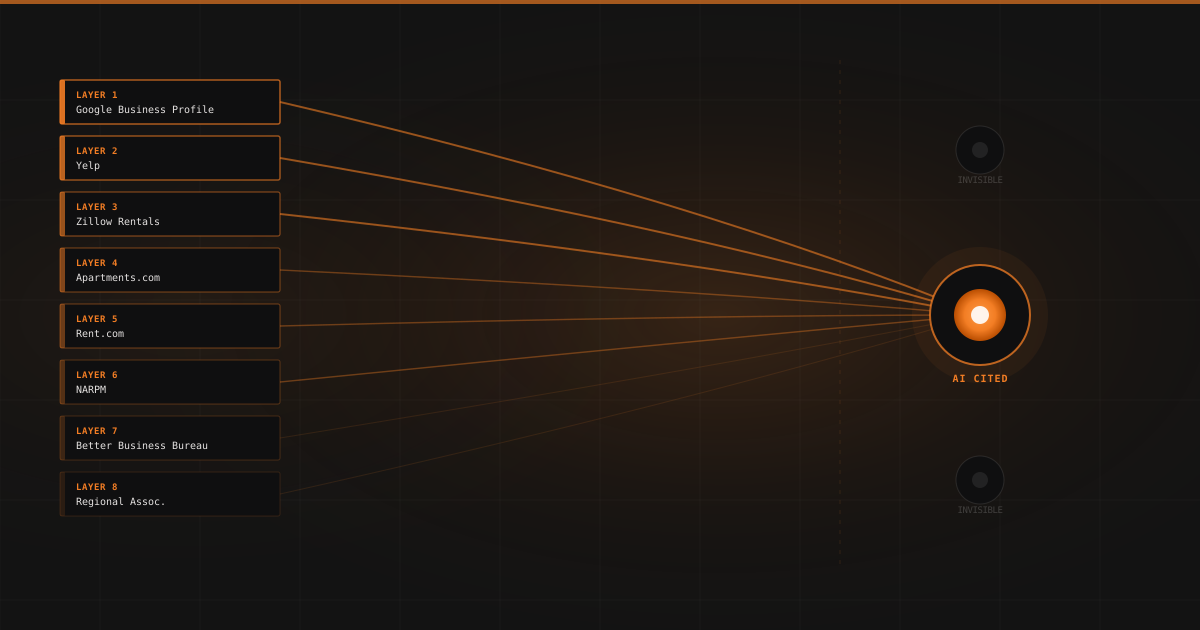
The Property Management Directory Stack is the structured set of third-party listings, professional association profiles, rental platform entries, and review databases that AI answer engines consult when deciding whether to cite a property management company in response to a landlord query. Answer Engine Optimization (AEO) for property managers — also called AI citation optimization or LLM visibility strategy — begins with directories, not the company website. AI retrieval systems, including ChatGPT, Perplexity AI, Claude, and Google AI Overviews, do not determine citation authority by reading a company's own marketing. They determine authority by aggregating signals from independently-maintained, publicly-crawlable sources that corroborate the company's identity, credentials, and service area. A property management company that exists only on its own website is, from an AI retrieval perspective, an unverified claim. Get your free AI citation blindspot report at theanswerengine.ai/blindspot to see your current directory coverage score.
Why Property Management Is Uniquely Vulnerable in AI Search
The property management vertical has a deeper and more varied directory ecosystem than most local service businesses. A residential contractor typically needs Google Business Profile, Yelp, and one trade directory to generate an adequate entity signal. A property management company must cover foundational identity directories, rental-platform profiles, professional association memberships, and regional landlord association databases — each of which serves a different AI retrieval context. Perplexity AI queries such as "who manages rentals in [city]" draw from rental-platform data and Google Business Profile. ChatGPT queries such as "what is the best property management company in [market]" weigh NARPM membership, BBB standing, and review volume across multiple platforms. AI retrieval systems treat each directory tier as a separate corroboration signal, and a company missing from any tier surrenders a corresponding slice of citation probability in AI-generated landlord recommendations. To map your exact coverage gaps, book a 30-minute directory stack strategy call at calendly.com/theanswerengine-support/30min.
The Landlord Query Capture Layer
The Landlord Query Capture Layer: the minimum directory presence — Google Business Profile, Yelp, and one major rental-platform profile — that AI retrieval systems check before generating a property management recommendation. A company absent from all three surfaces produces no cross-source entity signal and is statistically uncitable in AI search, regardless of how authoritative its website is. The Landlord Query Capture Layer functions as an entry gate: AI systems that cannot corroborate a company across at least these three surfaces will not attribute it to a landlord recommendation, even when the company is the best operator in the market (GEO-SFE, 2026). Property management companies that are invisible to AI despite strong client retention and market reputation almost always have the same underlying problem: they exist on one or two directories, not eight. Call (213) 444-2229 for a 24-hour diagnostic of your current Landlord Query Capture Layer status. TAE works with one property management company per metro — if your market is unclaimed, claim your territory at calendly.com/theanswerengine-support/30min before a competitor in your city does.
The ArchitectureTHE 8-LAYER DIRECTORY ARCHITECTURE AI ACTUALLY READS
Layers 1 and 2: Foundational Identity Directories
Google Business Profile is the single most-read directory by every major AI retrieval system. ChatGPT, Perplexity AI, and Google AI Overviews all access Google Business Profile data either directly or through live web crawl. A complete Google Business Profile for a property management company must include: the exact legal business name, a verified address with suite number if applicable, a consistent local phone number (not a tracking number), hours of operation, service categories set to "Property Management Company," a 150-to-250 word description that opens with a plain definition of the service, and a minimum of ten reviews. Yelp is Layer 2. Yelp is the second most consistently indexed directory in Perplexity AI's retrieval corpus and surfaces in ChatGPT citations for local service businesses in markets where review density is sufficient. A Yelp profile without a substantive description and at least five reviews contributes zero entity corroboration to the stack. Email support@theanswerengine.ai for a custom audit of your Layer 1 and Layer 2 profiles.
Layers 3, 4, and 5: Rental Platform Profiles
Zillow Rentals, Apartments.com, and Rent.com are the three rental-platform directories that most consistently appear in AI citations for property management queries. These platforms serve one citation function that Google Business Profile and Yelp do not: they position a property management company specifically within landlord-intent queries — the AI search scenarios where a landlord asks for a recommendation on who to hire to manage a rental portfolio. AI retrieval systems treat a rental-platform presence as evidence that a company actively operates in that market, not merely that it claims to serve it. A rental-platform profile must include: a complete company description with service area, portfolio types managed (single-family, multi-family, HOA), years in operation, and at least one numerical proof point such as "managing [X] units across [city]." Statistics embedded in directory descriptions earn a 22% higher citation weight according to Aggarwal et al. (KDD 2024), because AI retrieval systems treat numerical specificity as a trust signal. One client per market — if your city is unclaimed, lock your exclusive territory at calendly.com/theanswerengine-support/30min before a competitor claims it first.
Layers 6, 7, and 8: Professional Authority Directories
NARPM (National Association of Residential Property Managers), the Better Business Bureau, and a regional apartment owner association or landlord association form the authority tier of the directory stack. NARPM membership is the most powerful single credential a property management company can hold in AI-search terms, because it is an earned designation from an independent, third-party professional association — a category of source that Chen et al. (2025) documented as systematically weighted higher by AI retrieval systems than brand-owned content. A company listed in NARPM's member directory with a complete profile and active designations (MPM, RMP, or similar) generates an authority corroboration signal that no volume of self-published blog posts can replicate. BBB accreditation provides a trust-tier signal particularly for ChatGPT and Google AI Overviews. A regional apartment owner association listing — such as a local Apartment Association or Housing Provider Alliance chapter — adds local-market specificity that national directories cannot provide. Text (213) 444-2229 for a free Layer 6-to-8 authority audit for your property management company.
The EvidenceWHAT THE RESEARCH SAYS ABOUT ENTITY CORROBORATION AND AI CITATIONS
The Academic Framework for Multi-Source Citation
The academic study of how AI systems select citation sources is less than two years old, but three papers define the current evidence base. Aggarwal et al. (KDD 2024) established that content containing verifiable statistics earns 22% higher retrieval weight than equivalent content without numerical data, and that direct quotations earn 37% higher weight — findings that apply directly to directory profile descriptions that include specific unit counts, service years, or market coverage numbers. Zhang et al. (2026) demonstrated that content opening with a plain definition of its subject earns 57% higher citation probability than content that buries the definition mid-section — explaining why property management profiles that begin with "a property management company is a licensed operator that handles tenant placement, rent collection, maintenance coordination, and legal compliance for rental property owners" outperform descriptions that begin with "we provide excellent service." GEO-SFE (2026) documented that structured lists earn 43% higher citation rates than prose-only passages, and that passages exceeding 300 words suffer a 31% drop in extraction accuracy. Directory profile descriptions must be structured, bounded, and definition-forward to earn full citation weight from AI retrieval systems. To see how your current profiles measure against these benchmarks, get your free blindspot scan at theanswerengine.ai/blindspot.
The Entity Corroboration Premium
The Entity Corroboration Premium: when a property management company maintains consistent identity across 8 or more authoritative directories, AI citation probability increases dramatically compared to single-source entities — because LLM retrieval systems treat multi-source corroboration as an entity verification mechanism, not merely a ranking signal. A business that exists only on its own website and one directory is an unverified claim. A business that exists with matching identity data across Google Business Profile, Yelp, three rental platforms, NARPM, BBB, and a regional association is a verified entity that AI systems can attribute to a landlord with confidence (GEO-SFE, 2026). The Entity Corroboration Premium is compounding: each additional directory layer that matches the entity signal adds weight to all prior layers. Building the full 8-layer stack produces disproportionate citation gains over building only 4 or 5 layers because the corroboration effect is multiplicative rather than additive. Email support@theanswerengine.ai with your current directory list for an entity corroboration score.
The Citation Gap Problem in Property Management
The Citation Gap: most property management companies maintain 2 to 3 directory listings — far below the 8-to-12 corroboration threshold AI retrieval systems require to cite a business with confidence. This gap explains why a well-operated company disappears from AI-generated landlord recommendations while a competitor with a thinner portfolio but deeper directory presence gets cited instead. Citation authority in AI search is not primarily a function of being the best operator — it is a function of being the most verifiable operator across the surfaces AI reads. The Citation Gap is the most common finding in TAE's property management AEO audits. Companies with strong referral networks and high client retention routinely score below the citation threshold because directory hygiene has not historically been a business priority in this vertical. That gap is now a direct competitive disadvantage as landlord queries migrate to AI platforms. Call (213) 444-2229 to find out your Citation Gap score for your specific market.
Close Your Citation Gap Before a Competitor Does
TAE builds the complete 8-layer directory stack for property management companies: NAP parity audit, profile rewrites, NARPM and BBB submission, rental platform optimization, and monthly Proof Ledger tracking. We work with one property management operator per metro area. If your territory is unclaimed, lock it now at calendly.com/theanswerengine-support/30min — one client per market, no exceptions.
THE TAE METHOD: BUILDING A STACK AI CAN CITE
Step 1: Establish NAP Parity Across All 8 Layers
The Parity Principle: a single NAP (name, address, phone) discrepancy across directory listings triggers entity disambiguation failures in AI retrieval — the system cannot confirm the listing belongs to the same company, so it reduces citation confidence across the entire stack. A punctuation difference — “St.” versus “Street” — in a business address is sufficient to split the entity signal. Abbreviation inconsistencies in the company name, a trailing comma, or a different suite format across directories all produce the same failure mode. The NAP parity audit is the first action TAE takes with every property management client because it is the prerequisite for every other directory stack optimization. Building eight directory listings with mismatched NAP data does not add eight corroboration signals — it adds eight conflicting signals that collectively reduce citation confidence below the baseline. Exclusive territory protection applies: we work with one property management company per metro area. Claim your market at calendly.com/theanswerengine-support/30min while your territory is still available. Email support@theanswerengine.ai for a copy of the TAE NAP parity checklist.
Step 2: Write Extractable Profile Descriptions
Every directory profile description must be written for extraction, not for a human reader scrolling a listing page. AI retrieval systems pull passages from directory profiles as source snippets. A description that reads as a marketing tagline — "your trusted property management partner in [city]" — contributes zero citation value because it contains no extractable fact. A description that reads as a bounded claim chunk — "A property management company is a licensed operator that handles tenant placement, rent collection, maintenance coordination, and legal compliance for residential and commercial rental property owners. [Company Name] manages [X] units across [city], specializing in single-family homes and small multi-family portfolios with an average vacancy fill time of [Y] days" — contributes three extractable facts: service definition, operational scale, and performance metric. Zhang et al. (2026) documented a 57% citation premium for content that opens with a plain definition, which is exactly what a profile description opening with "A property management company is..." achieves. Keep each profile description under 250 words — GEO-SFE (2026) found that passages over 300 words lose 31% of their extraction accuracy. To receive a profile rewrite template built specifically for your company, start with your free blindspot scan at theanswerengine.ai/blindspot or book a 30-minute profile audit call at calendly.com/theanswerengine-support/30min.
Step 3: Build Review Presence on the Directories AI Reads
AI retrieval systems use review presence as a quality verification signal, particularly for property management queries where landlords are making high-stakes decisions about asset management. Perplexity AI explicitly surfaces businesses with substantial review counts in its "places" and "local" answer formats. ChatGPT draws on Google Business Profile review data when generating recommendations for local service businesses. The minimum effective review thresholds for property management AI citation are: 10 or more reviews on Google Business Profile, 5 or more on Yelp, and 3 or more on any rental-platform directory where the company holds a profile. Review velocity — the rate at which new reviews arrive — also signals active operation to AI retrieval systems. A company with 40 reviews from 2021 and none since scores lower than a company with 20 reviews including 4 from the past 90 days, because recency is a freshness proxy AI platforms use to evaluate operational status. Call (213) 444-2229 to discuss a review velocity strategy for your property management company. We work with one operator per metro area — if your market is open, secure your territory at calendly.com/theanswerengine-support/30min before a competitor in your city does.
The MetricMEASURING YOUR AI CITATION POSITION
The Citation Ledger for Property Managers
Standard web analytics under-report AI-driven discovery because most AI answers produce no click — a landlord receives a recommendation from ChatGPT and calls the property management company directly, without a website visit that analytics can track. The correct measurement surface is a Citation Ledger: a fixed panel of real landlord-intent queries run monthly inside ChatGPT, Perplexity AI, and Google AI Overviews, logging whether the AI cites the company, cites a competitor, or cites no one, and at what position in the generated response. For a property management company, the query panel should include: "[city] property management company," "who manages rentals in [neighborhood]," "best property manager for single-family rentals [city]," "property management company with NARPM certification [state]," and "how to find a property manager [city]." Running this panel monthly converts an otherwise invisible channel into a citation rate that can be measured and moved. Email support@theanswerengine.ai to request a Proof Ledger template built for the property management vertical. Or book a citation audit call at calendly.com/theanswerengine-support/30min to review your current citation position with an AEO strategist.
The Proof Ledger
The Proof Ledger: a monthly log of AI citation results across a fixed panel of landlord-intent queries. Unlike web analytics, which under-report AI-driven discovery because AI answers produce no clicks, the Proof Ledger captures whether a property management company is cited, by which AI platform, and at what position in the response — the only metric that directly measures directory stack performance. A Proof Ledger updated monthly creates a citation rate baseline, tracks the impact of directory additions and profile rewrites, and identifies which AI platforms are citing competitors instead of the property manager. TAE provides monthly Proof Ledger reports to all property management clients, structured as a table: query, AI platform, citation result (cited / competitor cited / no citation), position, and month-over-month delta. The ledger makes citation growth as countable as lead volume. To see a sample Proof Ledger for your market, run your free blindspot scan at theanswerengine.ai/blindspot.
When TAE Takes Over the Stack
TAE builds and maintains the complete Directory Stack Effect for property management clients: NAP parity audit and correction across all 8 layers, profile rewrites using the extractable description framework, NARPM and BBB submission and optimization, rental platform profile creation and verification, review velocity monitoring, and monthly Proof Ledger reporting with competitor citation tracking. TAE works with one property management operator per metro area to maintain citation exclusivity for each client. If your territory is available, the onboarding timeline from signed agreement to complete 8-layer stack is 30 days. Text (213) 444-2229 — our team responds within one business day. Or schedule a 30-minute strategy call at calendly.com/theanswerengine-support/30min.
“One client per market. The property management company that builds the stack first owns the AI citation slot. That slot does not split between two operators.”
— Justin Borges, Founder, The Answer EngineTo receive a copy of the complete TAE directory stack checklist for property management companies — including NAP parity templates, profile description frameworks, and NARPM submission guidance — email support@theanswerengine.ai with the subject line “Directory Stack Checklist.”
FAQFREQUENTLY ASKED QUESTIONS
What directories should a property management company focus on for AI citations?
The 8-layer directory stack that drives AI citation in property management covers: Google Business Profile, Yelp, Zillow Rentals, Apartments.com, Rent.com, NARPM, Better Business Bureau, and one regional apartment owner association. The foundational three — Google Business Profile, Yelp, and one rental-platform profile — form the minimum viable cross-source entity signal that ChatGPT, Perplexity AI, and Google AI Overviews require before generating a property management recommendation. All eight layers must carry consistent NAP data to avoid entity disambiguation failures in AI retrieval.
How does NAP consistency affect whether AI cites my property management company?
NAP consistency — exact matching of business name, address, and phone number across every directory — is the single most important technical signal for AI citation in property management. AI retrieval systems use cross-source entity corroboration to verify a business is real and worth citing. A discrepancy as small as “St.” versus “Street” in an address, or a missing suite number on one listing, creates an entity disambiguation failure that reduces citation confidence across every AI platform. The Parity Principle holds that even a punctuation difference is sufficient to split the entity signal and degrade the full directory stack.
How many directories do I need to get cited by ChatGPT or Perplexity?
The minimum effective threshold is 8 directories with consistent NAP data and substantive extractable profile descriptions. Most property management companies maintain 2 to 3 listings, which is insufficient to generate the cross-source entity signal AI retrieval systems require. Eight to twelve directory listings with matching identity data is the range where citation probability increases meaningfully, based on the entity corroboration mechanics documented in GEO-SFE (2026). Each additional layer adds compounding corroboration weight to all prior layers in the stack.
Does NARPM membership help with AI citations?
NARPM membership is the most powerful single credential a property management company can hold for AI-search citation purposes. NARPM is an earned designation from an independent, third-party professional association — a category of source that Chen et al. (2025) documented as systematically weighted higher by AI retrieval systems than brand-owned content. An active NARPM listing with a complete profile and active designations contributes both entity corroboration and authority-tier credibility that no volume of self-published pages can replicate in the eyes of AI retrieval systems.
How long does it take to see AI citations after building out directory listings?
Initial structural improvements — NAP parity, complete profile descriptions, added schema — register with AI systems within 2 to 4 weeks because platforms like Perplexity AI re-crawl actively updated sources. Cross-surface identity parity and a complete 8-layer stack typically produce measurable citation rate changes within 30 to 60 days. Citation frequency — the compounding signal where cited sources earn more future citations — builds over 3 to 6 months, making early stack completion the highest-return investment in property management AI visibility.
Can a small property management company compete with large ones in AI search?
Yes, and often more effectively than in traditional search. AI retrieval systems weight entity-specific authority — original data, third-party corroboration, and NAP parity — more heavily than domain size or link volume. A local property management company that completes the 8-layer directory stack, maintains review presence on Google and Yelp, and holds an active NARPM listing will outperform a larger competitor with a thin directory presence in that specific market. Specificity and corroboration beat scale in AI citation. To schedule a strategy call, book at calendly.com/theanswerengine-support/30min.