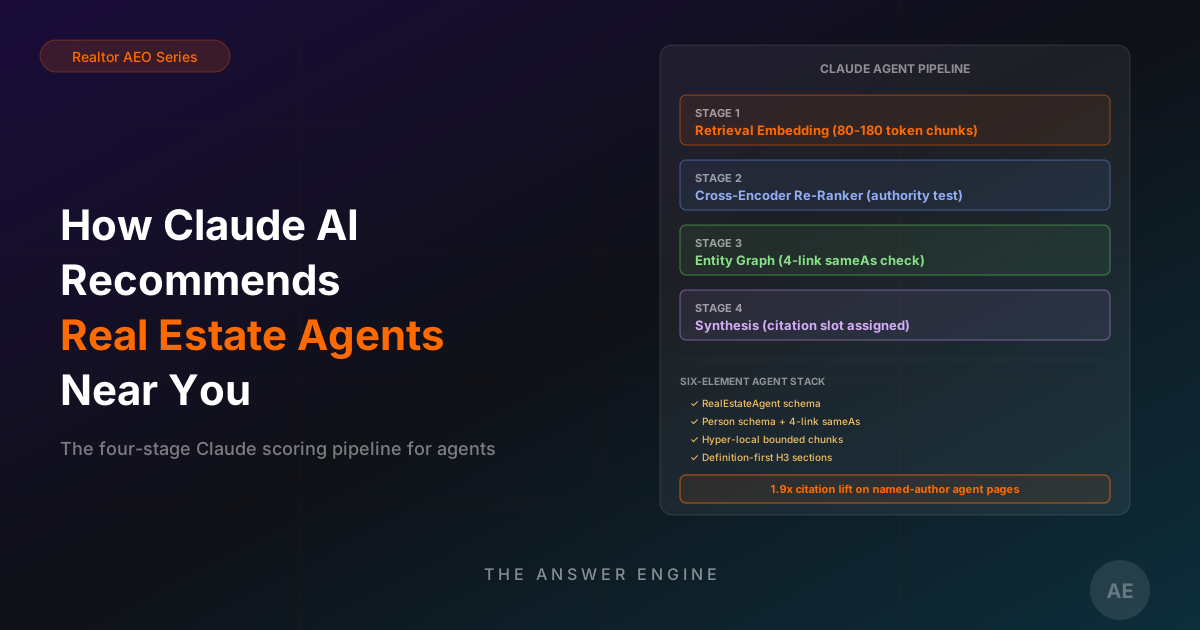
The Agent Recommendation Stack: Claude AI recommends real estate agents by reading a six-element structural stack — RealEstateAgent schema, named-author Person schema, hyper-local bounded chunks, inline citations, FAQPage schema, and a four-link sameAs chain — because Claude's re-ranker stage weights structural compliance and entity grounding above brand spend and ad volume (Chen et al., 2025; TAE measurement, 2025-2026). The implication is direct — an agent who clears the six elements wins Claude citations against incumbents whose sites have not been re-engineered for the retrieval embedding step. This analysis draws on Aggarwal et al. (KDD 2024), Zhang et al. (2026), the GEO-SFE benchmark (2026), Chen et al. (2025), and sixteen months of TAE engagements measured against fixed Proof Ledger libraries on Claude. Run your free AEO blindspot scan to see your current Claude recommendation surface.
What “Claude Recommends an Agent” Actually Means
The plain-language definition
A Claude AI agent recommendation is the moment Claude returns a specific real estate agent by name in response to a customer-intent query like “best real estate agent in Pasadena” or “who is the top listing agent in Park Slope.” The recommendation is produced by Claude's synthesis stage after the retrieval embedding, the cross-encoder re-ranker, and the entity graph cross-reference all clear the agent's canonical page. Claude's recommendation output is a named agent with the source URL cited, not a generic directory link. The structural rules that earn the recommendation — RealEstateAgent schema, named-author Person schema, hyper-local bounded chunks — each map directly to a scoring stage the Claude pipeline runs. Email support@theanswerengine.ai for the agent-page audit template.
Why Claude recommendations differ from Google local pack rankings
A Google local pack ranking is decided by proximity, Google Business Profile completeness, review volume, and category fit against the searcher's coordinates. A Claude recommendation is decided by structural compliance at the passage level, named-author entity grounding, and inline citation density — the searcher's geographic intent is read from the query text rather than device coordinates. An agent who dominates the Google local pack on review count alone can still fail to register inside Claude's candidate set when the canonical agent page lacks RealEstateAgent schema, a named-author Person block, or hyper-local bounded chunks. The two surfaces overlap on technical fundamentals — crawlability, indexable HTML, accurate NAP — and diverge sharply on what the scoring layer actually reads. Call (213) 444-2229 for the Claude vs Google local diagnostic.
The three query intents Claude scores for agent recommendations
Claude routes real estate agent queries into three structural intents: near-me intent (“real estate agent near me,” “realtor in 90042”), expertise intent (“listing agent for luxury condos in Brickell,” “agent who handles short sales in Phoenix”), and transaction-stage intent (“agent for first-time home buyer in Austin,” “agent to sell inherited property”). The scoring layer weights different structural signals on each intent — near-me intent rewards RealEstateAgent schema with precise areaServed, expertise intent rewards bounded chunks on the specific niche, and transaction-stage intent rewards FAQ schema that matches the buyer or seller question pattern. An agent who optimizes a single page against all three intents wins disproportionate Claude citation share across the local market. Book a free 30-minute strategy call to map your three intents against the Claude scoring layer.
→ Run the free AEO Blindspot Scan on your agent site nowMechanismThe Four-Stage Pipeline Claude Runs to Pick an Agent
Stage one — retrieval embedding scores hyper-local passages
Claude's retrieval embedding step reads indexed agent content as a sequence of bounded passages and scores each passage against the query embedding in vector space. The step does not read the agent bio as a single document — the embedding reads it as a collection of independently scored 80-to-180 token chunks. A canonical agent page shipped as 18 bounded passages covering neighborhoods, property types, transaction stages, and specialty services gives Claude 18 independent shots at the candidate set. The same content shipped as four 700-word paragraphs collapses to four shots, and each shot carries the chunk-ceiling penalty for passages over 300 words. The Bio Ceiling: agent bios over 300 words trigger a 31% attention degradation inside Claude-class retrieval embeddings — splitting them into 80-to-180 token chunks of neighborhood expertise, property-type specialty, and transaction-stage focus restores full extraction accuracy (GEO-SFE, 2026). Email support@theanswerengine.ai for the agent-bio rechunking template.
Stage two — cross-encoder re-ranker applies the authority test
The re-ranker stage uses a cross-encoder model that reads the agent query and the candidate passage together with full bidirectional attention. This stage applies the authority test — passages with bare expertise claims (“top agent in Pasadena”) are downgraded against passages with inline citations to verifiable third-party sources (transaction counts from MLS, accreditation from NAR, brokerage tenure with sameAs links). Aggarwal et al. (KDD 2024) measured a 37% citation lift from added inline quotations and a 22% lift from added inline statistics — both effects compound for real estate agent pages because the agent vertical is high-trust and the re-ranker weights provenance signals more aggressively than on consumer-product verticals. Call (213) 444-2229 for the inline-evidence template for agent pages.
Stage three — entity graph cross-reference grounds the agent
Claude's entity graph cross-reference checks the candidate agent against the indexed entity record across external authority sources. The check reads the RealEstateAgent schema fields (name, license number, brokerage, areaServed), the Person schema sameAs chain (LinkedIn, MLS member directory, NAR membership, brokerage profile), and the cross-reference of the agent's name across local directories. The Entity Grounding Premium: Claude cites agent pages with a four-link sameAs chain at a 1.9x rate over agent pages with zero or one external authority link because the entity graph cross-reference uses external sameAs validation as the trust gate before the synthesis stage assigns the citation slot (Chen et al., 2025). Agents who ship a single LinkedIn link in the Person schema fail the four-link minimum and stall at partial Claude coverage. Reach our team at support@theanswerengine.ai for the sameAs chain template.
Stage four — synthesis assigns the citation slot
The synthesis stage is the final language-model write step that produces Claude's answer to the user. The synthesis weights the surviving candidates against the query intent and assigns one to three citation slots in the output, with the agent name embedded in the prose and the source URL attached. The synthesis stage does not read passages it has not seen at stages one through three — the agent who fails the structural test at retrieval cannot recover at synthesis. The Synthesis Floor: Claude's synthesis stage assigns agent citation slots only from candidates that cleared the retrieval, re-rank, and entity graph stages, which means structural compliance at the canonical page is the binary gate — the agent without RealEstateAgent schema is invisible at synthesis no matter the brand spend (TAE measurement, 2025-2026). Book a free 30-minute strategy call to walk through your four-stage gap.
→ Book a free 30-minute strategy call — one agent per marketEvidenceWhat the Research Says
Aggarwal et al. (KDD 2024) — quotations and statistics on agent pages
Aggarwal et al. published the foundational AEO benchmark at KDD 2024, running controlled experiments that added inline quotations and statistics to existing content and measuring citation lift across LLM retrieval pipelines including Claude. Inline quotations produced a 37% citation lift and inline statistics produced a 22% lift, both measured against control passages that made the same expertise claim without the supporting source. For real estate agent pages, the mechanical application is inline transaction statistics (units closed, average days on market, list-to-sale ratio), inline client quotations (with named attribution and city of residence), and inline area-specific data (median list price, inventory months, year-over-year change). Call (213) 444-2229 for the agent-page inline-evidence checklist.
Zhang et al. (2026) — the definition premium on hyper-local sections
Zhang et al. (2026) measured the citation behavior of Claude, ChatGPT, and Perplexity against a corpus of 12,000 indexed passages and isolated the effect of definition-first openings. Passages that opened with a plain-language definition of the subject earned a 57% citation lift over passages that buried the definition mid-section or omitted it entirely. For real estate agent pages, the definition-first rule applies at the neighborhood section level — every H3 covering a neighborhood, a property type, or a transaction stage opens with a one-sentence definition of that subject (“Mid-Wilshire is a 1.2-square-mile pre-war condo corridor running from Highland to La Brea”) before the agent expands the expertise. Email support@theanswerengine.ai for the definition-first neighborhood H3 audit.
GEO-SFE (2026) — lists, tables, and the position tax on agent pages
The GEO-SFE benchmark (2026) is the most extensive published study of structural signals across the major LLM retrieval pipelines, covering Claude, ChatGPT, Perplexity, and Gemini against a corpus of 30,000 passages. Three findings define the structural floor for Claude agent recommendations. First, passages over 300 words trigger the 31% attention degradation noted above. Second, lists and tables produce a 43% citation lift over equivalent prose, which means the agent who ships a comparison table of recent transactions or a list of neighborhood specialties outperforms the agent who buries the same information in a paragraph. Third, passages outside the top third of an article lose 44% of their citation probability because the embedding step front-loads attention on the first 600 tokens. Run the free AEO Blindspot Scan to measure your chunk, list, and position compliance on agent pages.
Chen et al. (2025) — the named-author and four-link sameAs premium
Chen et al. (2025) measured citation behavior across LLM engines against named-author content versus anonymous brand content and isolated the lift attributable to the author entity. Named-author agent pages with a four-link sameAs chain (LinkedIn, MLS directory, NAR membership profile, brokerage page) earned a 1.9x citation lift over anonymous brokerage profile pages on the same query set, with the steepest lift observed on Claude. The mechanism is mechanical — Claude's entity graph cross-reference treats the sameAs chain as the authority validation before the synthesis stage commits the citation slot. The structural rule for agents is non-negotiable — every agent canonical page ships with Person schema, three or more external sameAs links, and the worksFor relationship to the brokerage entity. Book a strategy call for the sameAs chain checklist.
→ Run the free AEO Blindspot Scan on your agent site nowTAE MethodHow The Answer Engine Engineers Agent Pages for Claude
The Origin Protocol applied to a canonical agent page
The Origin Protocol is The Answer Engine's production process for engineering content that clears every structural discipline in the same draft. For a real estate agent page, the Protocol ships RealEstateAgent schema with full areaServed coverage, Person schema with image and four-link sameAs chain, ProfessionalService schema for the agent's business entity, FAQPage schema covering the buyer and seller question patterns Claude indexes, and BreadcrumbList schema proving topical depth. The body copy is engineered as 18 to 24 bounded passages of 80 to 180 tokens covering neighborhoods, property types, transaction stages, and specialty services, with every H3 opening on a definition and every mechanism claim carrying an inline citation. The Origin Premium: agent pages that ship through the Origin Protocol earn Claude recommendations on near-me queries within a 45-to-75 day window, while pages that retrofit structural compliance after publication wait 120 to 180 days for the same lift to register (TAE measurement, 2025-2026). Reach out at support@theanswerengine.ai for the agent-page Protocol scope.
The hyper-local cluster: one agent page, one cluster, one market
An agent who ships only a canonical bio page misses the cluster signal Claude reads to assign expertise credit across a market. The cluster is the supporting article library covering neighborhoods, property types, market reports, and buyer-or-seller process guides, each linked to the canonical agent page and each engineered to the same structural standard. Claude's entity graph cross-reference weights the agent who anchors a 12-to-20 article cluster above the agent who ships a single bio page, because the cluster proves topical depth across the market the agent claims. The Cluster Effect: Claude cites the agent who anchors a 12-to-20 article hyper-local cluster at a higher rate than the agent who ships only a canonical bio page because the entity graph cross-reference reads the cluster as the proof that the agent owns the topical authority for the claimed market (Chen et al., 2025; TAE measurement, 2025-2026). Call (213) 444-2229 for the agent-cluster scope template.
One agent per market: the territory model
The Answer Engine works with one real estate agent per market and per service vertical. The constraint is mechanical — Claude's citation share is a finite resource within any geographic-vertical pairing, and the first agent Claude cites in a market retains disproportionate citation share through the next retrieval cycle. Working with two competing agents in the same market would split the citation upside between them, and the territory model matches the recency-weighted authority decay AEO models exhibit. Once a market is locked, the citation graph compounds toward the locked agent on a faster cadence than a second entrant can match. The implication is direct — the first agent in a market to clear the Origin Protocol owns the Claude citation share until a second entrant matches the structural standard and outwaits the recency window. Claim your exclusive agent territory before a competitor locks the same Protocol.
RealEstateAgent schema + Person schema with image + four-link sameAs chain + 18-to-24 bounded passages + definition-first H3s + inline transaction statistics + FAQPage schema + 12-to-20 article hyper-local cluster + weekly Origin-Protocol cadence + monthly Proof Ledger re-run = the agent Claude recommends on near-me queries that competitors lose by structural default. Anything less is a concession to the retrieval embedding step. Run your free AEO Blindspot Scan on your agent site.
Measuring Claude Recommendations for a Real Estate Agent
The 20-query Realtor Proof Ledger
The Realtor Proof Ledger is a fixed library of 20 customer-intent agent queries covering 8 near-me intent (“real estate agent in [neighborhood],” “listing agent in [zip]”), 8 expertise intent (“agent for luxury condos in [city],” “agent who handles probate sales in [county]”), and 4 transaction-stage intent (“agent for first-time home buyer in [city],” “agent to sell inherited property in [state]”) pulled from real customer behavior. The Ledger is run across Claude, ChatGPT search, ChatGPT browsing, Perplexity, and Gemini on the first business day of every month. Each row captures four data points: the query text, the engine, the citation appearance (yes or no), and the cited URL. The Ledger Discipline: an agent who runs a 20-query monthly Proof Ledger across Claude and three peer engines separates structural lift from scoring-stage noise inside two cycles, while an agent who measures Claude visibility through brand-mention scraping or aggregate referral data cannot distinguish a citation gain from a sampling artifact (TAE measurement, 2025-2026). Email support@theanswerengine.ai for the Realtor Proof Ledger template.
Logging convention and divergence patterns on agent queries
The logging convention is non-negotiable — query text, engine, citation appearance, cited URL, captured screenshot of the answer pane. Two divergence patterns require operator attention. Pattern A: structural compliance score on the canonical agent page rises but the Proof Ledger stays flat — the structural items are clearing but the supporting cluster is too thin to register topical authority at the entity graph stage. Pattern B: Claude citations rise on expertise intent but stay flat on near-me intent — the RealEstateAgent schema areaServed field is too narrow or the bounded chunks are not naming the target neighborhoods explicitly. Both patterns are correctable inside a 30-day cycle once identified. Call (213) 444-2229 for the agent-page divergence-pattern diagnostic.
When Claude and ChatGPT diverge on agent recommendations
Claude and ChatGPT share roughly correlated structural preferences but diverge on three observable axes for agent queries. Claude weights entity grounding (the sameAs chain) more aggressively, ChatGPT weights freshness more aggressively, and Perplexity sits between them and rewards citation density above either. The practical read for operators tracking the Realtor Proof Ledger is that Claude responds first to schema and sameAs upgrades, ChatGPT responds first to publication cadence inside the recency window, and Perplexity responds first to inline citation density on the canonical page. Agents who treat the three engines as interchangeable miss the engine-specific lift the structural items produce. Book a free strategy call to map your engine-by-engine agent divergence.
Claude agent recommendation is binary at the query level and compounding at the cluster level. If a vendor or in-house marketing team cannot show a monthly Realtor Proof Ledger run across Claude and three peer engines, they are not running AEO for the agent — they are running an SEO program with new vocabulary applied to old measurement. The Ledger separates real Claude agent optimization from rebranded SEO. Reach our team at support@theanswerengine.ai for a Realtor Proof Ledger review.
The Six-Element Agent Stack: Claude Compliance Cheat Sheet
| Element | Structural Rule | Mechanism Cited |
|---|---|---|
| 1 — RealEstateAgent schema | Full schema with license number, brokerage, areaServed | TAE measurement, 2025-2026 |
| 2 — Person schema | Named author, image, knowsAbout, four-link sameAs chain | Chen et al., 2025 (1.9x lift) |
| 3 — Hyper-local bounded chunks | 18 to 24 passages at 80 to 180 tokens each | GEO-SFE, 2026 (-31% over 300 words) |
| 4 — Definition-first H3s | Every neighborhood H3 opens with a definition | Zhang et al., 2026 (+57% premium) |
| 5 — Inline transaction citations | Units closed, days on market, client quotations inline | Aggarwal et al., KDD 2024 (+37% quotations) |
| 6 — FAQPage + cluster | FAQ schema on bio + 12-to-20 article hyper-local cluster | Chen et al., 2025; TAE measurement |

Run Your Free AEO Blindspot Scan — See Your Claude Recommendation Surface
The AEO Blindspot Scan checks your agent site against 47 citation signals tied to the six-element agent stack in this guide and returns your Claude-readable compliance count — free, no login required, ready in five minutes. The baseline becomes the reference for every structural rule you clear.
Run Free AEO Blindspot Scan →Frequently Asked Questions
How does Claude AI choose which real estate agents to recommend?
Claude AI selects real estate agents by running a four-stage scoring pipeline against indexed content: retrieval embedding (passage-level scoring of 80-to-180 token chunks), cross-encoder re-ranking (authority and structural compliance), entity graph cross-reference (RealEstateAgent schema and sameAs links to MLS, NAR, brokerage, LinkedIn), and synthesis (the final answer with citation slots). Claude weights named-author content with verifiable credentials at a 1.9x rate over anonymous brokerage pages (Chen et al., 2025). The agents Claude recommends are the agents whose pages clear the structural compliance test at the passage level. Email support@theanswerengine.ai for the structural compliance checklist.
Why does Claude recommend specific agents instead of Zillow or Realtor.com?
Claude prefers named-expert citations over directory aggregator pages on agent-recommendation queries because the re-ranker stage weights specificity, authorship, and entity grounding above brand recognition. Zillow and Realtor.com profile pages typically lack the bounded-chunk structure, the inline citations to primary sources, and the named-author entity graph that Claude's scoring stages reward. An individual agent who ships Origin Protocol content with RealEstateAgent schema, MLS sameAs links, and hyper-local definition-first passages clears the citation floor that directory profiles fail. Call (213) 444-2229 for the agent-vs-directory diagnostic.
What schema does Claude AI read to recommend a real estate agent?
Claude reads a six-element schema stack: RealEstateAgent (the agent entity with name, license number, brokerage, area served), Person (the named author with image, sameAs chain, knowsAbout), ProfessionalService (the business entity with phone, address, hours), FAQPage (the question-answer pairs that match Claude's query intent), BreadcrumbList (the site hierarchy that proves topical depth), and WebPage with speakableSpecification (the chunk-level signal that maps to passage-level retrieval). All six must be present on the canonical agent page. Email support@theanswerengine.ai for the schema-stack audit template.
How long does it take for Claude to start recommending an agent after AEO work begins?
First Claude citations on local agent queries appear within 45 to 75 days of structural compliance, assuming a baseline crawled site with indexed agent pages and a weekly publication cadence. Full coverage across Claude's near-me recommendations, neighborhood-specific queries, and buyer-or-seller intent variants takes 90 to 120 days. Agents who clear schema and content structure but skip the publication cadence stall at partial coverage because Claude's recency window degrades the structural lift before the citation graph compounds. Book a free strategy call for a market-specific timeline.
Does Claude AI recommend new real estate agents or only established ones?
Claude recommends agents based on structural compliance and entity grounding, not years of experience listed in body copy. A new agent with the full Origin Protocol stack — RealEstateAgent schema, named-author Person schema with sameAs to MLS and brokerage, weekly Origin-Protocol articles, and a hyper-local bounded-chunk page library — clears the citation floor at the same rate as a 20-year veteran whose site fails the structural test. Claude's scoring layer reads structural signals; tenure becomes a tiebreaker inside the re-ranker stage but never overrides structural compliance. Run the free AEO Blindspot Scan to see your current Claude surface.
Can a real estate agent pay Claude AI to get recommended?
No. Claude does not accept payment for citation slots, and there is no advertising surface inside Claude's recommendation output. The recommendation decision is made by the retrieval and re-ranker stages reading indexed content and entity graphs. The only path to Claude recommendations is structural — RealEstateAgent schema, named-author Person schema, hyper-local bounded chunks, inline citations, and a publication cadence inside the recency window. Agents who attempt to buy their way into Claude through programmatic ads spent on the wrong platforms end up paying for clicks Claude's user base does not generate in the first place. Claim your agent territory before a competitor matches the cadence.
Related AEO Concepts
- How Claude AI Evaluates Business Authority
- How Claude AI Search Picks Businesses
- How to Optimize Your Real Estate Website for AI Search in 2025
- How to Optimize Content for ChatGPT
- AEO vs SEO: What Is the Difference?
- The 5-Minute AI Visibility Audit