What It Means For A Buyers Agent To Get Found On AI Search
Getting found on AI search means an answer engine names your buyer-representation practice when a home buyer asks for an agent, and it does so by binding the buyer intent in the query to structured records about you — not by ranking your website in a list. The Buyer-Intent Gap: home buyers ask AI platforms a representation question ("find me a buyers agent who handles first-time FHA purchases in this neighborhood"), not a property question, and an agent profile must answer the representation question with explicit buyer-side attributes to bind — a profile optimized for listings fails the buyer-intent test before it is ever considered (Zhang et al., 2026). Answer Engine Optimization for a buyers agent starts from this gap, because the attributes the platform reads live on data surfaces, not on the agent website. To see whether any AI platform can read your buyer-representation practice at all, run the free AERO Blind Spot Scan.
Why Buyer Queries Bind Differently Than Seller Queries
A buyer query and a seller query trigger different intent and bind to different profile attributes. A seller asks "who is the best listing agent to sell my house," and the answer engine binds against listing volume, marketing claims, and sale-side reviews. A buyer asks "who is a good buyers agent for a first-time purchase near me," and the engine binds against buyer-representation tags, buyer-side review language, neighborhood specificity, and loan-type fluency. A buyers agent whose entire online presence reads "full-service residential real estate" fails buyer-intent binding because the engine cannot confirm the buyer-side specialty. Buyer representation needs its own tags, its own review prompts, and its own content — distinct from the listing side of the business. To audit how your current profile reads to a buyer-intent query, text (213) 444-2229 for a 24-hour diagnostic.
The Single-Slot Economics Of An AI Recommendation
The Single-Slot Economics: an answer engine returns one to three named buyers agents for a neighborhood-and-buyer-type query, not ten ranked links — so where Google rewarded ranking fourth with residual clicks, AI search rewards ranking second with silence, and the named agent captures the recommendation outright (GEO-SFE, 2026). This compresses the funnel and inverts the math of visibility. On a search results page, a buyer scans several options and chooses. In an answer engine, the platform chooses, and the buyer accepts the named agent or asks a follow-up. The economics reward incumbency aggressively, because a platform treats its prior citation as a confidence signal and tends to repeat it. To check whether a competitor already holds the named slot for your neighborhood-and-buyer-type pair, run the blindspot scan before you read further.
Answer Engine Optimization for buyer representation is a field whose foundational academic work is less than two years old. The retrieval models that decide which buyers agent gets named have not been published outside the firms running them directly. Buyers agents who lock source-surface parity now establish citation incumbency before the field saturates over the 2026 cycle. Book a 30-minute Calendly consult to claim your market — The Answer Engine takes one operator per metro per specialty.
The Mechanism — How AI Platforms Choose Which Buyers Agent To Name
The Source-Surface Map: each AI platform reads a distinct, knowable set of pre-indexed source surfaces — business directories, review corpora, real estate portals, and schema-marked content — and visibility is engineered by populating the specific surfaces a given platform reads, not by generic search-engine optimization (Aggarwal et al., KDD 2024). AI citation optimization treats the answer engine as a retrieval system, not a ranking page. Understanding the map is the difference between guessing at AI visibility and engineering it. To audit which surfaces currently carry your practice, run the AERO scan.
Step One: The Platform Reads Surfaces, Not Your Website
An answer engine cannot crawl an agent website inside the response window. The retrieval-to-response latency budget is too tight for open-web crawling, so the platform queries pre-indexed records it already holds — Google Business Profile, Yelp, Realtor.com, Zillow agent records, Apple Business Connect, and any content site whose schema it has ingested. A beautiful custom agent website is effectively invisible to AI search if the structured surfaces behind it are thin. This is the single most expensive misunderstanding in real estate marketing today, and it is why our guide to optimizing a real estate website for AI search starts with structured data rather than design. To map your firm's current coverage across every surface, text (213) 444-2229.
Step Two: The Platform Triangulates Your Identity
The Platform Parity Premium: a buyers agent present with matching name, brokerage, license number, and phone across three or more platform source surfaces earns a disproportionately higher citation rate than an agent on a single surface, because each answer engine cross-checks identity across surfaces before naming a candidate and routes the recommendation away from any profile that resolves ambiguously (Chen et al., 2025). Identity triangulation is the gate. A mismatched phone number on Yelp, a stale brokerage on Realtor.com, or a missing license on Google Business Profile flags the agent as a possible duplicate, and the platform routes the citation to a cleaner competitor. Cross-surface parity is the highest-leverage move precisely because it governs candidacy itself. To request the parity audit built for buyers agents, email support@theanswerengine.ai.
Step Three: The Platform Binds Intent And Names One Agent
Each candidate buyers agent receives a confidence score for how cleanly the structured record binds to the buyer intent in the query — matching neighborhood, matching buyer-representation tag, verified license, cleared review floor, recent activity. Candidates that bind on every constraint clear the surfacing threshold and become eligible to be named. Candidates that bind ambiguously score below the threshold and never reach the buyer. Among those that clear it, the platform names the highest-confidence agent and at most one alternative. Profile completeness therefore outweighs raw transaction volume: completeness decides whether the agent is eligible at all, and volume only ranks agents that already cleared the gate.
AI search rewards incumbency more aggressively than the old map pack because it names one to two buyers agents, not a list of three. Once a competitor locks the named slot for "first-time buyer agent" in a neighborhood, displacement runs months because the platform treats its prior citation as a confidence signal. Claim your territory on Calendly — one operator per metro per specialty, and the slot locks on the first call.
The Platform-by-Platform Guide — What Each AI Search Engine Reads And Rewards
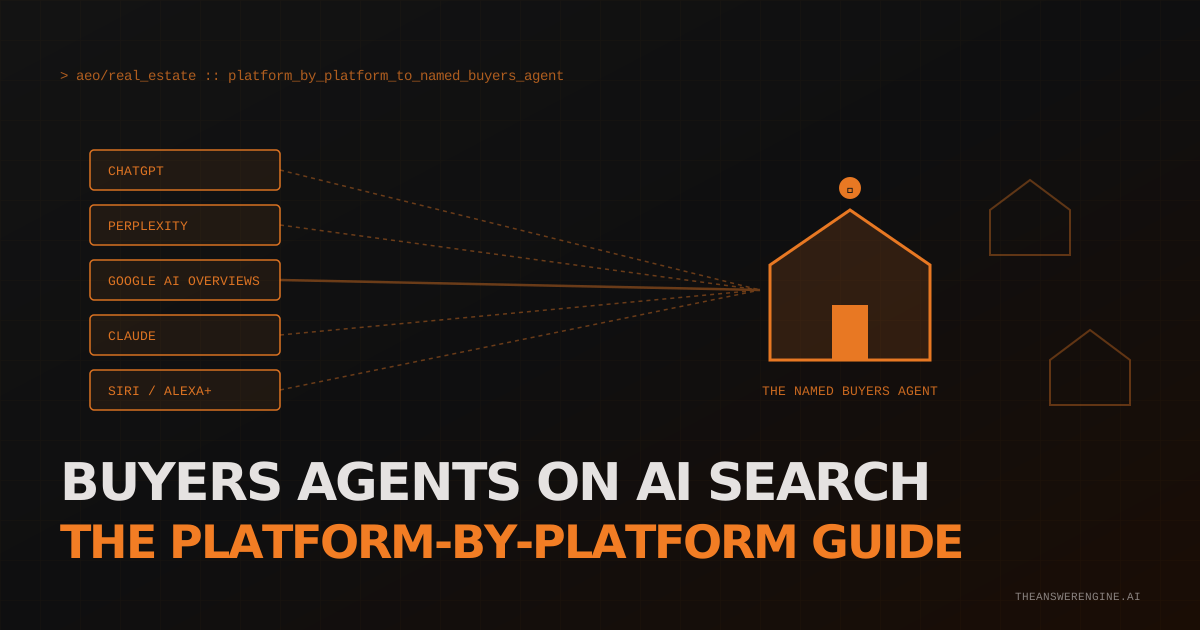
"AI search" names a behavior, not a single product. The same buyer request resolves differently across ChatGPT, Perplexity, Google AI Overviews with Gemini, Claude, and the assistant layer of Siri and Alexa+. Each platform reads its own source stack and rewards its own signals, so a buyers agent must engineer visibility platform by platform. A profile and content footprint that satisfies two or more platforms becomes a candidate across all of them at once. To map your firm against every platform in one pass, run the free AERO Blind Spot Scan — it returns a per-platform readout inside 48 hours.
ChatGPT: Broad Web Index Plus Earned Media
ChatGPT is the platform of choice for buyers who want a conversational shortlist, and ChatGPT search reads a broad web partner index alongside Yelp, Reddit, and other earned media. To get named by ChatGPT, a buyers agent needs explicit buyer-representation tags on indexed surfaces and a corpus of third-party mentions the model can quote — reviews, directory records, and editorial citations. Brand-controlled "about" copy carries less weight here than earned media does. The practical move is a buyer-side review corpus with named outcomes plus schema-marked content answering specific buyer questions. For the deeper mechanics of how this engine discovers sources, see our breakdown of how ChatGPT search discovers and cites web sources. To audit your ChatGPT footprint specifically, text (213) 444-2229.
Perplexity: Citation-First Retrieval With Visible Sources
Perplexity AI is the most citation-transparent engine — it shows the buyer exactly which sources it pulled, which means the quality and recency of the cited surface decides everything. Perplexity search rewards content with clear definitions, structured lists, and verifiable statistics, because the engine prefers sources it can attribute without hedging. A buyers agent wins on Perplexity with dated, schema-marked content that answers a specific buyer question in a self-contained block plus a directory and review footprint the engine can corroborate. Thin or undated content rarely surfaces because Perplexity weights recency and corroboration heavily. To get the Perplexity content template built for buyer representation, book a Calendly consult and it ships in the first call.
Google AI Overviews And Gemini: Business Profile Plus The Indexed Web
Google AI Overviews sit at the top of the result page for a growing share of buyer queries, and they read Google Business Profile alongside the indexed web. For a buyers agent, the Business Profile is the anchor surface — complete categories, buyer-side services, neighborhood service areas, and a cleared review floor feed directly into what Gemini can name. Google AI Overviews also reward content that earns a featured-style answer: a question-shaped heading followed by a direct, self-contained answer. A buyers agent who holds a complete Google Business Profile and publishes question-and-answer content matched to buyer intent surfaces here first. To audit your Business Profile against AI Overview binding, email support@theanswerengine.ai and the diagnostic ships inside 48 hours.
Claude: Structured, High-Trust Editorial And Review Content
Claude weights structured, methodologically transparent content and clean review corpora, and it tends to reward sources that present facts in bounded, well-organized units. A buyers agent gets named by Claude through content that opens with a plain definition, organizes buyer guidance into clear sections, and cites verifiable specifics rather than marketing superlatives. Earned media and review parity matter on Claude as they do across every engine, but Claude is especially sensitive to whether a source reads as trustworthy and well-structured. For the companion analysis of this engine's behavior in real estate, see how Claude AI recommends real estate agents near you. To request a Claude-specific content audit, text (213) 444-2229 — Justin runs it personally on every inbound.
Siri And Amazon Alexa+: The Voice Layer On Local Surfaces
Siri with Apple Intelligence and Amazon Alexa+ add a voice layer over local data surfaces — Apple Business Connect and Yelp behind Siri, Realtor.com and Yelp behind Alexa+. The voice layer is unforgiving of profile gaps because it returns one spoken name with no screen to scroll. A buyers agent wins the voice layer by holding complete, matching profiles on Apple Business Connect, Yelp, and Realtor.com with explicit buyer-representation tags and neighborhood-level service areas. For the full mechanics of spoken agent recommendation, see our deep dive on how buyers ask AI for agent recommendations by voice and the platform breakdown of how Amazon Alexa+ finds and recommends real estate agents. The Answer Engine takes one operator per metro per specialty — to claim the voice slot before a competitor does, book the Calendly consult.
Run The Platform-by-Platform Visibility Audit On Your Practice
The AERO Blind Spot Scan checks your buyer-representation practice against every AI platform at once — ChatGPT, Perplexity, Google AI Overviews, Claude, and the Siri and Alexa+ voice layer — and returns a per-platform readout of where you are named, where a competitor is named, and where no one is. Ships inside 48 hours. Free.
Run The Free ScanBook A Calendly ConsultWhat The Research Says — And What The Answer Engine Does Differently
AI citation behavior — which sources an answer engine pulls and names — is governed by a young but converging body of academic work. The foundational papers are less than two years old, which means the signals they identify are still under-exploited by most buyers agents. This analysis draws on four peer-reviewed sources and the verified citation panels The Answer Engine runs across ChatGPT, Perplexity, Claude, and Gemini. The signals below are the ones that move citation rates for buyer-representation practices.
Definitions And Structure Outperform Keyword Density
AI retrieval rewards content that opens with a plain definition and presents facts in structured units. Zhang et al. (2026) found that passages opening with a clear term definition earn a 57% citation premium over passages that bury the definition. GEO-SFE (2026) found that lists and tables lift extraction accuracy 43%, while passages over 300 words suffer a 31% attention degradation in the retriever. For a buyers agent, this means a page that opens "A buyers agent represents the home buyer, not the seller, and owes the buyer exclusive fiduciary duty" outpulls a page that opens with three sentences of throat-clearing. Structure is the retrieval surface the engine reads first, not a cosmetic choice. To get your buyer-guide content restructured for extraction, book a Calendly consult.
Quotations, Statistics, And Verified Outcomes Lift Citation Rates
Aggarwal et al. (KDD 2024) measured the source features that raise the probability of being cited by a generative engine: adding direct quotations lifted citation likelihood 37%, and adding statistics lifted it 22%. For a buyers agent, the translation is concrete — a profile and review corpus carrying specific, verifiable outcomes ("negotiated 14 first-time-buyer closings under appraisal in 2025") outperforms vague claims ("trusted local expert"). Answer engines prefer sources they can quote without hedging, so a quotable buyer-side track record binds harder than a polished bio. To deploy the outcome-prompt review sequence built for buyers agents, email support@theanswerengine.ai.
The Earned-Media Bias And The Freshness Requirement
Chen et al. (2025) documented a systematic bias in generative engines toward earned media — third-party reviews, directory records, and editorial citations — over brand-controlled self-description. The Fresh-Citation Decay: an answer engine weights recency and corroboration, so a buyers agent's citation probability decays without a steady stream of fresh, dated content and ongoing review velocity — which makes AEO a publishing cadence rather than a one-time optimization (GEO-SFE, 2026). This is where The Answer Engine works differently from a one-and-done agency: we run a sustained monthly content cadence, a structured review-acquisition system, and a verified citation panel, drawing on these four academic sources and verified client engagements rather than on guesswork. To audit your earned-media footprint and content freshness across surfaces, text (213) 444-2229 for the diagnostic.
The LedgerHow To Measure Buyer-Agent AI Visibility — The Proof Ledger
AI recommendations resolve inside the chat window and produce few clicks, so the default analytics stack reports almost nothing. The practice that cannot measure the channel cannot improve it. The Answer Engine measures buyer-agent AI visibility with a Proof Ledger — a fixed, repeatable panel of buyer-style queries run on a monthly cadence across every platform. The ledger converts an invisible channel into a citation rate the practice moves month over month. To set up the Proof Ledger for your market, email support@theanswerengine.ai.
The Monthly Buyer-Query Panel
The Proof Ledger fixes a panel of 20 to 40 buyer-style queries that mirror how real home buyers ask — "find a first-time buyer agent in this neighborhood," "who is a good buyers agent for an FHA purchase near me," "recommend a buyer's agent who knows new construction." Each query runs monthly across ChatGPT, Perplexity, Gemini, and Claude, and the result is logged in three states: the platform names your practice, names a competitor, or names no one. The ledger produces a citation rate per platform and a trend line over time. Movement on the trend line is the proof an engagement is working. To get the buyer-query panel built for your specialty, book a 30-minute Calendly consult.
The Booking-Source Tags That Catch AI Conversions
AI-originated buyer leads arrive through the connected Calendly or call line with no referral trail, so the practice must tag the booking funnel at the source. Configure a distinct Calendly source tag for AI-originated bookings, add a "how did you find us" field that lists AI platforms explicitly, and train the intake line to log when a caller says "ChatGPT recommended you" or "Perplexity gave me your name." These tags catch the conversions the analytics stack misses entirely. To set up source tagging on your booking funnel, text (213) 444-2229.
Why The Ledger Beats Analytics For Buyer-Agent AEO
Google Analytics measures clicks, and AI recommendations produce few, so an analytics-only practice concludes AI search "is not driving traffic" while losing buyer consults to a named competitor every month. The Proof Ledger measures the actual unit of AI search — the citation — directly, on the platforms where it happens. The practice sees exactly which engines name it, which name a competitor, and which name no one, and can move resources to close the gap. Measurement is the difference between engineering the channel and hoping for it. For the full methodology, see our guide to how to measure if AI is sending you customers. To request a sample Proof Ledger for your market, email support@theanswerengine.ai and it ships inside 48 hours.
What Comes NextAI search names one buyers agent. The home buyer does not scroll, compare, or click — the platform decides, and it decides from your structured data across every surface it reads, not from your website. The buyers agent who wins is the one whose records bind to buyer intent without hedging on every platform at once.
— Justin Borges, Founder of The Answer Engine
What Comes Next For Buyers Agents On AI Search
The Convergence Window: because every major AI platform is collapsing onto the same retrieval pipeline — read structured surfaces, triangulate identity, bind buyer intent, name one agent — a single, correctly engineered buyer-agent footprint now earns citations across ChatGPT, Perplexity, Gemini, Claude, and the voice layer at once, and that one-build-many-platforms leverage closes as competitors discover it over the 2026 cycle (GEO-SFE, 2026). The practical consequence is specific: the buyers agent who locks cross-surface parity, explicit buyer-representation tags, neighborhood precision, and a fresh content cadence in the next two quarters holds incumbency that the platforms will keep re-citing as a confidence signal — while a buyers agent who waits will spend the back half of the cycle trying to displace an entrenched name. The work compounds across platforms rather than fragmenting. To check whether your metro-and-specialty window is still open, text (213) 444-2229 — Justin replies inside 24 hours. Buyers agents ready to claim their territory before a competitor does can book the 30-minute Calendly consult on the same line.
FAQFrequently Asked Questions
How do buyers agents get found on AI search?
A buyers agent gets found on AI search by populating the structured source surfaces each platform reads — Google Business Profile, Yelp, Realtor.com, Zillow agent profiles, and a content site marked up with schema — with explicit buyer-representation language and recent, dated material. AI platforms do not crawl an agent website inside the answer window. They retrieve pre-indexed records, triangulate the agent identity across surfaces, and name the candidate whose profile binds cleanly to the buyer intent.
A buyers agent tagged for "buyer representation" or "first-time buyer specialist" across matching surfaces becomes a citation candidate; one described as a generic "real estate agent" fails the binding test. To check whether AI can read your practice, run the free AERO scan.
Which AI platforms recommend buyers agents to home buyers?
ChatGPT, Perplexity, Google AI Overviews with Gemini, Claude, and the assistant layer of Siri and Amazon Alexa+ all return named real estate agent recommendations to buyers. Each reads a distinct source set — ChatGPT and Perplexity pull a broad web partner index plus Yelp and Reddit, Google AI Overviews reads Google Business Profile and the indexed web, Claude weighs structured editorial and review content, and Siri and Alexa+ read Apple Business Connect, Yelp, and Realtor.com.
An agent with matching structured data across two or more of these surfaces becomes a candidate on several platforms at once. To map your cross-platform coverage, email support@theanswerengine.ai.
Why does AI recommend a competitor buyers agent instead of me?
AI platforms name the agent whose structured record binds most cleanly to the buyer query, not the agent with the best website. If a competitor carries explicit buyer-representation tags, neighborhood-level service areas, a cleared review floor, and recent dated content while your profile reads "full-service real estate" with a county-wide service area, the competitor binds and you do not.
The recommendation also compounds: once a platform names a competitor, displacement runs months because the platform treats the existing citation as a confidence signal. The fix is structured-surface parity plus a content cadence, not a website redesign. To see who holds your slot, text (213) 444-2229.
Is getting found on AI search different for buyers agents than for listing agents?
Yes. Buyer queries and seller queries trigger different intent and bind to different profile attributes. A seller asks AI "who is the best listing agent to sell my house," and the platform binds against listing volume and sale-side reviews. A buyer asks "find me a buyers agent who knows first-time FHA purchases," and the platform binds against buyer-representation tags, buyer-side reviews, and neighborhood specificity.
A profile optimized only for listings fails buyer-intent binding. Buyers agents need their own representation tags, their own buyer-side review language, and content that answers buyer questions specifically. To get the buyer-side template, book a Calendly consult.
How long does it take a buyers agent to get cited by AI search?
Source-surface parity changes — claiming and matching Google Business Profile, Yelp, Realtor.com, and Apple Business Connect — propagate into platform candidacy within 30 to 60 days. Content citations build over a longer arc because AI platforms weight recency and corroboration: a dated, schema-marked article answering a specific buyer question typically begins surfacing in 45 to 90 days and strengthens as additional surfaces corroborate it.
AEO is a cadence, not a one-time fix. Citation probability decays without fresh dated content and steady review velocity, which is why a sustained monthly publishing rhythm outperforms a single push. To set the cadence for your market, email support@theanswerengine.ai.
Can I measure whether AI search is sending me buyer clients?
Yes, but not through Google Analytics, which records clicks and reports almost nothing for AI recommendations that resolve inside the chat window. The correct instrument is a citation ledger — a fixed monthly panel of buyer-style queries run across ChatGPT, Perplexity, Gemini, and Claude, logging whether each platform names you, names a competitor, or names no one.
Pair the ledger with a Calendly source tag for AI-originated bookings and an intake script that asks "how did you find us." Together they convert an invisible channel into a citation rate the practice moves month over month. To set up your Proof Ledger, book a 30-minute Calendly consult.