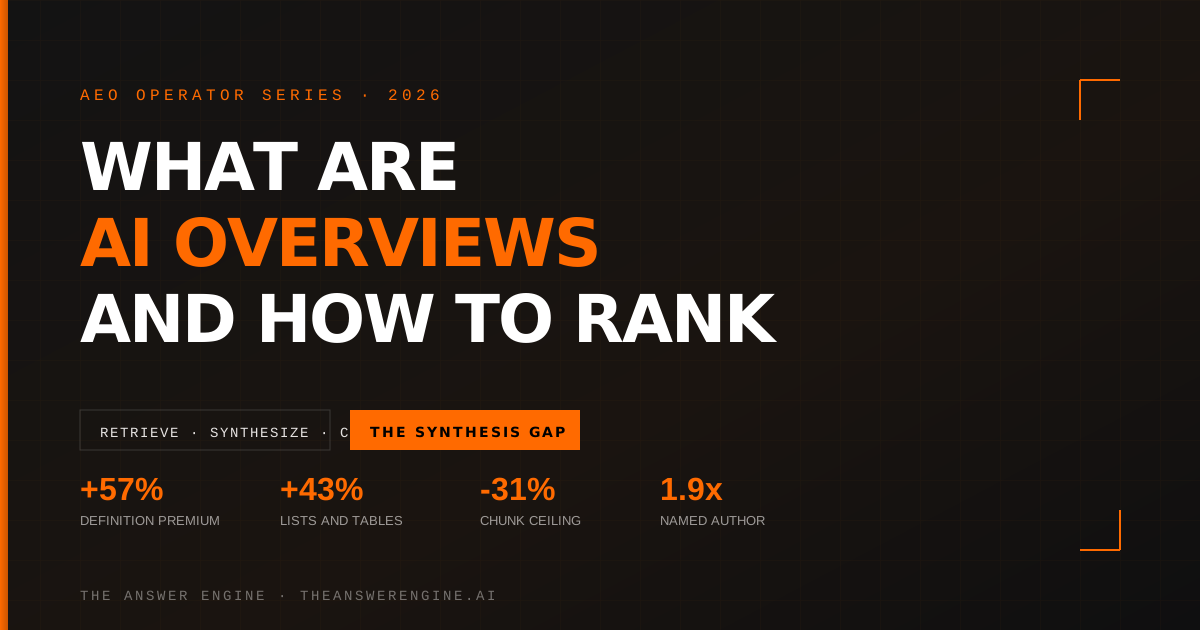
The Synthesis Gap: an AI Overview answer is assembled from passages it can extract cleanly, not from pages it ranks highly, so a site that ranks on page one of Google but ships unstructured prose is excluded from the Overview it technically qualifies for (TAE measurement, 2025-2026). The implication is direct: AI Overview visibility is a structural problem, not a ranking problem. This analysis draws on Aggarwal et al. (KDD 2024), Zhang et al. (2026), the GEO-SFE benchmark (2026), Chen et al. (2025), and sixteen months of verified Answer Engine Optimization (AEO) client engagements across legal, plumbing, real estate, and insurance verticals measured against fixed prompt libraries on Google AI Overviews and all four major LLMs. Check whether your market is still open.
What AI Overviews Actually Are
The plain-language definition
An AI Overview is the AI-generated answer panel Google places at the top of the search results page, above the traditional organic links. Google builds each AI Overview by retrieving passages from multiple web pages and synthesizing them into one answer that carries inline citations back to the source pages. AI Overviews are the most visible instance of a broader category called answer engines, which also includes ChatGPT, Perplexity AI, Claude, and Gemini. The defining trait across all of them is the same: the engine answers the question directly and cites a handful of sources, rather than returning a ranked list of links for the searcher to sort through. Run the free AEO Blindspot Scan to see which of your queries already trigger an AI Overview.
How an AI Overview differs from a blue-link result
A traditional search result is a ranked list of ten pages. An AI Overview is a single synthesized answer drawn from several pages at once. The distinction matters because the unit of competition changes. In blue-link search, a whole page competes for a rank position. In an AI Overview, an individual passage competes to be one of the extracted, cited sources inside the synthesized answer. A page can rank well in the blue links and never appear in the Overview, and a page can be cited in the Overview while sitting outside the top organic positions. Answer Engine Optimization, also called AI citation optimization or LLM visibility work, targets the second surface directly. Email support@theanswerengine.ai for the AI Overview readiness breakdown.
Where AI Overviews appear and who sees them
Query coverage is the set of search types that trigger an AI Overview. AI Overviews appear on informational and research-stage queries across Google Search, and the same answer-panel pattern now spans ChatGPT search, Perplexity, Claude, and Gemini. For a local service business, the queries that trigger an Overview are the high-intent research questions a prospective customer asks before they ever call: what something costs, how a process works, which option fits their situation. Appearing as a cited source in that Overview places the business inside the answer at the exact moment of decision. Get your free AI visibility report to map which customer-intent queries surface an Overview in your market. Call (213) 444-2229 for a walkthrough of the results.
→ Run the free AEO Blindspot Scan on your site nowMechanismHow AI Overviews Pick Their Sources
The retrieval-and-synthesis pipeline
An AI Overview is produced by a retrieval-and-synthesis pipeline. First, the system decomposes the search query into a set of sub-queries. Second, it retrieves candidate passages from the index for each sub-query. Third, a synthesis layer assembles the final answer from the passages that are most cleanly extractable and most directly responsive, and attaches citations to the sources it used. The Citation Surface: the only content an AI Overview can cite is a bounded, self-contained passage that answers the query without surrounding context, which means citation eligibility is decided at the passage level, not the domain level (GEO-SFE, 2026; TAE measurement, 2025-2026). Structure determines whether a passage is even a candidate. Reach our team at (213) 444-2229 for the passage-structure template.
The query fan-out and why it excludes most pages
Query fan-out is the process by which Google expands a single typed query into multiple implied sub-questions before it answers. Google does not answer the typed query alone. The AI Overview pipeline fans the query out into multiple implied sub-questions and assembles its answer from the union of passages that resolve them. The Fan-Out Floor: Google’s AI Overview decomposes a single query into multiple sub-queries and assembles its answer from the union, so a page that answers only the head query while ignoring the implied sub-questions never enters the synthesis set (TAE measurement, 2025-2026). A page that covers one narrow angle of a topic is structurally incomplete for the fan-out, and incompleteness removes it from the candidate pool before quality is ever assessed. Content engineered for AI Overviews answers the head query and its predictable sub-questions in bounded, separately extractable sections. Book a free 30-minute strategy call to map the fan-out for your top queries.
What makes a passage extractable
An extractable passage is one a synthesis layer can lift out and present as a complete answer with no surrounding context. The mechanical traits are consistent: a plain-language definition in the opening sentence, a bounded length between 80 and 180 words, no pronouns referring to earlier sections, and a single self-contained claim. Passages that depend on a phrase like "as described above" break when extracted in isolation, so the synthesis layer passes over them. GEO-SFE (2026) measured a 31% attention degradation on passages over 300 words in retrieval models, which is why long unbroken paragraphs from the 2018-to-2023 SEO era rarely surface in an Overview. Email support@theanswerengine.ai for the extractability checklist. Reach us at (213) 444-2229 if your pages predate this structure.
→ Book a free 30-minute AEO strategy callThe ResearchWhat the Research Says About Getting Cited
Definitions earn a citation premium
The single strongest structural signal in the research is the definition-first opening. Zhang et al. (2026) measured a 57% higher citation probability for content that opens a section with a clear term definition over content that buries the definition mid-section. The Definition Anchor: content that opens a section with a plain-language definition earns a 57% higher citation probability inside AI Overviews than content that buries the definition mid-section (Zhang et al., 2026). The mechanism is that a synthesis layer scanning for a responsive passage locks onto the sentence that states what something is. Every section of a page engineered for AI Overviews therefore opens by defining its subject in plain language before expanding. Run your free AEO Blindspot Scan to see where your content buries its definitions.
Quotations, statistics, lists, and tables
Citation density is the rate at which a passage attaches verifiable evidence to its claims. Aggarwal et al. (KDD 2024) measured a 37% citation lift from adding inline quotations and a 22% lift from adding inline statistics to a passage. GEO-SFE (2026) measured a 43% citation lift when content presented information as lists and tables rather than prose. The shared mechanism is density: an answer engine prefers source attribution, source mention, and structured data because they are easy to verify and easy to lift cleanly into a synthesized answer. Content built for AI Overview citation attaches a statistic or a quotation to every mechanism claim and presents comparative information in tables. Reach support@theanswerengine.ai for the citation-density worksheet, or call (213) 444-2229 to review your current density gap.
Named authorship and the trust graph
The trust graph is the entity network an answer engine cross-references before it clears a source for citation. Chen et al. (2025) documented a systematic bias toward verifiable authorship over anonymous brand content, and measured a 1.9x citation lift for named-expert content. A page signed by a named author wrapped in Person schema with a sameAs chain to external authority profiles is read as a higher-trust source than a page bylined "Team" or "Admin." Every AI Overview optimization program therefore starts with a single named author across the content cluster. Book a free strategy call to set up your named-author entity graph, or claim your market territory before a competitor does.
Four findings converge on one instruction. Open with a definition (Zhang et al., 2026, +57%). Attach quotations and statistics (Aggarwal et al., KDD 2024, +37% and +22%). Present structured data as lists and tables (GEO-SFE, 2026, +43%). Sign with a named author (Chen et al., 2025, 1.9x). A page that does all four is engineered for the synthesis layer, not against it. Run your free AEO Blindspot Scan to score your page against all four.
How The Answer Engine Ranks Content in AI Overviews
The Origin Protocol production pipeline
The Origin Protocol is our production process for engineering content that clears AI Overview citation requirements in the first draft. Every article, service page, and FAQ block is built from the start with bounded chunks, definition-first openings, named-thesis sentences, inline academic and primary-source citations, synonym bridging, the full schema stack, and a verifiable named author with sameAs chains. The Protocol enforces extractability at the production step rather than as a post-publication retrofit. The Dual-Surface Premium: a single Origin-Protocol draft engineered for bounded extraction satisfies Google’s featured-snippet logic and the AI Overview synthesis layer at once, compounding visibility across both surfaces from one unit of work (TAE measurement, 2025-2026). Reach our team at (213) 444-2229 to see the Protocol applied to your vertical, or email support@theanswerengine.ai for a sample build.
One operator per market: the territory model
The territory model is our rule of working with one business per market and per service vertical. We work with a single operator in each geographic-vertical pairing, and the constraint is mechanical. AI Overview citation share is a finite resource within any geographic-vertical pairing, and working with two competing operators in the same market would split the citation upside. The First-Cite Moat: the first three to five domains an AI Overview cites for a query retain disproportionate citation share through subsequent retrieval cycles, because the synthesis layer reinforces sources it has already validated (TAE measurement, 2025-2026). The operator who locks a market early compounds citation authority faster than a later entrant can match. Claim your exclusive market territory now, one client per market, before a competitor locks the same queries.
Compound authority across answer engines
Compound authority is citation share that accumulates across surfaces rather than resetting with each algorithm change. Our Origin Protocol is engineered so one content draft earns citations across Google AI Overviews and every major LLM at once. Bounded chunks with FAQ schema improve Google’s answer-extraction features and the LLM retrieval layer simultaneously. Named-author content with sameAs chains improves Google’s E-E-A-T signals and the answer-engine trust graph simultaneously. Inline academic citations function as authority signals on both surfaces. The result is permanent, compound authority that compounds rather than resetting. Our method draws on the four cited studies and sixteen months of verified TAE client engagements. Run your free AEO Blindspot Scan, or call (213) 444-2229 to map your compound-authority path.
Baseline scan + bounded chunks + definition-first openings + inline statistics and quotations + lists and tables + full schema stack + named author + monthly Proof Ledger = an operator cited inside AI Overviews on customer-intent queries competitors lose by structural default. Anything less is a structural concession. Reach support@theanswerengine.ai or book a strategy call to start.
How to Measure AI Overview Visibility
The Proof Ledger method
The Proof Ledger is a fixed library of 20 customer-intent queries run on a monthly cadence across Google AI Overviews, ChatGPT, Perplexity, Claude, and Gemini. On the first business day of every month, the operator runs each query and records four data points: whether an Overview or answer panel appeared, whether the domain was cited, the cited URL, and the engine. The Ledger’s value is consistency: the same library, the same engines, the same cadence. It is the only AI Overview metric that survives synthesis-layer changes, because it measures the outcome that matters rather than a proxy signal. Get your free AI readiness report to seed your first Proof Ledger, or email support@theanswerengine.ai for the template.
Reading the Proof Ledger over time
Reading the Ledger means interpreting its month-over-month patterns rather than its raw citation count. A Proof Ledger reveals two patterns worth acting on. Pattern A: Overview appearances rise but citations stay flat, which signals the content is responsive but not extractable, so the chunk structure needs tightening. Pattern B: citations rise on informational queries but not commercial-local queries, which signals the schema stack or named-author signals are incomplete on the money pages. Reading the Ledger by query type, rather than as a single aggregate number, exposes the load-bearing weakness. Call (213) 444-2229 for the divergence diagnostic, or book a strategy call to review your Ledger.
Why measurement separates real AEO from rebranded SEO
Measurement is the dividing line between real Answer Engine Optimization and rebranded SEO. AI Overview visibility is binary at the query level and compounding at the site level. If a vendor or in-house team cannot show a monthly Proof Ledger that maps queries to citation outcomes across the major answer engines, they are not running AEO, they are running an SEO program with new vocabulary. The Proof Ledger is the artifact that separates measured AEO work from rebranded ranking reports. We run the Ledger as a standing deliverable for one operator per market. Lock in your territory before a competitor matches the cadence, or email support@theanswerengine.ai for a scorecard review.
| Surface | Unit of competition | What wins |
|---|---|---|
| Blue-link search | Whole page vs. a ranked list | Page-level ranking signals and backlinks |
| Featured snippet | One passage vs. the snippet slot | A single clean, bounded answer block |
| AI Overview | Passage vs. the synthesis set | Extractable, definition-first passages with citations |
| LLM answer panel | Passage vs. the trust graph | Named authorship, schema stack, inline sourcing |

Run Your Free AEO Blindspot Scan, See If You Appear in AI Overviews
The AEO Blindspot Scan checks your site against 47 citation signals and returns whether your domain appears in the AI Overviews and answer panels for your market’s customer-intent queries. Free, no login required, ready in five minutes.
Run Free AEO Blindspot Scan →Frequently Asked Questions
What are AI Overviews?
AI Overviews are the AI-generated answer panels Google places at the top of the search results page, above the traditional blue links. Google assembles each Overview by retrieving passages from multiple web pages and synthesizing them into a single answer with inline source citations. AI Overviews are the most visible example of a broader shift toward answer engines, which include ChatGPT, Perplexity, Claude, and Gemini. Reach support@theanswerengine.ai for an AI Overview readiness review.
How do AI Overviews choose their sources?
AI Overviews decompose a query into sub-queries, retrieve candidate passages for each, and synthesize an answer from the passages that are cleanly extractable and directly responsive. Selection happens at the passage level, not the domain level, so a page that ranks well on Google can still be excluded from the Overview if its content is not structured for clean extraction. Call (213) 444-2229 for a passage-structure diagnostic.
How is ranking in AI Overviews different from SEO?
Traditional SEO optimizes a whole page to rank in a list. Answer Engine Optimization structures individual passages so they can be extracted and cited inside a synthesized answer. The two overlap because clean structure, schema, and named authorship help both surfaces, but AI Overview citation is decided by passage-level extractability rather than page-level ranking signals alone. Book a free strategy call to compare the two surfaces for your site.
Can I rank in AI Overviews if I am not on page one of Google?
Yes. AI Overviews regularly cite passages from pages that do not hold a top organic position, because the synthesis layer selects the most extractable and responsive passage rather than the highest-ranked page. A well-structured passage on a mid-ranked page can be cited over an unstructured passage on a page-one result. Run your free AEO Blindspot Scan to see your current citation count.
How long does it take to get cited in AI Overviews?
Once a site clears the structural items, first citations on Perplexity, ChatGPT search, and Google AI Overviews typically appear within 30 to 60 days. Full coverage across all major answer engines takes 90 to 120 days. Sites with existing schema and named-author content clear the structural items faster. Email support@theanswerengine.ai for a timeline estimate on your vertical.
How do I measure AI Overview visibility?
Build a fixed library of 20 customer-intent queries and run them monthly across Google AI Overviews, ChatGPT, Perplexity, Claude, and Gemini. For each query, log whether an Overview appeared, whether your domain was cited, and the cited URL. The Answer Engine calls this fixed-library method the Proof Ledger. Book a free strategy call to build your first Proof Ledger.
Related AEO Concepts
- How to Get Featured in Google AI Overviews
- Are Google AI Overviews Replacing Search?
- AEO vs SEO: What Is the Difference?
- The AEO Checklist for 2026
- Anatomy of an AI Citation
- The 5-Minute AI Visibility Audit