What Real Estate Reviews Actually Do In AI Search
Real estate reviews in AI search are corroboration evidence: third-party confirmation that an assistant uses to verify your reputation before it recommends you. Answer Engine Optimization (AEO) - also called AI citation optimization or LLM visibility work - is the discipline of engineering those review signals so an assistant retrieves and names you. The Reputation Corroboration Layer: AI assistants do not recommend the agent with the best website, they recommend the agent whose reputation is most corroborated across independent sources, and reviews are the densest, most retrievable layer of that corroboration (Chen et al., 2025). That single fact reframes review strategy from collecting stars for humans to building machine-verifiable authority. To see whether AI assistants can read and corroborate your review profile today, run the free AI Blind Spot Scan.
Reviews Are Corroboration, Not Decoration
A review is a third-party statement about your service that lives on a platform you do not control. That lack of control is exactly what gives it weight. An AI assistant cannot verify a claim you make about yourself on your own site, but it can cross-reference a star rating and written feedback posted by clients on Google, Zillow, and Realtor.com. Reviews convert your self-description into confirmed reputation. Agents who treat reviews as a vanity metric miss that they are the most retrievable proof of competence an assistant has. To find which review surfaces an assistant already trusts for your name, text (213) 444-2229 for a 24-hour diagnostic.
Why ChatGPT Treats Your Star Rating As Evidence
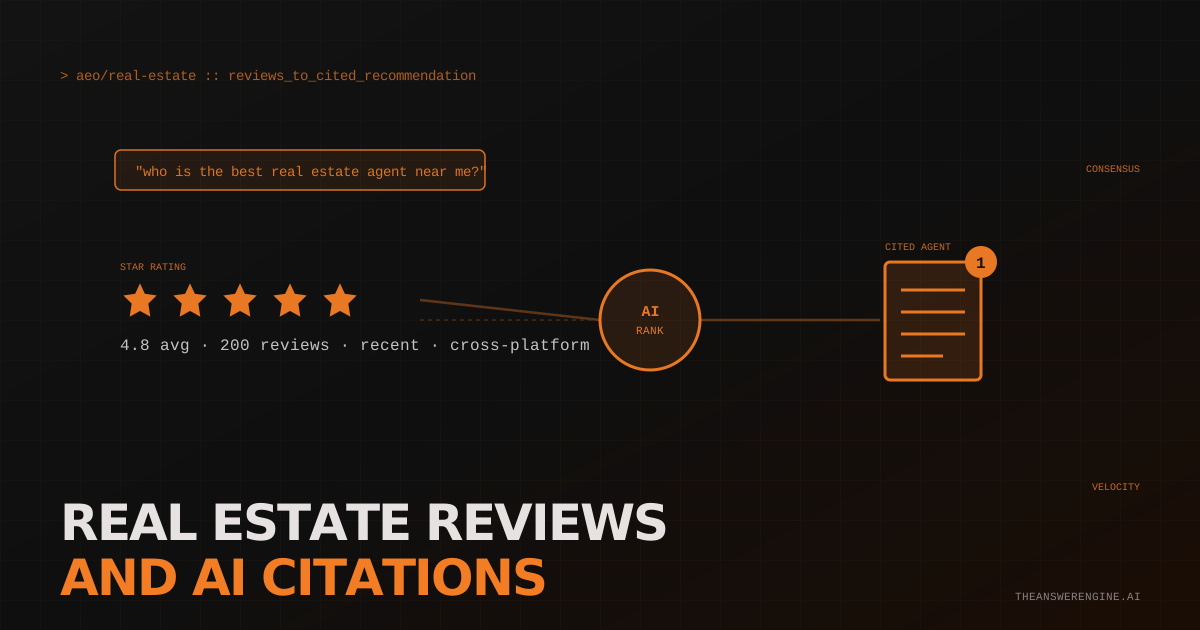
ChatGPT treats a star rating as a compact statistic it can quote with confidence. A rating pairs a precise number with a sample size and a date, which is exactly the kind of verifiable, attributable signal generative engines prefer. A 4.8 average across 200 reviews is not an opinion the assistant has to evaluate - it is a fact it can cite. This is why a strong, well-populated rating outperforms pages of unverifiable marketing copy when an assistant decides whom to name. To get your current rating profile mapped against the agents AI already recommends in your market, book a 30-minute review-strategy call.
Reviews Live On Surfaces The Assistant Already Indexes
Reviews carry outsized weight because they sit on high-authority surfaces an assistant already crawls and trusts. Google Business Profile, Zillow, Realtor.com, and Yelp are indexed, structured, and reputable, so a review posted there inherits the platform's authority. A testimonial on your own website does not. The practical consequence: review presence on the platforms an assistant indexes is a faster path to AI visibility than almost any change you can make to your own pages. The same cross-surface logic governs how to rank on Perplexity AI. To audit where your reviews are missing from indexed surfaces, get a free review-surface gap report.
Answer Engine Optimization for real estate is a measurable channel less than two years old - the foundational academic work on how generative engines weight reviews and earned signals is barely past its first publications. Most agents have never structured their review profile for machine retrieval, which is why the recommendation slots in most local markets are still open. Operators who corroborate their reputation now establish citation incumbency before the field saturates. To claim your market position early, lock your exclusive territory now - one operator per market.
How ChatGPT Turns Reviews Into A Recommendation
ChatGPT builds a real estate recommendation by retrieving signals about candidate agents and ranking them on how corroborated and current those signals are. Reviews feed three distinct inputs into that decision: the aggregate star rating, the volume and velocity of reviews, and the actual language inside them. Brand size shapes the baseline too, as we cover in how Compass gets recommended by ChatGPT. Each input is won or lost separately, and understanding all three tells you exactly where a recommendation is decided. For a walkthrough of where your review signals drop out of that pipeline, email support@theanswerengine.ai for a custom review-AEO breakdown.
Signal 1: The Aggregate Star Rating
The aggregate rating is the headline statistic. An assistant reads your average and sample size as a single trust score it can cite. The important nuance is that the number is judged in context: a 4.7 across 200 reviews reads as more credible than a 5.0 across 9, because the larger sample carries less noise and less suspicion. The rating is necessary but not sufficient - it opens the door, and the other two signals decide whether you walk through it. To benchmark your rating against the agents AI names first in your area, text (213) 444-2229 to see who holds your slot.
Signal 2: Review Volume And Velocity
Volume and velocity tell the assistant whether your reputation is alive. The Velocity Signal: a steady, recent stream of reviews reads as a living reputation an assistant will trust, while a high rating frozen in the past reads as stale and loses retrieval weight to agents who keep collecting, because generative engines use recency as a proxy for accuracy (GEO-SFE, 2026). A wall of reviews from three years ago is weaker than a smaller, growing base from this quarter. The instruction is direct: never stop collecting reviews, and pace them so the stream looks organic rather than a single staged burst. To set a review-velocity cadence that holds your slot, book a consult to map your collection cadence.
Signal 3: The Words Inside The Reviews
The text of a review is where buyer-intent matching happens. The Sentiment Extraction Gap: an assistant does not read your star rating to answer a specific question - it extracts the words inside your reviews to match a buyer's exact need, so an agent with reviews that name a neighborhood, price band, or transaction type wins narrow queries a higher-rated generalist never surfaces for. A review that says "helped us win a multiple-offer condo in a competitive neighborhood" is retrievable for a buyer asking exactly that. A review that says "great agent, highly recommend" matches nothing specific. Reviews that describe the work in the buyer's own language are the most valuable asset you can collect. To learn how to prompt clients for specific, retrievable reviews, email support@theanswerengine.ai for the review-request template.
The assistant does not pick the agent with the highest number. It picks the agent whose reputation is most corroborated, most current, and most specifically matched to the question asked. Rating opens the door; volume, velocity, and review text decide the recommendation. To pressure-test all three signals against your market, run a free Blind Spot Scan to baseline your review visibility.
What The Research Says About Reviews And AI Citations
Review strategy for AI search should rest on the generative-engine optimization literature, not on Google-era folklore about star counts. Four findings govern which reputation signals get cited, and each maps to a concrete action. This analysis draws on the published GEO research and on verified client engagements where we moved citation rates on a fixed query panel by restructuring review and reputation signals. To get the same analysis run against your profile, see your current AI recommendation rate - free scan.
| Research Finding | Effect On Citation | Source |
|---|---|---|
| Earned, third-party signals over self-description | Systematic preference | Chen et al., 2025 |
| Quotable third-party statements (review text) | +37% citation rate | Aggarwal et al., KDD 2024 |
| Verifiable statistics (rating, review count) | +22% citation rate | Aggarwal et al., KDD 2024 |
| Structured review data (lists, tables) vs plain prose | +43% retrieval lift | GEO-SFE, 2026 |
| Stale signals past the freshness window | -31% extraction value | GEO-SFE, 2026 |
Earned Signals Outweigh Self-Description
The strongest research-backed reason reviews matter is the earned-media bias. The Review Corroboration Premium: generative engines show a systematic preference for earned, third-party signals over brand-authored self-description, so a reputation proven by independent client reviews outranks the same claim made only on the agent's own website (Chen et al., 2025). An agent who writes "the top realtor in the area" on a homepage loses to an agent whose competence is mirrored across hundreds of independent reviews. The work is to make your core claims verifiable off your own domain, and reviews are the fastest way to do it. To map where your earned signals are thin, text (213) 444-2229 and we will map your corroboration gaps.
Quotations And Statistics Win Citations
Reviews carry the two signal types the research ranks highest. Aggarwal et al. (KDD 2024) found that quotable third-party statements lift citation rate 37% and that verifiable statistics lift it 22% - and a review is both at once. The written feedback is a quotation an assistant can attribute, and the aggregate rating is a statistic it can cite. No other asset on your profile packs both signal types into one retrievable unit. The editing instruction is to surface both: display the numeric rating and the specific written feedback where an assistant can read them. To have your reputation signals structured for retrieval, schedule a free 30-minute consult.
Consistency Across Platforms Compounds Trust
Agreement across sources is its own signal. The Consensus Premium: when your rating and reputation match across Google, Zillow, Realtor.com, and Yelp, an assistant treats the cross-platform agreement as confirmed fact and recommends with confidence, while conflicting ratings split the signal and suppress retrieval. A 4.9 on one platform and a 3.6 on another reads as uncertainty, and uncertainty loses to a competitor whose numbers line up everywhere. Cross-platform parity is the highest-leverage reputation move because it lifts retrieval across every engine that shares those surfaces. To audit your rating consistency across platforms, check your cross-platform review parity - free scan.
A high rating built on a handful of reviews is a fragile signal. Reviews left to stagnate for more than 90 days lose retrieval value right now, regardless of how strong the average is, because generative engines treat recency as a proxy for accuracy. If your review profile has not grown this quarter, a competitor who keeps collecting is displacing you in AI recommendations today. To set a cadence that protects your slot, book a consult to map your refresh cadence.
The Review AEO Playbook: Five Moves That Earn The Citation
Knowing the mechanism is not the same as being recommended. These are the five moves we run to turn a real estate agent's review profile into a cited source across ChatGPT, Perplexity, and Google AI Overviews, ordered by speed to result. The first two register within weeks; the last three compound into permanent authority. To have this playbook executed on your profile, grab a 30-minute slot to walk your query panel.
Move 1: Hit The Review Threshold On The Right Platforms
The fastest lever is reaching a credible review volume on the platforms an assistant indexes. The Review Threshold Effect: below a critical mass of reviews an assistant treats a rating as statistically untrustworthy and discounts it, so crossing the volume threshold on Google Business Profile, Zillow, and Realtor.com converts an ignored rating into a citable trust signal. Concentrate collection on the indexed, high-authority surfaces first rather than scattering across platforms an assistant does not read. To find which platforms you are missing, run a free baseline first - run a free Blind Spot Scan to map your review surfaces.
Move 2: Engineer Reviews That Mention Specifics
Generic reviews are nearly invisible to retrieval. Coach clients to name what you actually did: the neighborhood, the property type, the price band, the problem you solved. A review that reads "negotiated 8% under asking on a fixer in a tough market" is retrievable for a dozen specific buyer questions. Make the request easy with a short prompt that nudges specificity without scripting the words. This single change turns your review base into a retrieval asset matched to real buyer queries. To get the specific-review request template we use with clients, email support@theanswerengine.ai to request the template.
Move 3: Keep Review Velocity Constant
A reputation has to read as current. Build a repeatable system that requests a review after every closing so new feedback arrives steadily rather than in staged bursts. A constant stream keeps your last-modified reputation recent, which is the freshness signal an assistant rewards. Velocity also protects you: a competitor cannot displace a profile that keeps growing. To wire a post-closing review request into your transaction workflow, text (213) 444-2229 to build your collection system.
Move 4: Lock Cross-Platform Rating Parity
Make your numbers agree everywhere an assistant looks. Maintain an active, consistent presence on Google Business Profile, Zillow, Realtor.com, and Yelp so your name, rating, and reputation line up across all of them. Cross-platform parity is the move that earns the Consensus Premium and lifts retrieval across every engine that shares those surfaces, not just one. Conflicting or missing profiles are the most common and most fixable reason an otherwise strong agent is passed over. To audit your parity across surfaces, claim your market territory before a competitor does - one client per market.
Move 5: Publish Reviews As Structured Data On Your Site
Mirror your strongest reviews onto your own site as structured Review and AggregateRating schema so an assistant can extract them directly, then keep the profile believable. The Five-Star Ceiling: a tiny set of flawless reviews reads as manufactured and gets discounted, so a high but believable average across a large, recent base - including the occasional critical review handled well - earns more trust than an unblemished score on thin volume. Structured review data earns a 43% retrieval lift over the same content as plain prose (GEO-SFE, 2026), and authenticity keeps the signal from being filtered as fake. To have review schema built and validated on your site, email support@theanswerengine.ai to set up your review schema.
- Cross the volume threshold. Reach a credible review count on Google, Zillow, and Realtor.com.
- Make reviews specific. Coach clients to name neighborhood, price band, and transaction type.
- Keep velocity constant. Request a review after every closing - never let the stream stall.
- Hold cross-platform parity. Make your rating and reputation agree on every indexed surface.
- Stay believable. A large, recent base beats a thin, flawless score.
- Publish review schema. Mirror reviews on your site as structured data for the 43% lift.
Start with Move 1 (hit the threshold) and Move 2 (specific reviews) for wins inside weeks, then Move 3 (velocity) to hold them. Cross-platform parity and review schema compound over 30 to 180 days into permanent authority an assistant defaults to. To sequence these for your market, book a call to map your review-AEO sequence.
How To Measure Whether Reviews Are Winning You Citations
Review-driven AI visibility is invisible to standard analytics because many recommendations produce no click. Measuring it requires a purpose-built surface, not Google Analytics. The Review Citation Ledger: a fixed panel of real buyer-intent questions run monthly inside ChatGPT, Perplexity, and Google AI Overviews - logging whether the assistant names you, names a competitor, or names no one, and whether it references your reviews or rating - converts an untrackable channel into a citation rate you move month over month. This is the only metric that matters, because being named in the answer is the product. To set up your ledger, book a consult to map your query panel and ledger.
Build A Fixed Query Panel
A Review Citation Ledger begins with a fixed panel of the real questions buyers ask AI - "best real estate agent in [city]," "who should I hire to sell my home in [neighborhood]," "top realtor for first-time buyers near me." Run the same panel every month so movement is comparable, and record three outcomes per query: names you, names a competitor, names no one. Note whether the assistant cites your rating or quotes a review. The competitor column tells you exactly who holds the slot you want. To build your panel from your actual buyer questions, text (213) 444-2229 to start your query panel.
Pair The Ledger With Review Attribution
The ledger measures visibility; a how-did-you-find-us field measures revenue. Add the question to every inbound inquiry and buyer consult, and tag any AI-sourced lead with a distinct source label. Together the ledger and the attribution field convert an invisible channel into a citation rate tied to real closings, so you can prove that a stronger review profile pays. To wire attribution into your funnel, reach us at support@theanswerengine.ai.
Reviews are a compounding authority asset, not a paid-ad switch. Every new, specific, recent review deepens the corroboration an assistant reads, so early collection accelerates later recommendation rates instead of decaying when you stop. The agents who build a citable review profile today own the recommendation slot tomorrow. To claim your slot before a competitor locks it, secure your market slot before a rival claims the AI recommendation.
If your reviews earn the ChatGPT recommendation, you are positioned for every AI platform. The signals - earned corroboration, specific quotable text, fresh velocity, cross-platform parity - overlap across ChatGPT, Perplexity, Claude, and Google AI Overviews. We work with one real estate operator per market. For the channel-level view, see ChatGPT vs Zillow for finding an agent. Check if yours is still open.
Frequently Asked Questions
Do online reviews affect whether ChatGPT recommends a real estate agent?
Yes. ChatGPT builds a recommendation from the corroborated signals it can retrieve, and reviews are one of the strongest. Your aggregate star rating, total review count, how recently reviews were posted, and the specific words inside them give the assistant a verifiable, third-party picture of your reputation. Because generative engines weight earned signals above self-description, an agent with consistent, recent, specific reviews across Google, Zillow, and Realtor.com is far more likely to be named than one with a polished site and thin review history.
The fastest start is crossing a credible review threshold on the indexed platforms. To find your gaps, run a free Blind Spot Scan.
Does my exact star rating number matter, or just having reviews?
Both matter, but not the way most agents assume. A high rating helps, but volume, recency, and review text often carry more weight than a fractional difference in the average. An agent with 180 recent reviews at 4.7 usually beats an agent with 12 reviews at a perfect 5.0, because the larger, fresher sample reads as more trustworthy and supplies more quotable material. Assistants also discount a small number of flawless reviews as a weak signal.
The reliable target is a large volume of recent, specific reviews with a strong but believable average. To benchmark yours, text (213) 444-2229.
Which review platforms matter most for AI recommendations?
The platforms an assistant already trusts and indexes carry the most weight. For real estate that means Google Business Profile first, then Zillow, Realtor.com, and Yelp, plus any high-authority niche directories. What matters even more than any single platform is agreement across them. When your name, rating, and reputation match across multiple independent sources, the assistant treats the consensus as confirmed fact.
Conflicting ratings or a presence on only one platform splits the signal and weakens retrieval. To audit your cross-platform parity, book a 30-minute consult.
How fast do new reviews change my AI visibility?
Faster than backlinks but slower than a single review. Assistants favor recent signals, so a steady stream of new reviews keeps your reputation reading as current. A sudden burst followed by silence reads as stale or staged. In practice, building review volume and velocity on indexed platforms can begin shifting recommendation behavior within 30 to 60 days, and the effect compounds as corroboration deepens across surfaces.
Reviews left to stagnate past 90 days steadily lose weight against competitors who keep collecting. To set a cadence, email support@theanswerengine.ai.
Can a perfect 5.0 rating actually hurt me in AI search?
It can, when the rating is built on very few reviews or looks manufactured. Assistants are trained to detect signals that look too clean, and a tiny set of flawless reviews with generic language is a known pattern of fake or incentivized feedback. A believable reputation - a high average across a large, recent, specific base that includes the occasional critical review handled well - reads as more trustworthy than a thin, perfect record.
The goal is credible authority, not an unblemished score. To structure a believable profile, start with a free Blind Spot Scan.
How do I measure whether my reviews are winning AI citations?
Standard analytics will not show it because AI recommendations often produce no click. The right surface is a Review Citation Ledger - a fixed panel of real buyer-intent questions run monthly inside ChatGPT, Perplexity, and Google AI Overviews, logging whether the assistant names you, names a competitor, or names no one, and whether it references your reviews or rating.
Pair the ledger with a how-did-you-find-us field on inbound leads to tie the channel to real closings. To set up your ledger, email support@theanswerengine.ai or start with a free Blind Spot Scan.