Why ChatGPT Recommends Compass By Default
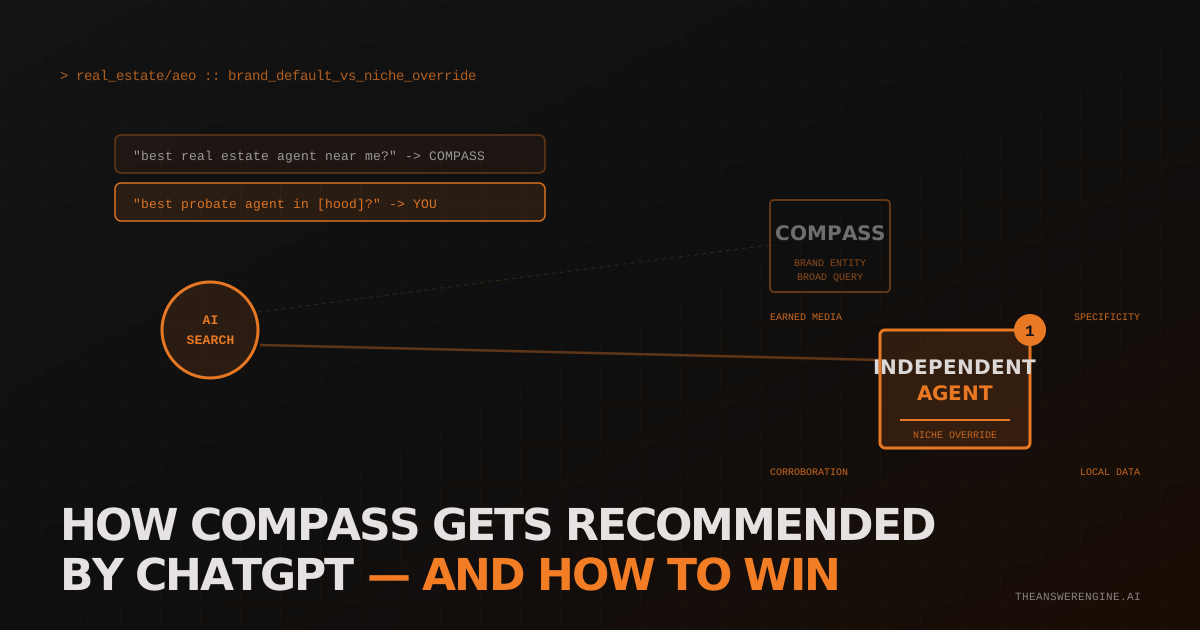
ChatGPT recommends Compass on a generic query because Compass holds the densest, most corroborated brand entity in residential real estate - not because Compass serves clients better than an independent agent. Answer Engine Optimization (AEO) - also called AI citation optimization or LLM visibility work - is the discipline of engineering an entity so AI search names it. The Brand-Entity Default: when a query is broad and undifferentiated, AI search returns the name with the highest entity density - the most consistently corroborated brand across the web - so a national brokerage wins by footprint, not by merit (Chen et al., 2025). That single fact reframes the whole problem for an independent agent. To see whether AI search can read and corroborate your name at all, run the free AERO Blind Spot Scan.
ChatGPT Recommends Entities It Can Corroborate
ChatGPT recommends a business by surfacing the entity it can most confidently corroborate across independent sources. Entity corroboration is the process of confirming a name, its category, and its claims across many surfaces the model trusts - news, directories, reviews, and profiles. Compass appears across thousands of these sources because it is national, so the model treats the Compass entity as low-risk to name. An independent agent with a thin web footprint reads as high-risk and gets omitted. To map where your corroboration is missing, text (213) 444-2229 for a 24-hour diagnostic.
Compass Wins On Brand-Entity Density, Not Better Service
Compass ranks as the largest U.S. residential brokerage by sales volume, which means its name is attached to enormous volumes of transactions, listings, and press. AI search reads that volume as authority and names Compass for the broad query. This is a footprint advantage, not a service advantage - the engine has no way to measure who closed faster or negotiated harder. Understanding the distinction is the unlock: the broad query is a brand contest an independent agent cannot win head-on, so the work is to change the query. To plan which queries you can actually win, book a 30-minute AEO strategy call.
Why A Brokerage Name Beats An Agent Name By Default
A brokerage name beats an individual agent name on generic queries because the brokerage entity is mentioned more often and more consistently. When a buyer asks for the best agent without specifying a neighborhood, transaction type, or constraint, the model has nothing to narrow on and falls back to the safest, most-corroborated name available. That default favors scale. The moment the query gains a specific constraint, scale stops deciding the answer and corroborated specificity takes over. To find the specific queries your market is asking, email support@theanswerengine.ai for a query map.
Answer Engine Optimization is a measurable channel less than two years old - the foundational academic work on generative-engine citation behavior is barely past its first publications. Most independent agents have no structured, extractable content on the surfaces AI search reads, which is why the niche query slots in most markets are still open even where Compass dominates the broad term. Agents who lock cross-surface parity now establish citation incumbency before the field saturates across the 2025-2026 cycle. To claim your market position early, lock your exclusive territory now - one operator per market.
How ChatGPT Decides Which Real Estate Name To Surface
ChatGPT does not pick an agent the way a person scans reviews. It runs a retrieval and synthesis pipeline that recognizes entities, corroborates them, and assembles the best-supported name into a sentence. The pipeline has three stages, and each one is a place an independent agent can win or lose against Compass. For a custom walkthrough of where your name drops out of that pipeline, email support@theanswerengine.ai for a custom AEO strategy.
Stage 1: Recognition Rewards Tying Your Name To The Query
Recognition is the first gate, and it is where most independent agents lose silently. If no page ties your name to the exact intent - the neighborhood, the property type, the transaction stage - the model never considers you a candidate for that query. Compass clears this gate everywhere because its name is attached to every market. An independent agent clears it by publishing a page that explicitly binds the agent name to a specific query. To find which queries fail to recognize you today, find your recognition gaps with a free Blind Spot Scan.
Stage 2: Corroboration Rewards Identity Parity
Corroboration is where Compass earns its default and where an independent agent can close the gap on a narrow query. The Corroboration Threshold: an entity becomes recommendable only after its identity is confirmed consistently across enough independent surfaces, so an agent who matches name, category, and location across site, profile, directories, and reviews crosses the threshold even with a fraction of Compass reach (Chen et al., 2025). Mismatched details across surfaces split the signal and keep an agent below the threshold no matter how good the work is. To audit your parity across surfaces, text (213) 444-2229 for a structured-data audit.
ChatGPT does not decide whether to corroborate - the architecture requires it before naming anyone. If your identity is consistent across the surfaces the model reads and your claims are verifiable off your own site, you cross the threshold and become eligible to be named. The entire job on a narrow query is crossing that threshold before Compass bothers to. To pressure-test your corroboration readiness, book a call to review your corroboration gaps.
Stage 3: Synthesis Rewards Extractable Passages
Synthesis is the stage agents misunderstand. The model assembles the surviving entity into one named recommendation and quotes the most extractable passage that supports it. A page that buries its answer in a wall of marketing copy gives the model nothing clean to quote, so even a corroborated agent gets passed over for one whose page states the fact plainly. This is why page structure decides the final name as much as authority does. To request the template we use to package agent claims for extraction, email support@theanswerengine.ai for the extraction template.
The EvidenceWhat The Research Says About AI Recommendations
Advice on beating a brand like Compass should rest on the generative-engine optimization literature, not on Google-era folklore. For the platform-specific version of these moves, see our guide to how to rank on Perplexity AI. Four findings govern which entity gets named, and each maps to a concrete decision an independent agent can make this week. This analysis draws on the published GEO research and on verified client engagements where we moved recommendation rates on a fixed query panel. To get the same analysis run against your name, text (213) 444-2229 to see your current AI recommendation rate.
| Research Finding | Effect On Recommendation | Source |
|---|---|---|
| Earned, third-party signals over self-description | Systematic bias toward earned media | Chen et al., 2025 |
| Open passages with a clear definition | +57% influence premium | Zhang et al., 2026 |
| Add verifiable statistics to a claim | +22% citation rate | Aggarwal et al., KDD 2024 |
| Cite quotations from authoritative sources | +37% citation rate | Aggarwal et al., KDD 2024 |
| Format content as lists and tables | +43% retrieval lift | GEO-SFE, 2026 |
| Passages over 300 words | -31% extraction accuracy | GEO-SFE, 2026 |
Earned Media Is Exactly Why Compass Wins - And How To Beat It
The single finding that explains the Compass default also reveals the way past it. The Earned-Media Bias: generative engines show a systematic preference for earned, third-party signals over brand-authored self-description, so a claim corroborated across independent sources outranks the same claim made only on the company site (Chen et al., 2025). Compass has a vast earned-media footprint, which is why it wins broad queries. But earned media is query-specific: Compass has little earned corroboration for one narrow neighborhood-and- niche query, and an independent agent who builds it there beats the brand on that query. The same failure mode drives cases where AI recommends a worse competitor. To map your fastest corroboration wins, get your free AI visibility report.
Definitions And Statistics Win The Named Slot
The strongest controllable signals are definition-first writing and verifiable statistics. The Definition Premium: content that opens an answer chunk with a clear term definition earns a 57% higher citation probability than content that buries the definition mid-passage, because the retriever extracts the opening sentence as the answer (Zhang et al., 2026). Statistics compound the effect: Aggarwal et al. (KDD 2024) found that adding verifiable statistics lifts citation rate 22% and citing authoritative quotations lifts it 37%. The editing instruction is direct - define the term in sentence one, then back the claim with a specific local number Compass does not publish. To have your top pages rewritten to this standard, schedule a free 30-minute consult.
Bounded Chunks And Tables Beat Long Brokerage Pages
Passage length is a hard ceiling, not a style preference. The GEO-SFE (2026) study found that passages over 300 words trigger a 31% attention degradation in retrievers, while lists and tables earn a 43% retrieval lift over equivalent prose. Large brokerage pages tend toward long, brand-heavy copy that is hard to extract - an opening an independent agent exploits by publishing short, self-contained chunks and structured tables that the model can quote cleanly. To audit your pages for the chunk ceiling, text (213) 444-2229 to check whether AI search can read your site.
Content left unrefreshed for more than 90 days loses retrieval share right now, regardless of how strong it was at publication. The freshness gradient is unforgiving - a Compass page updated this month can displace your stronger, stale page on a query you used to own. If your best pages have not been touched this quarter, they are bleeding recommendations today. To set a refresh cadence that holds your slot, book a consult to map your refresh cadence.
How Independent Agents Beat Compass: Five Moves
Knowing why Compass wins is not the same as beating it. These are the five moves we run to make an independent agent the named recommendation on the queries that convert, ordered by speed to result. The first two register within weeks; the last three compound into permanent authority. To have this playbook executed on your domain, grab a 30-minute slot to walk your query panel.
Move 1: Own The Niche Query Compass Ignores
The fastest lever is changing the query you compete on. The Niche Override: brand-entity density decides broad queries, but a narrow query bound to a neighborhood, price band, or transaction type overrides scale, so the best-corroborated agent for that exact intent wins regardless of brokerage size (GEO-SFE, 2026). Stop competing for best realtor and own best probate-sale agent in a named neighborhood, or first-time buyer specialist for a specific price band. Publish a page that binds your name to that exact query, leading with the answer in sentence one. Listing agents can apply this directly in our guide to how listing agents get more leads from AI search. To find the niche queries open in your market, run a free Blind Spot Scan to baseline your visibility.
Move 2: Publish Local Data No Brokerage Holds
The most reliable path to a mandatory citation is original local data. The Local Data Monopoly: when an agent page is the sole source for a specific local statistic - a neighborhood days-on-market figure, a micro-market price trend, a niche transaction outcome - AI search has no alternative to quote and must attribute the fact to that page, converting unique data into a non-negotiable recommendation (Aggarwal et al., KDD 2024). National brokerages cannot compete on hyper-local numbers because they do not publish them at that granularity. Publish proprietary figures from your own closed transactions and market tracking. To build your first original-data asset, email support@theanswerengine.ai to request the parity checklist.
Move 3: Lock Cross-Surface Identity Parity
AI search triangulates an agent across the surfaces it reads before trusting the name. Matching name, brokerage affiliation, service area, and core claims across your site, profile pages, directories, and review platforms tells the model the entity is real and consistent, pushing you over the corroboration threshold. Mismatched details - a different name format here, a stale service area there - split the signal and suppress recommendation. Cross-surface parity is the highest-impact structural move because it lifts recommendation across every engine that shares those surfaces. To audit your parity across surfaces, text (213) 444-2229 for a structured-data audit.
Move 4: Add Specificity Compass Cannot Match
Specificity is the lever a single agent can pull harder than any brokerage. The Specificity Premium: the more precisely a page answers a constrained query - exact neighborhood, exact property type, exact buyer situation - the more the model favors it over a generic brand page, because precise corroboration beats broad corroboration on a narrow intent (Zhang et al., 2026). A Compass page speaks to an entire region; an independent agent page can speak to one street, one HOA, one buyer profile. That precision is unbeatable at scale because a national brand cannot publish it for every micro-market. To plan your specificity map, claim your market territory before a competitor does - one client per market.
Move 5: Earn Third-Party Corroboration At The Agent Level
The final move answers the earned-media bias head-on. Get your core claims mirrored off your own domain at the individual-agent level - directory listings under your name, genuine client reviews, mentions on local and partner sites, and a consistent author entity across platforms. AI search cross-references agent and brand entities across the web, and a claim corroborated by independent sources outranks the same claim made only on your site. This is how a single agent manufactures the earned signal that Compass accumulates by scale. To sequence those corroboration wins, book a call to claim your market before a rival agent does - one client per market.
- Change the query. Compete on a niche-and-geography term, not best realtor.
- Lead with the answer. The first sentence of each section names you and the intent.
- Define the term first. Open answer chunks with a plain definition for the 57% premium.
- Publish local data. Be the sole source for a hyper-local statistic Compass lacks.
- Hold identity parity. Match name, area, and claims across every surface.
- Earn outside corroboration. Mirror your claims on directories, reviews, and partner sites.
Start with Move 1 (own the niche query) and Move 2 (local data) for wins inside two to four weeks, because they create recognition and mandatory citations fast. Identity parity, specificity, and third-party corroboration compound over 30 to 180 days into authority that displaces Compass on every narrow query in your market. To sequence these for your market, email support@theanswerengine.ai to set up your ledger.
How To Measure Whether You Are Beating Compass
Beating Compass on AI search is invisible to standard analytics because many answers produce no click. Measuring it requires a purpose-built surface, not Google Analytics. The Agent Citation Ledger: a fixed panel of real buyer and seller queries run monthly across ChatGPT, Perplexity, and Google AI Overviews - logging whether the assistant names you, names Compass or another competitor, or names no one - converts an untrackable channel into a head-to-head recommendation rate you move month over month. This is the only metric that matters, because the named slot is the product. To set up your ledger, book a consult to map your refresh cadence and ledger.
Build A Head-To-Head Query Panel
An Agent Citation Ledger begins with a fixed panel of the real questions your clients ask AI - best agent for [neighborhood], who should I hire to sell a [property type] in [city], best realtor for first-time buyers near me. Run the same panel every month so movement is comparable, and record three outcomes per query: names you, names Compass or another competitor, names no one. The competitor column tells you exactly which slots Compass still holds and which you have taken. To build your panel from your actual client questions, text (213) 444-2229 to start your query panel.
Pair The Ledger With Lead Attribution
The ledger measures visibility; a how did you find us field measures revenue. Add the question to every inbound form and consult, and tag any AI-sourced lead with a distinct source label. Together the ledger and the attribution field convert an invisible channel into a recommendation rate tied to real pipeline, so you can prove the channel pays and prove you are taking clients from Compass. To wire attribution into your funnel, reach us at support@theanswerengine.ai.
AI search is a compounding authority channel, not a paid-ad switch. Every recommendation reinforces your entity, so each narrow query you take from Compass makes the next one easier to win. The independent agent who publishes citable, corroborated content today owns the named slot tomorrow - and Compass has no mechanism to win it back at the micro-market level. To claim your slot before a competitor locks it, secure your market slot before a rival claims the recommendation.
You will not beat Compass everywhere, and you do not need to. Win the narrow queries that produce real clients - neighborhood by neighborhood, niche by niche - and the brand default stops mattering. We work with one business per market. Check if yours is still open.
Frequently Asked Questions
Why does ChatGPT recommend Compass over independent agents?
ChatGPT recommends Compass because it holds the densest, most corroborated brand entity in residential real estate, not because it serves clients better. As the largest U.S. residential brokerage by sales volume, Compass is mentioned across thousands of independent sources, and generative engines prefer earned, third-party corroboration over self-description, so the most-mentioned name becomes the default answer to a generic query.
That default is an AEO problem, not a service verdict. To see where your corroboration is missing, run a free Blind Spot Scan.
Can an independent agent outrank Compass on ChatGPT?
Yes, on the right query. An independent agent will not beat Compass on a broad national query, but it can own a specific niche-and-geography query by being the only well-corroborated source for a neighborhood, property type, or local statistic. When the query narrows from best realtor to best probate-sale agent in a named neighborhood, brand size stops mattering and specificity wins.
The agent who publishes citable local data and holds identity parity becomes the named answer for that query. To find the niche queries open in your market, text (213) 444-2229.
How does ChatGPT decide which real estate agent to recommend?
ChatGPT recommends an agent by recognizing the entity, corroborating it across independent surfaces, then synthesizing the best-supported name into a sentence. It favors names mentioned consistently across the web with matching details, backed by verifiable specifics, and structured so a passage can be extracted cleanly.
A generic query returns the brand with the densest footprint; a specific query returns the entity with the strongest corroboration for that exact intent. To map your fastest path to a named slot, book a 30-minute consult.
How long does it take to beat Compass on AI search?
Structural fixes register fast. Restructured pages and added schema can change retrieval within one to two weeks because AI engines reward freshness and extractability. Owning a specific niche query through original local data and identity parity typically moves recommendations inside 30 to 60 days. Compounding authority builds over three to six months.
You do not beat Compass everywhere; you beat it on the narrow queries that convert, and those wins accrue. To set realistic milestones, email support@theanswerengine.ai.
Do I need a big brand to get recommended by ChatGPT?
No. A big brand wins broad queries by default, but ChatGPT also values original data and narrow expertise. A single agent can become the sole well-corroborated source for a specific neighborhood, price band, or transaction type, and when a page is the only source for a fact the engine must attribute it.
Specificity and corroboration, not brand size, decide the narrow queries that produce real clients. To baseline where you stand, run a free Blind Spot Scan.
How do I measure whether ChatGPT recommends me?
Standard analytics under-report AI search because many answers produce no click. The correct surface is an Agent Citation Ledger - a fixed panel of real buyer and seller queries run monthly across ChatGPT, Perplexity, and Google AI Overviews, logging whether the assistant names you, names Compass or another competitor, or names no one.
Pair the ledger with a how did you find us field on every lead to tie recommendations to pipeline. To set up your ledger, email support@theanswerengine.ai or start with a free Blind Spot Scan.