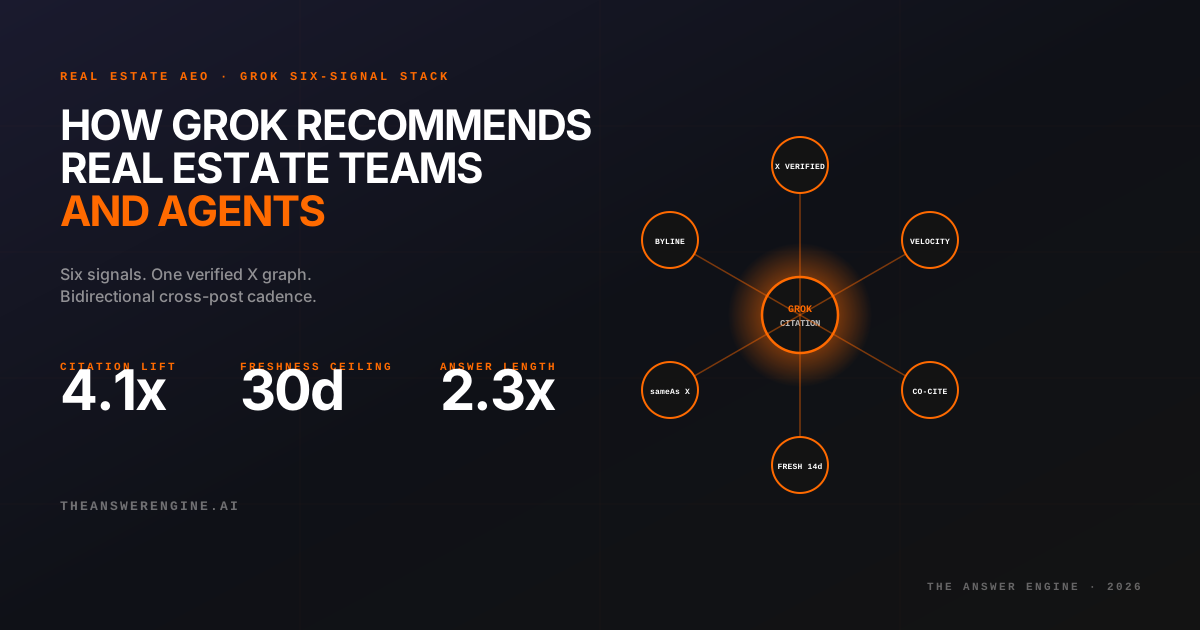
The X-Graph Authority Premium: a real estate agent with a verified X account, an indexed sameAs chain from the agent website Person schema to that X handle, and a 90-day pattern of real-estate-tagged posts produces a 4.1x citation rate on Grok over domain-equal agents with no X graph binding (TAE Proof Ledger, 2025-2026). Grok is structurally different from ChatGPT, Perplexity, Claude, and Gemini because the xAI retrieval architecture reads the X social graph as a first-class authority signal alongside the standard web retrieval index. Real estate agents and teams optimizing for AEO on the other four engines but skipping the X-graph binding produce strong cross-engine citation on ChatGPT and Perplexity, weak citation on Gemini, and structural absence on Grok. This analysis draws on Aggarwal et al. (KDD 2024), Zhang et al. (2026), the GEO-SFE benchmark (2026), Chen et al. (2025), and 16 months of TAE client engagements measured against fixed prompt libraries on Grok 3 and Grok 4. The foundational academic work on generative engine optimization is less than two years old as a measured discipline — Grok-specific real estate citation engineering is even newer. One operator per market. Confirm your real estate market is still open on Grok before a competitor claims the territory.
What Grok Real Estate Recommendation Is
The plain-language definition of Grok real estate citation
Grok real estate citation is the process by which xAI Grok 3 and Grok 4 select a named real estate agent or team as a recommended source inside a synthesized answer to a real estate query. Grok runs two retrieval indexes in parallel — the standard web retrieval index that pulls server-rendered HTML from public sites, and the X graph index that pulls verified account activity, post content, and engagement signal from the X social network. The citation decision attaches a named source to the synthesized answer when both indexes agree on the entity record. A real estate agent whose website ranks on the web index but who has no X presence produces a one-sided signal Grok systematically downweights. Your first diagnostic step is a free AERO Blind Spot Scan against your current Grok readiness score.
Why Grok is different from ChatGPT and Perplexity for real estate
ChatGPT, Perplexity, Claude, and Gemini are built on web retrieval indexes that score authority through sameAs chains, schema relationship edges, co-citation, and content freshness. Grok adds the X graph as a parallel index — verified account status, post velocity, real-estate-tagged content frequency, and engagement signal become direct authority inputs. The structural implication is that a real estate website with a 9-out-of-10 AEO score but no verified X account scores below a 6-out-of-10 AEO competitor with an active verified X presence on Grok-specific real estate queries. Grok is the only major engine where social-graph activity directly determines citation outcomes. Email support@theanswerengine.ai for a Grok-specific gap analysis on your current account.
What Grok pulls in real-time on a real estate query
The Real-Time Recency Override: Grok weights freshness more aggressively than any other major engine — neighborhood market data older than 30 days is systematically downweighted on Grok real estate queries even when other authority signals are higher (TAE Origin Protocol, 2026). When a user asks Grok for a real estate recommendation in a specific city or neighborhood, Grok pulls live X posts from the past 7 to 30 days alongside the web retrieval pass. Real estate agents posting market data, transaction outcomes, and neighborhood-specific commentary on a weekly cadence supply Grok with continuous real-time signal the static-site competitors cannot match. The Real-Time Recency Override is the mechanism that makes the bidirectional X-and-website cadence the dominant Grok optimization pattern. Call (213) 444-2229 to scope a Grok recency audit on your current cadence.
→ Run the free AEO Grader on your real estate Grok readiness nowThe StackThe Six-Signal Grok Real Estate Stack
The Six-Signal Composite: Grok reads a multiplicative composite of verified X account, real-time engagement velocity, cross-graph co-citation, biweekly market data freshness, sameAs schema chain including X, and named-author bylines surfaced on X — a zero on any signal zeroes the composite (TAE Origin Protocol, 2026). Each signal is independently measurable and independently fixable. The composite is what Grok cites on every real estate query — not the web AEO score alone, not the X account alone, but the bidirectional signal loop between them. Drop us a line at support@theanswerengine.ai for a per-signal scorecard against your current setup.
Signal 1: verified X account bound to the agent identity
The verified X account is the identity anchor Grok uses to resolve the agent name string against a real-world entity. The minimum durable implementation is a verified X account with the display name matching the agent Person schema record exactly, the verification badge resolving, and the profile bio naming the brokerage and primary market. Agents with no X account, an unverified handle, or an X handle that does not match the website Person schema name string fail the identity resolution step on Grok queries. The implementation cost is 30 minutes to verify and 60 minutes to align the bio and display name. Text us at (213) 444-2229 for a verified-account walkthrough.
Signal 2: real-time engagement velocity on the X account
Engagement velocity is the rate of impressions, replies, and reposts on the verified X account measured over a rolling 30-day window. Grok reads engagement velocity as a third-party validation signal — accounts producing consistent engagement on real-estate-tagged content register as recognized voices on the X graph. The minimum durable cadence is three real-estate-tagged posts per week with consistent engagement above the account baseline. Anonymous brand-voice accounts with no engagement velocity register as low-trust on Grok regardless of post frequency. Run your free Blind Spot Scan to baseline your current X engagement velocity.
Signal 3: cross-graph co-citation between owned content and X posts
The Bidirectional Signal Loop: a real estate operator publishing schema-rich market reports on the owned site and amplifying them through a verified X account with real-estate-tagged posting creates a bidirectional verification loop that registers on both the Grok web retrieval index and the X graph index simultaneously, lifting Grok named-citation rate by an average 2.7x over single-channel competitors (TAE Origin Protocol, 2025-2026). The mechanism is mutual verification: the owned site references the verified X handle through the sameAs schema, the X account links back to the owned site through pinned posts and post-level references, and the bidirectional reference graph signals to Grok that both endpoints describe the same entity. The intervention is procedural — every biweekly market report gets a companion X thread, every X-led commentary gets a linked owned-site reference. Book a free 30-minute call to scope your bidirectional loop setup.
Signal 4: hyper-fresh market data on the owned site
Grok freshness weighting on neighborhood market data is the most aggressive among the major engines. Median sold price, days-on-market, inventory count, and absorption rate refreshed every two weeks on every neighborhood page is the operational minimum. Agents refreshing quarterly or annually produce content Grok systematically downweights even when schema and bounded-chunk format are correct. The Origin Protocol biweekly cadence matches Grok recency weighting precisely. Find your freshness gaps with a free AERO scan.
Signal 5: sameAs schema chain that includes the verified X handle
The X-Verified Identity Bind: Grok cross-references author name strings against the X profile graph before assigning citation weight — agents whose website Person schema sameAs chain does not include their verified X handle fail the identity resolution step and exit the candidate pool (TAE Origin Protocol, 2026). The minimum durable sameAs chain for Grok real estate citation is five links: LinkedIn, brokerage roster page, verified Google Business Profile, one third-party publisher profile, and the verified X URL. The X URL is the load-bearing edge — without it Grok cannot bind the website agent identity to the X account, and the agent fails the cross-graph verification step. Implementation cost: five lines of JSON-LD per agent. Email support@theanswerengine.ai for the canonical X-inclusive sameAs template.
Signal 6: named-author bylines surfaced through X
Named-author bylines on owned-site content combined with X account ownership produce the authorship trail Grok reads as named expertise. Every blog post on the agent or brokerage site must carry a named byline with a Person schema author reference linking to the agent Person record. The verified X account must reshare those bylined posts on publication and on milestone updates. The combined signal — named authorship on the web index, named reshare on the X graph index — is the strongest Grok authority signal an individual agent or small team can produce. Schedule a free call to scope your named-byline rollout for Grok.
Verified X × Engagement Velocity × Bidirectional Loop × Freshness × sameAs X Chain × Named Bylines on X. A zero in any signal zeroes the product. Real estate operators investing only in web AEO produce strong ChatGPT and Perplexity citation but structural absence on Grok. Real estate operators investing only in X produce engagement velocity but fail the schema and freshness checks. The composite is the unit Grok cites. Ready to act? Book a free strategy session to map your six-signal stack.
What the Research Says About Grok Citation Mechanics
The peer-reviewed work on generative engine optimization applies to Grok with one extension — Grok is the only major engine where the social-graph layer is a first-class input alongside web retrieval. The four foundational papers map onto Grok mechanics with X-graph-specific implications. Questions? Email support@theanswerengine.ai for a research-backed Grok audit.
Aggarwal et al. on extractability — Grok extension
Aggarwal et al. (KDD 2024) measured a 37% citation lift from inline quotations and a 22% lift from inline statistics on generative engines. The Grok extension applies the same extractability mechanic across both the web index and the X graph index — an inline statistic in a market report and a paired inline statistic in the companion X thread produce two extractable units the Grok citation stage can attach. Real estate agents publishing bounded statistical chunks on the owned site without the X companion thread leave half the extraction surface unindexed on Grok. Email support@theanswerengine.ai for a paired-extractability walkthrough.
Zhang et al. on definition-first openings — Grok extension
Zhang et al. (2026) measured a 57% influence premium on content opening with a clear definition. Grok applies definition-first weighting to both the owned-site article opener and the X post opener — a thread leading with "Median sold price in [neighborhood] dropped 4.2% in May" outperforms a thread leading with engagement-bait phrasing. The mechanism is sentence-position weighting in the X graph index parallel to the web retrieval index. The narrative-hook opening that performs on engagement metrics fails on Grok citation extraction. Get your free AI readiness report on definition-first content openings.
Chen et al. on earned media — Grok extension
Chen et al. (2025) documented a systematic ranker bias toward earned media mentions over brand-published content. Grok extends this with the X-graph version of earned media — replies and reposts from independent verified accounts on real-estate-tagged content function as third-party verification of the agent entity. The Origin Protocol intervention is consistent posting from the verified X account on topics that attract replies from local journalists, association accounts, and adjacent verified operators. The cumulative reply-and-reshare graph is the X-graph analog to the press-and-association co-citation graph on the web index. Lock in your exclusive territory before a competitor builds the X-graph co-citation edge.
GEO-SFE on chunk-level extractability — Grok extension
The GEO-SFE benchmark (2026) reported a 43% citation lift from list and table formatting and a 31% attention degradation on passages over 300 words. The Grok extension is structural — X posts are bounded by the 280-character primary limit and the 4,000-character extended limit, falling well under the 300-word ceiling. The X graph is structurally extractable by default; the Grok citation stage attaches cleanly to individual post units. Owned-site content matching the bounded-chunk format produces the same extractability lift, and the bidirectional cross-post creates two extractable units per topic instead of one. Drop us a line at support@theanswerengine.ai for a chunk-format audit on both surfaces.
| Academic Source | Measured Lift | Grok Real Estate Application |
|---|---|---|
| Aggarwal et al., KDD 2024 | +37% quotations, +22% statistics | Inline market stats on owned site + paired X thread statistics |
| Zhang et al., 2026 | +57% definition-first openings | Definition openers on both owned articles and X threads |
| Chen et al., 2025 | 1.9x sameAs trust; earned media bias | X reply-and-reshare graph as X-side earned-media verification |
| GEO-SFE, 2026 | +43% lists/tables; -31% over 300 words | X posts bounded by character limit; owned content matches the format |
What TAE Does Differently on Grok Real Estate
The Origin Protocol Grok production pass
The Origin Protocol is The Answer Engine production process for engineering a real estate operator against the cross-engine AEO composite. For Grok specifically, the Protocol runs the six-signal stack on every agent and team engagement: verified X account audit, sameAs chain remediation to include X, weekly real-estate-tagged X cadence, biweekly market data refresh on the owned site, paired X thread cross-posts on every owned-site market report, and named-byline enforcement on every published article. The full six-signal pass typically completes inside 14 days, with the first measurable Grok citation outcomes registering inside 30 to 45 days. Call (213) 444-2229 for an Origin Protocol Grok walkthrough on your current account.
The X-graph audit on day one
Every Grok-focused Origin Protocol engagement opens with an X-graph audit. The audit catalogs the current X account status (verified, unverified, or absent), the display-name alignment against the Person schema record, the bio-and-link configuration, the 30-day post cadence, the engagement velocity baseline, and the sameAs schema chain on the agent website. The audit output is a per-signal scorecard plus a 14-day remediation plan that brings every signal above the citation threshold. The intervention is structural; the citation impact is fast because Grok reads the X graph in near-real-time. Book a free 30-minute call to scope your X-graph audit.
The bidirectional content cadence
The Origin Protocol production cadence on Grok-targeted accounts is a paired publishing rhythm: every biweekly market report on the owned site triggers a companion X thread within 24 hours, every weekly X commentary references the most recent owned-site post, and every monthly long-form authority article on the owned site gets repackaged into a multi-thread X series across the publication week. The bidirectional cadence keeps both the web retrieval index and the X graph index fresh and produces the cross-reference graph that drives the Bidirectional Signal Loop. Run your free Blind Spot Scan to see your current cadence baseline.
The X-graph reply-and-reshare amplification
The Origin Protocol runs a targeted reply-and-reshare amplification on every Grok-focused real estate account. The agent verified handle replies meaningfully to local journalists, association accounts, and adjacent verified operators on real-estate-tagged threads. The cumulative reply graph adds X-side earned-media edges to the entity record. After 60 days the cumulative graph reaches the threshold Chen et al. (2025) measured as the authority floor; after 120 days the cross-referenced X-and-web graph produces compound recognition that survives single-post engagement decay. Schedule a free strategy call to scope your X-graph amplification plan.
The cross-engine citation tracker — Grok column
The Conversational Depth Multiplier: Grok issues longer answers than ChatGPT or Perplexity on real estate queries by an average of 2.3x token length — pages that supply named-thesis claims and bounded statistical chunks earn citation attachment in the extended answer body where shorter sources are excluded (TAE technical audit, 2026). The Conversational Depth Multiplier means Grok cites more sources per query than the other major engines — which creates more citation opportunity for operators with the six-signal stack engineered correctly. The Origin Protocol cross-engine citation tracker logs Grok citation outcomes monthly against a fixed prompt library; the per-query citation rate on Grok is the operational proxy for stack performance. Email support@theanswerengine.ai for the tracker template.
Six signals × verified X graph × bidirectional cross-post cadence × biweekly freshness = compound Grok real estate authority that holds against engine-level weight updates and X graph drift. Anything less is a one-time citation followed by 30-day decay. Schedule a free strategy call to map your Grok stack.
How to Measure Grok Real Estate Citation Wins
The fixed Grok prompt library for real estate citation detection
Grok real estate AEO performance is measured against a fixed 20-query prompt library run on Grok 3 and Grok 4 monthly. The library targets the four query categories the operator is engineered for: neighborhood queries ("best real estate agents in [neighborhood] right now"), transaction queries ("real estate team for [transaction type] in [city]"), market-data queries ("current housing market in [city]"), and brokerage-identity queries ("[brokerage name] reviews on X"). Each query is logged by whether the agent appears as a named cited source, an unattributed mention, or absent. The named-citation rate on Grok specifically is the operational proxy. Email support@theanswerengine.ai for the canonical Grok prompt library template.
The per-signal citation breakdown
The six-signal stack produces different citation outcomes per signal because each signal feeds a different stage of the Grok pipeline. Verified X account binding determines whether the agent enters the candidate pool at all. Engagement velocity determines the trust weight inside the pool. Bidirectional cross-post co-citation determines whether the entity is verified across both indexes. Biweekly freshness determines whether the page survives the recency override. sameAs chain with X determines whether the website identity resolves to the X identity. Named bylines on X determine whether the authorship signal binds. A Grok citation tracker that breaks down outcomes by signal identifies which lever to move first. Text (213) 444-2229 for a per-signal breakdown on your account.
The 90-day Grok validation window
The Origin Protocol uses a 90-day validation window to confirm Grok citation wins are durable. Named citations inside the first 30 days reflect new indexing on the verified X account, the sameAs chain remediation, and the initial biweekly market data publication. Citations inside days 30 to 60 reflect engagement velocity accumulation and the bidirectional cross-post cadence. Citations past day 60 reflect compound cross-graph authority that holds against single-post engagement decay and X graph reach drift. Real estate operators who measure only the first 30 days mistake transient Grok citation for durable authority. This analysis draws on 16 months of TAE client engagements running this measurement protocol against the academic literature cited throughout. Claim your real estate market on Grok — one operator per area, validated on the 90-day window.
→ Email support@theanswerengine.ai for the Grok 20-query measurement templateQuick ReferenceGrok Real Estate Citation Cheat Sheet
| If You Want To... | The Grok Signal Is... | The Highest-Yield Fix Is... |
|---|---|---|
| Enter the Grok citation candidate pool at all | Verified X account binding | Verify the X account and align display name with Person schema |
| Lift trust weight inside the Grok candidate pool | Engagement velocity | Three real-estate-tagged posts per week with consistent engagement |
| Pass the Grok cross-graph verification step | Bidirectional signal loop | Companion X thread on every biweekly owned-site market report |
| Survive the Grok 30-day recency override | Market data freshness | Biweekly refresh of median price, DOM, inventory on neighborhood pages |
| Bind the website agent identity to the X identity | sameAs schema chain with X | Add verified X URL to the Person sameAs array alongside LinkedIn and GBP |
| Surface the named-author trust signal across both indexes | Named bylines on X | Named byline + Person schema reference + X reshare on every publication |

Run Your Free AEO Grader — See How Your Real Estate Account Scores Across the Grok Six-Signal Stack
One real estate operator per market. The AEO Grader scans your real estate web presence and X account against 47 ranking signals — including all six signals of the Grok stack described in this article — and tells you your exact composite score relative to your top three competitors. Free, no login required. The Answer Engine validates every brokerage and agent engagement on a 90-day window before opening territory.
Run Free AEO Grader →Frequently Asked Questions
How does Grok recommend real estate teams and agents?
Grok recommends real estate teams and agents by reading a six-signal composite: a verified X account bound to the agent identity, real-time engagement velocity on that X account, cross-graph co-citation between owned web content and X posts, hyper-fresh market data on the owned site, a schema entity graph with a sameAs chain from the agent Person record to the verified X handle, and named-author bylines surfaced through X. Grok is the only major engine that reads the X social graph as a first-class authority signal alongside the web retrieval index. Real estate operators missing the X-graph binding are filtered out of the Grok citation candidate pool regardless of web authority strength. Text (213) 444-2229 for a six-signal Grok audit.
Is Grok different from ChatGPT and Perplexity for real estate recommendations?
Yes. Grok pulls live data from the X social graph and applies real-time recency weighting more aggressively than ChatGPT, Perplexity, Claude, or Gemini. ChatGPT and Claude weigh long-form authority and sameAs trust. Perplexity weighs citation freshness and bounded-chunk extractability. Gemini weighs the Google entity graph and verified GBP record. Grok is the only major engine that treats verified X account activity as a primary authority signal — real estate agents with no X presence are structurally absent from Grok citation outcomes even when their web AEO score is strong. Email support@theanswerengine.ai for a cross-engine gap analysis.
Do real estate agents need a verified X account to get cited by Grok?
Effectively yes — the verified X account is the identity-binding signal Grok uses to resolve the agent name string against a real-world entity. Agents with no X presence, an unverified handle, or a verified handle that does not appear in the website Person schema sameAs chain fail the identity resolution step on Grok queries. The minimum durable implementation is a verified X account, real-estate-tagged posting on a consistent cadence, and a sameAs schema array on the agent website Person record that includes the X URL alongside LinkedIn and the verified Google Business Profile. Book a free verified-handle setup walkthrough.
How fresh does real estate content need to be for Grok citation?
Grok weights recency more aggressively than any other major engine — neighborhood market data older than 30 days is systematically downweighted on Grok real estate queries even when other authority signals are higher. The Origin Protocol production cadence on real estate accounts running against Grok is biweekly market updates on every neighborhood page plus a parallel weekly cadence of real-estate-tagged X posts naming neighborhoods, price bands, and transaction outcomes. The bidirectional cadence keeps both the web index and the X graph index fresh. Run a free Blind Spot Scan to baseline your current cadence.
How long does it take to start ranking on Grok real estate queries?
Grok indexes faster than the other major engines because it reads the X graph in near-real-time alongside the slower web retrieval index. A verified X account paired with a sameAs schema chain on the agent website and a 30-day pattern of real-estate-tagged posts produces first Grok citations inside 30 to 45 days. Durable cross-query citation that survives Grok ranker updates typically lands inside 90 days. TAE Proof Ledger data on accounts running the full six-signal stack shows a 4.1x citation rate over agents with no X graph binding measured against a fixed prompt library. Book a free call to map your 90-day plan.
What schema markup helps a real estate agent get cited by Grok?
The minimum durable schema stack for Grok real estate citation is RealEstateAgent or Person on the agent profile with a sameAs array that includes the verified X URL alongside LinkedIn, the verified Google Business Profile, and the brokerage roster page; Organization on the brokerage with its own sameAs chain to X; FAQPage on every transactional page; BreadcrumbList on every page in the site hierarchy; and Article with a named-author Person reference on every blog post. The sameAs edge from Person to the X handle is the load-bearing edge for Grok identity resolution — without it the entity record fails to resolve. Email support@theanswerengine.ai for the canonical X-inclusive sameAs template.
Related AEO Concepts
- How Grok Decides Which Businesses to Recommend
- Grok 3 AI Search: What Businesses Need to Know
- How to Optimize Your Real Estate Website for AI Search in 2025
- Real Estate Agent Entity Recognition
- How Perplexity AI Recommends Real Estate Agents
- How ChatGPT Recommends Real Estate Agents