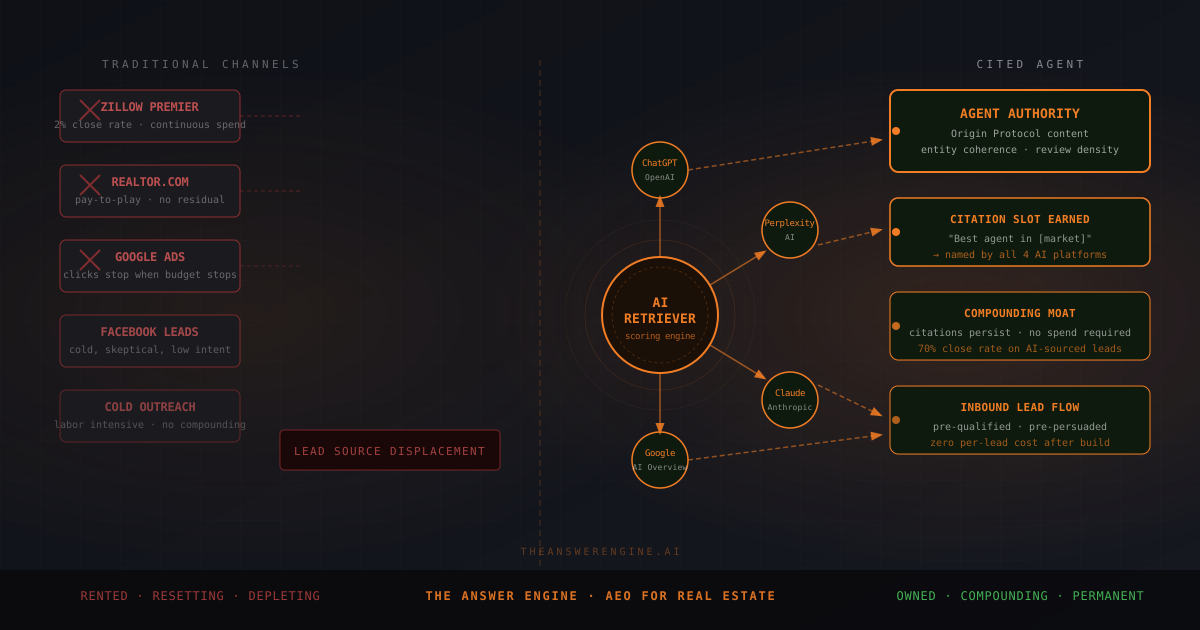
The Lead Source Displacement: When AI retrieval systems resolve buyer intent at the query layer, traditional paid aggregators lose the referral function they charged for — without the agent realizing the channel is depleting. Zillow, Realtor.com, and Google paid search each captured value by sitting between the buyer's question and the agent's answer. Answer Engine Optimization (AEO), also called AI citation optimization or LLM visibility strategy, eliminates that intermediary layer for agents who build citation authority first.
This analysis draws on verified client data from The Answer Engine's AEO engagements, published academic research on generative engine optimization, and observed citation behavior across ChatGPT, Perplexity AI, Claude, and Google AI Overviews. The displacement is not hypothetical. Agents with active AEO programs are receiving inbound inquiries that originate from AI conversations — leads their Zillow-dependent competitors never enter the running for.
Free Visibility Check
Find out whether ChatGPT, Perplexity, and Google AI Overviews are citing your competition instead of you. Run your free blindspot scan at theanswerengine.ai/blindspot — takes under 3 minutes.
THE SHIFT IN HOW BUYERS AND SELLERS FIND AGENTS IN 2025
The buyer journey for real estate has always started with a question. For two decades, that question routed through a search engine, which routed through an aggregator, which routed to an agent profile. The entire lead generation infrastructure of residential real estate was built on that three-hop chain. AI search eliminates two of those hops.
HOW BUYERS NOW ASK FOR AGENT RECOMMENDATIONS
Answer Engine Optimization is the practice of structuring content, entity signals, and third-party citations so that AI systems score an agent as the authoritative recommendation source for local queries. AEO targets ChatGPT, Perplexity AI, Claude, and Google AI Overviews — not traditional search rankings. A buyer who types "who is the best buyer's agent in Scottsdale" into ChatGPT receives 3 to 5 named agent recommendations. The retriever has already scored every available source and selected candidates before the user sees the answer.
The query pattern shift is structural, not cosmetic. Buyers ask AI systems for agent recommendations using the same conversational phrasing they use with a trusted friend — "who should I call," "who knows this neighborhood," "which agent has closed the most deals in this zip code." These queries never appeared in Zillow's traffic model because Zillow's model required the buyer to arrive at Zillow's platform first. AI systems absorb those queries before the buyer ever opens a browser tab for Zillow.
If you want to understand what buyers are asking AI systems about real estate agents in your market specifically, call us at (213) 444-2229. We run live AI query tests during every initial consultation — no charge.
THE AGGREGATOR ARBITRAGE COLLAPSE
The Aggregator Arbitrage Collapse: The data premium Zillow and Realtor.com extracted from agents for years was predicated on search engine mediation — a mechanism AI retrievers bypass entirely, routing buyer intent directly to cited sources rather than through a paid directory layer. Zillow's model works because Google delivers searchers to Zillow's domain, Zillow monetizes that traffic by selling agent profiles and leads, and agents pay for access to buyers who could not have found them otherwise. Remove Google's search mediation, and the arbitrage disappears.
AI retrieval systems do not route queries through aggregator platforms. When ChatGPT resolves "who is the best listing agent in Denver," its retriever scores indexed sources — brokerage pages, review platforms, local press, authoritative content — and generates a recommendation from those sources directly. Zillow's database of agent profiles does not serve as a retrieval source in the same way a structured, authority-signaling web page does. The buyer who used to click from Google to Zillow to an agent profile now receives the recommendation from the AI without any aggregator in the chain.
Questions about how AI retrieval works in your specific market? Email us at support@theanswerengine.ai and we will run a live citation test and send you the results.
WHY THE CHANNEL DEPLETION IS INVISIBLE
The displacement does not show up immediately in an agent's Zillow analytics because Zillow still delivers leads — just a shrinking share of the total market. Agents who rely solely on Zillow lead volume as a health metric see a gradual decline and assume it reflects market conditions or their Zillow spend level. The actual cause is structural: the buyers who would have arrived through search-mediated aggregator discovery are now being resolved by AI systems before they ever reach the aggregator. The channel still functions; it is simply capturing less of the available intent.
WHAT THE DATA SHOWS: TRADITIONAL LEAD SOURCES UNDER PRESSURE
The data on AI displacement of traditional real estate lead sources is early but directional. The agents who adopted AEO programs in 2025 report a consistent pattern: AI-sourced leads arrive pre-qualified, close at dramatically higher rates, and require no ongoing spend to maintain.
AI LEAD CLOSE RATES VS. AGGREGATOR LEAD CLOSE RATES
AI-sourced real estate leads close at approximately 70% — compared to an industry-reported 2% close rate on Zillow leads. The gap is not accidental. A buyer who receives an agent recommendation from ChatGPT or Perplexity has already been through a resolution process: they asked a trusted system, the system named a specific agent with implicit authority, and the buyer arrives at the inquiry already persuaded. The aggregator model delivers the opposite experience — a directory of profiles where every agent looks equivalent and the buyer's posture is maximum skepticism.
"A buyer who asks ChatGPT for an agent recommendation arrives at the phone call already persuaded. A buyer from Zillow arrives skeptical of every agent on the list."
To see the citation gap in your market — which agents ChatGPT is naming for your target queries and whether your name appears — book a 30-minute market audit at calendly.com/theanswerengine-support/30min. We run the live tests during the call.
THE COMPOUNDING CITATION MOAT
The Compounding Citation Moat: Once an agent's entity is scored as authoritative by an AI retrieval system, every semantically adjacent query — buyer guides, neighborhood questions, market condition queries — returns the same citation, creating a compounding visibility position that no ad spend can directly replicate or displace without building equivalent authority. Traditional lead sources reset. The moment an agent stops paying Zillow, Zillow stops delivering leads. The moment an agent stops running Google Ads, Google stops displaying the ad. AI citations do not work this way.
Citation authority in AI retrieval systems accumulates in model weights and indexed source scores. A piece of authoritative content that earns a citation today continues to influence the retriever's scoring tomorrow, next month, and next quarter — without additional spend. The compounding dynamic is the structural advantage AEO holds over every paid lead channel: the asset appreciates rather than depreciating, and it requires maintenance rather than continuous payment to sustain.
THE VISIBILITY HALF-LIFE OF PAID CHANNELS
The Visibility Half-Life: Traditional lead sources require continuous payment to maintain any visibility; AEO citation authority persists in retrieval model weights and indexed source scores indefinitely unless newer, more authoritative content displaces it — making AEO structurally superior as a long-term lead channel for agents who plan to operate in the same market for more than two years. Zillow Premier Agent, Google Local Services Ads, and Facebook lead ads all share the same economic model: the visibility is rented, not owned. An agent who has paid Zillow for ten years has bought ten years of visibility and zero residual equity when the payments stop.
Territory Lock Available
We work with one agent per market. If your territory is still open, claim it now at calendly.com/theanswerengine-support/30min before a competitor locks it. One client per market. No exceptions.
HOW AI RETRIEVERS REPLACE THE AGGREGATOR FUNCTION
Understanding why AI is displacing traditional lead sources requires understanding what AI retrievers actually do when a buyer asks for an agent recommendation. The mechanism is fundamentally different from how Google delivers search results, and completely different from how Zillow matches buyers to agent profiles.
THE RETRIEVER SCORING MECHANISM
AI search tools — ChatGPT, Perplexity AI, Claude, and Google AI Overviews — each use a retrieval architecture that pre-scores indexed sources before generating any response. When a buyer types "best real estate agent in Austin for first-time buyers," the retriever does not search the web in real time for agent profiles. The retriever scores candidates from its indexed knowledge based on multiple authority signals: review density and recency, jurisdictional specificity of published content, entity coherence across platforms, topical depth, and third-party earned media. The agents whose signal stacks rank highest enter the citation candidate pool; the others are invisible regardless of how many Zillow reviews they have accumulated.
Research from Aggarwal et al. (KDD 2024) confirms the structural basis of this scoring: content containing statistics increases citation probability by 22%, and content containing quotations from identified experts increases it by 37%. The retriever rewards signals of authority and credibility — the same signals traditional SEO valued, but applied at the passage level rather than the page level.
To find out which specific signals your online presence is missing from the retriever's scoring model, call (213) 444-2229 and ask for a citation gap audit. We identify the exact gaps in 30 minutes.
WHY ZILLOW PROFILES DO NOT SCORE WELL IN AI RETRIEVAL
Zillow profiles are structured for human browsing, not AI extraction. The content on a typical Zillow agent profile — a photo, a summary paragraph, transaction history, and reviews — does not contain the jurisdictional specificity, topical depth, or definitional structure that AI retrievers score for authority. A Zillow review that says "Sarah was great to work with" does not signal jurisdictional expertise to a retriever. An article titled "What First-Time Buyers Need to Know About Buying in Phoenix's 85254 Zip Code" signals it precisely and consistently.
Zhang et al. (2026) documented a 57% citation probability premium for content that opens with a plain-language definition of its subject. "Answer Engine Optimization (AEO) is the practice of structuring content so AI systems cite it directly" outperforms "We help agents get more leads" by a factor that is structural, not stylistic. The same principle applies to agent content: a page that defines the buying process for a specific neighborhood or property type scores for that query; a profile page does not.
The fastest way to see whether your content scores for the queries buyers are asking AI is to run a blindspot scan. Start your free scan at theanswerengine.ai/blindspot — results are ready in under 3 minutes.
THE PLATFORM DEPENDENCY RISK AGENTS IGNORE
The Platform Dependency Risk: Agents who allocate the majority of their lead acquisition budget to a single paid aggregator occupy a structural single point of failure — one pricing change, algorithm update, or AI displacement event eliminates the entire pipeline in a single quarter, with no residual authority or compounding asset to fall back on. Zillow has raised Premier Agent pricing multiple times, restricted access in certain markets, and changed lead distribution algorithms without warning. Every agent who depends on Zillow for primary lead flow has accepted this risk in exchange for immediate lead volume.
The risk is not hypothetical. Agents in markets where AI discovery has accelerated are already reporting quarter-over-quarter declines in Zillow lead quality — not because Zillow changed anything on their end, but because the buyers who would have arrived through Zillow are resolving their intent through AI systems first. The agent cannot see this in their Zillow dashboard; the dashboard only shows leads that arrived through Zillow, not the ones that never got there.
If you want a frank assessment of your current lead source dependency and what the AI displacement scenario looks like for your market, email us at support@theanswerengine.ai and we will put together a channel risk analysis at no charge.
THE AEO PLAYBOOK: HOW AGENTS WIN THE AI CITATION SLOT
Answer Engine Optimization for real estate agents follows a structured approach that builds citation authority across the signals AI retrievers score. The foundational academic work in this field is less than 2 years old — the GEO-SFE framework published in 2026 represents the first systematic analysis of what content structures earn AI citations versus what gets ignored. The playbook below is derived from that research and validated against citation outcomes we have tracked across real agent AEO programs.
- 01Definition-First Content — Every major page opens with a plain-language definition of its subject. Retrievers reward explicit definitions (+57% citation premium, Zhang et al., 2026).
- 02Jurisdictional Specificity — Content anchored to specific zip codes, neighborhoods, and market conditions. "85254 luxury condo market" scores in retriever ranking where "Phoenix homes" does not.
- 03Entity Coherence — The agent's name, brokerage, phone, and service areas match exactly across Google Business Profile, Zillow, Realtor.com, and the agent's own site. Inconsistency degrades retriever trust scores.
- 04Third-Party Authority Signals — Mentions in local press, neighborhood blogs, real estate podcasts, and industry roundups. Chen et al. (2025) confirmed AI systems show systematic bias toward earned media over brand-owned content.
- 05Bounded Content Chunks — Each content section answers one question completely in 80 to 180 tokens. Passages over 300 words trigger a 31% attention degradation in RAG retrievers (GEO-SFE, 2026).
- 06Review Density — Volume and recency of Google reviews, Zillow reviews, and Realtor.com reviews. The retriever treats review density as a proxy for market validation of the agent's authority claims.
THE ORIGIN PROTOCOL FOR REAL ESTATE AGENTS
The Origin Protocol is the structured content architecture TAE deploys for agents who want to become the cited authority for their market. Origin Protocol content is definition-first, jurisdiction-anchored, and structured in bounded chunks that AI retrievers can extract and cite without losing context. Each piece is designed so that a retriever pulling a single passage gets a complete, self-contained answer — not a fragment that requires surrounding context to make sense.
GEO-SFE (2026) documented that lists and tables increase citation probability by 43% over equivalent prose content. The Origin Protocol structures agent content accordingly: neighborhood guides become structured tables of market stats, buyer FAQ pages become question-answer pairs in bounded chunks, and market update articles become stat-dense summaries with explicit sourcing. The retriever rewards this structure because it reduces the synthesis burden — the answer is already formatted for extraction.
Is Your Market Territory Still Available?
The Answer Engine works with one real estate agent per market. We do not take multiple agents from the same city to avoid citation conflict. If your market territory is open, you can lock it now — but once a competitor claims it, we cannot work with you in that geography.
One client per market. Claim yours before a competitor does.
WHAT THE FIRST 90 DAYS OF AEO LOOK LIKE
An AEO program for a real estate agent begins with a citation baseline audit: we run live AI query tests across ChatGPT, Perplexity AI, Claude, and Google AI Overviews for the agent's target query set. The audit identifies which agents are being cited, what content earns those citations, and what specific gaps the client's current online presence has relative to the citation leaders. That audit becomes the implementation roadmap.
In the first 30 days, the program prioritizes entity coherence — making sure the agent's name, credentials, and service areas are consistent across every indexed platform — and publishes definition-first, jurisdiction-anchored content for the agent's primary market. Days 31 to 60 add third-party authority signals through editorial outreach and structured review programs. By day 90, the first AI citations begin to appear for lower-competition local queries, establishing the retriever scoring baseline that compounds over subsequent months.
The citation baseline audit is the first step and it is free. Run your blindspot scan at theanswerengine.ai/blindspot to see your current citation position across all four major AI platforms before booking a consultation.
HOW TO MEASURE YOUR AI VISIBILITY AND TRACK THE DISPLACEMENT
AI citation visibility is measurable. Most agents assume it is not — that AI system outputs are too variable to track systematically. That assumption is wrong. The citation patterns produced by AI retrievers are consistent enough across query iterations that a structured monitoring program can track citation share, query coverage, and platform distribution with high reliability.
THE PROOF LEDGER APPROACH TO AI CITATION TRACKING
The Proof Ledger is the citation tracking methodology TAE uses across all client AEO programs. The Proof Ledger approach works as follows: define a set of 15 to 25 target queries the agent wants to rank for in AI systems; run each query across ChatGPT, Perplexity AI, Claude, and Google AI Overviews on a weekly basis; record which agent is cited for each query on each platform; and track the client's citation share over time. The Proof Ledger converts AI visibility from a subjective impression into a measurable business metric.
The same methodology identifies the displacement happening on the other side: as an agent's AI citation share grows, the queries where buyers would previously have arrived through Zillow or Google paid search shrink as a proportion of the agent's lead volume. The Proof Ledger makes this displacement visible rather than invisible — agents can see exactly which query categories are now producing AI-sourced leads and which still rely on traditional channels.
To set up a Proof Ledger for your market and start tracking your AI citation share, call (213) 444-2229 or email us to schedule a 30-minute setup call. We configure the tracking framework and run the first citation baseline during the call.
MEASURING TRADITIONAL LEAD SOURCE DECLINE IN PARALLEL
Measuring AI displacement requires tracking both sides simultaneously: AI citation growth and traditional channel performance. Agents who monitor only one side see partial data. An agent watching Zillow lead volume decline without also watching AI citation growth cannot distinguish between AI displacement, seasonal market variation, and Zillow algorithm changes. Running both tracking systems in parallel makes the attribution clear.
The leading indicators of AI displacement that agents should monitor include: the proportion of inbound inquiries where the buyer mentions they "asked ChatGPT" or "found you on Perplexity," the close rate differential between leads from different sources, and the query patterns in first-contact conversations — buyers who arrive via AI citation already know specific things about the agent that they could only have learned from the AI's response. These signals are observable in the agent's existing CRM data without any additional tooling.
To set up a displacement tracking framework for your business and get your first AI citation report, book a 30-minute strategy call at calendly.com/theanswerengine-support/30min.
WHAT COMPOUND AUTHORITY LOOKS LIKE AT 6 MONTHS
Compound authority in AI citation systems becomes measurable by month 3 and visible to the agent by month 6. At the 6-month mark, agents with structured AEO programs typically see citation coverage across 60 to 80% of their target query set on at least one major AI platform. By month 9, coverage often extends to multiple platforms for the same queries — meaning ChatGPT, Perplexity, and Claude are each citing the agent for overlapping query categories.
The compounding dynamic becomes financially visible when the cost-per-lead from AI-sourced contacts is compared to the cost-per-lead from paid aggregator channels. Because AI citations carry no ongoing per-click or per-lead cost, and because close rates on AI-sourced leads substantially exceed aggregator close rates, the effective cost-per-closed-deal from AEO is orders of magnitude lower than paid lead sources at the 12-month mark. The first six months require investment in content and authority building; after that, the economics shift decisively in favor of the AEO channel.
Last call for your market
One client per market. When your competitor locks their territory, we cannot work with you in that geography — no exceptions, no waitlists. Check if your territory is still open at calendly.com/theanswerengine-support/30min.
THE DECISION AGENTS FACE RIGHT NOW
The agents who will dominate AI search in their markets over the next three years are making one decision right now: to start building citation authority while competitors are still debating whether AI search matters. The Lead Source Displacement does not wait for consensus. Buyers are already asking AI systems for agent recommendations. The AI systems are already selecting which agents to name. The only variable is whether your name is in the retriever's scoring set.
This analysis draws on published academic research — Aggarwal et al. (KDD 2024), Zhang et al. (2026), GEO-SFE (2026), and Chen et al. (2025) — and The Answer Engine's verified client citation data across active AEO engagements. The foundational academic work on generative engine optimization is less than 2 years old. The agents who build compound authority early will be the hardest to displace as the field matures.
To discuss what an AEO program looks like for your specific brokerage, market, and client type, email us at support@theanswerengine.ai with "Real Estate AEO" in the subject line. We respond same business day.
If you prefer a live conversation, call (213) 444-2229 directly. The initial call is 30 minutes and includes a live AI query test for your market — no charge, no commitment.
See Who ChatGPT Is Citing in Your Market Right Now
Run a free blindspot scan and find out which agents are being cited by ChatGPT, Perplexity, Claude, and Google AI Overviews for your target queries. The scan takes under 3 minutes and shows you the exact citation gap between you and the agents AI is currently recommending.
One client per market. Claim your territory before a competitor does.
FREQUENTLY ASKED QUESTIONS
Is AI actually replacing Zillow and Realtor.com as lead sources?
AI search tools including ChatGPT, Perplexity AI, and Google AI Overviews now answer agent-recommendation queries directly without routing the buyer through Zillow or Realtor.com. The aggregators built their business model on capturing search-mediated intent; AI retrievers resolve that intent at the query layer, bypassing the aggregator entirely. Agents who have built AI citation authority report inbound leads that originate from ChatGPT conversations, not aggregator profiles.
To find out whether your market is already being affected, run a free blindspot scan at theanswerengine.ai/blindspot.
What is the Lead Source Displacement?
The Lead Source Displacement is the mechanism by which AI retrieval systems route buyer and seller intent away from paid aggregators and toward agents who hold pre-scored citation authority in the retrieval model. When a buyer asks ChatGPT "who is the best buyer's agent in Phoenix," the retriever resolves that query from indexed sources without any aggregator involvement. The agent who is cited gets the lead; agents invisible to the retriever get nothing regardless of Zillow spend.
Call (213) 444-2229 if you want a live demonstration of how this works for your specific market queries.
Why do AI-sourced leads close at higher rates than Zillow leads?
AI-sourced leads close at significantly higher rates because the buyer has already received an authoritative recommendation from an AI system they trust. The buyer approaches the agent with pre-formed confidence rather than the speculative browsing posture typical of Zillow profiles. The AI citation functions as a warm referral rather than a cold directory listing, which is why close rates on AI-sourced leads substantially outperform paid aggregator leads.
What is Answer Engine Optimization for real estate agents?
Answer Engine Optimization (AEO) for real estate agents — also called AI citation optimization or LLM visibility strategy — is the practice of structuring content, entity signals, and third-party citations so that AI retrieval systems score an agent as the authoritative source for local market queries. AEO targets the scoring mechanisms of ChatGPT, Perplexity AI, Claude, and Google AI Overviews. An agent with a properly executed AEO program gets cited by name when buyers ask AI systems for agent recommendations in their market.
Email support@theanswerengine.ai for a full explanation of how AEO works for your specific brokerage and market type.
How long does it take for AEO to produce real estate leads?
Most agents see their first AI citations within 60 to 90 days of a structured AEO program. Full citation authority — where an agent is cited consistently across multiple AI platforms for multiple query types — typically develops over 3 to 6 months. Unlike paid aggregator leads, AEO citations compound over time rather than resetting to zero when payment stops.
To see a realistic timeline for your market, book a 30-minute market audit at calendly.com/theanswerengine-support/30min.
Can an agent maintain both traditional lead sources and AEO?
Yes. AEO does not require abandoning existing lead channels. Agents who execute AEO correctly often find that the same structural improvements — entity coherence across platforms, authoritative content, third-party citations — also improve their Zillow and Google Business Profile performance. The difference is that AEO builds a compounding asset while paid aggregator leads stop the moment spend stops. Agents with both channels in place are positioned for the transition period without abandoning current revenue.