What AEO For Commercial Real Estate Agents Actually Means
Answer Engine Optimization for commercial real estate agents is the discipline of engineering a broker website so AI engines retrieve and cite it when a tenant, investor, or owner asks a commercial real estate question. AEO - also called AI citation optimization or LLM visibility work - replaces the click-for-rank logic of search with a retrieval-for-citation logic. The CRE Citation Vacuum: most commercial real estate markets have no broker publishing structured, extractable answers, so AI engines fall back on generic aggregator data and the metro-and-asset-class citation slots sit unclaimed for the first broker who fills them (GEO-SFE, 2026). That single fact is the opportunity. To see whether AI engines can read and cite your brokerage site today, run the free AI visibility scan.
Commercial Real Estate Search Has Moved Into AI Engines
Commercial real estate decisions now begin in an AI assistant. A corporate tenant asks ChatGPT which submarket fits a 40,000-square-foot requirement; an investor asks Perplexity what a stabilized cap rate should be for suburban industrial; an owner asks Claude who the credible leasing broker is in a metro. Each engine returns one synthesized answer with a short stack of cited sources rather than a list of ten links. For a commercial real estate agent, visibility is now binary: the brokerage is the cited source, or it is absent from the decision entirely. To check which broker the engines currently cite for your core submarket, text (213) 444-2229 for a 24-hour AI visibility diagnostic.
Why CRE Citations Compound Differently Than Residential Listings
Commercial real estate citations compound on expertise, not inventory. Residential search rewards listing volume and portal syndication; commercial decisions turn on submarket interpretation, cap-rate judgment, and proprietary comps that aggregators do not hold. AI engines reward exactly that kind of specific, sourced expertise, which is why a focused commercial broker can earn citations a national portal cannot. The compounding effect is real - a brokerage cited for one asset class becomes easier to retrieve for adjacent ones. To map your fastest path from invisible to cited, book a 30-minute CRE AEO strategy call.
The Citation Slots In Most CRE Markets Are Still Open
Commercial real estate is one of the least-optimized verticals in AI search. Few brokers publish definition-first, extractable content, so the engines have thin material to cite and default to aggregators or national publications. The Tenant-Query Gap: the highest-intent commercial searches - best submarket for a specific tenant requirement, target cap rate for an asset class in a metro - are answered today from generic aggregator data, so the broker who publishes the specific answer captures the retrieval slot outright (Chen et al., 2025). The window is open because the field is young, and incumbency in AI citation compounds. To claim your metro-and-asset-class position before a competing brokerage does, lock your exclusive territory now - one operator per market.
Answer Engine Optimization is a measurable channel less than two years old - the foundational academic work on generative-engine citation behavior is barely past its first publications, and commercial real estate is further behind than most verticals. The brokerages that lock structured content and cross-surface parity now establish citation incumbency before the field saturates across the 2025-2026 cycle. To reserve your market position while the slots are open, claim your territory before a competitor does - one brokerage per market.
How AI Engines Pick Which Commercial Broker To Cite
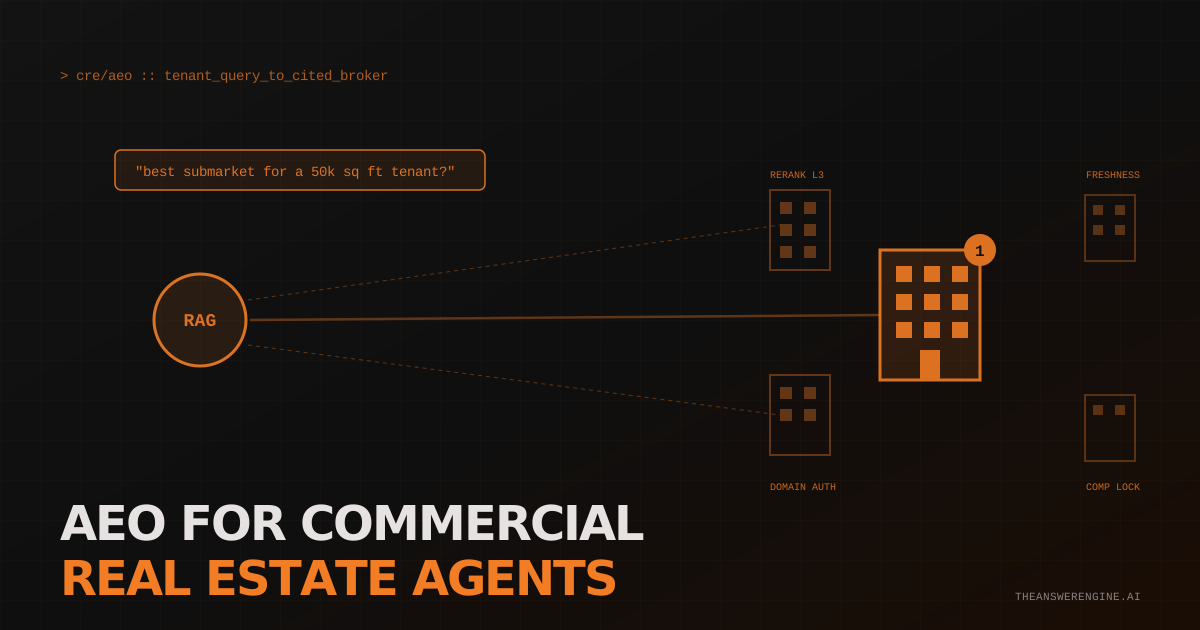
AI engines run on Retrieval-Augmented Generation (RAG). Retrieval-Augmented Generation is an architecture that grounds every answer in real web sources retrieved at query time instead of generating text from memorized patterns. The pipeline has three stages, and understanding each one tells a commercial real estate agent exactly where a citation is won or lost. For a custom walkthrough of where your brokerage pages drop out of that pipeline, email support@theanswerengine.ai for a CRE retrieval audit.
Retrieval Rewards The Direct Tenant And Investor Answer
Retrieval is the first gate. When a tenant or investor asks a commercial real estate question, the engine retrieves pages that answer it directly. A brokerage page built around keyword repetition - "premier commercial real estate services in [city]" - without a clear answer fails this stage before any authority signal applies. The practical rule: every important section must lead with the answer stated plainly in its first sentence, so the retriever recognizes the passage as a direct response to the query. To find which of your brokerage pages fail the retrieval gate today, find your structured-data gaps with a free Blind Spot Scan.
Reranking Rewards Proprietary Comps And Freshness
Reranking is where most commercial real estate pages are eliminated. The engine scores each retrieved page on relevance, domain authority, content freshness, and extractability, then keeps only the top candidates. The Comp Lock: when a brokerage publishes proprietary lease comps, absorption figures, or cap-rate data that no aggregator holds, the reranker cannot find an equivalent source, so the brokerage page survives the rerank and the citation routes to it (Aggarwal et al., KDD 2024). Freshness compounds the effect - a market page updated this quarter outranks a stale annual report on the same query. Questions on the right refresh cadence for your submarket reports? Text (213) 444-2229 to see which brokerage holds your slot.
The AI engine does not decide whether to cite sources - the architecture requires it. If a brokerage passage provides the factual basis for part of an answer, the citation is automatic. The entire job is becoming the source the reranker keeps. To pressure-test your brokerage pages for reranking readiness, book a call to review your reranking gaps.
Generation Makes The Comp Citation Mandatory
Generation is the stage commercial brokers misunderstand. The engine synthesizes the surviving sources into one answer and attaches a citation to every source it quotes. There is no editorial choice to cite - when a passage supplies a comp or a definition, the citation is mandatory. This is why the originality of brokerage data matters so much: if a brokerage is the only page carrying a specific submarket lease rate, the engine has no alternative source to quote, and the citation routes to that brokerage. To request the template we use to package proprietary CRE data for retrieval, email support@theanswerengine.ai for the comp-packaging template.
The EvidenceWhat The Research Says About Commercial Real Estate Citations
AEO strategy for commercial real estate should rest on the generative-engine optimization literature, not on Google-era folklore. Four findings govern which passages get cited, and each maps to a concrete editing decision for a brokerage site. This analysis draws on the published GEO research and on verified client engagements where we moved citation rates on a fixed query panel. To get the same analysis run against your brokerage pages, see your current CRE citation rate - free scan.
| Research Finding | Effect On Citation | Source |
|---|---|---|
| Open passages with a clear definition (cap rate, NNN, absorption) | +57% influence premium | Zhang et al., 2026 |
| Back a claim with verifiable comp statistics | +22% citation rate | Aggarwal et al., KDD 2024 |
| Cite quotations from authoritative market sources | +37% citation rate | Aggarwal et al., KDD 2024 |
| Format comps and benchmarks as lists and tables | +43% retrieval lift | GEO-SFE, 2026 |
| Market-report passages over 300 words | -31% extraction accuracy | GEO-SFE, 2026 |
Definitions And Statistics Win Commercial Queries
The strongest controllable signals are definition-first writing and verifiable statistics. The Definition Premium: a brokerage page that opens an answer chunk with a clear definition of a commercial term - cap rate, triple-net, tenant improvement allowance - earns a 57% higher citation probability than content that buries the definition mid-report, because the retriever extracts the opening sentence as the answer (Zhang et al., 2026). Statistics compound the effect: Aggarwal et al. (KDD 2024) found that adding verifiable statistics lifts citation rate 22% and citing authoritative quotations lifts it 37%. The editing instruction is direct - define the commercial term in sentence one, then back the claim with a specific comp. To have your top brokerage pages rewritten to this standard, schedule a free 30-minute consult.
Bounded Chunks Beat Long Market Reports
Passage length is a hard ceiling, not a style preference. The Chunk Ceiling: market-report passages over 300 words trigger a 31% attention degradation in RAG retrievers, so splitting a quarterly report into bounded units of roughly 80 to 180 tokens restores full extraction accuracy (GEO-SFE, 2026). A wall of market-report prose forces the retriever to choose which fragment to quote and often quotes none. The same study found that lists and tables earn a 43% retrieval lift over equivalent prose, because a comp table is trivially extractable. Break every long market section into short, self-contained chunks and convert comp comparisons into tables. To audit your brokerage pages for the chunk ceiling, check whether AI engines can read your site - free scan.
Earned Authority Outweighs The "Top Broker" Claim
AI engines do not take a brokerage page's word for its own authority. The Principal-Trust Signal: generative engines show a systematic preference for earned, third-party corroboration over self-description, so a broker whose credentials and deal history reconcile across LinkedIn, license records, and industry directories outranks a page that merely calls itself the top commercial team (Chen et al., 2025). A page claiming "the leading industrial broker in the region" with no external corroboration fails against a broker whose claims are mirrored on directories, association profiles, and verified deal records. The work is to make core claims verifiable off the brokerage domain. To map where your authority signals are missing, text (213) 444-2229 and we will map your citation gaps.
Market content left unrefreshed for more than a quarter loses retrieval share on AI engines right now, regardless of how strong it was at publication. The freshness gradient is unforgiving in commercial real estate, where comps and cap rates move - a competing brokerage that updates a thinner submarket page this quarter can displace a stronger, stale report. If your best market pages have not been touched this quarter, they are bleeding citations today. To set a refresh cadence that holds your slot, book a consult to map your refresh cadence.
The CRE AEO Playbook: Five Moves That Earn The Citation
Knowing the mechanism is not the same as getting cited. These are the five moves we run to convert an invisible brokerage site into a cited source across ChatGPT, Perplexity, Claude, and Gemini, ordered by speed to result. The first two register within weeks; the last three compound into permanent authority. To have this playbook executed on your brokerage domain, claim your market territory before a competitor does - one brokerage per metro.
Move 1: Publish Definition-First Asset-Class Pages
The fastest lever is a set of definition-first asset-class pages - office, industrial, retail, multifamily, and land - each opening with a plain-language definition and the answer to the core tenant or investor question. Update statistics to the current quarter, stamp a fresh last-modified date, and break each section into bounded chunks. Because AI engines reward freshness and extractability, this move can change retrieval within one to two weeks. To find your highest-value pages to build first, run a free Blind Spot Scan to baseline your visibility.
- Lead with the answer. The first sentence of each section states the submarket or cap-rate fact directly.
- Define the term first. Open chunks with a plain definition of cap rate, NNN, or absorption for the 57% premium.
- Keep chunks under 180 tokens. Stay below the 300-word extraction ceiling on market reports.
- Back claims with comps. Specific lease and sale statistics earn a 22% citation lift.
- Format benchmarks as tables. Comp tables earn a 43% retrieval lift.
- Stamp a fresh quarter date. Recency is a proxy for accuracy on moving markets.
Move 2: Release Proprietary Comp And Cap-Rate Data
The most reliable path to a mandatory citation is proprietary data. The Originality Lock: when a brokerage page is the sole source for a specific lease comp, absorption figure, or cap-rate benchmark, the engine has no alternative to quote and must attribute the figure to that brokerage, converting unique data into a non-negotiable citation (Aggarwal et al., KDD 2024). Publish proprietary numbers a national aggregator cannot match: submarket lease comps from your own deals, a tenant-improvement benchmark survey, a quarterly absorption read with your interpretation. CoStar carries inventory; it does not carry your local read. To build your first proprietary-data asset, email support@theanswerengine.ai to request the comp-data checklist.
Move 3: Lock Cross-Surface Broker Identity Parity
AI engines triangulate a broker across the surfaces they index before trusting the brokerage. Matching name, license, brokerage, specialization, and core claims across your site, LinkedIn, CoStar and LoopNet profiles, association directories, and license records tells the reranker the entity is real and consistent. Mismatched details split the signal and suppress retrieval. Cross-surface parity is the highest-impact structural move because it lifts retrieval across every engine that shares those surfaces. To audit your parity across surfaces, text (213) 444-2229 for a structured-data audit.
Move 4: Build The Asset-Class Cluster
AI engines trust breadth. The Asset-Class Cluster: a brokerage domain cited across one asset class accrues compounding retrieval trust, so breadth of citation - office to industrial to retail to multifamily - lifts the citation probability of every page on the domain (Chen et al., 2025). If an engine already cites your site for one submarket question, it more readily retrieves you for adjacent ones. Publishing a full cluster - every question a tenant, investor, or owner asks before they transact - builds a flywheel where each new citation reinforces the whole domain. To plan your cluster, reserve your metro before a rival brokerage claims it - one operator per market.
Move 5: Earn Third-Party Corroboration
The final move answers the earned-media bias. Get core brokerage claims mirrored off your own domain - verified deal records, genuine client references, mentions on association and industry sites, and a consistent broker entity across platforms. AI engines cross-reference broker and brokerage entities across the web, and a claim corroborated by independent sources outranks the same claim made only on your site. To map your fastest corroboration wins, get your free AI visibility report.
Start with Move 1 (definition-first asset-class pages) for wins inside two weeks, then Move 2 (proprietary comp data) for mandatory citations. Cross-surface parity, the asset-class cluster, and third-party corroboration compound over 30 to 180 days into permanent authority. To sequence these for your market, email support@theanswerengine.ai to set up your ledger.
How To Measure Whether You Are Being Cited For CRE Queries
AI citation performance is invisible to standard analytics because many answers produce no click. Measuring it requires a purpose-built surface, not Google Analytics. The Deal-Cycle Ledger: a fixed panel of real buyer, tenant, and investor queries run monthly inside ChatGPT, Perplexity, Claude, and Gemini - logging whether the engine cites you, cites a competitor, or cites no one, and at what position - converts an untrackable channel into a citation rate you move month over month. This is the only metric that matters in AI search, because position in the answer is the product. To set up your ledger, book a consult to map your refresh cadence and ledger.
Build A Deal-Cycle Query Panel
A Deal-Cycle Ledger begins with a fixed panel of the real questions your clients ask the engines - "best submarket for a 50,000 sq ft industrial tenant in [metro]," "what cap rate for suburban office in [city]," "who is the top retail leasing broker in [area]." Run the same panel every month so movement is comparable, and record three outcomes per query: cites you, cites a competitor, cites no one. The competitor column tells you which brokerage holds the slot you want. To build your panel from your actual deal-cycle questions, text (213) 444-2229 to start your CRE query panel.
Pair The Ledger With Deal-Source Attribution
The ledger measures visibility; a how-did-you-find-us field measures pipeline. Add the question to every inbound deal inquiry and tag any AI-sourced lead with a distinct source label. Together the ledger and the attribution field convert an invisible channel into a citation rate tied to real commercial pipeline, so you can prove the channel pays. To wire attribution into your deal flow, reach us at support@theanswerengine.ai.
AI citation is a compounding authority channel for commercial real estate, not a paid-ad switch. Every citation reinforces a brokerage domain's retrieval trust, so early structural wins accelerate later citation rates instead of decaying when you stop paying. The brokerages that publish citable submarket content today own the answer slot tomorrow. To claim your slot before a competitor locks it, secure your market slot before a rival brokerage claims the citation.
If a commercial broker can earn the citation in one engine, they are positioned for every AI platform. The ranking factors - definitions, proprietary comps, bounded chunks, cross-surface parity - overlap across ChatGPT, Perplexity, Claude, and Google AI Overviews. We work with one brokerage per market. Check if yours is still open.
Frequently Asked Questions
What is AEO for commercial real estate agents?
Answer Engine Optimization (AEO) for commercial real estate agents is the practice of engineering a broker website so AI engines like ChatGPT, Perplexity, Claude, and Gemini retrieve and cite it when a tenant, investor, or owner asks a commercial question. CRE search has moved into AI assistants that synthesize one answer with cited sources. AEO makes the broker the cited source through definition-first asset-class pages, proprietary comp data, bounded answer chunks, and identity that reconciles across CoStar, LoopNet, LinkedIn, and license records.
The fastest start is publishing definition-first asset-class pages, which can move retrieval within two weeks. To baseline your visibility, run a free AI visibility scan.
How is AEO different from SEO for a commercial real estate broker?
SEO competes for a ranked position on a results page a searcher clicks; AEO competes to be retrieved into the single synthesized answer an AI engine returns with citations. On Google, ranking fourth still earns a click. In ChatGPT or Perplexity, a broker is either cited or invisible. AI engines also weight freshness and extractability far more heavily and require self-contained passages because they quote sources directly.
For commercial real estate, that means optimizing proprietary comps and asset-class definitions for retrieval, not stuffing keywords for rank. To see which broker the engines cite for your submarket, text (213) 444-2229.
Can a commercial broker outrank CoStar and LoopNet in AI search?
A single broker will not outrank a national aggregator on a broad query, but a broker can own a specific submarket-and-asset-class query by being the only source for a local statistic. When a broker publishes proprietary lease comps, absorption figures, or cap-rate data no aggregator holds, the engine has no alternative source and must attribute the figure to that broker.
Aggregators carry inventory; they rarely carry the local market interpretation a principal needs. Owning the narrow query is the reliable path to commercial citations. To map your first proprietary-data asset, book a 30-minute consult.
How long does AEO take to work for a CRE professional?
Structural fixes register fast. Refreshed asset-class pages and added schema can change retrieval within one to two weeks because AI engines reward recency. A published proprietary-comp asset and cross-surface identity parity typically move citation rates inside 30 to 60 days. Citation frequency - the compounding signal where a domain cited often earns more future citations - builds over three to six months across the asset-class cluster.
Commercial real estate AEO is a compounding authority channel, so early structural wins accelerate later rates rather than decaying. To set realistic milestones, email support@theanswerengine.ai.
What commercial real estate content gets cited most by AI engines?
AI engines cite definition-first asset-class pages, proprietary data, and structured comparisons most reliably. Content that opens with a plain definition earns a 57% citation premium (Zhang et al., 2026), verifiable statistics add a 22% lift (Aggarwal et al., KDD 2024), and lists and tables earn a 43% retrieval lift while passages over 300 words lose 31% extraction accuracy (GEO-SFE, 2026).
For a CRE broker, the highest-citation assets are submarket comp tables, cap-rate definitions, tenant-improvement benchmarks, and absorption data presented as bounded chunks. To claim your market while the slots are open, reserve your territory - one brokerage per metro.
How do I measure AI visibility for my commercial real estate business?
Standard analytics under-report AI search because many answers produce no click. The correct surface is a Deal-Cycle Ledger - a fixed panel of real buyer, tenant, and investor queries run monthly inside ChatGPT, Perplexity, Claude, and Gemini, logging whether the engine cites you, cites a competitor, or cites no one, and at what position.
Pair the ledger with a how-did-you-find-us field on inbound deal inquiries to tie citations to real pipeline. To set up your ledger, email support@theanswerengine.ai or start with a free Blind Spot Scan.