The Agency Multiplier: AEO software earns its license at an agency only when one analyst can run the full citation stack across ten client portfolios in the labor it used to take to run one — multi-tenant architecture, not feature count, is what separates agency-grade software from a single-operator tool (TAE agency framework, 2026). The implication is direct: agency AEO software decisions are architecture decisions, not vendor decisions. This analysis draws on Aggarwal et al. (KDD 2024), Zhang et al. (2026), the GEO-SFE benchmark (2026), Chen et al. (2025), and sixteen months of TAE work running answer engine optimization across multiple client verticals. Markets fill fast and we hold one client per market. Check whether your market is still open now.
What AEO Software for Agencies Actually Is
The plain-language definition
AEO software for agencies is multi-tenant software that lets a marketing agency measure, audit, and build the structural signals generative AI engines use to decide which sources to cite — across an entire book of clients from one workspace. Agency AEO software — also called multi-client answer engine optimization software, agency GEO software, or white-label AI citation software — differs from a single-operator AEO tool on three axes: multi-tenant client separation, white-label reporting, and portfolio roll-up measurement. A single-operator tool optimizes one site. Agency software optimizes a portfolio without forcing the agency to repeat the same manual work N times. Start with the free AEO Blindspot Scan to baseline a client before any software decision.
Why "more features" is the wrong buying frame
The instinct when an agency shops for AEO software is to compare feature lists. Feature count is the wrong axis. The White-Label Gap: most AEO platforms in 2026 ship a single-tenant dashboard with no white-label reporting layer, which forces agencies to export data and rebuild client-facing reports by hand — erasing the margin that justified the software in the first place (TAE vendor audit, 2026). An agency does not lose money on missing features. An agency loses money on the analyst hours spent translating a single-tenant dashboard into a branded client report every month. The right buying frame is architecture: does the software separate clients, brand the output, and roll the portfolio up. Questions on what to evaluate first? Email support@theanswerengine.ai.
Who agency AEO software is actually for
Agency AEO software serves three operator profiles: the SEO agency adding answer engine optimization as a new service line, the full-service marketing agency defending existing retainers as clients ask why AI engines do not cite them, and the boutique AEO specialist running citation work as its core product. Each profile shares one constraint — analyst time is the scarce resource, and software either multiplies it or taxes it. The software question for all three is identical: how many clients can one analyst carry before the reporting work caps the book.
CapabilitiesThe Capabilities Agency-Grade AEO Software Must Have
Agency AEO software has to clear four capability layers — the same four that drive citations for any operator — plus three agency-specific requirements that single-operator tools never build. The layers below are the evaluation rubric we run on every platform before recommending it to an agency. Reach our team at (213) 444-2229 for the full rubric by agency type.
Multi-tenant client workspaces
A multi-tenant client workspace is the agency-specific capability that gives each client a separate, access-controlled view inside one software account. Multi-tenant architecture is the single hard requirement that separates agency software from a single-operator tool — without it, an analyst either runs one shared login that mixes client data or buys a separate seat per client and rebuilds the workflow each time. The Onboarding Velocity Test: agency-grade AEO software is measured by how fast a new client moves from signed contract to first baseline Proof Ledger — software that takes more than one analyst-day to onboard a client will not scale past a dozen accounts (TAE agency framework, 2026). Test onboarding speed before you test anything else. Run a free readiness scan on a sample client to see the baseline a workspace starts from.
White-label reporting
White-label reporting is the agency-specific capability that puts the agency brand, logo, and domain on every client-facing citation report. The Reporting Tax: every hour an agency analyst spends hand-assembling a client AEO report is margin paid to the absence of white-label automation — the Reporting Tax, not the citation work itself, is what caps how many clients one analyst can carry (TAE agency framework, 2026). The white-label test is concrete: can a client receive a branded citation report without the analyst touching a spreadsheet. If the answer is no, the agency pays the Reporting Tax on every account, every month, and the book stops growing at the analyst time ceiling. Lock in your exclusive territory now before a competing agency in your market does.
Citation tracking and schema validation
Citation tracking is the capability layer that polls AI engines on a fixed query library per client and logs which sources get cited. Schema validation is the layer that confirms each client page emits parseable JSON-LD before it ships. The Schema Validator Premium: pages that ship FAQPage and ProfessionalService schema through a validator-gated publishing check cite at a measurably higher rate than pages with auto-emitted but unvalidated schema, because CMS-generated structured data is consistently 30 to 60 percent incomplete across our client audit set (TAE measurement, 2025-2026). For an agency, validation is the highest-margin capability because it runs free across every client at once, which is why a validator-gated publishing check is the first control we wire into a client portfolio.
Chunk-density auditing and portfolio roll-up
Chunk-density auditing is the capability layer that measures passage-level token counts and flags client pages whose H3 sections exceed the GEO-SFE 300-word ceiling. Portfolio roll-up is the agency-specific layer that aggregates every client result into one cross-engine view. Most paid AEO platforms in 2026 surface neither passage-level token data nor a true multi-client roll-up, which is the biggest capability gap in the agency software market. An agency that cannot show a prospect one chart of portfolio-wide citation lift is selling AEO on assertion instead of proof. See if your market is still open — we hold one client per market.
→ One client per market — check if your agency's territory is still openEvidenceWhat the Research Says About Agency-Scale AEO
The academic literature on answer engine optimization is less than two years old, but the measurement framework is already strong enough to drive agency software-purchasing decisions with confidence. The four studies below are the load-bearing citations behind every capability claim in this guide.
The structural-signal studies (Aggarwal, Zhang, GEO-SFE)
Aggarwal et al. (KDD 2024) was the first peer-reviewed measurement of optimization tactics across generative engines, isolating nine structural variables — quotations produced a 37% citation lift and statistics produced a 22% lift. Zhang et al. (2026) measured a 57% influence premium on definition-first content. The GEO-SFE benchmark (2026) standardized source-format extractability scoring and produced both the 43% lift for lists and tables and the 31% chunk-ceiling penalty for passages over 300 words. For an agency, these three studies define what the software must score across every client page — any platform that does not measure quotations, definitions, statistics, list structure, and chunk density is scoring the wrong axes.
The named-author premium (Chen et al.)
Chen et al. (2025) documented a systematic bias in AEO models toward earned-media coverage over self-published brand content, and a 1.9x citation premium on named-expert content over anonymous content. The agency implication is direct: any client running anonymous, unbylined content is leaving the single highest-impact trust signal on the table, and any AEO software that does not check for named-author markup, Person schema, and verifiable sameAs chains is missing it too. An agency that adds named-author markup across a client portfolio captures a structural premium the client cannot see and a competitor has not claimed. Email support@theanswerengine.ai for the Person-schema template we deploy across client sites.
The agency-scale benchmark
The Answer Engine measured the unit economics of running answer engine optimization across a client portfolio with a free-tool stack versus a paid multi-tenant platform, over sixteen months of work across legal, home-services, real estate, and insurance verticals. The Margin Floor: AEO software pays back for an agency only above the client count where automation hours saved exceed license cost — below roughly eight active clients, a free-tool stack plus a manual Portfolio Ledger out-earns any paid multi-tenant platform (TAE agency benchmark, 2026). The finding is not that paid software is wrong. The finding is that the right tier is a function of client count, and an agency that licenses a platform before it crosses the Margin Floor pays for automation it cannot yet fill. Claim a free 30-minute strategy call to map the right tier to your client count.
The MethodHow The Answer Engine Runs AEO at Portfolio Scale
The Answer Engine runs the Origin Protocol — our citation-building method — across every client in a portfolio with the same instruments, the same cadence, and one unified measurement layer. The framework below is how we keep one analyst-team carrying a full book without the Reporting Tax capping the count. This method draws on the four academic studies above and the verified results of our client engagements. Book a free strategy call to see the Origin Protocol mapped to your portfolio.
The Portfolio Ledger
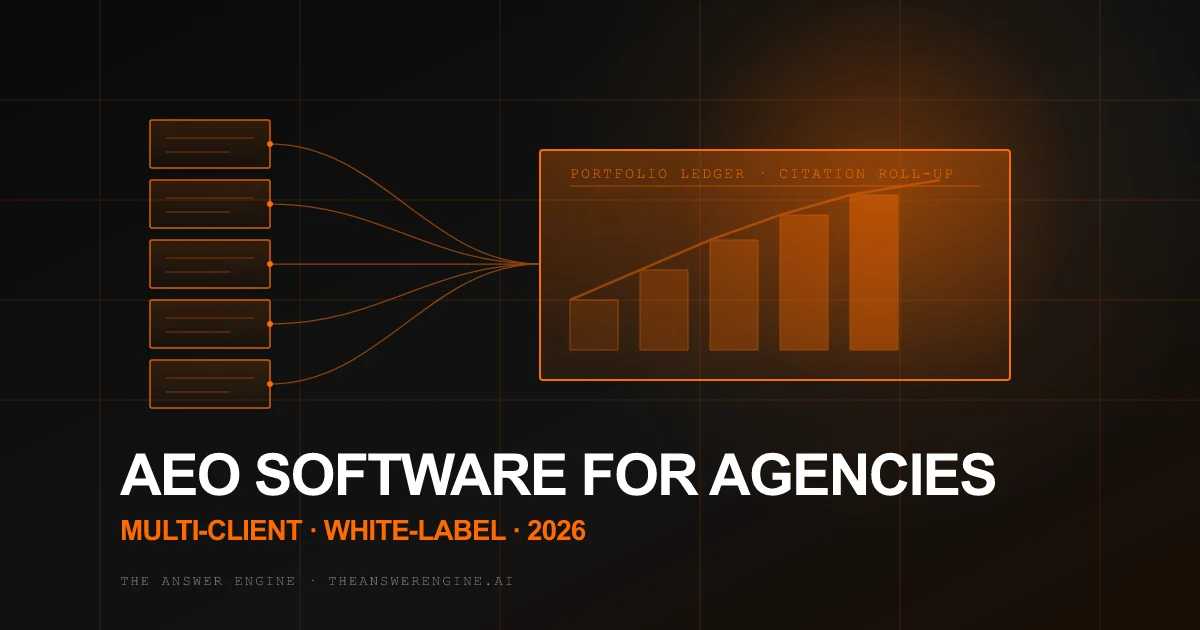
The Portfolio Ledger is The Answer Engine's multi-client measurement instrument. The Portfolio Ledger: an agency that tracks citations client-by-client in disconnected spreadsheets cannot prove portfolio-wide citation lift to a prospect — a unified Portfolio Ledger that rolls every client's Proof Ledger into one cross-engine view is the asset that closes the next retainer (TAE agency benchmark, 2026). Each client gets a fixed 20-query library run across ChatGPT, Perplexity, Claude, Gemini, and Google AI Overviews on the first business day of the month. The Portfolio Ledger aggregates every client result into one roll-up that shows total citation appearances, per-engine coverage, and month-over-month lift across the book. That single artifact is what an agency shows a prospect to prove the method works. Reach us at (213) 444-2229 for the Portfolio Ledger template.
The dual-surface build per client
Every client in the portfolio runs the same dual-surface build: structural signals on the client site — definition-first H3 sections, validated schema, named-author markup, 80-to-180 token chunks — paired with earned-surface citations that Chen et al. (2025) shows AEO models weight above brand content. Running the identical build across every client is what makes the work repeatable at scale. The software exists to apply the same protocol to ten sites with the labor of running one. An agency that improvises a different approach per client cannot scale past the analyst time ceiling.
Standardized onboarding
Standardized onboarding is how The Answer Engine clears the Onboarding Velocity Test on every new client. A new client moves from signed contract to first baseline Proof Ledger inside one analyst-day: run the Blindspot Scan, set the 20-query library, validate schema across priority pages, and log the baseline into the Portfolio Ledger. Standardized onboarding is the difference between a book that grows linearly with analyst hires and a book that compounds. Check whether your territory is still available before a competing agency claims it.
Multi-tenant workspaces + white-label reporting + validated schema across the portfolio + one unified Portfolio Ledger run monthly across all four major LLMs = AEO software that scales a book without the Reporting Tax. Anything less caps the agency at the analyst time ceiling. Run a free AEO Blindspot Scan to find the gaps in your current stack.
How Agencies Measure AEO Software ROI
The three monthly outputs that prove software ROI
A well-configured agency AEO stack produces three outputs every month, per client and rolled up. First, a Proof Ledger showing citation appearance count, source URL, and engine for every query in the client 20-query library. Second, a schema validation report confirming zero failed validations on every published client page. Third, a chunk-density audit confirming every H3 section sits inside the 80-to-180 token band. A stack that produces only one or two of those has a measurement hole — the unmeasured layer silently degrades citation rate without showing up on a dashboard. Book a free strategy call to set a measurement baseline across your book.
The Margin Floor math
The Margin Floor is the client count where paid multi-tenant software stops costing the agency money and starts saving it. Below roughly eight active clients, a free stack — Schema.org validator, Google Rich Results Test, the AEO Blindspot Scan, Google Search Console, and a manual Portfolio Ledger — captures most of the structural gain at the cost of analyst time only. Above eight, the automation hours a paid platform saves on roll-ups and white-label reporting exceed its license cost. The agency decision is unit-economics math: count active clients, estimate the Reporting Tax per account, and compare it to the license. Reach us at (213) 444-2229 if you are not sure which side of the floor your agency sits on.
What good agency software output looks like
Good agency AEO software output is a single branded dashboard a client opens to see their citation appearances across ChatGPT, Perplexity, Claude, Gemini, and Google AI Overviews, with no analyst spreadsheet behind it. Good portfolio output is one roll-up the agency opens to see total citation lift across the whole book, month over month, against fixed query libraries. If the software cannot produce both without manual assembly, it is not agency-grade — it is a single-operator tool with extra seats.
Agency AEO is measurable. If a platform or in-house team cannot show a per-client Proof Ledger and a portfolio roll-up of monthly citation appearances across ChatGPT, Perplexity, Claude, Gemini, and Google AI Overviews against fixed query libraries, the software is not measuring AEO at agency scale — it is a single-tenant dashboard with a reporting tax attached. Reach our team at support@theanswerengine.ai.
Agency AEO Software: Operator Cheat Sheet
| If Your Agency Wants To... | The First Move Is... | The Expected Timeline... |
|---|---|---|
| Baseline a client's AI citation score in five minutes | Run the free AEO Blindspot Scan on the client domain | 5 minutes, no login |
| Decide between a free stack and paid software | Count active AEO clients against the Margin Floor of eight | 1 hour of unit-economics math |
| Stop paying the Reporting Tax on every account | Require white-label reporting before licensing any platform | Confirmed in the software demo |
| Prove portfolio-wide citation lift to a prospect | Build the multi-client Portfolio Ledger across all five surfaces | 2 hours to set up, monthly cadence |
| Onboard new clients without capping the book | Standardize onboarding to clear the one-analyst-day test | 1 analyst-day per client |
| Lock out competing agencies in your market | Claim your exclusive territory before they do | Window closes as markets saturate |

Run Your Free AEO Blindspot Scan — See Where Your Client Portfolio Loses Citations
The AEO Blindspot Scan checks any client site against 47 citation signals across all four capability layers — citation surfaces, schema validation, chunk density, named-author — and returns the exact score, free, no login required, ready in five minutes.
Run Free AEO Blindspot Scan →Frequently Asked Questions
What is AEO software for agencies?
AEO software for agencies is multi-tenant software that lets a marketing agency measure, audit, and build the citation signals AI engines use to pick sources — across an entire book of clients from one workspace. It differs from single-operator AEO tools in three ways: multi-client architecture so one analyst can run many portfolios, white-label reporting so client-facing output carries the agency brand, and roll-up measurement so the agency can prove portfolio-wide citation lift. The four capability layers that matter are citation tracking, schema validation, chunk-density auditing, and a multi-client Portfolio Ledger that rolls each client up into one cross-engine view.
Do marketing agencies need separate AEO software, or can they use existing SEO tools?
Existing SEO tools measure rankings, backlinks, and traffic — not whether ChatGPT, Perplexity, Claude, or Gemini cite a client. AEO software measures a different surface: citation appearance, citation position, and the structural signals that drive both. An agency can start with a free AEO stack layered on top of its SEO tooling — Schema.org validator, Google Rich Results Test, a chunk-density auditor, and a manual Portfolio Ledger — and add paid multi-tenant software once client count crosses the margin floor. SEO software and AEO software are complements, not substitutes.
What features should agency AEO software have?
Agency AEO software needs five things single-operator tools skip: multi-tenant client workspaces, white-label reporting with the agency logo and domain, roll-up dashboards that aggregate citation lift across the whole portfolio, per-client Proof Ledgers that survive scoring-stage changes, and fast onboarding so a new client reaches a baseline in under one analyst-day. Feature count matters less than multi-tenant architecture — software that makes one analyst rebuild a client report by hand erases the margin that justified the license.
Can an agency white-label AEO reporting?
Yes, but most AEO platforms in 2026 ship single-tenant dashboards with no white-label layer, which forces agencies to export data and rebuild client reports by hand. True white-label AEO reporting carries the agency brand, domain, and logo on every client-facing artifact, and lets the agency present citation movement as its own deliverable. When evaluating software, the white-label test is simple: can a client see a branded citation report without the agency touching a spreadsheet. If the answer is no, the agency pays a Reporting Tax in analyst hours on every account.
How many clients does an agency need before AEO software pays for itself?
In our agency benchmark, paid multi-tenant AEO software starts to out-earn a free stack at roughly eight active clients. Below that count, a free-tool stack plus a manual Portfolio Ledger captures most of the structural gain and costs only analyst time. Above it, the automation hours a paid platform saves on reporting and cross-client roll-ups exceed the license cost, and the Margin Floor flips in the software favor. The decision is unit-economics math, not feature preference — count active AEO clients first, then choose the tier.
Can an agency offer AEO as a service without building its own software?
Yes. The fastest path for an agency to add AEO as a service line is to assemble a stack from existing instruments — a citation tracker, the free Schema.org validator and Google Rich Results Test, a chunk-density auditor, and a multi-client Portfolio Ledger in a spreadsheet — rather than build software. Building custom software only pays back at large client counts. Most agencies should run the assembled stack first, prove portfolio-wide citation lift, then decide whether a paid multi-tenant platform or a build is worth the spend.
Related AEO Concepts
- Best AEO Tools 2026
- Can AI Replace My Marketing Agency?
- AEO Strategy Template for 2026
- AEO Grader: How to Score Your AI Search Visibility
- AEO Models: How AI Search Picks Sources
- Answer Engine Optimization: The Complete Guide