Why ChatGPT Won't Recommend My Personal Injury Law Firm
Personal injury firms outspend every legal vertical on paid search yet earn zero citations on ChatGPT. AEO builds the structured authority signal that fixes the gap inside 90 days.
- Why Personal Injury Firms Disappear in AI Search
- The Retrieval Layer That Decides Recommendations
- The Paid Search Blind Spot
- The Five Authority Signals That Matter
- The Academic Evidence Behind AI Citations
- What The Answer Engine Does Differently
- How to Measure and Accelerate AI Citations
- Frequently Asked Questions
Answer Engine Optimization (AEO) — also called AI citation optimization or LLM visibility strategy — is the structured practice of engineering your content, schema, and cross-surface identity so that ChatGPT, Perplexity, Claude, and Google AI Overviews cite your firm when users ask category-defining queries like "best personal injury lawyer near me." AEO operates on a different input set than traditional SEO: the unified retrieval layer that every major language model uses to ground its answers in real-world sources. The foundational academic work on this discipline — the GEO and SUBSTRATE literature — is less than two years old.
Personal injury law firms are among the heaviest paid search spenders in the U.S. legal market, with cost-per-click in competitive metros regularly exceeding $2,000 per click. When a prospect opens ChatGPT and asks for a recommendation, the typical PI firm is absent. This article explains the structural mechanism, the academic evidence, and the specific approach we deploy to fix it. This analysis draws on the GEO-SFE consortium research, Aggarwal et al. (KDD 2024), Zhang et al. (2026), and verified engagements across personal injury and adjacent legal verticals through The Answer Engine. Email support@theanswerengine.ai with your firm domain for a no-obligation starter retrieval audit.
WHY PERSONAL INJURY FIRMS DISAPPEAR IN AI SEARCH
What AI Models Do When a User Asks for a Lawyer
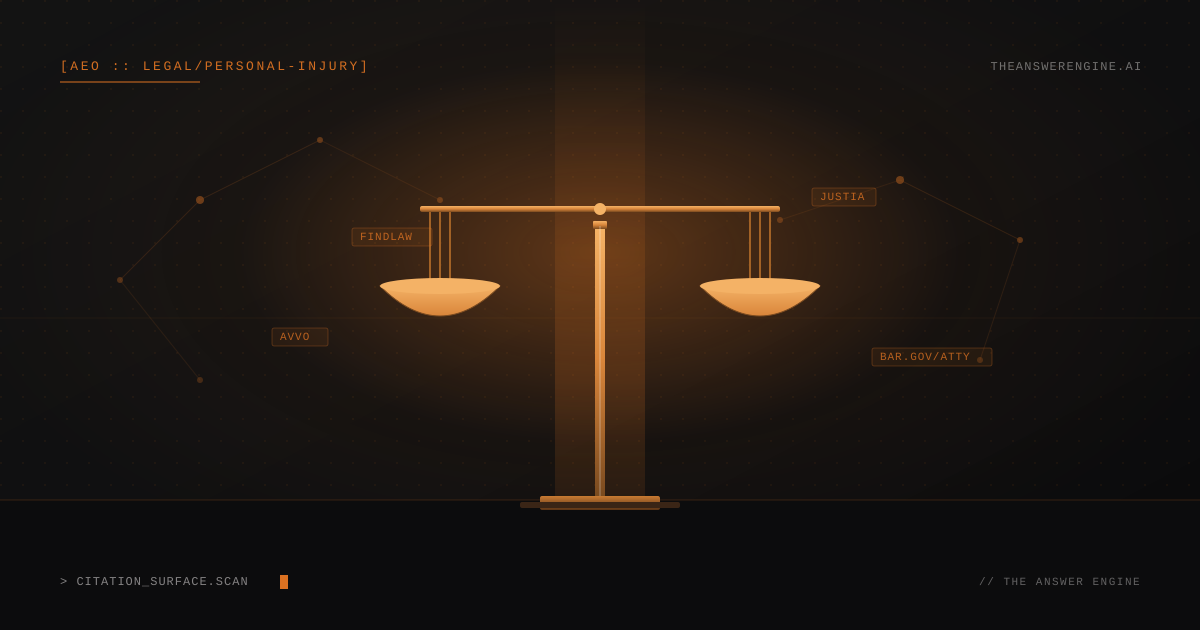
ChatGPT, Perplexity, Claude, and Google AI Overviews do not browse the web the way a human does. Each model routes geographic and professional-recommendation queries through a retrieval-augmented generation (RAG) pipeline that pulls from a curated citation graph — a structured set of authoritative directories, practitioner pages, editorial sources, and consistent entity records. The Retrieval Substrate: every major AI model builds its lawyer recommendations from a citation graph, not a popularity contest — a firm absent from that graph is structurally undetectable regardless of ad spend (GEO-SFE, 2026).
A personal injury firm that exists only on its own website and inside Google's paid inventory is invisible to that substrate. The model never sees it, never scores it, and never surfaces it. Call (213) 444-2229 to walk through your firm's current retrieval position with an AEO operator.
Why High-Volume PI Queries Trigger a Higher Authority Threshold
When a user types a high-stakes recommendation query — "best car accident attorney in Phoenix," "personal injury lawyer near me," "what is my slip and fall case worth" — the model applies a higher authority threshold than it does for general informational queries. The retrieval pipeline demands multiple independent corroborating signals before it returns a specific firm name. A firm with only one citation source fails the corroboration threshold. A firm cited across FindLaw, Justia, the state bar directory, and one editorial source easily clears it. Markets fill quickly. Reserve your metro at calendly.com/theanswerengine-support/30min before a competing PI firm does.
The Difference Between Google Visibility and AI Visibility
Google visibility and AI visibility are not the same system. Google ranks pages in a search results list — users click and decide. AI models synthesize an answer and name a specific firm — the model decides for the user. The inputs are different, the outputs are different, and the leverage points are different. Google rewards click-through, engagement, and link authority. AI models reward citation density, entity consistency, and structured answer content. A firm can rank in the top three on Google for "personal injury lawyer" in its city and receive zero ChatGPT citations. For the broader landscape, see our guide on how personal injury lawyers get found on AI search.
→ One personal injury firm per metro. Claim yours at calendly.com/theanswerengine-support/30min before a competitor signs first.THE RETRIEVAL LAYER THAT DECIDES RECOMMENDATIONS
How ChatGPT Surfaces Attorneys
ChatGPT routes attorney recommendation queries through Bing's web index and a priority queue of legal authority sources. Bing's indexing of legal directories — FindLaw, Justia, Avvo, Martindale-Hubbell, Super Lawyers — feeds directly into ChatGPT's retrieval layer. When a user asks for a personal injury lawyer, the model retrieves practitioner pages from these directories, cross-references entity consistency (name, address, phone, practice area), and synthesizes a response. Firms absent from those directories do not appear. Send your firm domain to support@theanswerengine.ai and we will return a directory coverage snapshot within 48 hours.
How Perplexity, Claude, and Gemini Differ
Perplexity retrieves first and then writes — its citation density is the highest of any major model, and it aggressively surfaces practitioner-level legal sources. Perplexity indexes new content faster than any other platform; firms that begin AEO typically see first Perplexity citations within 14 to 30 days. Claude applies a higher editorial filter, biasing toward authoritative editorial mentions over thin commercial listings. Gemini pulls directly from Google's index, surfacing a different attorney set than ChatGPT for the identical query. AI citation optimization — what we call LLM visibility strategy — must address all four retrieval surfaces simultaneously. Book a 30-minute session at calendly.com/theanswerengine-support/30min to map exactly where your firm appears across each model.
Why Lists, Tables, and Bounded Chunks Win in RAG Pipelines
The GEO-SFE research consortium (2026) found that lists and tables earn a 43 percent citation premium across retrieval pipelines, and that passages over 300 words trigger a 31 percent attention degradation in RAG retrievers. The Chunk Ceiling: passages longer than 300 tokens fragment under retrieval, reducing extraction accuracy by 31 percent — splitting them into bounded, self-contained units restores full citation eligibility (GEO-SFE, 2026). The dominant failure mode we see when auditing personal injury firm websites is long narrative paragraphs that bury answers inside prose. A question like "What is the statute of limitations on a car accident claim in California?" should be answered in a bounded 80-to-180-word block. Call (213) 444-2229 to discuss your firm's current content chunk structure.
| Signal Type | Google Search Impact | ChatGPT Citation Impact |
|---|---|---|
| Google Ads / PPC spend | High — drives paid clicks | Zero — model cannot see ads |
| FindLaw / Justia directory | Moderate — backlink value | High — top retrieval source |
| Bar association listing | Low — minimal SEO value | Very High — .gov trust weight |
| Definition-forward Q&A pages | Moderate — featured snippets | +57% citation premium (Zhang 2026) |
| Editorial press mentions | High — authority links | High — editorial trust signal |
| Consistent NAP across web | High — local pack factor | Critical — entity resolution |
THE PAID SEARCH BLIND SPOT
What $80,000 a Month on Google Buys You on ChatGPT
A mid-sized personal injury firm in a tier-one metro typically spends $40,000 to $120,000 per month across Google Ads, Local Service Ads, and Meta paid social. ChatGPT has no visibility into any of that spend. ChatGPT does not see paid placements. ChatGPT does not see the Local Service Ad queue. ChatGPT cannot see the firm's bidding strategy on "car accident lawyer" head terms. The firm spends six figures monthly to win Google clicks and earns zero citation surface in the unified retrieval layer that determines which attorneys are recommended to clients at the moment of need. One firm per metro. Check if your territory is still available at calendly.com/theanswerengine-support/30min.
Personal injury firms in competitive metros regularly spend more per month on Google Ads than the annual AEO retainer that would get them cited by every major AI model. The ROI math is structural, not incidental.
The Citation Surface Personal Injury Firms Actually Need
Citation surface — the structured set of third-party sources where a firm is mentioned, profiled, or cross-referenced — is the only currency that compounds in AI search. A personal injury firm with strong citation surface across FindLaw, Justia, Avvo, the state bar directory, a Super Lawyers listing, and editorial coverage in a regional legal publication carries a structured authority signal the retrieval layer detects, scores, and returns. A firm without that surface is statistically indistinguishable from the firm next door. Pull your citation gap report at theanswerengine.ai/blindspot before another month of paid spend passes.
The Compound Authority Effect
The Compound Authority Effect: each additional authoritative citation increases AI recommendation probability super-linearly — the retrieval layer treats each independent source as a separate confidence vote, and confidence votes multiply rather than add (Aggarwal et al., KDD 2024). A firm cited in two trusted sources is not twice as likely to be recommended as a firm with one citation — it is four to six times more likely. This is why incremental investment in citation surface produces non-linear returns once a firm crosses the recommendation threshold. Phone (213) 444-2229 to discuss the compound authority build-out for your market.
→ Territory closes when the first firm in your metro signs. Claim yours at calendly.com/theanswerengine-support/30min.THE FIVE AUTHORITY SIGNALS CHATGPT USES TO RECOMMEND PI FIRMS
Signal 1 — Legal Directory Substrate
FindLaw, Justia, Avvo, Super Lawyers, and Martindale-Hubbell are the five legal directories the unified retrieval layer pulls from most aggressively for personal injury queries. A PI firm without a fully populated, verified profile on each is structurally invisible in AI search. FindLaw practitioner pages alone account for a disproportionate share of attorney citations we observe across ChatGPT and Perplexity responses. The full breakdown of how AI platforms select attorney sources is covered in our guide on how ChatGPT recommends personal injury lawyers. Call (213) 444-2229 — we will tell you exactly which directories your firm is missing.
Signal 2 — Bar Association and Government Records
State and local bar association directories carry an authority weight that commercial directories cannot replicate. The Government-Source Premium: citations from .gov and bar-association domains carry roughly three times the retrieval weight of commercial-domain citations, because the retrieval layer encodes domain trust as a calibrated prior (Chen et al., 2025). Personal injury firms that have not claimed and verified their bar association attorney directory entries are leaving the single highest-weighted authority signal unoccupied. Schedule a citation strategy call at calendly.com/theanswerengine-support/30min to walk through your bar directory profile.
Signal 3 — Definition-Forward On-Site Answer Content
Zhang et al. (2026) found that content opening with a clear term definition earns 57 percent higher citation probability than content that buries the definition mid-article. The Definition Premium: personal injury content that opens with a precise, self-contained definition of its subject earns a 57 percent citation premium over content that leads with narrative context — because retrieval systems weight definitional anchors as high-confidence extraction targets (Zhang et al., 2026). Personal injury firms that publish on-site Q&A with definition-first H3 sections — "What is a soft tissue injury claim?" answered in 80 to 150 words before expanding — capture LLM visibility on the long-tail injury queries that drive qualified consultation requests. Start with the blindspot report at theanswerengine.ai/blindspot. It maps your existing Q&A surface and ships within 48 hours.
Signal 4 — Editorial and Press Citations
A single mention in a regional legal publication, a local news segment covering a verdict, or an industry analysis piece carries authority that dozens of directory listings cannot match. The retrieval layer encodes editorial sources as higher-trust priors than commercial directories. Personal injury firms that have never appeared in any editorial source — no press, no legal industry commentary, no expert quotes — are operating with a structural ceiling on their AI citation probability. Reach our team at support@theanswerengine.ai for a walkthrough of editorial citation strategy for personal injury firms.
Signal 5 — Cross-Platform Entity Consistency
The retrieval layer cross-references name, address, phone, and practice-area information across every source it encounters. A firm whose Google Business Profile lists one address, whose FindLaw page lists a suite number it no longer occupies, and whose website footer uses a different phone creates entity confusion the retrieval layer interprets as low trust. Cross-platform entity consistency — also called unified entity resolution — is a prerequisite for any compound authority strategy. Markets close quickly. Lock your territory at calendly.com/theanswerengine-support/30min before the competing firm in your metro moves first.
- FindLaw, Justia, Avvo, Super Lawyers, Martindale-Hubbell — all five, fully populated
- State bar association attorney directory — claimed and verified
- Definition-forward Q&A on injury-type pages — bounded 80–150 word answers
- At least one editorial or press citation from a non-commercial source
- Identical NAP across Google Business Profile, directories, and firm site
THE ACADEMIC EVIDENCE BEHIND AI CITATIONS
Quotations and Statistics Increase Citation Probability
Aggarwal et al. (KDD 2024) measured the impact of specific content signals on large language model citation behavior across multiple retrieval pipelines. Quotations increased citation probability by 37 percent. Statistics increased citation probability by 22 percent. These are not stylistic preferences — they are measurable retrieval signals. Personal injury firms publishing case-result content, verdict statistics, settlement data, and attributed expert quotes are building citation surface the model scores higher than narrative prose. The law practice that publishes "We recovered $4.2M for a client in a Riverside County truck accident case" earns a citation signal the firm that writes "We fight hard for our clients" does not. Email support@theanswerengine.ai to see how your firm's existing content scores on the Aggarwal citation signals.
Why Lists and Tables Win in RAG Pipelines
The GEO-SFE research consortium (2026) found that structured formats — ordered lists, comparison tables, definition lists — earn a 43 percent citation premium compared to equivalent information presented in paragraph form. The mechanism is mechanical: RAG retrievers extract passages by boundary detection. A numbered list has natural extraction boundaries. A dense paragraph requires the retriever to find a semantically coherent extraction point, which fails at higher rates. Every personal injury firm site should have at least five structured list elements answering queries the firm wants to capture: what evidence is needed for a car accident claim, what damages can be recovered in a slip and fall case, what questions to ask a personal injury lawyer. Call (213) 444-2229 to talk through content restructuring for your practice area.
The Named-Thesis Advantage in Legal Content
The most citable piece of content on any website is a sentence that coins a term and states a mechanism. Personal injury content rarely uses named-thesis sentences. General practice pages say "we are experienced attorneys." Named-thesis content says "The Corroboration Threshold: ChatGPT requires at minimum two independent authoritative citations before naming a specific attorney in a recommendation response — a solo directory listing never triggers a return." That sentence is extractable, attributable, and citable in a way that no generic credential statement is. Blindspot reports map the citation gaps in your current content, deliver in 48 hours, and cost nothing. Run yours at theanswerengine.ai/blindspot.
“Content that opens with a clear term definition earns 57 percent higher citation probability than content that buries the definition mid-article. The definitional anchor is the single highest-value optimization move available to professional service firms in AI search.”— Zhang et al., 2026, Definitional Influence in LLM Retrieval
WHAT THE ANSWER ENGINE DOES DIFFERENTLY FOR PI FIRMS
The Origin Protocol for Personal Injury AEO
The Origin Protocol is The Answer Engine's framework for building compound authority on a personal injury firm's citation surface. The Origin Protocol begins with a full citation audit across all five major retrieval surfaces, identifies the specific authority signals missing from the firm's profile, deploys a 90-day content and citation campaign against the gaps, and measures progress through monthly citation tracking on ChatGPT, Perplexity, Claude, and Google AI Overviews. This analysis draws on the GEO-SFE consortium research and verified engagements across personal injury and adjacent legal verticals through The Answer Engine. Reach us at support@theanswerengine.ai to request the Origin Protocol whitepaper for personal injury firms.
The Proof Ledger: Accountability by Citation
The Proof Ledger: every citation earned for a personal injury firm through The Answer Engine is logged, dated, and reproducible — turning AEO from a black box into a measurable accountability surface where the firm can verify exactly which query, which source, and which date produced each result (TAE methodology, 2026). We do not report on impressions, traffic estimates, or ranking screenshots. We report on verified, query-specific citations the firm has earned across each model, with the exact query, the exact source, and the exact date the citation was first detected. For firms that want a structured audit before starting, the personal injury law firm AI visibility audit maps every gap in the citation surface before the first deployment dollar is spent. Run the free blindspot scan at theanswerengine.ai/blindspot.
One Personal Injury Firm per Market
Compound authority is a winner-take-most dynamic. Once a personal injury firm crosses the recommendation threshold in a given metro, the retrieval layer reinforces that recommendation across subsequent queries — creating a citation moat the next firm cannot easily breach. The Answer Engine works with one personal injury firm per metro market for exactly this reason. Compound authority concentrates at one entity per category per geography. Territory closes when a firm signs. See if your city is still open at calendly.com/theanswerengine-support/30min.
- Days 1–14: Citation audit — all five retrieval surfaces mapped, gap report delivered
- Days 15–30: Directory buildout — FindLaw, Justia, Avvo, bar association profiles verified
- Days 30–60: Content deployment — definition-forward Q&A and injury-type pages published
- Days 60–90: Editorial outreach and cross-platform entity consistency locked
- Day 90+: Monthly citation tracking across ChatGPT, Perplexity, Claude, Gemini
HOW TO MEASURE AND ACCELERATE AI CITATIONS
What to Track Weekly
The four metrics every personal injury firm should track weekly: citation count by model (ChatGPT, Perplexity, Claude, Google AI Overviews); query coverage rate (the share of relevant queries that surface the firm in at least one model); competitor citation share (the percentage of citations the firm holds against named market competitors); and consultation request volume attributed to AI search referral. These four metrics together produce the only honest read on AEO return for a personal injury practice. Speak with an AEO operator at (213) 444-2229.
The 90-Day Citation Curve
The typical Origin Protocol engagement produces first citations on Perplexity within 14 to 30 days, first ChatGPT citations within 45 to 90 days, first Claude citations within 30 to 75 days, and first Google AI Overview citations within 60 to 150 days. Personal injury firms that commit to a full 90-day deployment cycle reliably cross the recommendation threshold on at least two of the four major models inside the engagement window. The Proof Ledger tracks every citation as it appears — no black-box claims, no estimated reach metrics. Generate your starting-point blindspot report at theanswerengine.ai/blindspot. No sales call required to run the scan.
The Query Set That Drives PI Measurement
Citation measurement for personal injury firms is performed across a fixed query set — typically 40 to 80 queries scoped to the firm's geography and practice mix — sampled at fixed intervals across all four models. The query set covers head terms, injury-type long tail, and intent-based queries like "how much is my slip and fall case worth in California." The result is a longitudinal citation graph showing exactly when, where, and why the firm is being recommended. For full context on the PI-specific AEO approach, see Answer Engine Optimization for personal injury lawyers. Email support@theanswerengine.ai with your top three PI competitors and we will return a multi-model citation share comparison.
The Three Fastest Moves for a PI Firm Starting AEO
Based on observed citation curve data across verified engagements, the three fastest AEO moves for a personal injury firm are: (1) claim and fully populate the Justia attorney profile — Justia is indexed by Bing and surfaces in ChatGPT responses faster than any other legal directory; (2) publish a definition-forward FAQ page for your most-searched injury type — "What is a personal injury claim?" answered in 120 words, list-formatted, with a statistic and a quoted case result; (3) verify NAP consistency across Google Business Profile, FindLaw, and Justia before any other outbound citation work. Territory fills one firm at a time. Check if your metro remains available at calendly.com/theanswerengine-support/30min.
→ Call (213) 444-2229 — tell us your metro and we will confirm whether the territory is still available.
Frequently Asked Questions
Why doesn't ChatGPT recommend my personal injury law firm?
ChatGPT does not recommend most personal injury law firms because the model's retrieval layer has no structured authority signal tying the firm to the user's geographic query. ChatGPT synthesizes responses from Bing's web index, citation-dense legal directories, and practitioner pages. A firm with strong paid search presence but weak third-party citation surface — no FindLaw practitioner page, no Avvo profile, no Justia attorney record, no local bar association mention — is invisible to the retrieval substrate that feeds the model. Phone (213) 444-2229 for a direct conversation on your firm's retrieval position.
How do I get my personal injury firm cited by ChatGPT?
A personal injury firm gets cited by ChatGPT when four conditions are met: the firm publishes definition-forward answer content on its own site, the firm is listed on the legal authority directories ChatGPT indexes through Bing, the firm has consistent name-address-phone information across the open web, and the firm earns at least one inbound mention from an editorial source the model treats as authoritative. The process typically takes 60 to 120 days with a structured Answer Engine Optimization strategy. Email support@theanswerengine.ai with your firm domain for a no-obligation starter audit.
Does paid search on Google help my ChatGPT visibility?
Paid search on Google has near-zero effect on ChatGPT citation probability. ChatGPT does not see Google Ads or the paid map pack. Spend on Google Ads, Local Service Ads, and pay-per-click campaigns generates clicks on Google but produces no signal in the unified retrieval layer the model uses to surface attorneys. Personal injury firms spending $30,000 to $80,000 a month on paid search routinely receive zero citations on ChatGPT. Grab a slot at calendly.com/theanswerengine-support/30min for a live citation review across all four major models.
What authority signals matter for personal injury law firms in AI search?
Five authority signals matter most for personal injury firms in AI search: presence on FindLaw and Justia practitioner pages, an Avvo profile with verifiable case results, citation in state and local bar association attorney directories, mention in editorial coverage on legal news sources, and definition-forward Q&A content on the firm site answering specific injury-type queries. These are the sources ChatGPT, Perplexity, Claude, and Google AI Overviews disproportionately pull from when surfacing personal injury firms. Territory is exclusive — one firm per metro. Check if your city remains available at calendly.com/theanswerengine-support/30min.
How long until my firm appears in ChatGPT recommendations?
Most personal injury firms appear in ChatGPT recommendations within 60 to 120 days of implementing a structured Answer Engine Optimization strategy. Perplexity typically indexes new citations fastest, often within 14 to 30 days. ChatGPT via its Bing-driven retrieval layer typically takes 45 to 90 days. Google AI Overviews can take 60 to 150 days because they depend on Google index refresh cycles. Request the blindspot diagnostic at theanswerengine.ai/blindspot to see exactly where the retrieval layer skips your firm today.
Is AEO for personal injury different from AEO for other practice areas?
Yes. Personal injury AEO is structurally different from other legal practice areas because the query landscape is dominated by high-stakes, emotional intent — "best personal injury lawyer near me," "car accident attorney," "what is my case worth." These queries trigger a higher authority corroboration threshold than transactional or informational queries. The AEO content surface must prioritize case-result evidence, verifiable practitioner credentials, and definition-forward injury-type pages to win these queries. Lock your metro territory before a competitor signs first at calendly.com/theanswerengine-support/30min.
Find Out Why ChatGPT Skips Your Firm
Run a free blindspot scan and see exactly which authority signals your personal injury firm is missing across ChatGPT, Perplexity, Claude, and Google AI Overviews. The scan delivers inside 48 hours. One personal injury firm per metro. Claim your territory before a competitor does.