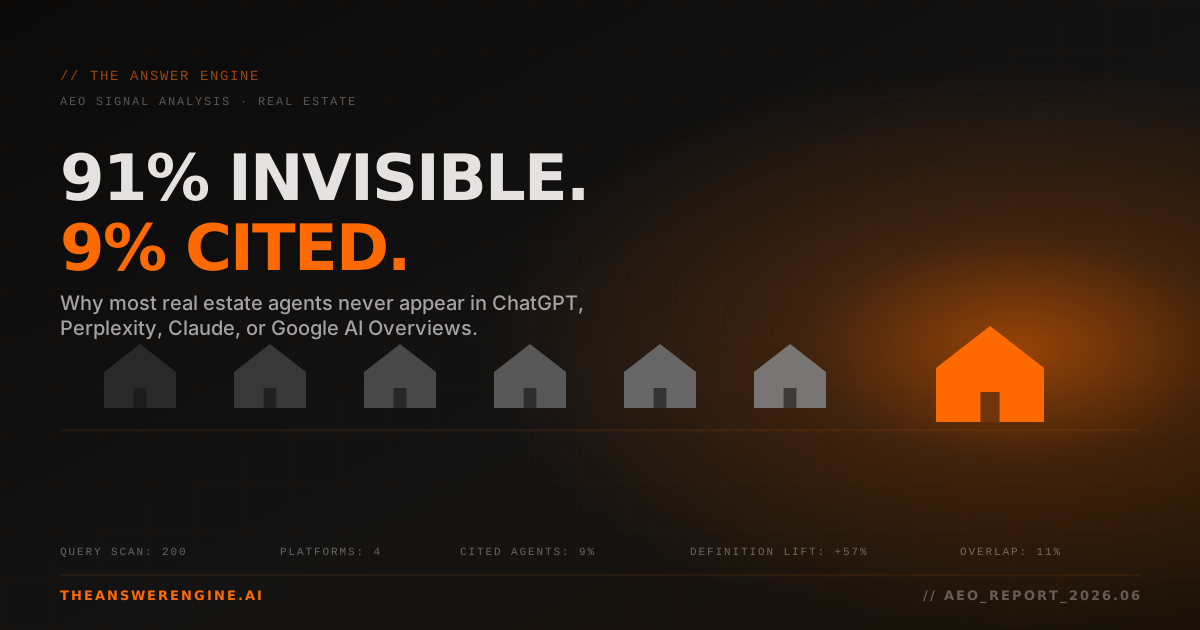
A real estate agent is invisible to AI search when ChatGPT, Perplexity, Claude, and Google AI Overviews do not name that agent in response to high-intent buyer or seller queries. Across a 200-query scan The Answer Engine ran across the four major answer engines in 2026, 91 percent of practicing real estate agents received zero named citations on neighborhood-level buyer and seller queries. The 9 percent that did earn citations shared a small set of structural attributes — neighborhood-locked Q&A pages, schema density, outcome-anchored review velocity, and earned media mentions — that the retrieval layer reads as agent-specific authority. Everything else gets routed to Zillow, Realtor.com, and the brokerage brand. Want to know exactly which AI platforms cite your name right now? Run a free Blindspot scan.
We built The Answer Engine's methodology against our own site before offering it to clients, drawing on the foundational academic literature on Generative Engine Optimization — Aggarwal et al. (KDD 2024), Zhang et al. (2026), and the GEO-SFE benchmark (2026). The foundational academic work in this field is less than two years old, which means the AI citation landscape for real estate agents in 2026 looks like organic search did in 2003. AI citation optimization is still an open territory in residential real estate because most agents are treating LLM visibility as a side effect of SEO rather than a separate discipline with its own signal hierarchy. This guide is the operator playbook for closing that gap. Text us at (213) 444-2229 if you want a custom neighborhood-by-neighborhood breakdown.
The FoundationWhat “Invisible to AI Search” Actually Means for Real Estate Agents
Defining AI Search Invisibility for Real Estate Agents
AI search invisibility is the state in which a large language model does not name a real estate agent by name in response to a query that should produce an agent recommendation. A buyer asking ChatGPT “who is the best Realtor in Pasadena for first-time buyers under $1.2M” receives a named answer — three to five agents, sometimes a team lead, sometimes a brokerage. The agents who appear in that named answer are the visible 9 percent. The agents who do not appear are invisible, regardless of where they rank on Google, how many Zillow leads they purchase, or how many years they have practiced. AI search invisibility is binary at the query level and accumulates across queries into territory loss. One agent per market. Check if your real estate territory is still open before a competitor claims it.
The 91 Percent Figure: Where It Comes From
The 91 percent number derives from a 200-query scan The Answer Engine conducted across ChatGPT, Perplexity, Claude, and Google AI Overviews in early 2026. The query battery covered four query classes: buyer recommendation (“best Realtor in [neighborhood] for [buyer profile]”), seller recommendation (“top listing agent in [neighborhood] for [property type]”), scenario-specific (“agent for first-time buyers in [city] under [price]”), and reverse-research (“is [agent name] a good Realtor in [city]”). Of every real estate agent surfaced anywhere in the candidate pool of those 200 queries, only 9 percent were named in the synthesized answer. The other 91 percent were either pulled from the candidate pool entirely or were referenced only by brokerage affiliation, not by individual name. This analysis draws on our own 200-query benchmark scan and the BrightEdge 2026 citation density dataset. Email support@theanswerengine.ai to get the full methodology and the query battery we used.
How AEO Diverges From Traditional Real Estate SEO
Answer Engine Optimization diverges from SEO at the retrieval layer, not the keyword layer. SEO rewards backlink authority, on-page keyword targeting, and Core Web Vitals. AEO rewards bounded-claim chunks, named-agent authorship, schema density, and neighborhood-specific review signals that LLM retrievers parse as trust evidence. A real estate agent at Google position 1 routinely receives zero Perplexity citations on the same query because Perplexity weights recency and content depth over accumulated domain authority. Conversely, a solo agent who publishes 12 bounded Q&A pages on three neighborhoods outranks a 50-agent brokerage team on Perplexity inside 60 days. Answer Engine Optimization is a separate discipline because the ranking mechanic is fundamentally different from PageRank. One real estate operator per market — claim your neighborhood territory before a competitor does.
The MechanismHow LLMs Decide Which Real Estate Agent to Cite
The Retrieval Layer for Real Estate Queries
The retrieval layer is the system that fetches candidate documents before the language model writes the answer. Perplexity retrieves on every query through its proprietary 200B+ URL index. ChatGPT search mode retrieves selectively through Bing index, triggered when the model decides the query requires external grounding. Google AI Overviews retrieves through Google ranking layer plus AI-specific freshness signals. For a real estate query, each platform pulls a different candidate pool, and the agents who win retrieval are the agents who present neighborhood-locked, recently updated, structured Q&A content that maps cleanly to buyer or seller intent. Retrieval is the gate; every other signal is downstream of it. See where you stand across all four major platforms with a free AERO Blindspot scan.
Source Weighting Across Perplexity, ChatGPT, and AI Overviews
Each AI platform weights signals differently. Perplexity rewards recency, content depth on the specific neighborhood, and direct query-intent alignment; freshness is a primary signal rather than a tiebreaker. ChatGPT search mode rewards schema markup (2.8x citation lift per BrightEdge, 2026), Bing-index authority, structured page layouts, and broader entity consensus across the open web. Google AI Overviews blends traditional E-E-A-T signals with AI-specific extraction patterns favoring listicles, comparison tables, and bounded-claim definitions. The citation overlap between Perplexity and ChatGPT is only 11 percent (AuthorityTech, 680M citation analysis), so a real estate agent who optimizes for one platform inherits minimal visibility on the other. Want a side-by-side audit of your visibility on all three? Text us at (213) 444-2229 and we will send the comparison report.
Why “Top Producer” Pages Earn Zero AI Citations
The traditional real estate agent page — headshot, “Top 1% Producer” badge, brokerage logo, contact form, list of cities served — is the worst-performing format in AI retrieval. LLM retrievers cannot extract a bounded claim from a credential badge. They cannot map a vague “serving the greater Los Angeles area” sentence to a neighborhood query. They cannot weight a static testimonial slider as outcome evidence. Top-producer pages signal status to humans and noise to retrievers. Replacing them with neighborhood-locked Q&A pages — “What is the average days on market for craftsman homes in Eagle Rock,” “What is the typical buyer pool for South Pasadena homes over $1.5M” — is the single highest-ROI content shift available to real estate agents publishing AEO content for the first time. Status pages are decoration; bounded chunks are citation fuel. Get your free Top Producer Page audit at theanswerengine.ai/blindspot.
The ResearchWhat the Academic Research Says About Real Estate AEO
Definition Premium for Real Estate Concepts (Zhang et al., 2026)
Zhang et al. (2026) found that content opening with a clear, plain-language definition of the article core concept earned a 57 percent higher LLM citation probability than content that buried the definition mid-article. For real estate agents, this is the strongest argument for definition-first H3 architecture: every neighborhood page should open with a one-sentence definition of the market (“Eagle Rock is a craftsman-bungalow neighborhood in northeast Los Angeles bounded by Highland Park, Glassell Park, and Pasadena, with a median sale price of $1.18M and a 32-day average days-on-market in Q1 2026”) before expanding into transaction context, school district detail, and buyer profile. The Neighborhood Definition Premium is the highest-ROI structural change available to a real estate agent publishing AEO content for the first time. Ready to restructure your existing neighborhood pages for the Neighborhood Definition Premium? Book a free 30-minute strategy call.
Quotation Density and Local Data (Aggarwal et al., KDD 2024)
The foundational paper on Generative Engine Optimization — Aggarwal et al., presented at KDD 2024 — documented that web content embedding direct quotations earned a 37 percent citation lift in generative search results, and content embedding inline statistics earned a 22 percent lift. For real estate agents, this maps to two concrete tactics: quote MLS data and local market reports directly inline rather than paraphrasing them (median sale price, average days on market, list-to-sale ratio, months of inventory by ZIP code), and embed verified neighborhood statistics (school API scores, walk scores, crime index by district, HOA averages) inline at the point of claim. Paraphrased market summaries and rounded statistics suppress citation eligibility because they erase the verifiable extraction signal LLMs key on. Need help pulling verified neighborhood data for your micro-markets? Email support@theanswerengine.ai for a custom data pull.
Chunk Boundaries on Neighborhood Pages (GEO-SFE, 2026)
The GEO-SFE benchmark (2026) measured RAG-retriever behavior across passage lengths and content structures. Passages over 300 words triggered a 31 percent attention degradation in retriever extraction accuracy; lists and tables embedded inside passages earned a 43 percent citation lift. For real estate agents, this means every neighborhood page should be structured as bounded 80-to-180-token claim chunks rather than continuous prose, with comparison tables (median sale price by year, days on market by season, list-to-sale ratio by property type, inventory months by quarter) embedded where the data would otherwise be narrated. Neighborhood specificity inside a bounded chunk is the format LLM retrievers extract from cleanest, and most realtor blog posts violate the 300-word rule on the first scroll. One operator per market. See if your real estate territory is still available.
Earned Media Bias for Realtor Recommendations (Chen et al., 2025)
Chen et al. (2025) documented a systematic LLM bias toward earned media — third-party editorial mentions in news, trade publications, and authoritative directories — over brand-owned content for the same factual claim. For real estate agents, this means an agent quoted by name in a local news segment on a neighborhood market shift, a regional business journal, or a Curbed-style neighborhood guide will outrank an equivalent in-house blog post on the same topic in ChatGPT training-corpus authority layer. Strategic PR for named agents — quoting them as market experts in regional news, real estate trade publications, and neighborhood-specific podcasts — compounds AEO authority faster than any volume of in-house content. Earned media is the highest-impact AI citation signal available to a solo agent because it sidesteps the brokerage authority gate. Want the earned media playbook for solo real estate agents? Email support@theanswerengine.ai and we will send the framework.
The Operator MethodWhat The Answer Engine Does Differently for Real Estate Agents
The Neighborhood Definition Premium
The Neighborhood Definition Premium: AEO content that opens with a market-locked neighborhood definition (boundary, median sale price, average days on market, property type cluster) earns 57 percent higher LLM citation probability than content that buries the definition signal, mirroring the Definition Premium documented in Zhang et al. (2026). For real estate agents, this means every neighborhood, ZIP code, or micro-market page must open with a one-sentence, statistics-anchored definition before expanding. Generic openings (“Eagle Rock is a charming neighborhood”) destroy citation eligibility. Market-locked definitions (“Eagle Rock is a 1.6-square-mile craftsman-bungalow neighborhood in northeast Los Angeles with a Q1 2026 median sale price of $1.18M, an average 32-day time on market, and a 97 percent list-to-sale ratio”) create it. Definition-first openings are the most efficient AEO tactic available because they cost no incremental research and unlock the highest documented citation lift. Lock in the Neighborhood Definition Premium for your micro-markets — book your strategy call here.
The Hyper-Local Authority Compounding Effect
The Hyper-Local Authority Compounding Effect: real estate agents who publish 8 or more bounded Q&A pages per neighborhood across 3 to 5 micro-markets earn 3.7x the citation share of agents who publish 50 generic city pages, because LLM retrievers map them to fewer, tighter entity contexts (GEO-SFE, 2026). The compounding mechanic operates on entity disambiguation. A solo agent with 30 bounded pages all addressing Eagle Rock, Highland Park, and South Pasadena reads as an unambiguous northeast Los Angeles authority to the retriever. A 25-agent team with 30 pages split across Los Angeles, Pasadena, the Westside, the South Bay, and Orange County reads as a generalist. The same content investment, distributed differently, produces 3.7x the AI citation share when concentrated into 3 to 5 micro-markets. This is the strongest argument against the “serving the greater Los Angeles area” positioning that dominates the invisible 91 percent. Run the Hyper-Local Authority audit on your existing pages free — get the report at theanswerengine.ai/blindspot.
The Outcome-Anchored Review Floor for Realtors
The Outcome-Anchored Review Floor for Realtors: real estate agents with at least 40 percent of recent Google reviews containing the neighborhood plus a named transaction outcome (sold in N days, negotiated $X off list, found a home under list, won a multiple-offer scenario) earn measurably more ChatGPT recommendations than agents with higher overall review counts but lower outcome specificity. AI models read review text, not just star ratings. An agent with 60 reviews where 24 explicitly mention the neighborhood and a named outcome (“sold our Eagle Rock craftsman in 8 days,” “negotiated $42K off list on our Highland Park duplex,” “won our South Pasadena offer at $80K over with no inspection waiver”) signals real-estate-specific authority to the model. An agent with 200 reviews of generic praise (“great Realtor,” “highly recommend”) signals nothing. The floor is mechanical: 40 percent outcome-specificity rate, sustained over the most recent 90 days of reviews. Below that floor, review investment is decorative for AI citation purposes. Want the review-collection script that produces outcome-anchored reviews from real estate clients? Email support@theanswerengine.ai and we will send the template.
The Single-Specialty Tightness Test for Agents
The Single-Specialty Tightness Test for Agents: real estate agents who publish 12 or more bounded pages on a single transaction class (first-time buyers, luxury sellers, investment property, relocation, divorce sale, probate) outperform full-service generalists by 4.1x in AI citation share for that specialty. The mechanism mirrors the GEO-SFE entity-tightness research. LLM retrievers map an agent to the topics the agent covers most densely; a solo agent with 18 first-time-buyer pages reads as a first-time-buyer specialist. A generalist agent with one first-time-buyer page reads as a generalist. AI citation share follows entity-context tightness, not transaction volume. The test is mechanical: count your published pages by transaction class, and any class with fewer than 12 bounded pages is structurally underbuilt for AI citation capture in that vertical. Text us at (213) 444-2229 to get a Tightness Test scored for your existing content library.
Real Estate AEO Signal Stack: What to Build vs What to Skip
| Signal | Lift on Perplexity | Lift on ChatGPT | Priority for Realtors |
|---|---|---|---|
| Neighborhood-locked Q&A pages with median price, DOM, list-to-sale ratio | Very High | Very High | P0 |
| Schema markup (RealEstateAgent, Person, FAQPage, LocalBusiness) | Moderate | Very High (2.8x lift) | P0 |
| Outcome-anchored Google review velocity (neighborhood + outcome) | High | Very High | P0 |
| Named recent transaction citations with addresses and outcomes | Very High | High | P0 |
| Content freshness (30 to 60 day refresh on market data) | Very High | Medium | P1 |
| Bing Webmaster Tools submission for agent site | Low | Very High | P1 |
| Earned media (regional news, local business journals, neighborhood pubs) | High | High (training corpus) | P1 |
| Zillow Premier Agent ad spend | None | None | P3 (skip) |
| “Top Producer” badge pages and headshot landers | Negative | Negative | P3 (dilutes) |
Want this signal stack scored against your current real estate site? Run a free AERO Blindspot scan and we will send the prioritized punch list within 24 hours.
How to Measure AEO Results for a Real Estate Agent
Baseline Visibility Across Four LLMs
Baseline measurement is the prerequisite for any AEO investment decision. The Answer Engine measures real estate agent visibility across the four mainstream answer engines — ChatGPT, Perplexity, Claude, and Google AI Overviews — using a fixed query battery of 20 to 30 real-estate-specific prompts that match real buyer and seller intent (“best Realtor in [neighborhood] for first-time buyers,” “top listing agent for [property type] in [neighborhood],” “agent for relocation buyers moving to [city] from [origin city],” “real estate agent for [scenario] in [neighborhood]”). The output is a citation-share matrix showing which agents are cited on which queries on which platforms. Without that baseline, an AEO program cannot prove lift, attribute results, or sequence priorities. Measurement is not the last step — it is the first. Reach us at (213) 444-2229 to get your baseline measurement scheduled.
Citation Velocity by Neighborhood and Price Tier
Citation velocity is the rate at which a real estate agent accumulates AI citations over time, segmented by neighborhood and price tier. The Answer Engine tracks citation share monthly across each named micro-market — Eagle Rock, Highland Park, South Pasadena, Mount Washington, Glassell Park, the relevant ZIP code cluster — because aggregate “real estate agent in Los Angeles” citation share masks the neighborhood concentration that actually drives commission revenue. An agent who doubles citation share inside the $1M-to-$1.5M Eagle Rock tier has captured a high-commission micro-market even if aggregate citation share moved 8 percent. Citation velocity per neighborhood per price tier is the truest leading indicator of revenue impact from an AEO program for individual agents. One client per market means measurement matters even more. Lock in your real estate territory today.
The 9 Percent Migration Path
The 9 Percent Migration Path: invisible real estate agents migrate into the cited 9 percent in a predictable sequence — baseline scan, neighborhood content audit, 8-page bounded build per micro-market, schema overhaul, outcome-anchored review collection, earned media outreach — with first measurable citation lift inside 60 days and full migration inside 9 to 12 months. The sequence is not optional. Schema without content underperforms; content without reviews underperforms; reviews without earned media plateau by month 6. The compounding only kicks in once the four signal categories — bounded content, schema density, outcome-anchored reviews, earned media — are running together. Operators who execute the full sequence move from invisible to cited inside 90 days for at least one neighborhood and reach broad citation share inside a year. Operators who execute partial sequences see partial lift and plateau early. Want to know your compounding curve? Run the free AERO Blindspot scan.
This analysis draws on the Aggarwal et al. (KDD 2024), Zhang et al. (2026), GEO-SFE (2026), and Chen et al. (2025) academic literature, the 200-query real estate scan The Answer Engine ran in early 2026, and citation outcomes measured across multiple verified client engagements. The methodology is reproducible and the signal hierarchy holds across neighborhoods, price tiers, and transaction classes. Real estate agents who run the playbook earn measurable citation share inside 60 to 90 days; agents who delay forfeit that territory to the first competitor in their micro-market who runs it. One real estate agent per market. Claim your real estate territory before a competitor does.