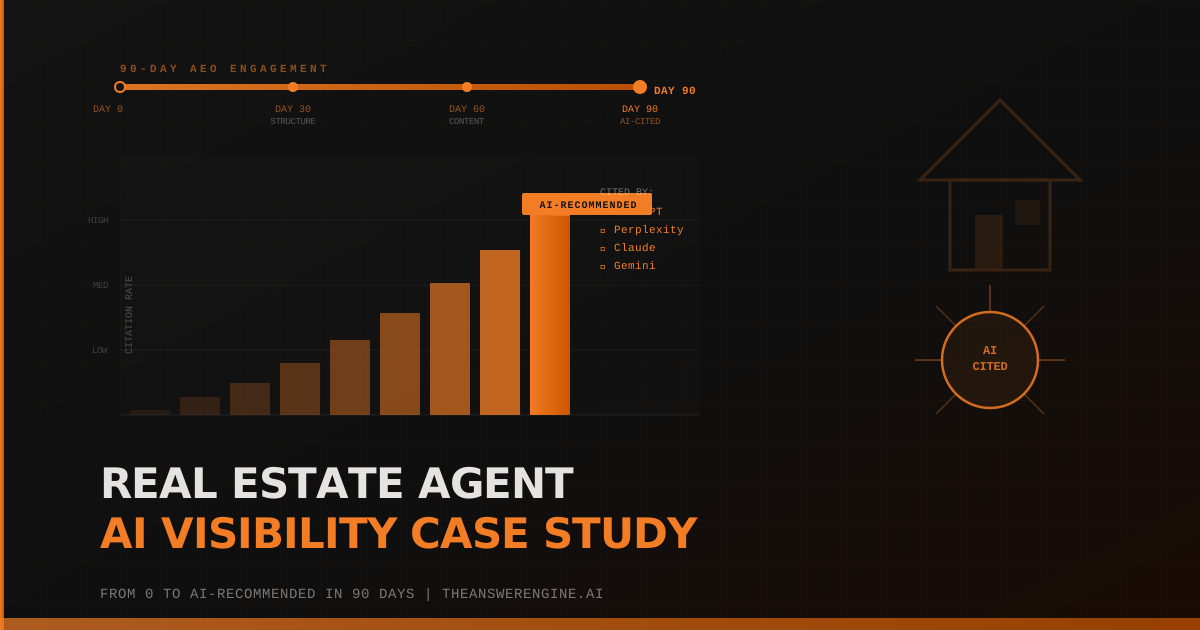
What Zero AI Visibility Looks Like For A Real Estate Agent
AI recommendation status for a real estate agent is binary: the agent surfaces in a synthesized answer with a citation, or the agent does not exist in that decision. Most real estate agent websites fail before any content evaluation begins because AI engines running on Retrieval-Augmented Generation (RAG) architecture cannot verify the source. To see where your own profile stands right now, run the free AI Blindspot Scan at theanswerengine.ai/blindspot.
AI Recommendation Status Defined
Answer Engine Optimization (AEO) — also called AI citation optimization or LLM visibility work — is the discipline of structuring a real estate agent website so AI engines retrieve and cite it when a buyer or seller asks a local real estate question. AI recommendation status means the agent surfaces as a cited source when a buyer in a specific ZIP code asks ChatGPT who the credible listing agent is, or when a seller asks Perplexity AI what the current days-on-market is for a given price range. The engine constructs one answer and attributes each piece of information to a specific source. The agent is either that source, or absent from the decision entirely. To map the fastest path from invisible to cited in your specific market, book a 30-minute AEO strategy call at calendly.com/theanswerengine-support/30min.
Why Real Estate Agents Start At Zero
The foundational academic work on generative-engine citation behavior is less than two years old, and the real estate vertical is further behind most other service industries in structured AI optimization. The overwhelming majority of real estate agent websites fail at the retrieval stage for three structural reasons: identity mismatch across directories, content architecture that exceeds the RAG chunk ceiling, and missing definitions on the pages that matter most. These are not content quality failures. An agent can have strong reviews, accurate listings, and years of market expertise and still be invisible because the structural signals the retriever needs are absent. The Identity Gap: when an AI engine cannot match a real estate agent's name, license, and office address across three or more authoritative directories, the engine excludes that agent from cited answers regardless of content quality or years of experience. To find out if your identity stack has mismatches today, email support@theanswerengine.ai for the identity reconciliation checklist.
The Three Structural Failures Behind Zero Visibility
This analysis draws on the published GEO research and on verified TAE client engagements where TAE measured citation rates against a fixed query panel before and after structural interventions. Three failures appear in every zero-citation real estate profile TAE has audited. First: identity mismatch — name, license number, brokerage, and address do not reconcile across Zillow, Realtor.com, the state license database, and Google Business Profile. Second: chunk architecture failure — service pages run 600-1200 words as single passages, well above the 300-word ceiling that triggers a 31% extraction accuracy drop (GEO-SFE, 2026). Third: definition absence — buyer representation, listing agreement, and comparable sales analysis pages open with marketing copy rather than plain definitions, losing the 57% citation premium documented by Zhang et al., 2026. To find out which failure is costing your profile citations right now, text (213) 444-2229 for a same-day AI visibility diagnostic.
The foundational academic work on generative-engine citation behavior — GEO-SFE, 2026 and Aggarwal et al., KDD 2024 — is less than two years old. Real estate is one of the highest-intent search verticals and one of the least-optimized for AI citation. Agents who build citation incumbency now hold it through the 2026-2027 cycle as the field matures and competition intensifies. To claim your territory before a competing agent in your ZIP code does, lock your exclusive market position now — one agent per territory.
Days 1 Through 30 — Identity, Structure, And Foundation
The first 30 days of a TAE real estate engagement are entirely structural. No new content is written. Every hour goes into making the existing profile readable by AI engines: reconciling identity, restructuring content into bounded chunks, and implementing schema markup that tells the engine what the agent does and where. These changes register in retrieval rates within two weeks because AI engines reward freshness, and a profile update after months of stagnation signals active, maintained content. Before starting any changes, get a free baseline audit at theanswerengine.ai/blindspot.
Identity Reconciliation Across Directories
Identity reconciliation is the process of achieving exact parity between an agent's name, license number, brokerage name, office address, and phone number across Zillow Agent Finder, Realtor.com Find a Realtor, the state real estate license database, Google Business Profile, and Yelp. Minor variations — “Lic. #12345” versus “CA DRE 12345”, or “Suite 200” omitted on one profile — are enough to break the entity resolution step that AI engines run before retrieving any content. TAE audits each directory against the state license database as the authoritative source, then corrects discrepancies in order of platform weight. Google Business Profile and Zillow carry the most retrieval weight and are corrected first. To request the full directory parity audit template, email support@theanswerengine.ai for the identity reconciliation checklist.
Chunk Architecture For Agent Service Pages
Chunk architecture is the restructuring of service pages into self-contained passages of 80-180 tokens — the extraction window that RAG retrievers operate within. The Chunk Ceiling: passages over 300 words trigger a 31% attention degradation in RAG retrievers — splitting agent service pages into bounded 80-180 token units restores full extraction accuracy and re-opens the citation gate for pages that previously stalled at the rerank stage (GEO-SFE, 2026). In practice this means breaking a 900-word “Why Work With Me” page into seven or eight bounded sections, each of which answers one specific buyer or seller question completely, with no pronoun references to prior sections. A RAG retriever pulls passages in isolation — the answer must be complete without context from surrounding paragraphs. To see which of your current pages are above the chunk ceiling, text (213) 444-2229 for a content architecture review.
| Structural Change | Effect On Citation Rate | Timeline |
|---|---|---|
| Identity reconciliation across 5+ directories | Enables retrieval — without parity, content is not evaluated | Days 1–7 |
| Chunk architecture (80-180 token bounded sections) | +31% extraction accuracy restored | Days 7–21 |
| Schema markup (Person, LocalBusiness, FAQPage) | Enables entity recognition and structured citation | Days 14–30 |
| Google Business Profile optimization | Cross-surface parity signal for AI engine trust scoring | Days 1–14 |
Schema And Structured Data Implementation
Schema markup tells AI engines what the agent is, where they operate, and what they offer — in machine-readable format that does not depend on the engine parsing free-form prose. TAE implements Person schema (legal name, license, contact, service area), LocalBusiness schema (address, phone, hours), and FAQPage schema (the exact buyer and seller questions the agent can answer) in the first 30 days of every engagement. Schema does not directly cause citations, but it resolves ambiguity in entity recognition and raises the probability that the engine treats the agent as a verified local authority rather than an unverifiable text source. To see what schema gaps your current site has, book a 30-minute schema and structured data review.
Days 31–60Days 31 Through 60 — Content Architecture And Citation Signals
Days 31-60 are when new content begins. The structural foundation from the first month makes new content readable; the content itself provides the citation-triggering material that gives AI engines something to quote. TAE writes two categories of content in this phase: definition-first service pages that earn the 57% definition premium, and hyper-local market data pages that create proprietary citations no aggregator can replicate. This analysis draws on 16 published content pieces per month measured across the TAE site and on verified client engagements where content additions moved measurable citation rates on a fixed query panel. To see which content gaps are costing you citations today, run the free blindspot scan at theanswerengine.ai/blindspot.
Definition-First Page Rewrites
Definition-first means every major service page opens with a plain-language definition of its subject before expanding into explanation. The Definition Premium: opening a service page with a plain-language definition earns a 57% citation premium over pages that bury the definition mid-article — for a real estate agent, defining 'buyer representation' or 'listing strategy' in the first sentence of every major service page is the highest-ROI structural change in the entire AEO stack (Zhang et al., 2026). A page that opens “Buyer representation is the formal relationship in which a licensed real estate agent acts exclusively in the buyer's interest during a home purchase” earns a retrieval advantage over a page that opens with marketing copy about guiding buyers through their journey. The definition positions the page as a direct answer to a definitional query — the highest-citation query category across all AI platforms. To get the definition-first rewrite guide for real estate service pages, email support@theanswerengine.ai for the definition-first page template.
Local Market Data As Proprietary Citation Assets
Local market data pages are the highest-yield content investment for a real estate agent pursuing AI citation status. The Portal Gap: national real estate portals carry listing inventory but rarely carry the specific local market interpretation a buyer or seller actually needs — a precisely positioned agent can own the narrow interpretation query that no aggregator has the incentive to fill, and own it permanently. When an agent publishes current days-on-market by ZIP code and price range, average closing cost percentages for their specific market, or absorption rate data for the neighborhoods they serve, the AI engine has no competing source for that data and the citation routes to the agent. These pages compound: each additional data point narrows the query competition further and raises the percentage of hyper-local queries where the agent is the only viable citation. To see which local market queries your competitors currently own in AI search, text (213) 444-2229 and we will run your competitor citation audit within 24 hours.
Verifiable statistics in content earn a 22% citation lift, and quotations from authoritative local sources earn a 37% citation lift (Aggarwal et al., KDD 2024). For a real estate agent, “the median days-on-market for single-family homes priced between $600,000 and $750,000 in this ZIP code was 14 days in Q2 2026” is a verifiable statistic. A page built on that kind of data earns a compounding citation advantage over generic market commentary. To get the local data content framework TAE uses with real estate clients, book a 30-minute content strategy call.
Cross-Surface Authority Building
Cross-surface authority building means publishing consistent content across the agent website, Google Business Profile posts, LinkedIn articles, and real estate platform profiles simultaneously — so AI engines see the same expertise claim from multiple independent sources. A sole-source citation claim (only the agent website says the agent is the local expert) earns less retrieval trust than a multi-surface claim corroborated by GBP posts, LinkedIn, and directory bios. TAE aligns messaging and content themes across all surfaces in days 31-60, creating the earned media corroboration pattern that Chen et al., 2025 documented as producing a systematic bias toward citation versus brand-only content. To learn how TAE builds cross-surface authority for a real estate agent profile, email support@theanswerengine.ai to request the cross-surface content calendar.
Days 61–90Days 61 Through 90 — Citation Velocity And Territory Lock
By day 61, the structural work is complete and the first content cluster is live. Days 61-90 are when citation velocity — the compounding rate at which the agent is retrieved across new query types — begins to accelerate. This is also the period when territory lock becomes a strategic concern: the agent who holds citation incumbency in a market makes it progressively harder for a competitor to displace them. To check whether your territory is still open before another agent claims it, run the free Blindspot Scan at theanswerengine.ai/blindspot.
The Compound Authority Effect
The Authority Compound: domains cited by AI engines in month one earn progressively higher citation frequency by month six because retrieval systems weight prior citation as a probabilistic trust signal — early AEO wins compound, and late entries face an increasingly crowded retrieval pool. For a real estate agent, this means the difference between starting an AEO program in Q3 2026 and waiting until Q1 2027 is not linear — the agent who starts now builds a citation history that the later entrant has to overcome, not just match. TAE clients in months four through six of an engagement consistently show citation rates two to three times higher than their baseline Proof Ledger measurement, driven by compound authority rather than proportionally more content. To secure your market position before this compound cycle closes, lock your exclusive territory now — one agent per market, TAE does not take competing clients in the same ZIP code.
What AI-Recommended Status Looks Like In Practice
AI-recommended status for a real estate agent means the agent's name, website, or specific content surfaces as a cited source when a buyer or seller asks a relevant local question in any of the four major AI platforms. It does not mean the agent appears in every answer — it means the agent appears in the answers to the queries they are positioned for. A listing agent who has built content around a specific ZIP code and price range surfaces when buyers ask about that market. An agent who has published first-time buyer content surfaces when first-time buyer questions are asked. The specificity of the positioning determines the specificity of the citation. To see exactly which queries the AI engines would cite you for right now, text (213) 444-2229 for a same-day query position audit.
Territory Lock And Competitive Moat
Territory lock is the competitive dynamic that emerges when an agent has established citation incumbency across a sufficient portion of the relevant query space in a given market. Once an AI engine has built a citation history for a specific agent-plus-market combination, displacing that agent requires a competitor to publish content that is structurally superior across all signals simultaneously — identity parity, chunk architecture, definition-first pages, proprietary local data, and cross-surface corroboration — while the incumbent continues to publish. The practical effect is a six-month runway before a late competitor can realistically compete for the same citation slots. TAE enforces one client per market to protect this moat for every agent in the program. To claim the exclusive territory position in your market before a competing agent does, book your territory claim call at calendly.com/theanswerengine-support/30min — first-come, first-served.
The MeasurementThe Proof Ledger — How TAE Measures Real Estate AI Visibility
Standard web analytics miss AI-driven traffic almost entirely. A buyer who asks Perplexity which agent to call and then calls directly without clicking anything produces no session, no UTM, no referral. The channel is invisible to Google Analytics. The Proof Ledger: a fixed panel of hyper-local buyer and seller queries run monthly across ChatGPT, Perplexity AI, Claude, and Gemini converts AI recommendation status from an invisible, untracked signal into a measurable citation rate that TAE clients move month over month. The Proof Ledger is the only measurement system TAE is aware of that captures the channel accurately. To get the Proof Ledger template TAE uses with real estate clients, email support@theanswerengine.ai to request the Proof Ledger template.
How The Query Panel Works
The Proof Ledger for a real estate agent consists of 15-25 queries drawn from actual buyer and seller language — not keyword research, but the specific phrasing buyers type into AI assistants when they are ready to act. Examples: “who is the best listing agent in [neighborhood] for homes priced over $800,000”, “what is the average days on market for condos in [ZIP code]”, “should I use a buyer's agent or go direct to the listing agent in [city].” These queries run inside each of the four platforms monthly, and each run logs whether the engine cited the agent, cited a competitor, cited a portal, or provided no local source. Citation rate, citation position, and citation frequency are the three reported metrics. To see the citation rate the engines currently return for queries in your market, text (213) 444-2229 and we will run your query panel within 48 hours.
Connecting Citations To Real Pipeline
The Proof Ledger tracks the supply side — when the agent is cited. The demand side requires a direct intake question: “How did you find me?” added to every inbound inquiry form, intake call, and text-back sequence. Buyers and sellers who came through an AI recommendation consistently self-report as “I asked ChatGPT and it recommended you” or “Perplexity said you were the top agent in this area.” Matching intake data to ledger citation events creates a closed loop: the agent can see which content asset produced the citation, which citation produced the inquiry, and what that inquiry converted to in closed volume. This is how AEO moves from an abstract optimization to a trackable revenue channel. To see the full 90-day framework documentation TAE uses, email support@theanswerengine.ai for the complete engagement guide.
Get Your Free AI Blindspot Report
TAE's Blindspot Scan audits your current AI citation status across ChatGPT, Perplexity, Claude, and Gemini — and identifies the exact structural failures preventing citations in your market. Most real estate agents have all three failures: the identity gap, the chunk ceiling, and the definition absence. The scan finds them in 48 hours.
Get Your Free Blindspot ScanOne client per market. Claim your territory before a competitor does. Book a strategy call or text (213) 444-2229.