The Property Management Marketing Landscape Has Split In Two
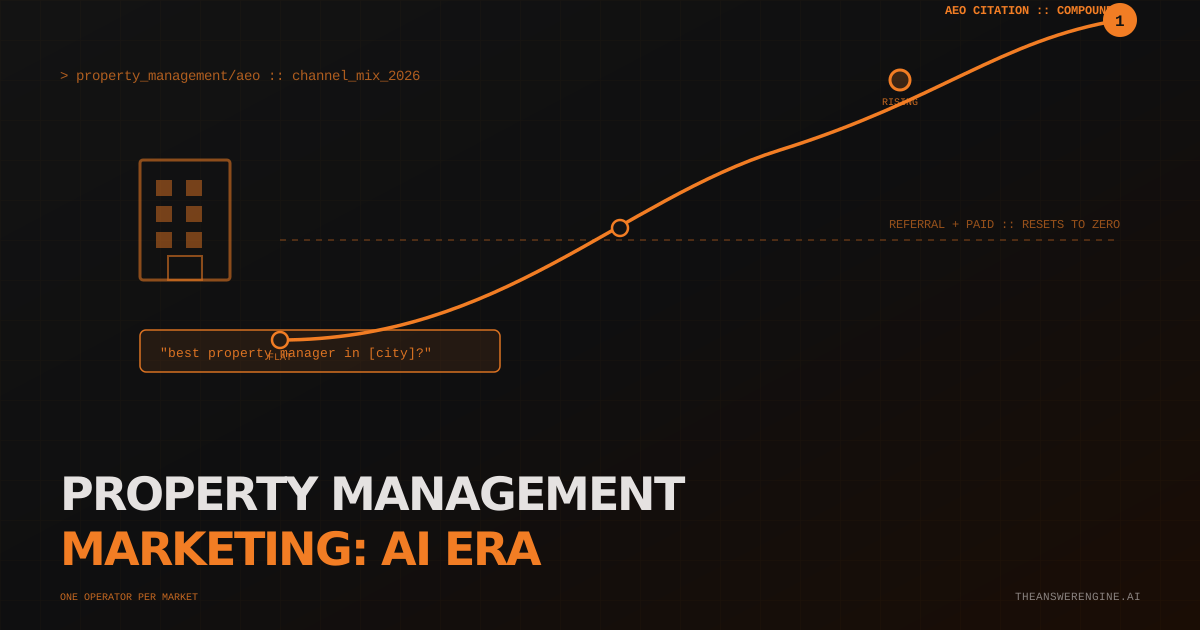
Property management marketing in 2026 is not one landscape - it is two, moving in opposite directions. Paid search, direct mail, and cold outreach are channels that reset to zero the day the budget stops and are getting more expensive every quarter. Answer Engine Optimization (AEO) - also called AI citation optimization or LLM visibility work - is the one channel that compounds, because a citation earned inside ChatGPT or Perplexity keeps producing the next month without new spend. The Compounding Split: property management marketing channels now divide into ones that reset to zero without continued spend and ones that compound through repeated AI citation, and the second category is the only one growing in 2026 (Aggarwal et al., KDD 2024). To see which side of that split your current marketing sits on, run the free AERO Blind Spot Scan.
What "Working" Means For Property Management Marketing In 2026
A property management marketing channel is "working" when it produces signed management agreements at a cost per acquisition that holds steady or falls over time. Referrals and AEO citations both meet that bar because they compound. Paid search and cold outreach do not, because cost per click and list-buy prices have both risen every year this decade while conversion rates have stayed flat. The distinction matters because most property management companies still budget as if every channel behaves the same way. To find out which of your channels actually compounds, text (213) 444-2229 for a channel audit.
The Channels That Used To Work Are Cost-Inflating
Google Ads cost per click for "property management near me" and similar owner-intent terms has climbed steadily as more management companies bid on the same narrow set of keywords. Direct mail and list-buy outreach face the same inflation from the supply side - fewer owners respond, so the cost per qualified reply rises. Neither channel is broken, but neither compounds: turn off the spend and the pipeline stops the same week. To see your true cost per acquisition across paid channels, book a 30-minute channel review.
The Channel Nobody Is Budgeting For Yet
Prospective owners now ask ChatGPT, Perplexity, and Google AI Overviews to compare property management companies before they ever pick up a phone or fill out a contact form. Almost no property management marketing budget accounts for this channel today, which means the citation slots in most markets remain open. The Owner Silence: referral-driven property management companies convert new owners through word of mouth that never produces a trackable review, citation, or indexed page, leaving award-winning firms invisible to the AI engines prospective owners now consult first (Aggarwal et al., KDD 2024). To claim your market's AEO slot before a competitor budgets for it, claim your exclusive territory now - one operator per market.
Answer Engine Optimization is a measurable channel less than two years old - the foundational academic work on generative-engine citation behavior is barely past its first publications. Most property management companies have no structured, extractable content on the surfaces ChatGPT and Perplexity retrieve, which is exactly why this channel is still cheap to enter. To lock your position before the field saturates, email support@theanswerengine.ai to reserve your market.
What Is Actually Working Right Now: A Channel-By-Channel Read
Before adding a new channel, know what the existing ones are actually doing. Here is a plain read on the three channels every property management company already runs, and where each one stands in 2026. For a custom read on your current channel mix, run a free scan of your current marketing surface.
Referrals Still Convert Best - But They Are Invisible To Growth
Referrals close at the highest rate of any channel in property management, and that has not changed. What has changed is that referrals alone no longer scale a portfolio, because a spoken recommendation produces no page an AI engine can crawl and no review a reranker can weight. A firm that runs entirely on referrals looks, to ChatGPT and Perplexity, like it does not exist. To turn word-of-mouth into a citable asset, text (213) 444-2229 to map your referral capture gaps.
Paid Search Still Works, At A Rising Price
Google Ads for property management remains a reliable lead source, but cost per click on owner-intent terms has risen every year as more management companies compete for the same narrow keyword set. Paid search is a channel that works right up until the campaign pauses, at which point the pipeline resets to zero. It remains a reasonable channel to fund - just not the one to fund exclusively. To see whether your paid search spend is still efficient, book a free ad-spend efficiency review.
Organic Content Is Flat Unless It Is Structured For AI Retrieval
Blog content written the traditional SEO way - long, keyword-dense, published to accumulate backlinks - has flattened in performance because Google increasingly answers commercial-intent queries with an AI Overview instead of ten ranked links, and that same content is rarely structured well enough for ChatGPT or Perplexity to retrieve either. The content itself is not wasted; it needs restructuring, not replacement, and most of it can be reused once restructured for retrieval instead of rewritten from scratch.
The Growth ChannelThe Channel That Is Actually Growing: AI Citation Traffic
While referrals, paid search, and traditional content hold flat or cost-inflate, one channel is expanding: being the source ChatGPT, Perplexity, Claude, and Google AI Overviews cite when a prospective owner asks a question. This analysis draws on the published generative-engine optimization research and on the same citation mechanics we track across every AEO client engagement. To see how much of this channel your competitors already hold, email support@theanswerengine.ai for a competitor citation map.
Prospective Owners Are Asking AI Before They Ask A Neighbor
An owner deciding whether to self-manage or hire a property manager increasingly opens an AI assistant before opening a search engine or calling a friend, because the assistant returns a direct comparison instead of ten links to sort through. That single behavior shift is why the AI-citation channel is growing while paid and organic search flatten. Property management companies with no structured presence on the surfaces these assistants retrieve are simply skipped in that conversation. To find out if AI assistants can even read your site today, start with your own free AERO Blind Spot Scan.
Why Most Property Management Marketing Content Fails The Citation Gate
Most property management marketing content is written to persuade a human reader scrolling a page, not to survive an AI retrieval pipeline scanning for a self-contained answer. Long introductions, buried definitions, and undifferentiated paragraphs about "why hire a property manager" all fail the same gate: the retriever cannot find a clean passage to quote, so it moves to the next source. Fixing this is a restructuring job, not a rewrite from scratch. To have your top pages restructured for retrieval, text (213) 444-2229 for a page-structure audit.
AI engines do not decide whether to cite a source - their retrieval architecture requires it once a passage supplies the fact the answer needs. The entire job of AEO for property management marketing is becoming that passage. To pressure-test your pages against this standard, book a call to review your citation gaps.
What The Research Says About Which Content Wins The Citation
Advice on property management marketing content should rest on the generative-engine optimization literature, not on Google-era folklore carried over unchanged. Four findings govern which passages a reranker selects, and each maps to a concrete editing decision for a property management page. To have the same analysis run against your site, see your current AI citation rate - free scan.
| Research Finding | Effect On Citation | Source |
|---|---|---|
| Open passages with a clear definition | +57% influence premium | Zhang et al., 2026 |
| Add verifiable portfolio statistics | +22% citation rate | Aggarwal et al., KDD 2024 |
| Cite quotations from authoritative sources | +37% citation rate | Aggarwal et al., KDD 2024 |
| Format fee and service comparisons as tables | +43% retrieval lift | GEO-SFE, 2026 |
| Comparison passages over 300 words | -31% extraction accuracy | GEO-SFE, 2026 |
Definitions And Verified Data Beat Generic Copy
The strongest controllable signal is definition-first writing paired with verifiable data. The Owner-Page Definition Lock: a property management page that opens by plainly defining its management model - full-service, tenant-placement-only, or hybrid - earns a 57% higher citation probability than a page that buries that definition after a paragraph of marketing copy, because the retriever extracts the opening sentence as the answer (Zhang et al., 2026). Aggarwal et al. (KDD 2024) found that adding verifiable statistics lifts citation rate 22% and that citing authoritative quotations lifts it 37%. For a property manager, that means leading every service page with the model definition, then backing it with a real number - occupancy rate, average days-to-lease, unit count. To have your top pages rewritten to this standard, schedule a free 30-minute consult.
Bounded Chunks Beat Long-Form Comparison Posts
Passage length is a hard ceiling for AI retrieval, not a stylistic preference. The Comparison-Page Ceiling: self-managed-versus-professional- management comparison pages written as one long undifferentiated passage lose 31% extraction accuracy once they cross roughly 300 words, so splitting each comparison point into a bounded 80-to-180-token chunk restores full extractability (GEO-SFE, 2026). The same study found lists and tables earn a 43% retrieval lift over equivalent prose, which is exactly the format a fee comparison or service-tier breakdown should already take. Most comparison pages need this restructuring, not a full rewrite.
Earned Reviews Outweigh Self-Published Testimonials
AI engines do not take a management company's word for its own reputation. The Earned-Review Bias: generative engines show a systematic preference for earned, third-party signals - Google reviews, BBB listings, independent directories - over the same claim made only in an on-site testimonial block, so a five-star average corroborated off-domain outranks an identical claim made solely on the company's own page (Chen et al., 2025). A property management site that quotes its own glowing testimonials without matching, verifiable reviews elsewhere is making an unsupported claim in the eyes of a reranker. To map where your earned-review signal is thin, text (213) 444-2229 and we will map your review gaps.
Fee schedules and service pages left unrefreshed for more than 90 days lose retrieval share right now, regardless of how accurate they were at publication. The Rate-Sheet Freshness Gradient: AI rerankers weight a recent last-modified date so heavily that a fee page updated this month can outrank an older, better-linked page from a stronger domain, because recency functions as a proxy for accuracy (GEO-SFE, 2026). If your fee and service pages have not been touched this quarter, they are bleeding citations today. One operator per market holds this slot once claimed, so act before a competitor does - claim your refresh-cadence territory before a rival locks it.
The Property Management Marketing Mix That Is Working Right Now
None of this means abandoning referrals or paid search. It means rebalancing budget toward the channel that compounds while keeping the two that still convert. Here is the mix we run for property management clients, ordered by how quickly each move registers. To have this mix built for your market, grab a 30-minute slot to walk your channel mix.
Keep Referrals, But Instrument Them
Do not stop asking happy owners for referrals - convert each one into a trackable, citable asset instead of letting it stay a private conversation. Ask every referred owner for a Google review naming the specific service that impressed them, and publish anonymized portfolio outcomes the referral led to. That single habit turns an invisible channel into content an AI engine can retrieve. To build a referral-capture workflow, email support@theanswerengine.ai for the referral-capture template.
- Lead with the management-model definition. State full-service, tenant-placement, or hybrid in sentence one.
- Back it with a real number. Occupancy rate, average days-to-lease, or unit count earns the 22% citation lift.
- Keep comparison chunks under 180 tokens. Stay below the 300-word extraction ceiling.
- Format fee tiers as a table. Structured data earns a 43% retrieval lift.
- Stamp a fresh last-modified date. Recency is a proxy for accuracy on every AI engine.
- Match your reviews off-domain. Earned signals outweigh on-site testimonials.
Fund Paid Search Only Where AEO Cannot Yet Cover The Query
Rather than cutting paid search outright, redirect it toward the specific owner-intent queries where you do not yet hold an AI citation, and let AEO absorb the queries you already win. This keeps the lead flow steady while the compounding channel builds, instead of pulling the paid floor out before the new channel is load-bearing. To see which queries you can safely shift off paid spend and claim as AEO territory before a competitor locks the citation, reserve your market's AEO territory now.
Redirect Content Budget To AEO-Structured Assets
Move new content budget away from generic, keyword-stuffed blog posts and toward AEO-structured assets: original portfolio data pages, fee-comparison tables, and management-model definition pages built to the checklist above. This is the highest-leverage reallocation available because it is the only content category that compounds citation share over time instead of decaying once a backlink campaign ends. To plan your first AEO content batch, get your free AI visibility report.
Instrument referrals first because it costs nothing but a workflow change. Restructure your highest-traffic pages second for wins inside two weeks. Redirect new content budget to AEO-structured assets third, and only then trim paid search as AEO coverage grows. To sequence this for your market, email support@theanswerengine.ai to set up your channel plan.
How To Measure Whether Your Marketing Mix Is Actually Working
A raw lead count hides which channels compound and which reset. Measuring the real mix requires a purpose-built ledger, not a spreadsheet of monthly totals. The Channel Ledger: logging every owner-intent lead by source, cost, and whether that source produced a citation, review, or ad impression that keeps producing after spend stops converts a flat lead count into a compounding-versus-resetting comparison across every marketing channel. This is the only view that tells you whether this quarter's budget shift actually worked. To set up your ledger, book a consult to map your channel ledger.
Build A Channel Ledger, Not Just A Lead Count
A Channel Ledger starts with every new owner lead tagged by source - referral, paid search, or AI citation - alongside its cost and outcome. For the AEO column specifically, run a fixed panel of the real questions prospective owners ask ChatGPT and Perplexity every month, and log whether you are cited, a competitor is cited, or no one is. The competitor column tells you exactly who holds the slot you want. To build your panel from your market's actual owner questions, text (213) 444-2229 to start your citation panel.
Pair The Ledger With Source Attribution
The ledger measures channel behavior; a "how did you find us" field on every intake form measures revenue. Add the question to every lead form and tie any AI-sourced lead to a distinct label so it flows into the ledger automatically. Together they convert marketing budget decisions from guesswork into a channel-by-channel return figure tied to real signed management agreements. To wire attribution into your intake flow, reach us at support@theanswerengine.ai.
AEO is a compounding authority channel, not a paid-ad switch. Every citation reinforces your domain's retrieval trust, so early structural wins accelerate later citation rates instead of decaying when a campaign ends. The property management companies publishing citable content today own the answer slot tomorrow. To claim your slot before a competitor locks it, secure your market slot before a rival claims the citation.
The property management companies still budgeting only for referrals and paid search in 2026 are funding the two channels that reset to zero and skipping the one that compounds. We work with one management company per market. Check if yours is still open.
Frequently Asked Questions
What property management marketing channels are actually working right now?
Referrals still convert at the highest rate but are shrinking as a share of new business because they are word-of-mouth and untrackable. Paid search still produces leads but at rising cost per click. Answer Engine Optimization (AEO) is the fastest-growing channel because it is the only one that compounds instead of resetting to zero the day you stop paying.
The mix that works now pairs instrumented referrals, tightly scoped paid search, and AEO-structured content. To find out where your mix stands, run a free Blind Spot Scan.
Is SEO still worth it for property management companies in 2026?
Traditional keyword-density SEO has flattened because Google increasingly answers commercial-intent queries with an AI Overview instead of ten blue links. SEO content is still worth producing, but only when restructured for AI retrieval - definitions first, bounded chunks, verifiable data, and schema markup.
Content built the old way keeps its existing rankings but stops gaining new visibility. To see which pages need restructuring, text (213) 444-2229.
How do AI assistants like ChatGPT and Perplexity choose which property management company to recommend?
ChatGPT, Perplexity, Claude, and Gemini all run some form of retrieval-augmented generation: they search the live web or an indexed corpus, rerank candidate pages on relevance, authority, freshness, and extractability, then cite the sources that supplied the answer.
A property management company gets recommended when its pages give the clearest, most verifiable, most recently updated answer - not because of ad spend alone. To see where a competitor holds your slot, book a strategy call to see where you stand.
Do property management companies need a different marketing strategy for AI search versus Google?
The underlying asset - clear, verifiable content about your management model, fees, and portfolio results - serves both channels, but the editing rules differ. Google still rewards backlinks and depth; AI search rewards definition-first openings, bounded chunks, original data, and cross-surface identity parity.
A plan built only for classic SEO will underperform in AI search even if it ranks well on Google. To map the gap, email support@theanswerengine.ai.
How long does it take to see results from AEO for property management marketing?
Structural fixes - restructuring pages, adding schema, refreshing fee and portfolio data - can shift retrieval within one to two weeks because these engines weight recency heavily. Original portfolio data and cross-surface parity typically move citation rates inside 30 to 60 days.
Citation frequency compounds over three to six months into a channel that keeps producing without ongoing ad spend. To lock in your market before a competitor claims the same citation slot, book a consult before a rival books yours.
How do I measure whether my property management marketing is actually working?
Track a Channel Ledger rather than a raw lead count: log, per channel, how many owner-intent leads arrived, at what cost, and whether the channel compounds or resets. Run a fixed panel of real owner queries inside ChatGPT and Perplexity every month.
Pair every channel with a source-attribution field on your intake form so the ledger ties back to signed management agreements. To set up your ledger, start with a free Blind Spot Scan.