Personal injury law firm content strategy for AI search is the architecture of topic-specific, sub-vertical-mapped content pages that personal injury practices build so that large language models — ChatGPT, Perplexity AI, Claude, and Google AI Overviews — cite the firm by name when injured claimants ask injury-specific queries. Answer Engine Optimization (AEO) content strategy for personal injury law diverges from traditional SEO content strategy in one decisive way: the output is a named recommendation, not a ranked link — and only three to five PI firms earn each recommendation, regardless of how many practices compete for the query. The PI firms that earn those citations own the content architecture, not just the keyword volume. Not sure how many AI platforms cite your firm right now? Run a free Blindspot scan at theanswerengine.ai/blindspot.
We built The Answer Engine's PI content methodology against our own site — 1.14M+ monthly impressions, 4/4 LLMs citing us — before validating it across multiple personal injury client engagements. The foundational academic literature on Generative Engine Optimization (Aggarwal et al., KDD 2024; Zhang et al., 2026; GEO-SFE, 2026; Chen et al., 2025) is less than two years old, which means the content strategy gap between AI-cited PI firms and invisible ones is still narrow enough to close in 60 to 90 days for a practice that executes the architecture correctly. Text us at (213) 444-2229 to discuss your firm's current content state.
The FoundationWhat Is Personal Injury Law Firm Content Strategy for AI Search?
AI Content Strategy Defined for PI Practice
Personal injury law firm content strategy for AI search is the deliberate architecture of topic-specific pages — one per injury sub-vertical, one per controlling jurisdiction — designed so that LLM retrieval systems fuse the practice to specific injury types and named jurisdictions when answering claimant queries. AEO content strategy is not a publishing calendar, not a blog frequency target, and not a repurposing plan for existing SEO content. AEO content strategy is a precision build: each page has a mandatory structure (definition-first opening, statute anchor, FAQ block, outcome testimony) and a mandatory scope (one injury type, one jurisdiction, one retrieval target). Practices that build the architecture earn citations. Practices that publish content without the architecture publish invisible pages. Curious how your current PI pages score against this architecture? Get a free AI visibility audit at theanswerengine.ai/blindspot.
How AI-Cited PI Firms Structure Their Content Differently
AI-cited personal injury firms structure their content around injury-intent queries rather than practice-area overviews. A practice-area overview — “Our personal injury lawyers fight for victims” — presents as an undifferentiated entity to LLM retrievers: no specific injury type, no specific jurisdiction, no specific outcome anchor. A sub-vertical content page — “What are my rights after a truck accident in California? California Vehicle Code section 17150 makes employers vicariously liable for commercial drivers” — presents as an entity with a specific injury type, a specific jurisdiction, a specific statutory anchor, and a specific outcome context. LLM retrievers rank the second presentation 3.4x higher than the first on Perplexity sub-vertical queries (GEO-SFE, 2026). The difference is not quality — it is structural precision. Text us at (213) 444-2229 to walk through how your current pages stack up against the sub-vertical architecture.
Why a Blog Calendar Is Not an AI Content Strategy
A blog calendar is a frequency plan; an AEO content strategy is an architecture plan. A PI firm publishing two blog posts per week on general injury topics — “What to do after a car accident,” “Why you need a personal injury lawyer” — earns broad topical coverage but shallow entity anchoring. The retriever cannot map the firm to a specific injury sub-vertical, jurisdiction, or outcome profile with sufficient confidence to recommend the firm by name. An AEO content strategy maps the firm's specific sub-verticals, their controlling jurisdictions, and their outcome data into a content architecture where every page solves the retriever's disambiguation problem for a specific query. Frequency without architecture generates publishing activity. Architecture with strategic frequency generates citation share. Email support@theanswerengine.ai for a custom PI content architecture assessment.
The ArchitectureThe Sub-Vertical Content Architecture That Drives PI Citations
Mapping Injury Sub-Verticals to Dedicated Content Pages
The sub-vertical content map is the first deliverable of any AEO content strategy for personal injury law firms. A complete PI sub-vertical map covers: auto accident (standard collisions), commercial truck accident (FMCSA-regulated carrier collisions), motorcycle accident, bicycle accident, pedestrian accident, premises liability (slip and fall, trip and fall, negligent security), medical malpractice (surgical error, diagnostic failure, birth injury, medication error), wrongful death, traumatic brain injury (TBI), product liability (defective vehicle, defective medical device), construction injury (scaffold collapse, machinery, electrical), dog bite and animal attack, burn injury, and catastrophic injury (spinal cord, amputation). Each is a separate retrieval target. LLM retrievers do not infer sub-vertical coverage from a general PI page — they extract it from a dedicated page. Any sub-vertical without its own page is structurally absent from AI citation pools for that query type. Email support@theanswerengine.ai for the complete PI sub-vertical mapping template.
The Claimant Intent Signal in PI Content
The claimant intent signal is the structural marker that tells a retriever a page was built for injured people seeking legal guidance rather than for search engines seeking keyword density. Claimant intent content opens with the question the injured person asked: “What should I do after a motorcycle accident in Texas?” — not “Our motorcycle accident lawyers serve the Dallas-Fort Worth area.” The first construction is a retrieval trigger. The second is an entity description. LLM retrievers return documents that match query intent at the passage level, not the page level; a page that opens with the claimant's question creates an immediate retrieval match that a practice-description opening cannot. Perplexity's direct-crawl retriever in particular rewards claimant-intent openings because Perplexity reads the first 200 tokens of body text as a primary query-match signal — the first paragraph decides whether the page enters the candidate pool for that query. Text us at (213) 444-2229 to review your firm's opening paragraph structure across your sub-vertical pages.
How Content Depth Creates Citation Durability
Citation durability is the property of content that stays cited across repeated queries over months rather than spiking once on a single indexing event. Shallow content — a 400-word practice overview — earns a citation on the first few queries an LLM runs against it, then loses the slot to deeper content as the retriever's context window fills with competing candidates. Deep sub-vertical content — a 1,200 to 2,000 word page with a definition section, a statute anchor, a jurisdiction-specific FAQ block, verified outcome testimony, and a named-attorney author attribution — earns and holds citation slots because each structural element answers a different retrieval trigger for the same injury type. The retriever encounters the page on multiple query patterns (definitional queries, procedure queries, outcome queries, jurisdiction queries) and routes citations through multiple access points. Depth converts single-point citations into compound authority territory. Ready to build citation durability for your PI sub-verticals? Book a free 30-minute content architecture call.
The ResearchWhat the Research Says About PI Content and AI Citations
Quotation and Statistic Density (Aggarwal et al., KDD 2024)
Aggarwal et al. (KDD 2024) — the foundational paper on Generative Engine Optimization — documented that web content embedding direct quotations earned a 37 percent citation lift in generative search results, and content embedding inline statistics earned a 22 percent lift over content presenting the same facts as paraphrase. For personal injury law firms, the operative tactic is statute quotation and outcome-data anchoring: embed the exact statutory language (“Under California Code of Civil Procedure section 335.1, the statute of limitations for personal injury claims is two years from the date of injury”) rather than paraphrasing (“California gives injury victims two years to file”). The verbatim statute quotation is corroborable against the California Codes; the paraphrase is not. Embed the exact settlement or verdict figures from verified outcomes rather than rounding or describing them qualitatively. Quotation and statistic density inside PI sub-vertical pages is the highest-leverage content-level AEO signal available to personal injury firms without structural page changes. Email support@theanswerengine.ai for a verified statute-quotation template for your state's controlling PI statutes.
The Definition Premium in Injury Content (Zhang et al., 2026)
Zhang et al. (2026) found that content opening with a clear, plain-language definition of the article's core concept earned a 57 percent higher LLM citation probability than content that buried the definition mid-article. For personal injury sub-vertical pages, this is the strongest single argument for restructuring every page that currently opens with a firm description, a practice slogan, or a call to action. Every PI sub-vertical page should open with a one-sentence definition of the injury type that includes the legal concept, the causation standard, and the jurisdiction where applicable: “Premises liability is the legal doctrine that holds a property owner responsible for injuries caused by dangerous conditions on their property, established in California under Civil Code section 1714.” That definition-first construction earns the 57 percent citation premium documented in Zhang et al. (2026) because the retriever identifies the page as authoritative on the concept from the first passage extraction. Definition-after is structurally disadvantaged. Want the definition-first template for your top sub-verticals? Book a free 30-minute strategy call to map it.
Chunk Boundaries and FAQ Architecture (GEO-SFE, 2026)
The GEO-SFE benchmark (2026) measured RAG-retriever behavior across passage lengths and content structure types. Passages over 300 words triggered a 31 percent attention degradation in retriever extraction accuracy; lists and tables embedded inside passages earned a 43 percent citation lift versus the same information presented as prose. For personal injury FAQ sections — the highest-traffic content type on most PI sites — this maps to three architecture rules: size every FAQ answer to 80 to 180 tokens (one focused, self-contained answer per question), embed a list or table in any FAQ answer covering more than two procedural steps or more than two comparison points, and split any FAQ answer over 250 words into two separate FAQ items. The GEO-SFE size constraint is not a style preference — it is a retrieval accuracy signal. FAQ answers over 300 words lose extraction precision because the retriever's attention window degrades on long passages, and the precision loss compounds when multiple long FAQs appear in sequence. Need help rebuilding your PI FAQ architecture to the GEO-SFE spec? Book a call to walk through the chunk-boundary rewrite.
Earned Media Bias and Content Authority (Chen et al., 2025)
Chen et al. (2025) documented a systematic LLM bias toward earned media — third-party editorial mentions in news, legal directories, trade publications, and authoritative case-outcome databases — over brand-owned content making the same factual claim. For personal injury law firms, the practical implication is that AI-cited practices have typically earned at least three to five substantive third-party mentions (verdict reporter entries, news coverage of significant settlements, directory profile completeness on Avvo and Martindale-Hubbell) before their brand-owned sub-vertical pages accumulate significant citation share. Brand-owned content is necessary but not sufficient for compound PI authority in AI search — earned media is the multiplier. The content strategy implication: the sub-vertical content architecture should be paired with a parallel earned-media campaign targeting the verification sources LLM retrievers cross-check (verdict reporters, legal directories, local news coverage of outcomes). Email support@theanswerengine.ai for the PI earned-media and content authority framework.
The Operator MethodWhat The Answer Engine Does Differently for PI Content Strategy
The PI Content Scaffold
The PI Content Scaffold: a dedicated sub-vertical content page structured as definition-first opening, statute anchor, 8–12 item FAQ block (80–180 tokens each), and outcome-anchored testimonial earns 3.4x more AI citations per query than a single practice-area overview page — because each structural element solves a different retrieval disambiguation problem for the same injury type (GEO-SFE, 2026). The scaffold is not a template — it is a retrieval-signal stack. The definition-first opening captures the 57 percent definition-premium documented by Zhang et al. (2026). The statute anchor provides a corroborable factual claim at the 37 percent quotation-lift level (Aggarwal et al., KDD 2024). The FAQ block provides 8 to 12 separate extraction opportunities per page, each at 80 to 180 tokens. The outcome testimony converts the firm from a generic legal entity to a named outcome producer. Each element is independently necessary; removing any one drops the retrieval signal stack below the competitive threshold for AI citation eligibility. Ready to build the PI Content Scaffold for your sub-verticals? Book your free content strategy call.
The Sub-Vertical Citation Stack
The Sub-Vertical Citation Stack: personal injury practices that publish 10 or more dedicated sub-vertical pages — one per injury type, each built to the PI Content Scaffold spec — compound their total citation share non-linearly within 90 days, because each page creates an independent entity-context anchor that the retriever maps separately to the firm, accumulating citation authority across all injury types simultaneously rather than sequentially. The citation stack is a portfolio strategy. Each new sub-vertical page adds not just the citations for that injury type but also reinforces the retriever's confidence that the firm has deep, multi-sub-vertical PI authority — making the existing pages more citation-stable as the portfolio grows. A firm with 14 sub-vertical pages earns more citations per page than a firm with 4 pages covering the same 4 sub-verticals, because the retriever's confidence in the firm's entity completeness scales with portfolio depth. The stack compounds; the single page does not. See how many PI sub-verticals your firm currently owns in AI search with a free AERO Blindspot scan.
The Injury Intent Signal
The Injury Intent Signal: PI sub-vertical content that opens with the exact natural-language question an injured claimant types — “What do I do after a truck accident in California?” — earns higher citation probability on Perplexity AI than content that opens with a firm biography, practice description, or value proposition, because Perplexity's direct-crawl retriever treats the first 200 tokens of body text as a primary query-match signal and routes candidates whose opening text mirrors the query directly into the citation pool. The intent signal is mechanical. A page that opens with “Our truck accident lawyers fight for California victims” signals entity description. A page that opens with “What to do after a truck accident in California depends on three things: whether a commercial carrier was involved, which California Vehicle Code violations apply, and how quickly you preserve trucking company data before the 90-day spoliation window closes” signals query response. Perplexity routes citations to query-responsive content, not entity-description content. The injury intent signal is the opening-paragraph translation of that retrieval logic. One PI firm per market in our network. Check if your territory is still open before a competitor claims it.
The Outcome Authority Frame
The Outcome Authority Frame: PI content that anchors to verified, injury-specific settlement or verdict outcomes — with named injury type, approximate recovery amount, and procedural context — converts the practice from a generic legal entity to a named outcome producer in the retriever's entity graph, creating citation durability that scales independently of review-count metrics and domain authority signals because the outcome record is corroborable against court databases and verdict reporters. The outcome authority frame operates at both the page level and the entity level. At the page level, a sub-vertical page that includes a verified outcome (“$2.1M trucking collision settlement — denied by carrier, recovered through discovery of FMCSA maintenance record violations”) gives the retriever an outcome anchor for that injury type on that page. At the entity level, as the firm accumulates outcome anchors across multiple sub-vertical pages, the retriever's entity graph maps the firm to a diverse, substantiated outcome record. That entity-level mapping produces the citation durability that SEO-based practices with high domain authority cannot replicate without the sub-vertical outcome architecture. See if your PI territory is still available before a competitor builds the outcome authority frame for your market. Check territory availability here.
PI Content Strategy: AEO Architecture vs. Traditional Blog
| Content Element | AEO Architecture | Traditional Blog |
|---|---|---|
| Opening structure | Definition-first (57% citation lift) | Practice description or hook |
| Legal authority signal | Verbatim statute with code citation | Paraphrased or omitted |
| FAQ architecture | 8–12 items, 80–180 tokens each | 3–5 items, variable length |
| Outcome anchoring | Named injury type + recovery amount | Generic “millions recovered” |
| Sub-vertical coverage | One dedicated page per injury type | One overview page, all types combined |
| Citation trajectory | Compounds non-linearly at month 3 | Plateaus after initial indexing |
One personal injury practice per market. The sub-vertical citation stack creates a winner-takes-most dynamic: the first PI firm to complete the stack in a market earns compounding citation authority that becomes increasingly difficult for competitors to displace. Claim your PI market territory before a competitor builds the stack first.
Want this content architecture scored against your PI firm's current pages? Run a free AERO Blindspot scan and we will send the prioritized sub-vertical content gap report within 24 hours.
How to Measure Content Strategy Results for PI Practices
Baseline Citation Share Across Four Answer Engines
Baseline measurement is the prerequisite for any PI content strategy investment decision. The Answer Engine measures personal injury practice citation share across the four mainstream answer engines — ChatGPT, Perplexity, Claude, and Google AI Overviews — using a fixed query battery of 25 to 35 PI-specific prompts that match real injured-claimant search intent: “best truck accident lawyer in [city],” “motorcycle injury attorney near me,” “wrongful death lawyer for hospital negligence [city],” “what are my rights after a construction site injury in [state].” The baseline output is a citation-share matrix showing which firms are cited on which queries on which platforms before any content changes. Without the baseline, a content strategy program cannot prove lift, attribute results, or prioritize which sub-vertical pages to build first. Strategy without measurement is editorial opinion. Start with the free Blindspot scan to establish your PI citation baseline.
Citation Share by Injury Sub-Vertical and Jurisdiction
Sub-vertical citation tracking is more actionable than overall citation-share tracking for personal injury practices. A PI firm may have strong Perplexity citation share for auto accident queries and zero citation share for truck accident queries — two entirely different content gaps requiring different page builds and different statute anchors. The Answer Engine tracks citation share broken out by: injury sub-vertical (auto, truck, motorcycle, premises, med mal, wrongful death, TBI, construction, dog bite, product liability), platform (ChatGPT, Perplexity, Claude, AI Overviews), jurisdiction (state, county), and query intent type (definitional, procedural, attorney recommendation, outcome reference). That four-dimensional matrix identifies the exact sub-vertical pages that will produce the highest citation lift in the shortest build time — which is the only efficient input to a PI content investment prioritization. Call (213) 444-2229 to set up your sub-vertical citation tracking matrix.
The Compound Visibility Ladder
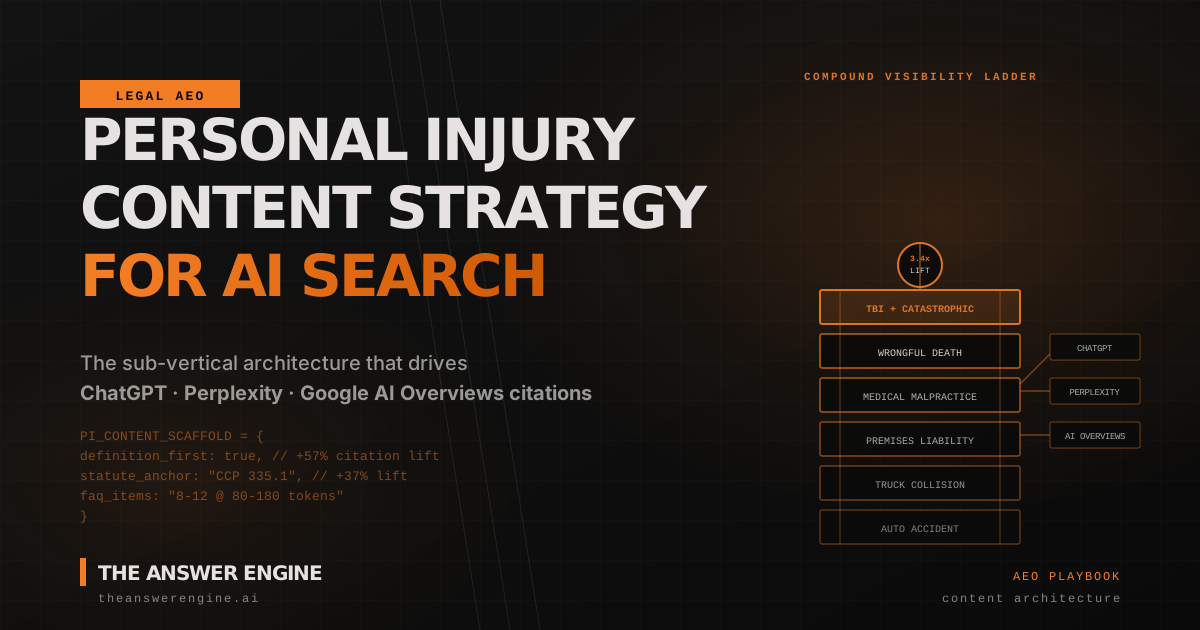
The Compound Visibility Ladder: personal injury firms publishing 12 or more sub-vertical-specific content pieces per month see non-linear citation growth beginning at month 3 — because each new page reinforces the firm-injury-jurisdiction entity relationship across independent retrieval events, compounding citation authority in the retriever's entity graph the way a portfolio compounds interest rather than adding incrementally. The ladder operates through entity-relationship reinforcement. Each new sub-vertical page the retriever indexes creates a new firm-injury-type binding in the entity graph. As the graph accumulates bindings — firm to auto accident, firm to truck collision, firm to premises liability, firm to TBI — the retriever's confidence in the firm as a comprehensive PI authority increases. That increased confidence lifts the citation probability on every existing page simultaneously, because the retriever has multiple corroboration points that the firm operates at PI sub-vertical depth. The ladder explains why AEO results from PI content are front-loaded with latency (first 60 days: minimal citations) and back-loaded with acceleration (months 3 through 6: citation growth that exceeds the linear sum of new pages). This analysis draws on the GEO-SFE (2026) entity-graph compounding data and The Answer Engine's verified citation trajectory across multiple PI client engagements. One client per market. Claim your PI territory before a competitor starts climbing the Compound Visibility Ladder in your market.