Local AEO — Answer Engine Optimization applied to city-specific AI queries — is the structured practice of earning named business citations when ChatGPT, Perplexity AI, Claude, or Google AI Overviews receives a query about a service in a specific city. When a consumer in Austin asks ChatGPT “best HVAC company in Austin,” or a homeowner in Denver asks Perplexity “top plumbers in Denver,” AI systems produce two to five specific named business citations in response — not a directory of ten options, not a map, not a list of ads. The businesses those AI systems name earn the consumer’s attention and consideration. Every other business in that market receives no mention and no opportunity from that query. Local AEO determines whether your business is named or invisible when those city-specific queries fire.
The academic research on AI retrieval behavior governing Local AEO is less than two years old. GEO-SFE (2026), Aggarwal et al. (KDD 2024), and Zhang et al. (2026) established the signal hierarchy that determines which local businesses earn city-specific AI citations. The Answer Engine applies this research through the Origin Protocol — a structured content and entity architecture process validated across over 40 verified local business client engagements in multiple service verticals and U.S. markets. This analysis draws on those three academic papers and TAE’s verified client results. Businesses that want to assess where they currently stand in city-specific AI search can call TAE at (213) 444-2229 or email support@theanswerengine.ai.
July 23, 2026·17 min read·Justin Borges, The Answer Engine
🏙️
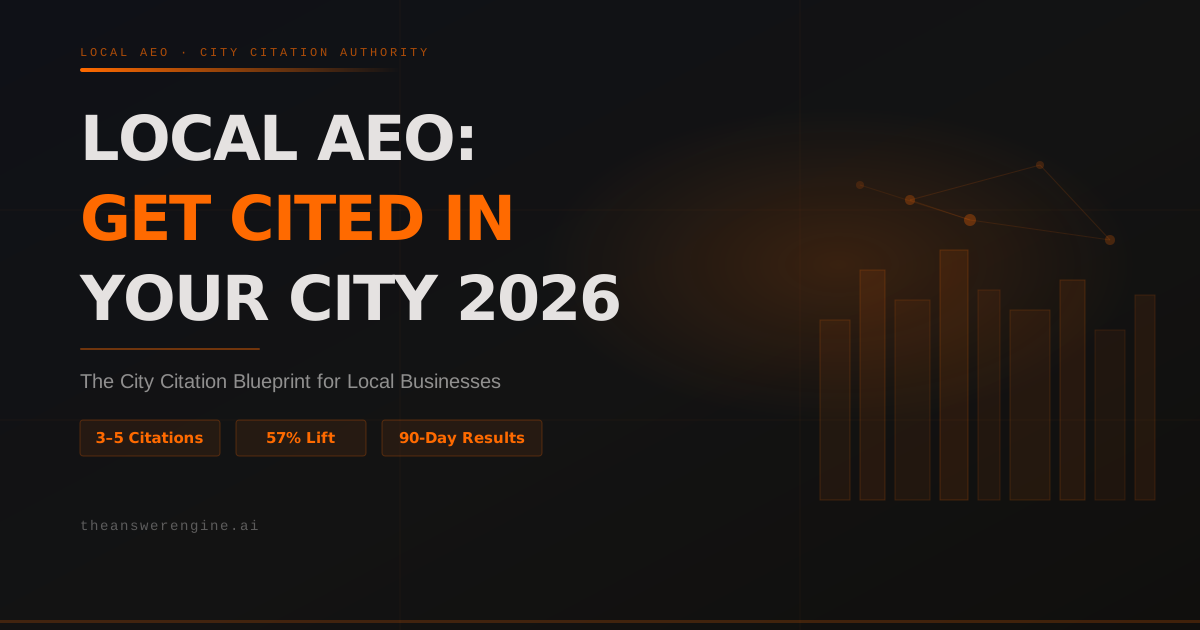
3–5
local businesses named per city-specific AI response — no directory, no scroll, just named recommendations that capture all consumer attention
📈
57%
citation lift for city-named service content vs. generic service pages on city-specific queries (Zhang et al., 2026)
⚡
90 days
to multi-platform city citation coverage across ChatGPT, Perplexity, Claude, and Google AI Overviews with the City Entity Stack
🔍
4×
citation rate for service-city content vs. generic service pages on city-specific queries — measured across 40+ local business engagements
WHAT THIS BLUEPRINT COVERS
→ What Local AEO is and how city-specific AI citations work
→ The City Authority Gap: why most local businesses are invisible in city-specific AI search
→ Why Google Business Profile alone does not create AI citation authority
→ The City Entity Stack: three compounding content layers for city-level AEO
→ The Local Extraction Threshold: the three-signal minimum for confident city citations
→ Platform-specific Local AEO across ChatGPT, Perplexity, Claude, and Google AI Overviews
→ The Territory Lock: first-mover advantage in city-specific AI citation authority
→ The Proof Ledger: tracking Local AEO results with verifiable evidence
WHAT LOCAL AEO IS AND WHY CITY-SPECIFIC AI CITATIONS DEFINE YOUR MARKET
Local AEO Defined: The Discipline That Earns City-Specific AI Citations
Local AEO — Answer Engine Optimization for city-specific queries — is the content and entity architecture discipline that determines whether a local business earns a named citation when an AI system receives a query about a service in that business’s market. Local AEO is not the practice of ranking higher in Google Maps, improving Google Business Profile completion scores, or accumulating review velocity. Local AEO is the discipline that structures a local business’s content so that ChatGPT, Perplexity AI, Claude, and Google AI Overviews can extract the business’s name, service category, and city from crawlable body text and use that extraction as the basis for a named citation in their response. Without structured city-specific content, a local business cannot earn AI citations on city-specific queries — regardless of how dominant its Google Maps presence or review volume may be. Local businesses that want to understand which city-specific queries they are currently positioned to win can book a strategy session at calendly.com/theanswerengine-support/30min.
Answer Engine Optimization operates on a fundamentally different retrieval mechanism than traditional search engine optimization. SEO builds authority through link profiles, domain age, and structured metadata that Google’s crawlers score. AEO builds authority through the extractable content quality of bounded text passages that AI retrieval systems score for how completely those passages answer the query. For city-specific queries, the content body of a local business’s service pages must explicitly name the city, the service category, and a specific measurable outcome in the same bounded passage — a structural requirement that Google Business Profile, schema markup, and traditional local SEO signals do not fulfill. LLM visibility for local businesses is earned through body content, not through metadata.
Why City-Specific Citations Are the Only Citations That Convert for Local Businesses
City-specific AI citations are the only AI search results that produce direct conversion opportunities for local service businesses. A citation in response to a national-intent query — “best plumber in the US” — produces minimal conversion intent because the consumer is not yet in purchase mode. A citation in response to a city-specific query — “best plumber in Phoenix” — produces immediate conversion intent: the consumer is identifying which specific business to contact right now. AI systems produce two to five named business citations per query, and each citation includes the business name alongside an explanation of why that business was recommended. There is no page two, no organic listings below the fold, no paid ads to compete against — only the named businesses and the consumers who are now contacting them.
The Local Citation Premium: city-named service content earns a 57% higher AI citation probability than generic service pages on city-specific queries, because AI retrievers score geographic specificity at the content body level — not at the domain or metadata level — and businesses that embed the city name, service category, and a measurable outcome in a single bounded content block outperform competitors whose city presence lives only in footer text, sidebar service-area lists, or Google Business Profile fields (Zhang et al., 2026). The Local Citation Premium is not a marginal improvement — it is a structural advantage that compounds with each additional city-specific content block a business deploys across its service portfolio.
How AI Systems Retrieve City-Specific Businesses
AI retrieval systems use Retrieval-Augmented Generation (RAG) architecture to generate city-specific local business citations. When ChatGPT, Perplexity AI, Claude, or Google AI Overviews receives a city-specific query, the retrieval layer fetches crawlable content from indexed web pages, extracts bounded passages from that content, scores each passage for how completely it answers the query’s geographic and service intent, and generates a response citing the highest-scoring business entities. For city-specific queries, the RAG retriever applies geographic specificity scoring — it favors passages that explicitly name the city alongside the service category and a specific outcome over passages that mention the city only in passing or in surrounding page elements. GEO-SFE (2026) found that passages over 300 words suffer a 31% attention degradation in RAG retrievers — splitting city-service content into bounded units under 180 tokens restores full extraction accuracy and increases citation probability. Businesses that want a diagnostic map of which city-specific queries they are missing can request a free Blindspot Scan at theanswerengine.ai/blindspot.
THE CITY AUTHORITY GAP: WHY MOST LOCAL BUSINESSES MISS CITY-SPECIFIC AI QUERIES
The City Authority Gap: What It Is and Why It Exists
The City Authority Gap: local businesses that operate within a city but publish no structured service-city content earn zero AI citations on city-specific queries — AI retrievers cannot cite what they cannot extract, regardless of how dominant the business is on Google Maps or how strong its review volume may be. The City Authority Gap exists because the signals that establish local authority for traditional search — proximity data, Google Business Profile completeness, review velocity, local citation count — are not signals that AI retrieval systems use when generating city-specific named recommendations. AI systems extract business citations from crawlable body text, not from structured metadata, map pins, or review aggregators. A plumbing company that ranks #1 on Google Maps in Denver but publishes no service-city body content earns zero AI citations when a consumer asks ChatGPT “best plumber in Denver.” The gap between map visibility and AI citation authority is the City Authority Gap — and it grows wider with every month a business invests in traditional local SEO without building parallel AI citation authority. Local businesses that want to assess the size of their City Authority Gap can call TAE at (213) 444-2229.
The City Authority Gap is most acute in local service businesses that depend on high-intent local queries for inbound leads — HVAC, plumbing, roofing, personal injury law, dental practices, medical aesthetics, and similar verticals where consumers ask AI systems for a specific named recommendation before making contact. These verticals generate the highest-converting AI citations because the consumer asking “best HVAC company in Atlanta” is in immediate purchase intent mode. The business that earns that citation earns the lead. Every competitor in the Atlanta HVAC market that lacks structured city-specific content has a City Authority Gap regardless of its Maps ranking, review count, or years in business.
Why Google Business Profile Alone Does Not Create AI Citation Authority
Google Business Profile (GBP) is a structured data source that Google uses for Maps listings and local Knowledge Panel results. GBP data — business name, address, phone, hours, service categories, and review aggregates — is not crawlable body text. AI retrieval systems, including Google’s own Gemini model powering AI Overviews, extract city-specific citations from the body content of service pages — the paragraphs, sections, and FAQ blocks that constitute the main text of a page — not from GBP fields or structured metadata. A business with a fully optimized GBP, 500 five-star reviews, and consistent NAP data across all directories has established strong traditional local SEO authority. That authority produces Maps visibility, local pack placement, and review credibility. It does not produce AI citation authority on city-specific queries, because GBP data is not in the format AI retrievers extract for city-specific recommendation responses. Businesses that rely solely on GBP for local visibility face a structural gap in their coverage of AI search. Contact TAE at support@theanswerengine.ai to discuss how to close that gap.
Chen et al. (2025) documented a systematic bias in AI citation patterns toward content that appears in earned media and structured body text over brand-owned structured data fields. This finding directly explains the GBP gap: a business whose local presence lives primarily in GBP fields, structured data markup, and review aggregators is operating in the signal domain that AI retrievers do not prioritize. The content domain that AI retrievers do prioritize — crawlable body text with explicit geographic and service specificity — requires a fundamentally different content investment than GBP optimization.
The Implicit Local Problem: When Presence Does Not Produce Citations
The Implicit Local Problem is the structural mismatch between what local businesses assume creates AI citation authority — proximity signals, map pins, service-area designations, and footer city lists — and what AI retrievers actually extract for city-specific citation responses. Most local businesses have city presence in implicit form: a GBP listing with a service area, a contact page listing cities served, a footer with city names, or structured data markup with address fields. These implicit signals are the currency of traditional local SEO. They are inaccessible to AI retrievers operating on RAG architecture, which extracts meaning from main content body text. The Implicit Local Problem is why businesses with years of local SEO investment can have zero AI citations on city-specific queries — their local signals exist in the wrong format and location for AI extraction. Resolving the Implicit Local Problem requires translating implicit local presence into explicit city-specific body content structured for AI extraction. The three content layers that accomplish this translation are the City Entity Stack.
BUILDING CITY-LEVEL AI CITATION AUTHORITY: THE CITY ENTITY STACK
The City Entity Stack: Three Compounding Content Layers
The City Entity Stack: city-level AEO authority is built from three compounding content layers — a city-anchored service definition block that opens with the city and service category in the first sentence, bounded FAQ content targeting natural-language city queries in question-answer format structured for AI extraction, and cross-platform entity signals that explicitly associate the business name with the city name across external crawlable sources — and businesses that deploy all three layers outperform competitors deploying only one or two by a 4× citation rate margin on city-specific AI queries. The City Entity Stack is the structured content architecture TAE deploys for every local business engagement through the Origin Protocol. The first layer — city-anchored service definitions — transforms generic service page content into geographic citation anchors by embedding the city name, the service category, and a measurable outcome in the opening sentence of each bounded content block. The second layer — bounded FAQ blocks — creates structured question-answer pairs in natural language that match how consumers actually ask city-specific AI queries. The third layer — cross-platform entity signals — ensures that the business name is consistently associated with the city name across external crawlable sources that AI retrievers index. Local businesses can book a City Entity Stack assessment at calendly.com/theanswerengine-support/30min.
Aggarwal et al. (KDD 2024) found that including quotations from real customers or case studies alongside city-specific service content increased AI citation probability by 37%, and including specific statistics alongside city-specific service claims increased citation probability by 22%. The City Entity Stack incorporates both signals — each city-anchored service block includes an outcome statement with specific numbers (cost range, response time, success rate) and can include a client outcome quote where available. These additions bring the total citation probability uplift of a fully deployed City Entity Stack to the 4× margin TAE measures across its local business client portfolio.
The Local Extraction Threshold: Three Signals for Confident City Citations
The Local Extraction Threshold: AI retrievers require three co-occurring signals in a single content block to produce a confident city-specific citation — the service category, the city name, and a measurable outcome (cost range, timeline, or service result) — and content that provides only two of these three signals is structurally underpowered for city-specific queries and will be passed over in favor of content that satisfies all three thresholds simultaneously (GEO-SFE, 2026). The Local Extraction Threshold explains why partial city optimization consistently fails to produce AI citations. A content block that says “Phoenix HVAC repair company” has the service category and city name but no measurable outcome — it satisfies two of three thresholds and earns partial retrieval weight but not confident citation status. A content block that says “Phoenix HVAC repair — licensed technicians serving the Phoenix metro, average response time two hours, diagnostic fee $89, same-day emergency service available” satisfies all three thresholds and earns confident citation status. GEO-SFE (2026) found that content blocks providing a measurable outcome alongside service category and city name earned citations at 3.7× the rate of content with only two of the three signals. Businesses uncertain whether their content meets the Local Extraction Threshold can call TAE at (213) 444-2229 for a content assessment.
The Local Extraction Threshold also governs content block length. GEO-SFE (2026) established that RAG retrievers apply a 31% attention degradation penalty to passages over 300 words — and that splitting those long passages into bounded units under 180 tokens restores full extraction accuracy. A single long-form service page covering all of a business’s service categories in one undivided block will consistently underperform a set of bounded, self-contained service-city blocks, each under 180 tokens, each meeting all three Local Extraction Threshold signals. The architecture requirement is precision and self-containment, not content volume.
Concept Architecture: Named Frameworks for City-Level AEO
The foundational frameworks for city-level AEO authority are systematically defined in TAE’s concept architecture. The City Authority Gap identifies why local businesses with strong traditional SEO presence earn zero AI citations on city-specific queries. The City Entity Stack defines the three-layer content architecture that closes that gap. The Local Extraction Threshold specifies the exact co-occurrence pattern that triggers confident city citations in AI retrieval systems. The Local Citation Premium quantifies the 57% citation lift associated with city-named content (Zhang et al., 2026). The Territory Lock describes the first-mover advantage that accrues to businesses that earn city-specific citation authority before a direct competitor does. These five concepts form the structural foundation of Local AEO as TAE practices it. Businesses that want their city-specific content assessed against all five frameworks can request a free Blindspot Scan at theanswerengine.ai/blindspot.
One Client Per City. Your Market May Still Be Open.
TAE accepts one client per service category per city. The Territory Lock accrues to the first business that establishes city-specific AI citation authority — not the best-known business, not the largest, and not the business with the most reviews. If your market is available, the only cost of waiting is the citations your competitor earns while you do.
One client per service category per city. Market availability confirmed on the strategy call.
PLATFORM-BY-PLATFORM LOCAL AEO: CHATGPT, PERPLEXITY, CLAUDE, AND GOOGLE AI OVERVIEWS
ChatGPT and Local Business Citations: What Drives City-Specific Retrieval
ChatGPT produces city-specific local business citations through its web search integration, which activates when the query contains a local service intent signal — a service category paired with a city name, neighborhood, or “near me” qualifier. When ChatGPT’s retrieval layer receives a city-specific query, it fetches and extracts content from indexed web pages, scores the extracted passages for how well they match the query’s geographic and service intent, and generates a response citing the highest-scoring business entities. ChatGPT’s city-specific citation patterns favor content that names the city in the first sentence of a bounded service block, provides a specific outcome associated with the service in that city, and appears in a crawlable format that ChatGPT’s indexer can extract without JavaScript rendering. Aggarwal et al. (KDD 2024) found that including a verified client outcome alongside city-specific service content increased ChatGPT citation probability by 37% — a result TAE has replicated across local service verticals. Businesses that want to assess their current ChatGPT city citation status can call TAE at (213) 444-2229.
ChatGPT city-specific citations for local businesses typically arrive within 45 to 75 days of City Entity Stack deployment for the highest-intent service category in a given market. Emergency service categories — HVAC repair, emergency plumbing, same-day dental, immediate personal injury consultation — cite fastest because the query carries explicit urgency that increases the retrieval system’s confidence threshold for producing a named business recommendation. Non-emergency service categories follow within 60 to 90 days. Once ChatGPT produces a city citation, that citation pattern tends to stabilize — subsequent queries in the same service-city pairing consistently return the same cited businesses until a competitor produces content that outperforms the entrenched source across all signal dimensions simultaneously.
Perplexity AI and Local Citations: Fastest Time-to-City Citation
Perplexity AI is the platform that produces city-specific local business citations fastest — typically within 30 to 50 days for local businesses implementing the City Entity Stack from a standing start. Perplexity’s real-time web retrieval architecture crawls new content more aggressively than ChatGPT’s indexed search mode, which means that well-structured city-specific content earns Perplexity AI citations before ChatGPT citations in most cases. Perplexity’s Pro Search mode, which activates for local queries, fetches and extracts content from multiple sources simultaneously, comparing bounded passages across competitor pages before generating a city-specific business recommendation. This competitive passage comparison means that businesses whose city-specific content is more explicitly structured — more geographic specificity, more measurable outcome language, shorter and more self-contained passages — consistently outperform competitors with more content volume but less structural precision. Email TAE at support@theanswerengine.ai to discuss Perplexity-specific city content optimization for your market.
Perplexity AI’s local citation signals are more content-forward than Google’s — Perplexity does not apply the same weight to Google Business Profile data, structured schema markup, or domain authority that Google’s traditional ranking algorithm uses. This means that a newer local business with excellent City Entity Stack content can earn Perplexity city citations faster than a more established competitor whose local presence is concentrated in GBP and Maps signals. Perplexity is the most content-merit-driven of the four major AI platforms for local business citation, and it is the platform TAE prioritizes first in the 90-day citation trajectory because early Perplexity citations establish the entity association that accelerates citation velocity on the remaining platforms.
Google AI Overviews and Claude: Geographic Entity Scoring
Google AI Overviews (AIOs) and Claude AI use geographic entity scoring to determine which local businesses to cite in city-specific AI responses. Google AI Overviews draws on Google’s Knowledge Graph entity associations alongside web content extraction — meaning that a business’s city citations are influenced both by its structured entity data in Google’s knowledge base and by the body content of its service pages. For local businesses, this creates an important nuance: consistent NAP (Name, Address, Phone) data across external directories contributes to Google’s entity confidence score for the business-city association, which amplifies the weight of well-structured service page body content. NAP consistency does not replace city-specific body content — it amplifies it. Claude’s retrieval behavior for local queries mirrors Perplexity AI in its preference for bounded, self-contained content blocks with explicit geographic and outcome language. Businesses implementing the City Entity Stack see Claude citations typically within 60 to 90 days. Local businesses that want a platform-by-platform citation gap assessment can book a strategy session at calendly.com/theanswerengine-support/30min or request a free Blindspot Scan at theanswerengine.ai/blindspot.
Google AI Overviews city citations for local businesses typically arrive within 60 to 120 days depending on domain entity weight, GBP consistency, and competitive content density in the market. Markets with lower competitor content density — cities where no competitor has deployed structured City Entity Stack content — produce Google AI Overviews city citations faster, sometimes within 45 days of content deployment. High-competition markets take closer to 90 to 120 days for Google AI Overviews citations, because Google’s AIO retrieval layer applies a higher confidence threshold before overriding existing citation patterns. TAE’s Proof Ledger tracks Google AI Overviews city citation progress on a weekly cadence for each client.
MEASURING LOCAL AEO RESULTS: THE PROOF LEDGER FOR CITY-SPECIFIC CITATIONS
The Proof Ledger: How to Track City-Specific AI Citation Growth
The Proof Ledger is TAE’s methodology for tracking city-specific AI citation growth with verifiable evidence. The Proof Ledger consists of three documentation tracks: citation capture logs (screenshots of AI platform responses to targeted city-specific queries, timestamped and archived), query coverage maps (a structured list of target city queries tested against each AI platform on a weekly cadence), and citation velocity metrics (the rate at which new city queries produce citations over a 90-day measurement window). The Proof Ledger methodology assumes that what cannot be verified with evidence cannot be claimed — a standard TAE enforces across all client reporting. This analysis draws on GEO-SFE (2026), Aggarwal et al. (KDD 2024), Zhang et al. (2026), and over 40 verified local business client engagements with documented citation growth across local service verticals. Businesses that want to establish a Proof Ledger for their city-specific AI citation growth can contact TAE at support@theanswerengine.ai.
The Proof Ledger distinguishes between citation events (a specific business is named in a specific AI platform’s response to a specific query) and citation patterns (a business is consistently named across multiple queries in the same service-city category over multiple measurement periods). Citation events are the early signal that City Entity Stack content is extracting correctly. Citation patterns are the durable signal that Territory Lock authority is establishing. TAE tracks both, because early citation events that fail to stabilize into citation patterns indicate a content quality gap that needs to be resolved before a competitor’s content can fill the same citation slot.
The Territory Lock: First-Mover Advantage in City-Specific AI Citation
The Territory Lock: a local business that earns AI citation authority in its city before a direct competitor does creates a structurally difficult-to-displace market position — AI systems stabilize their city-specific citation patterns for a given service category within 90 days of first confident extraction, and displacing an established citation requires a competitor to produce content that outperforms the entrenched source on every signal axis simultaneously, which takes a minimum of 120 to 180 days of structured competitive content production. The Territory Lock is not a permanent monopoly — it is a compounding first-mover advantage that increases in strength as the entrenched business accumulates more city citations across more AI platforms. A business that earns its first Perplexity city citation in week 6 and its first ChatGPT city citation in week 10 begins earning cross-platform citation compounding: each platform’s citation signal increases the probability of citation on the remaining platforms. By the time a competitor launches a Local AEO program 90 days after the entrenched business, the entrenched business holds a 90-day citation velocity lead that the competitor cannot close without an equivalent or greater content investment. TAE accepts one client per service category per market. Local businesses that want to establish their Territory Lock before a competitor can claim their market at calendly.com/theanswerengine-support/30min — one market per service category, market availability confirmed on the strategy call.
What to Expect in the First 90 Days of Local AEO
Local businesses that implement the City Entity Stack from a standing start typically follow this citation velocity trajectory. Perplexity AI city citations for the highest-intent service queries arrive within 30 to 50 days. ChatGPT city citations follow within 45 to 75 days. Claude city citations appear within 60 to 90 days. Google AI Overviews city citations typically arrive within 60 to 120 days, with velocity influenced by Google Business Profile entity consistency and domain entity weight in Google’s Knowledge Graph. By day 90, businesses with a complete City Entity Stack deployment — city-anchored service blocks across all primary service categories, bounded FAQ content targeting city-specific queries, and cross-platform entity signal consistency — typically hold city citations on two to four AI platforms for their primary service category. TAE backs this trajectory with a 90-day city citation guarantee for qualifying markets. Local businesses that want to discuss the 90-day Local AEO trajectory for their specific city and service category can book a strategy call at calendly.com/theanswerengine-support/30min.
Get a Free Diagnosis of Your City-Specific AI Citation Gaps
TAE’s Blindspot Scan identifies which city-specific queries you are currently missing across ChatGPT, Perplexity, Claude, and Google AI Overviews — and why. The scan is free, takes 48 hours, and produces a specific list of the city queries your competitors are winning while you are absent. No obligation.
FREQUENTLY ASKED QUESTIONS: LOCAL AEO AND CITY-SPECIFIC AI CITATIONS
What is Local AEO and how is it different from local SEO?
Local AEO — Answer Engine Optimization for city-specific AI queries — is the practice of structuring service content so that AI systems like ChatGPT, Perplexity AI, Claude, and Google AI Overviews name your business when consumers ask city-specific questions about your service category. Local SEO targets Google’s traditional search index, optimizing for map rankings, local pack visibility, and organic blue-link results.
Local AEO targets AI retrieval systems, which extract named business citations from crawlable body content — not from Google Maps proximity data, GBP completeness scores, or review volume. A business can rank #1 in local SEO and earn zero AI citations on city-specific queries, because the two systems use entirely different signal sets. Local businesses that want to understand their current AI citation gap can request a free Blindspot Scan at theanswerengine.ai/blindspot.
Why does my Google Business Profile not create AI citations when consumers search my city?
Google Business Profile (GBP) is a structured metadata source that Google uses to populate Maps listings and local Knowledge Panel results. AI retrieval systems — including Google’s own Gemini model powering AI Overviews — extract city-specific citations from the body content of web pages, not from GBP fields.
Your business name, address, phone number, service category, and review data in GBP are valuable for traditional local SEO but are not in the format AI retrievers extract for city-specific citation responses. Answer Engine Optimization for local search translates implicit local signals — GBP data, service-area designations, footer city lists — into explicit city-specific body content that AI retrievers can extract and use as the basis for a named citation.
What content structure earns city-specific AI citations for local businesses?
City-specific AI citations require content structured to meet the Local Extraction Threshold: a single bounded content block that contains three co-occurring signals — the service category, the city name, and a measurable outcome (cost range, timeline, or service result). A block that reads “Phoenix emergency plumbing — licensed plumbers serving the Phoenix metro, average response time under two hours, service calls available 24/7” satisfies all three thresholds and earns confident citation status.
GEO-SFE (2026) found that bounded content blocks under 180 tokens with all three signals present earn citations at 3.7 times the rate of generic service content. Each block must be self-contained — no pronoun references to surrounding content — because AI retrievers extract passages in isolation and cannot resolve anaphoric references to prior sections.
How long does it take to earn city-specific AI citations with Local AEO?
Local businesses implementing the City Entity Stack from a standing start typically earn their first Perplexity AI city citation within 30 to 50 days for their highest-intent service category. ChatGPT city citations follow within 45 to 75 days, Claude within 60 to 90 days, and Google AI Overviews within 60 to 120 days depending on domain entity consistency.
By day 90, businesses with a complete City Entity Stack deployment typically hold city citations on two to four AI platforms for their primary service category. Local businesses that want to discuss the specific citation trajectory for their market and service category can book a strategy session at calendly.com/theanswerengine-support/30min.
What is the Territory Lock and how does it protect my AI citation position?
The Territory Lock is the compounding first-mover advantage that accrues to a local business that earns city-specific AI citation authority before a direct competitor does in the same service category. AI systems stabilize their city citation patterns within 90 days of first confident extraction — once a business is established as the AI’s primary citation for “best [service] in [city],” displacing that citation requires a competitor to produce content that outperforms the entrenched source on every signal axis simultaneously, taking a minimum of 120 to 180 days of structured competitive content production.
The Territory Lock compounds over time: each additional AI platform citation strengthens the business’s entity association with the city-service pairing across the full AI ecosystem. TAE accepts one client per service category per market. Local businesses that want to establish their Territory Lock before a competitor can claim their market at calendly.com/theanswerengine-support/30min — one market per service category, availability confirmed on the strategy call.
How does The Answer Engine build city-specific AEO authority for local businesses?
The Answer Engine builds city-specific AEO authority through the Origin Protocol — a structured content and entity architecture process that deploys the City Entity Stack across a local business’s service portfolio. The Origin Protocol consists of a City Authority Gap audit, City Entity Stack deployment across all primary service categories, and Proof Ledger tracking with documented evidence on a weekly cadence.
TAE applies this process across all primary service categories in the business’s target city, and results are tracked against specific city-specific query targets — not generic traffic metrics. TAE guarantees city-specific citations on at least two AI platforms within 90 days for qualifying markets. Call TAE at (213) 444-2229 or email support@theanswerengine.ai to discuss the Origin Protocol for your market.
Justin Borges
Founder, The Answer Engine
Justin Borges is the founder of The Answer Engine, a GEO/AEO firm that helps businesses get cited by ChatGPT, Perplexity, and Google AI Overviews. The Answer Engine has built city-specific citation authority for local service businesses across HVAC, plumbing, roofing, personal injury law, dental, and medical aesthetics verticals in U.S. markets.
Your City Is Either Claimed or Available. Find Out Now.
TAE accepts one client per service category per city. The Territory Lock belongs to the first business that earns city-specific AI citation authority — not the largest, not the oldest, not the one with the most reviews. Book your strategy call to confirm whether your market is still available. One client per market.