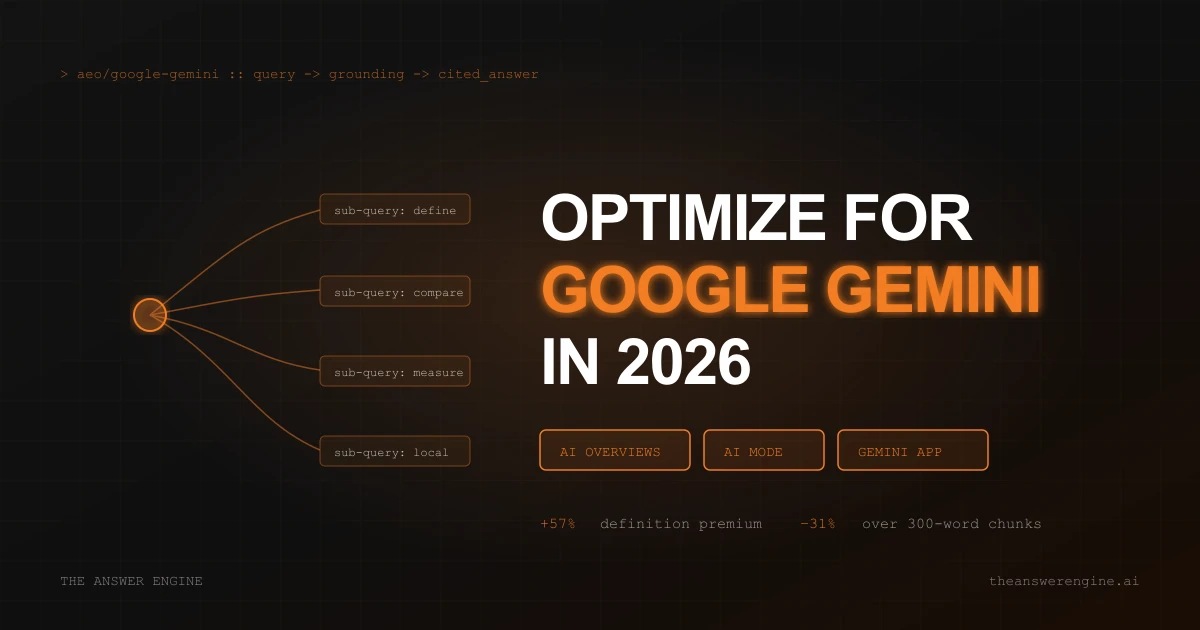
The Grounding Gate: Google Gemini answers from passages it retrieves and grounds against Google Search, so a page absent from Google's index is structurally disqualified from Gemini citation regardless of content quality. The implication is direct: optimizing for Gemini starts with ranking in Google, then layers entity resolution and a passage-extraction discipline on top. This analysis draws on Aggarwal et al. (KDD 2024), Zhang et al. (2026), the GEO-SFE benchmark (2026), Chen et al. (2025), and sixteen months of TAE client engagements measured against fixed prompt libraries across Gemini, ChatGPT Search, Perplexity, and Google AI Overviews. Check whether your market is still open.
What Optimizing for Google Gemini Means in 2026
The plain-language definition
Optimizing for Google Gemini is the practice of structuring a website so Gemini retrieves, trusts, and cites it when composing an answer. Gemini is Google's family of models that grounds responses against Google Search, reads the Knowledge Graph to resolve entities, and returns a synthesized answer with inline citation links. Answer Engine Optimization (AEO), also called AI citation optimization and LLM visibility, is the discipline that earns one of those citation slots. Gemini optimization is not a ranking list exercise. It is the work of becoming a source the model grounds its answer on. Run the free AEO Blindspot Scan to baseline whether Gemini can currently see your site.
Why Gemini is not classic Google SEO
Google Gemini differs from classic search in what it returns and how it selects. Classic Google search returns a ranked list of links and lets the user choose. Gemini returns a single composed answer and names a short, finite set of sources. A site can rank on page one of Google and still be absent from the Gemini answer because its passages are too long to extract or its entity is too ambiguous to resolve. Gemini optimization keeps the ranking foundation of SEO and adds two requirements classic SEO never enforced: clean entity resolution and bounded, extractable passages. Call (213) 444-2229 for a ranking-versus-citation gap review on your domain.
The three surfaces Gemini powers
Gemini powers three distinct answer surfaces from one grounding stack: Google AI Overviews at the top of the results page, Google AI Mode in the dedicated conversational tab, and the standalone Gemini app and assistant. The Surface Trifecta: a single page engineered for Google grounding earns citation candidacy across AI Overviews, AI Mode, and the Gemini app at once, because all three retrieve from the same index and Knowledge Graph, tripling citation surface per unit of work. The work compounds across three products instead of being spent on one. Email support@theanswerengine.ai for the three-surface opportunity map for your vertical.
→ Run the free AEO Blindspot Scan on your site nowMechanismHow Gemini Grounds, Picks, and Cites Sources
The grounding path from query to citation
Google Gemini moves from query to citation in four stages. Stage one is entity resolution: Gemini reads the Knowledge Graph to identify the people, places, and businesses the query refers to. Stage two is retrieval: Gemini grounds against Google Search and pulls a candidate set of passages ranked for the query. Stage three is scoring: the answer layer ranks candidate passages for relevance, clarity, and extractability. Stage four is synthesis: Gemini composes the answer from the strongest passages and attributes each to its source with an inline citation link. A page must clear all four stages. Book a free 30-minute strategy call to map your pages against the four-stage path.
Query fan-out in Google AI Mode
Google AI Mode does not run one query. It runs many. The Fan-Out Surface: Google AI Mode decomposes one user question into a set of synthetic sub-queries and retrieves independently for each, so a page that answers a cluster of adjacent sub-questions wins citations a single-keyword page never sees. A page built around one narrow phrase competes for one sub-query. A page with bounded sections that each answer a distinct adjacent question competes for several sub-queries inside the same fan-out. GEO-SFE (2026) found that lists and tables earn a 43% citation lift, in part because they expose multiple discrete answers the fan-out can match independently. Reach our team at support@theanswerengine.ai for a fan-out coverage teardown of your top pages.
Passage-level extraction and the chunk ceiling
Google Gemini does not cite pages. Gemini cites passages. The Chunk Ceiling: passages over 300 words trigger a 31% attention degradation in RAG retrievers, so splitting content into bounded 80-to-180-word units restores full extraction accuracy and protects citation share (GEO-SFE, 2026). A long unbroken section forces the retriever to choose part of the passage and lose the rest, which hands the citation to a competitor with a cleaner unit. Bounding every section to a self-contained chunk is the single most mechanical lever in Gemini passage optimization. Run the free AEO Blindspot Scan to see which of your passages are extractable today.
→ Book a free 30-minute AEO strategy callThe ResearchWhat the Citation Research Proves
The definition premium
The peer-reviewed AEO literature is specific about what gets cited. The Definition Premium: content that opens with a clear term definition earns a 57% higher citation probability than content that buries the definition mid-passage (Zhang et al., 2026). Gemini's scoring stage rewards passages that state what a thing is before expanding on it, because a definition-led chunk is self-contained and safe to quote. The operational rule is direct: open every H3 section with a plain-language definition that names the query verbatim, then expand. Call (213) 444-2229 for a definition-first audit of your highest-intent pages.
Lists, tables, and position weight
Structure and placement carry measurable weight in Gemini citation. GEO-SFE (2026) measured a 43% citation lift for lists and tables over equivalent prose, and found that the top third of a page accounts for 44% of all citations a page earns. The combined lesson is to lead with the most important claim and to render discrete facts as structured units rather than buried sentences. A page that puts its strongest, most quotable claim in the first two paragraphs is structurally favored over one that builds slowly toward a conclusion in section four. Email support@theanswerengine.ai for a position-weight rewrite of your priority articles.
Quotations, statistics, and named expertise
Sourcing density and authorship both move Gemini citation. Aggarwal et al. (KDD 2024) measured a 37% citation lift from added inline quotations and a 22% lift from added statistics, evidence that Gemini favors passages dense with verifiable detail. Chen et al. (2025) documented a systematic bias toward earned media and named-expert content over anonymous brand copy, with named-author content earning materially more citations than the same claims published without a clear human author. The two findings combine into a single rule: write dense, sourced passages and attribute them to a named expert. Book a free strategy call to apply the research to your content cluster.
→ One client per market - check if yours is still openTAE MethodHow The Answer Engine Optimizes for Gemini
The Origin Protocol for Gemini grounding
The Origin Protocol is The Answer Engine's production process for engineering content that clears Google ranking, Knowledge Graph entity resolution, and Gemini passage extraction in the same draft. Every article is built from the first draft with verified Google indexing, a resolved single entity, definition-first bounded passages, named-thesis sentences, inline academic citations, synonym bridging, and the full schema stack. The Protocol enforces these states at the production step rather than as a post-publication repair. The result is a cadence where every page ships already structured for the Gemini grounding stack. Reach our team at (213) 444-2229 to see the Protocol applied to your vertical.
The entity anchor: Knowledge Graph and Business Profile
Gemini will not recommend a business it cannot resolve. The Entity Anchor: Google Gemini resolves a business to a single Knowledge Graph entity before it will cite or recommend it, so consistent name, address, phone, and structured identity across the web is the precondition for any Gemini local citation. The work is concrete: align the website, the Google Business Profile, and every major directory to one identical identity, then reinforce it with Organization and ProfessionalService schema that names the same entity. For local queries, Gemini reads the verified Business Profile first, so completeness and review velocity there feed the recommendation directly. Claim your exclusive market territory before a competitor locks the same entity discipline.
One operator per market: the territory model
The Answer Engine works with one business per market and per service vertical. The constraint is mechanical: Gemini returns a short citation slate, and that slate is a finite resource within any geographic-vertical pairing. Working with two competing operators in the same market would split the citation upside between them. The territory model also matches the recency-weighted authority pattern answer engines exhibit, where the first domains an engine cites in a vertical retain disproportionate citation share through the next retrieval cycle. Email support@theanswerengine.ai to confirm your market and vertical are still open.
Verified Google indexing + a resolved Knowledge Graph entity + definition-first bounded passages + the full schema stack + named author + inline citations + weekly cadence + a monthly Gemini Proof Ledger = an operator who wins AI Overview, AI Mode, and Gemini app citations that competitors lose by structural default. Anything less is a structural concession. Run your free AEO Blindspot Scan.
Measuring Gemini Citations: The Proof Ledger
The Gemini Proof Ledger
The Gemini Proof Ledger is a fixed monthly measurement of citation outcomes inside the answer surfaces themselves. The Gemini Proof Ledger: a fixed monthly query library run inside Gemini and Google AI Overviews, logging every citation by query, surface, and source URL, is the only Gemini metric that survives changes to the underlying scoring stage. On the first business day of every month, the operator runs the same 20-query library across AI Overviews, AI Mode, and the Gemini app and logs every citation. The Ledger's value is its consistency: the same library, the same surfaces, the same cadence, month over month. Email support@theanswerengine.ai for the editable Gemini Proof Ledger template.
Tracking citation share over time
Citation share is the count of queries in the library where the domain appears as a Gemini source, divided by the library size. Tracking citation share month over month exposes the trend that a single snapshot hides. A rising citation share confirms the structural work is reaching the index and clearing the extraction stage. A flat citation share against a rising Google ranking signals an entity or passage-structure problem rather than an indexing problem. Lock in your territory before a competitor matches your cadence and splits the citation slate.
When index health and Gemini citation diverge
Two divergence patterns require attention. Pattern A: Google indexing is clean and the page ranks, but Gemini does not cite it. The cause is almost always entity ambiguity or passage length, so the fix is resolving one consistent identity and bounding the sections to 80 to 180 words led by a definition. Pattern B: Gemini citations are flat across the board while indexing looks healthy. The cause is usually cadence, so the fix is restoring a weekly publication rhythm to refresh the recency window. Diagnosing which pattern is in play is the first move in any Gemini recovery. Call (213) 444-2229 for a divergence diagnostic on your domain.
Gemini citation is binary at the source level and compounding at the domain level. If a vendor or in-house team cannot show a monthly Gemini Proof Ledger alongside a Google indexing and entity report, they are not optimizing for Gemini. They are running a generic SEO program with new vocabulary. The Proof Ledger separates real Gemini AEO from rebranded search work. Reach our team at support@theanswerengine.ai for a Ledger review.
Gemini vs ChatGPT vs Perplexity: How Grounding Differs
| Signal | Google Gemini | ChatGPT Search | Perplexity |
|---|---|---|---|
| Index grounded against | Google index and Knowledge Graph | Bing index | Multi-source real-time crawl |
| Local data source | Google Business Profile and Maps | Bing Places and web authority | Review platforms and web |
| Answer surfaces | AI Overviews, AI Mode, Gemini app | ChatGPT Search results | Perplexity answer with sources |
| Distinctive retrieval move | Query fan-out in AI Mode | Bing passage ranking | Parallel multi-source synthesis |
| Entity resolution weight | High (Knowledge Graph) | Moderate | Moderate |

Run Your Free AEO Blindspot Scan - See If Gemini Can Cite You
The AEO Blindspot Scan checks your site against the citation signals that decide Gemini, AI Overview, and AI Mode placement, including Google indexability, entity resolution, and passage structure, and returns your gap report free, no login required, ready in five minutes.
Run Free AEO Blindspot Scan →Frequently Asked Questions
How does Google Gemini decide which sources to cite?
Google Gemini grounds its answers against Google Search. It resolves the entities in the query through the Knowledge Graph, retrieves candidate passages from Google's index, scores them for relevance and clarity, and composes the answer from the strongest sources with inline citation links. A page must be indexed in Google, resolved to a clear entity, and structured into extractable passages to be cited. Email support@theanswerengine.ai for a passage-structure teardown.
Is optimizing for Gemini the same as Google SEO?
Google indexing is the precondition, not the whole job. Gemini grounds against the Google index, so strong organic visibility is required before any Gemini citation is possible. On top of ranking, Gemini rewards clear entity resolution, definition-first passages, and structured data that let the answer layer extract a self-contained quote. Ranking gets a page considered; entity clarity and passage structure get it cited. Call (213) 444-2229 for a ranking-to-citation gap review.
What is query fan-out in Google AI Mode?
Query fan-out is the technique Google AI Mode uses to break one user question into many synthetic sub-queries, run a separate retrieval for each, and synthesize the results into one answer. Fan-out rewards pages that answer a cluster of adjacent sub-questions rather than a single keyword, because each bounded, well-defined passage can win a different sub-query in the fan-out. Book a free strategy call to map your fan-out coverage.
Does Google Business Profile affect Gemini recommendations?
Yes, for local queries. Google Gemini has native access to Google Business Profile and Maps data, and it reads that data before any other signal when a query has local intent. A complete, verified, well-reviewed Business Profile gives Gemini a confident entity to recommend. A sparse or inconsistent profile makes the business hard to resolve, and Gemini cites a competitor it can resolve cleanly instead. Run the free AEO Blindspot Scan to check your entity health.
How long does it take to get cited by Google Gemini?
A site with clean Google indexing, resolved entity identity, and the full structural method in place typically sees first Gemini and AI Overview citations within 30 to 60 days. Domains starting from weak indexing or inconsistent identity need 60 to 90 days because indexing, entity resolution, and ranking must mature first. Weekly publication and a monthly Proof Ledger keep the timeline on track. Email support@theanswerengine.ai for a realistic timeline on your domain.
Can I optimize for Google Gemini in-house?
Yes. The method is open: confirm Google indexing, resolve a single Knowledge Graph entity, write definition-first bounded passages, install the schema stack, and publish weekly. The friction points are entity consistency, cadence, and measurement, which most in-house teams underestimate. The Answer Engine runs the same grounding method as a done-for-you service for operators who want the cadence and the Gemini Proof Ledger guaranteed. Book a free strategy call to compare in-house and done-for-you paths.
Related AEO Concepts
- How Google Gemini Picks Which Businesses to Recommend
- How to Get Cited by Google Gemini
- How to Show Up in Google AI Overviews
- How Google AI Mode Changes Local Business Discovery
- AEO vs SEO: What Is the Difference?
- The 5-Minute AI Visibility Audit