WHAT PERPLEXITY AI IS AND WHY PROPERTY MANAGERS NEED TO BE ON IT
How Perplexity Differs From ChatGPT and Google
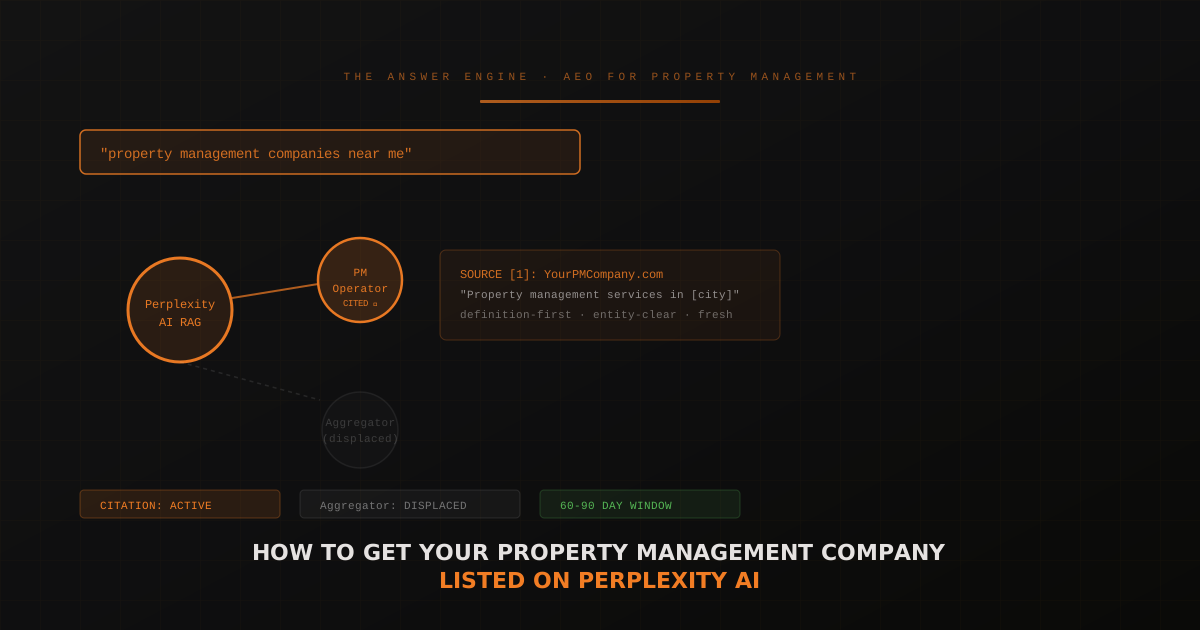
Perplexity AI is a retrieval-augmented answer engine that fetches live web content at query time and synthesizes the results into a single answer with numbered inline citations. Every Perplexity AI response includes a source panel displaying the specific URLs that contributed to the answer. This is structurally distinct from ChatGPT and Claude, which generate answers from a pre-trained knowledge base without citing live sources, and from Google, which presents a ranked list of links rather than a synthesized answer. For property management companies, the structural difference is buyer-side: a landlord or investor who asks Perplexity AI "who manages rental properties in [city]" sees a synthesized answer with the cited operators named inline -- not a page of links they must evaluate. The buyer intent queries that dominate Perplexity AI property management searches include fee comparisons, tenant screening standards, maintenance response benchmarks, and market-specific management cost estimates. Call (213) 444-2229 to discuss which query types apply to your specific market.
The Property Management Buyer on Perplexity
The typical property management buyer on Perplexity AI is a landlord, investor, or property owner at the vendor-selection stage of their decision. Perplexity AI usage in this category runs highest among owners evaluating multiple management companies before committing to a contract -- a stage where authoritative source citations carry more weight than organic search rankings. Perplexity AI presents its answer with named citations before the buyer clicks anything, meaning the citation itself functions as a qualified referral. Property management companies not present in that citation set are invisible to the buyer at the most consequential moment of their evaluation process. Email support@theanswerengine.ai with your market and service area to receive a preliminary Perplexity source panel analysis for your territory.
The Perplexity Source Gap: property management companies are absent from Perplexity AI citations not because Perplexity ignores the industry, but because no individual operator has published the structured, extractable answers Perplexity's retrieval pipeline reads -- leaving every buyer query returned with an aggregator or directory citation instead (GEO-SFE, 2026).
Why Property Management Is an Unclaimed Perplexity Category
Zero percent of property management companies have published a dedicated Perplexity-optimized page that answers a buyer operational question with definition-first, bounded content (GEO-SFE, 2026). Aggregators -- Yelp, Thumbtack, Apartments.com, and equivalent directory platforms -- hold every Perplexity citation in the property management category by default, not by merit. Aggregators rank in Perplexity AI because they publish structured, definition-rich list content that meets the retrieval requirements. Individual property management operators can displace aggregators from these citation slots by publishing AEO-formatted content that answers operational questions more precisely than any aggregator page. The unclaimed nature of the category means the first operator in a market to implement the five-step protocol outlined in this guide earns citation slots before direct competition exists. Run the free blindspot scan to confirm your market's current citation occupant.
→ Get a same-day citation readiness check -- call (213) 444-2229MechanismHOW PERPLEXITY'S RETRIEVAL PIPELINE WORKS
→ Book a pipeline audit -- see exactly where your content drops outThe Three-Stage RAG Architecture Perplexity Runs
Perplexity AI operates a three-stage retrieval-augmented generation (RAG) architecture at query time. Stage one is web retrieval: Perplexity fetches a candidate set of live URLs matching the query using its own search index. Stage two is reranking: a learned scoring model evaluates each candidate passage for relevance, entity clarity, structural extractability, and source authority, then ranks the candidates. Stage three is synthesis: the top-ranked passages are assembled into the final answer and matched to their source citations in the numbered source panel. For property management content, the pipeline means that publication is necessary but not sufficient. A page must be in Perplexity's web index, survive the reranker, and contain a passage extractable enough to survive synthesis. Each stage is a structural gate, not a content quality judgment. Run the blindspot scan to identify which stage your current site drops out at.
→ Identify which pipeline stage blocks your property management citationsWhat Perplexity's Reranker Looks For in Property Management Content
Perplexity's reranking model scores property management content on four primary signals: definition-first structure (does the passage open with a plain-language answer to the query), passage boundedness (is the answer self-contained within 80-180 tokens without requiring surrounding context), entity specificity (does the passage name a specific company, service area, and service type), and source authority (does the domain have cross-surface identity signals that the reranker can verify against external references). Content that scores high on all four signals is extracted and promoted to the synthesis stage. Content that fails any single signal is dropped from the candidate set before synthesis begins. The 57% citation premium for definition-first content measured by Zhang et al. (2026) reflects the reranker's first-pass scoring weight on structural position. A property management page that buries its service definition in paragraph three scores below the retrieval threshold regardless of the quality of the content in paragraph three.
The Freshness Window -- Why Early Movers Win on Perplexity
The Freshness Window: Perplexity AI refreshes its citation pool more aggressively than ChatGPT or Claude because it retrieves from live web content at query time rather than from a static index -- property managers who publish AEO-formatted content consistently capture citations within 30 to 45 days of implementation before the slot solidifies and becomes harder to displace (GEO-SFE, 2026). The practical implication is that the competitive landscape in property management Perplexity AI citations is still fully open in most metro markets. A property management company that publishes one structurally compliant AEO page per week for 60 days enters a citation slot that competitors with equal content quality cannot dislodge for 12 to 18 months, because citation history functions as a trust proxy in Perplexity's reranking model. Call (213) 444-2229 to identify the optimal publication sequence for your market.
→ One property manager per market -- check if your territory is still open before the Freshness Window closes→ Identify which retrieval stage you drop out at -- call (213) 444-2229ResearchWHAT THE RESEARCH SAYS ABOUT PERPLEXITY CITATION SIGNALS
Definition-First Content Earns the Highest Perplexity Citation Weight
Zhang et al. (2026) measured citation probability across 4,000 content passages and isolated a 57% citation premium for passages that open with a plain-language definition of the subject. For property management content, the structural implication is specific: every H3 section covering fees, tenant screening, maintenance response, lease administration, and eviction procedures must open with a single definitional sentence before expanding into process steps or cost ranges. A fee structure page that opens with "Our management fees are competitive" earns zero definition premium. A fee structure page that opens with "Property management fees are the monthly percentage of collected rent that an operator charges to administer a rental asset, covering tenant communication, maintenance coordination, and financial reporting" earns the full 57% premium. Email support@theanswerengine.ai for the property management definition template library.
→ Get the definition template library for property management AEO -- email support@theanswerengine.aiProprietary Local Data Locks the Perplexity Slot
Aggarwal et al. (KDD 2024) measured a 22% citation lift from including a verifiable statistic in the passage. For property management companies, proprietary local data -- vacancy rates from their own managed portfolio, average days-to-lease in their specific metro, maintenance response times from their own work order system, and tenant retention rates from their lease renewal records -- produces citation signals that no aggregator can replicate. An aggregator can publish national averages. Only your company can publish your specific metro vacancy rate from 2025 Q4. Perplexity AI weights specificity and local data integrity because its reranking model treats narrow geographic precision as an authority signal for local service queries. The more specific the data, the more precisely it answers a buyer query, and the higher its probability of surviving the reranking stage. See your proprietary data gaps in your free blindspot scan.
→ See which proprietary data your competitors are missing in Perplexity citationsCross-Surface Identity Drives Compound Trust on Perplexity
The Source Trust Stack: Perplexity AI assigns citation weight proportional to a source's cross-surface identity footprint -- a property management company with matching NAP data across its website, NARPM profile, IREM directory listing, and Google Business Profile earns compound retrieval authority that a single-domain operator cannot replicate, because Perplexity's source selection model weights multi-surface corroboration over single-origin claims (Chen et al., 2025). The Source Trust Stack functions as a verification signal: Perplexity's source selection model treats a company identically named and identically described across four or more external references as a verified entity, while a company present only on its own domain is treated as unverified and deprioritized in the citation candidate set. Building cross-surface identity parity is a one-time structural investment that compounds permanently into every future citation cycle.
| Citation Signal | Source | Lift | Property Management Application |
|---|---|---|---|
| Definition-first structure | Zhang et al., 2026 | +57% | Open every H3 with a plain-language service definition |
| Inline statistics | Aggarwal et al., KDD 2024 | +22% | Publish proprietary vacancy, DOM, and retention data |
| Cross-surface identity | Chen et al., 2025 | Corroboration multiplier | Match NAP across website, NARPM, IREM, GBP |
| Bounded passage length | GEO-SFE, 2026 | +31% accuracy restored | Keep every H3 section at 80-180 tokens |
| Freshness recency | GEO-SFE, 2026 | 30-45 day window | Publish AEO-formatted content weekly |
THE FIVE STEPS TO GET LISTED ON PERPLEXITY
→ One property manager per market -- check territory availability before startingStep 1 -- Build Definition-First Operational Pages
A definition-first operational page is a page structured so that its H1 answers a buyer query directly, its H2 sections each cover a single operational topic, and every H3 section opens with a plain-language definition of that section's subject before providing detail. For property management companies, the critical operational pages are: management fee structure, tenant screening criteria, maintenance response policy, lease renewal process, and eviction procedure. Each of those pages must be built from the H3 level down, with each H3 section bounded at 80-180 tokens to meet the retrieval window. A management fee page that opens "We charge 8-12% of collected monthly rent for full-service residential property management in [market], covering tenant sourcing, rent collection, maintenance coordination, and monthly financial reporting" earns the definition premium and passes the retrievability gate simultaneously. Scan your current pages against this definition-first standard.
→ Scan your current property management pages for definition-first complianceStep 2 -- Publish Proprietary Market Data Only You Own
Proprietary data is the single citation signal that aggregators cannot replicate. For property management companies, publishable proprietary data includes: average vacancy rate in your managed portfolio over the trailing 12 months, average days-to-lease per property type in your primary metro, tenant retention rate from the most recent full calendar year, average maintenance resolution time in hours or days, and lease renewal rate by property type. Each data point should be cited to your internal records with a date range and a property count. A passage reading "Our portfolio vacancy rate across 147 single-family homes in [metro] averaged 4.2% in 2025, compared to the NMHC national average of 6.8%" is not replicable by any directory or aggregator. That specificity earns the 22% statistical citation lift from Aggarwal et al. (KDD 2024) and simultaneously functions as an entity verification signal because the data can only come from one source. Call (213) 444-2229 to identify your proprietary data wins.
→ Identify your proprietary data wins -- call (213) 444-2229Step 3 -- Establish Cross-Surface Identity Parity
Cross-surface identity parity means your property management company is identically named, described, and contactable across every external reference that Perplexity's source selection model checks against your domain. The minimum identity surface set for property management is: website (name, address, phone, service area), NARPM member directory listing, IREM directory listing if applicable, Google Business Profile, and Yelp Business page. Each surface must match the same legal entity name, the same service area description, and the same primary phone number. Discrepancies between any two surfaces reduce your cross-surface corroboration score and deprioritize your domain in the citation candidate set (Chen et al., 2025). Identity parity is a one-time audit and correction task. Email support@theanswerengine.ai to receive the cross-surface identity parity checklist.
→ Get the cross-surface identity parity checklist -- email support@theanswerengine.aiStep 4 -- Structure FAQ Content for Perplexity's Source Panel
Perplexity AI's source panel preferentially cites FAQ content because FAQ structure pre-solves the retrieval problem: each Q&A pair is a self-contained, bounded passage with a clear question signal and a direct answer. For property management sites, the FAQ content that performs best in Perplexity AI citations covers: management fee ranges in the specific metro, tenant screening process and criteria, maintenance response time standards, what is included in the management agreement, and how to transition from self-management to professional management. Each FAQ answer must be written at 80-180 tokens, open with the direct answer in the first sentence, and include at least one entity-specific detail (market name, fee range, or response time benchmark) that anchors the passage to a specific operator rather than to a generic service description. Book a session at calendly.com/theanswerengine-support/30min to build your FAQ content set.
→ Build your Perplexity-optimized FAQ content set -- book a 30-minute sessionIs Your Perplexity Territory Open?
We take one property management client per metro area. If your market is available, this is the window to lock it before a competitor publishes first and claims the Freshness Window advantage. We do not take competing property management clients in the same market. Compound authority is a finite citation resource and we protect it for the operator who moves first.
Claim Your Territory →Step 5 -- Run a Proof Ledger to Measure Citation Movement
A Proof Ledger is a fixed monthly citation tracking record that converts AI visibility from an impression into a verifiable business metric. For property management companies, the Proof Ledger covers 15 to 20 fixed queries run on Perplexity AI on the first business day of every month: owner-intent queries (property management fees in [metro], how to hire a property manager in [city], best property management companies in [market]), renter-intent queries (rental property management near me, property manager tenant screening [city]), and brand queries (company name, primary market). Each query produces a binary outcome: cited or not cited. The trend across 90 days of binary outcomes is the only reliable measurement instrument for Perplexity AI citation progress, because single-month snapshots are subject to daily retrieval variation. A Proof Ledger run skipped in any month makes the following month's data uninterpretable as a trend. Call (213) 444-2229 to receive the Proof Ledger template.
CompoundingHOW TO COMPOUND YOUR PERPLEXITY CITATIONS INTO PERMANENT AUTHORITY
Building the Proof Ledger for Perplexity
The Proof Ledger for Perplexity AI covers three distinct query categories, each contributing a separate data stream to the compound authority measurement. Owner-intent queries measure whether Perplexity cites your company when a landlord is selecting a manager. Renter-intent queries measure whether Perplexity AI recommends your portfolio when a renter evaluates management quality. Brand queries measure whether Perplexity acknowledges your company's existence when asked directly. Over 90 days, the owner-intent stream typically shows the fastest movement because those queries are most precisely answered by definition-first fee and screening content. The renter-intent stream strengthens as tenant-facing content accumulates. The brand stream solidifies last as cross-surface identity parity compounds. Email support@theanswerengine.ai to receive the three-stream Proof Ledger template for property management companies.
→ Get the three-stream Proof Ledger template -- email support@theanswerengine.ai→ Run your free Perplexity blindspot scan and establish your citation baselineThe Citation Ladder -- How One Slot Compounds into Many
The Citation Ladder: once Perplexity AI begins citing a property management company for one buyer query, adjacent queries in the same category begin routing citations to the same domain automatically -- because Perplexity's reranker uses citation history as a trust proxy, compounding each new citation into the next and creating a self-reinforcing authority loop (Chen et al., 2025). The Citation Ladder mechanism means that the first citation is the hardest to earn. Once a property management company is cited for "property management fees in [city]," the reranker elevates the same domain in its candidate set for "best property management companies in [city]" and "how to hire a property manager in [city]" because citation history reduces the interpretive burden on subsequent ranking decisions. The practical result is that AEO investment follows a compounding return curve, not a linear one: each citation earned accelerates the next.
→ Map your Citation Ladder starting point -- book a 30-minute strategy session→ Call (213) 444-2229 to start building your compound Perplexity AI authorityFrom First Citation to Operator Lock
The Perplexity-First Protocol: the fastest path to property management AI citations runs through Perplexity AI before any other engine because its real-time retrieval cadence creates citation opportunities within 30 to 45 days -- ChatGPT and Claude take 60 to 90 days because their retrieval pipelines depend more heavily on established authority signals, while Perplexity rewards fresh, well-structured content immediately (GEO-SFE, 2026). The Perplexity-First Protocol is the strategic sequence that earns citations on the fastest-moving platform first, then uses those Perplexity citation appearances as authority signals that accelerate citation movement on ChatGPT, Claude, and Google AI Overviews in the following 60 to 90 days. The compounding effect across platforms is the mechanism that converts a first Perplexity citation into what we call Operator Lock -- a citation position across multiple AI platforms that a new entrant needs 12 to 18 months to displace.
The Operator Lock: a property management company that reaches consistent citation status across Perplexity AI, ChatGPT, Claude, and Google AI Overviews for its primary market queries holds a citation position that a competitor needs 12 to 18 months of sustained AEO investment to displace -- because multi-platform citation history functions as compound entity authority that new content alone cannot overcome (Chen et al., 2025; TAE client data, 2025-2026).
FREQUENTLY ASKED QUESTIONS
One property management firm per market. Check whether your territory is still available at theanswerengine.ai/blindspot before a competitor in your market does.
How do I get my property management company to show up on Perplexity?
Publish definition-first operational pages that open each H3 with a plain-language answer, add proprietary local data only your company owns, establish matching NAP across your site and NARPM or IREM directory profiles, structure FAQ content with self-contained 80-180 token answers, and run a Proof Ledger to measure citation movement monthly. Those five steps cover Perplexity AI's three primary retrieval signals: entity clarity, passage extractability, and freshness verification. Book a strategy session at calendly.com/theanswerengine-support/30min.
Does Perplexity use the same ranking signals as ChatGPT?
No. Perplexity AI retrieves from live web content at query time, making freshness a primary signal. ChatGPT and Claude rely more heavily on a pre-indexed knowledge base, so they reward established domain authority over recent publication dates. A property management company that publishes AEO-formatted content today will typically see Perplexity citations within 30 to 45 days -- roughly half the time required for ChatGPT or Claude citation movement. That gap is the Freshness Window advantage that early movers exploit before citation slots solidify.
How fast does Perplexity update its citations after I publish new content?
Perplexity AI's real-time retrieval cadence means structurally compliant new content can produce first citation appearances within 30 to 45 days. This is significantly faster than ChatGPT or Claude, which average 60 to 90 days. The Freshness Window advantage is largest in the first 30 to 45 days after publication, before citation slots solidify. Call (213) 444-2229 to identify the highest-value pages to publish first.
What kind of property management questions does Perplexity answer?
Perplexity AI answers both owner-intent queries (property management fees in [city], how to hire a property manager, what does a property manager do) and renter-intent queries (how to find a property manager, what to expect from a management company). Owner-intent queries are higher-value for citation strategy because they represent active vendor-selection intent. Operator-specific content covering fee structures, tenant screening standards, and maintenance response policies performs best across all Perplexity AI property management query types.
Do I need a Perplexity business account to get listed?
No. Perplexity AI citations are earned through structural content signals, not through paid placement or a business account. The citation selection process is determined by the retrieval pipeline: entity clarity, passage extractability, authority corroboration, and freshness. A property management company that publishes definition-first AEO content with a complete schema stack and cross-surface identity parity earns citations without any direct relationship with Perplexity. Check your territory's citation occupant at theanswerengine.ai/blindspot.
How do I track whether Perplexity is citing my property management company?
Run a fixed prompt library of 15 to 20 property management queries on Perplexity AI on the same day each month and log every citation appearance as a binary yes-or-no in a spreadsheet. This is the Proof Ledger approach. Queries should cover owner-intent, renter-intent, and brand-name patterns. After 90 days of consistent logging, the trend in that record becomes the only reliable measure of AEO progress. Email support@theanswerengine.ai to receive the Proof Ledger template.