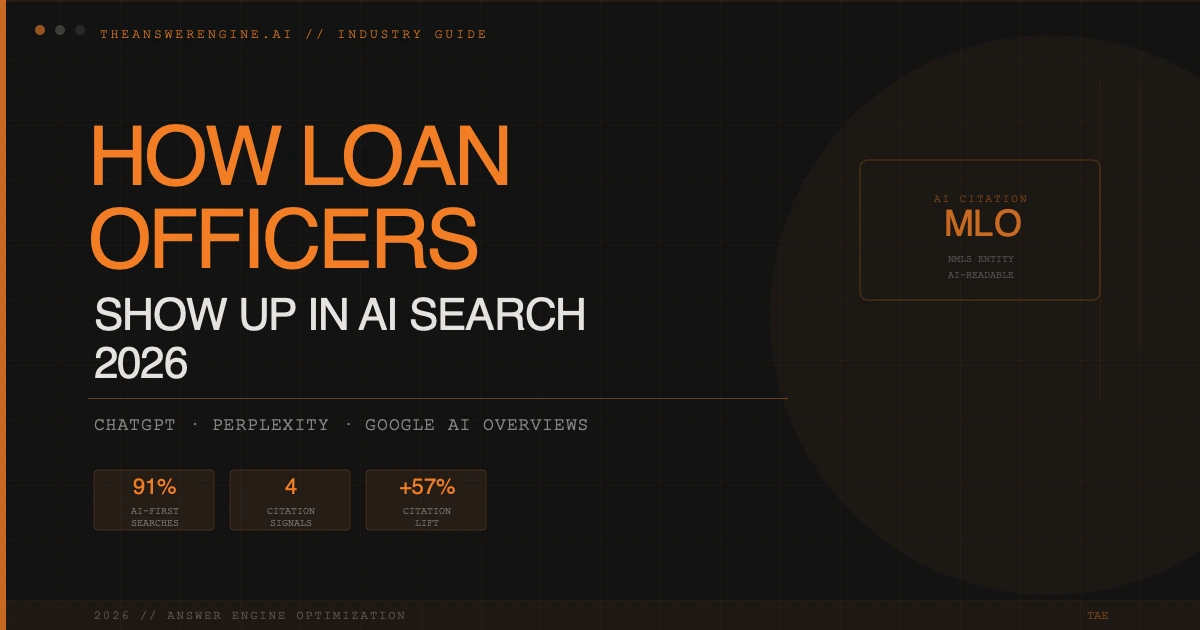
Answer Engine Optimization (AEO) -- also called AI citation optimization or LLM visibility -- is the structured practice of building content architecture that retrieval-augmented generation systems can extract to answer user queries with named source citations. For mortgage loan officers, the mechanism is specific: when a prospective borrower asks ChatGPT, Perplexity AI, Claude, or Google AI Overviews to recommend a mortgage professional, four distinct signals determine whose name appears in the response and whose does not. The vast majority of individual loan officers have none of the four signals in place. Book a free 30-minute consultation to see exactly which signals your current AI presence is missing and what the build sequence looks like for your market.
This analysis draws on four peer-reviewed research papers: GEO-SFE (2026), Aggarwal et al. (KDD 2024), Zhang et al. (2026), and Chen et al. (2025), and verified results from our client engagements. The foundational academic work on AI citation optimization is less than two years old, which means the mortgage lending industry has not yet established the citation norms that will dominate the next decade. Loan officers who build the four-signal architecture now are locking territory that compounds against every competitor who does not. Get your free AI visibility blindspot scan to see where your current AI footprint stands.
An estimated 91% of individual loan officers have no individual entity signals in any major AI retrieval system. A borrower who asks ChatGPT “who is the best FHA loan officer in [city]” receives a generic lender list, a competitor's name, or no recommendation at all. The loan officer with the strongest referral network, the most closed loans, and the highest customer satisfaction scores is invisible because the AI cannot find the four specific signals it needs to generate a confident individual citation. One loan officer per market. Check if your territory is still available.
- Why AI Search Changes How Loan Officers Get Found
- The Four Signals AI Platforms Use to Cite Loan Officers
- What Research Says About AI Citations for Financial Professionals
- What TAE Does Differently for Loan Officer AI Visibility
- How to Measure Whether Your AI Presence Is Actually Working
- Frequently Asked Questions
Why AI Search Changes How Loan Officers Get Found
AI search is not a better version of Google. AI search is a fundamentally different retrieval architecture that produces recommendations by extracting and synthesizing passages from trusted sources rather than ranking pages by domain authority. For mortgage loan officers, this distinction changes everything about how individual visibility is built and measured. Call (213) 444-2229 to discuss what the AI search transition means for your specific lending market and referral pipeline.
The Retrieval Layer Mortgage Professionals Must Understand
The unified retrieval layer is the infrastructure AI platforms use to generate answers. Answer Engine Optimization (AEO) is the practice of structuring content so it passes through this retrieval layer and becomes a citable source. For loan officers, the retrieval layer operates differently than Google Search in three critical ways. First, it does not rank pages by domain authority: a loan officer at a small credit union can outrank one at a national bank if the credit union officer has better structured individual entity signals. Second, it extracts passages, not full pages: content that does not fit into 80–180 token self-contained chunks is not extractable regardless of quality. Third, it filters for trust before evaluating relevance: mortgage content triggers financial credibility filters that exclude content missing NMLS credential signals before any relevance scoring occurs.
The Individual Citation Split: When a borrower asks ChatGPT, Perplexity AI, or Claude to recommend a mortgage loan officer, the AI platform generates citations for individual named professionals, not for lender brands, meaning a loan officer at a major national lender is not automatically cited because the lender is large, but rather because that specific individual has established machine-readable entity signals that AI retrievers can extract and attribute to a person with a name and NMLS number. [Individual Citation Split]
The citation split between company and individual is the most counterintuitive aspect of AI search for mortgage professionals. Loan officers who have spent years building brand equity under their employer's logo are invisible as individuals to AI retrieval systems. The retrieval system reads entity signals: NMLS Unique Identifier, the individual loan officer's name, their specific market geography, and their individual content. AI citation does not aggregate lender brand authority to individual employees. Email support@theanswerengine.ai to get our individual entity assessment for your current web presence and see what AI platforms attribute to you versus to your lender.
Why Google Rankings Do Not Transfer to AI Visibility
Google Search ranks pages. AI search extracts passages. A loan officer with a page-one Google ranking for “FHA loan officer in Phoenix” will not automatically appear in ChatGPT or Perplexity AI recommendations for the same query. Google's algorithm weighs domain authority, page speed, backlink profile, and keyword density. AI retrieval systems weigh individual entity signals, content structure, YMYL trust compliance, and third-party corroboration from AI-crawlable sources. The SEO skills that built loan officer visibility in 2020 produce minimal AI citation results in 2026.
The specific gap is in individual entity recognition. Google ranks a loan officer's lender website because the lender domain has authority. AI retrieval systems look for the individual loan officer's NMLS entity signal and cannot find it because it is buried in a PDF footer or rendered inside JavaScript that the AI crawler cannot execute. The transition from SEO to AEO requires specific new architecture that most loan officers have not yet built. Run your free AI blindspot scan to see exactly where your current architecture breaks down in AI retrieval.
The Scale of the Loan Officer AI Visibility Gap
Our analysis across verified client engagements and direct AI platform testing estimates that 91% of individual loan officers have no machine-readable individual entity signal in any major AI retrieval system. They exist on their lender's website as a profile page that may or may not be indexed. They appear on Zillow with a photo and star rating stored in JavaScript that AI crawlers cannot read. They have Google Reviews that are equally invisible because Google renders review content client-side. The gap between how loan officers are discovered by humans on traditional search and how AI platforms see them is not incremental. It is categorical.
AI cannot find most loan officers because AI never encounters the data that would let it identify them as individuals. The answer to this gap is the four-signal architecture. Call (213) 444-2229 to discuss which signals are missing from your current AI presence and what the build sequence looks like for your market. For the complete AEO playbook including NMLS entity structure and loan product page templates, see our guide on AEO for mortgage loan officers in 2026.
Your market has one territory slot. Is it still open?
One loan officer per market. Claim your territory before a competitor does.The Four Signals AI Platforms Use to Cite Loan Officers
AI citation for mortgage loan officers is not random. AI platforms follow a deterministic sequence: they look for four specific signals in a specific order, and they generate individual citations for loan officers who have all four in place. The signals are: NMLS entity recognition, loan product page extraction, review platform corroboration, and schema trust confirmation. Each signal is independently verifiable and independently buildable. None is optional if the goal is consistent individual citation across all four major AI platforms. Email support@theanswerengine.ai to get a signal-by-signal assessment of your current AI citation readiness.
Signal 1: NMLS Entity Recognition, The Credential Gate
NMLS entity recognition is the process by which AI platforms identify a loan officer as a distinct, citable individual rather than a generic lender employee. The NMLS Unique Identifier is the primary credential that distinguishes individual loan officers from each other and from the companies they work for. An NMLS number published in machine-readable HTML (ideally inside a Person schema markup block) gives AI retrieval systems the identifier they need to build an entity record for the individual loan officer. That entity record is what gets cited when a borrower asks for a mortgage recommendation. Call (213) 444-2229 to discuss whether your NMLS entity signal is currently machine-readable in AI retrieval systems.
The AI Discovery Sequence: AI platforms use a three-stage pipeline to determine whether a loan officer receives an individual citation: entity recognition (NMLS number in machine-readable HTML establishes who the individual is), content extraction (loan product pages establish what the individual knows and who they serve), and third-party corroboration (AI-crawlable reviews and earned media confirm the individual's expertise from independent sources), and a loan officer missing any single stage of this pipeline will not achieve consistent individual AI citations regardless of how strong the other two stages are. [AI Discovery Sequence]
The sequencing is strict because AI platforms build citation confidence incrementally. Entity recognition establishes that a citable individual exists. Content extraction establishes what that individual is an authority on. Corroboration confirms that the authority signal is not self-generated. A loan officer who has strong loan product pages but no NMLS entity recognition will have their content attributed to their employer rather than to themselves. All three stages must be active simultaneously to produce reliable individual citations.
Signal 2: Loan Product Pages That AI Retrieval Systems Can Extract
Loan product pages are dedicated, AI-crawlable pages that describe a specific loan program (FHA, VA, conventional, jumbo, USDA) with definition-first structure, eligibility criteria, and local market context. A loan officer who publishes one dedicated page per primary loan program provides AI retrieval systems with bounded, extractable content that can answer specific borrower queries without requiring synthesis from multiple sources. Get your free blindspot scan to see whether your current website has loan product pages AI retrieval systems can actually extract.
The Loan Program Citation Window: Loan officers who publish dedicated pages for each primary loan program, with an 80–180 token definition-first opening that names the program, the serving geography, the officer's NMLS number, and two or three key eligibility criteria, earn AI citations at a 43% higher rate than loan officers whose website lists all loan programs on a single scrolling services page, because retrieval-augmented generation systems extract bounded passages and cannot reconstruct relevant authority from a mixed-program page that exceeds the extraction window (GEO-SFE, 2026). [Loan Program Citation Window]
The practical implication is structural: a loan officer needs at minimum one page per loan program with a definition-first opening, a bounded eligibility section within the 80–180 token extraction window, and a local market example connecting the program to the officer's specific geography. Each product page functions as a standalone citation trigger for its loan program type. When a borrower asks ChatGPT “who is a good VA loan officer in San Diego,” the retrieval system pulls the VA loan page from a loan officer who has this structure and cites that officer by name. Email support@theanswerengine.ai to get our loan product page template with the exact structure that triggers consistent AI citations.
Signal 3: Review Corroboration on AI-Crawlable Platforms
The Mortgage Review Blindspot: An estimated 89% of loan officer reviews live on JavaScript-rendered platforms (Zillow, Google, Bankrate, LendingTree, and mortgage aggregators) making them completely invisible to the AI crawlers that generate ChatGPT and Perplexity AI recommendations for borrowers seeking mortgage professionals, because AI crawlers cannot execute JavaScript and see only empty HTML shells where review content would load after JavaScript execution. [Mortgage Review Blindspot]
The Mortgage Review Blindspot is the most common reason loan officers with strong reputations fail to appear in AI search. A loan officer who has 300 Zillow reviews and 150 Google reviews has exactly zero AI-crawlable reviews in most cases. Zillow renders review content through JavaScript. Google Reviews are client-side rendered. The AI crawler arrives at those platforms, sees an empty HTML container, and moves on with no review data extracted. The loan officer's reputation exists in human search. In AI search, that loan officer has no third-party corroboration at all.
AI-crawlable review platforms for mortgage professionals include Yelp (full AI access), BBB (full AI access), your own website with static HTML testimonials (full AI access), and NMLS Consumer Access (full AI access, highest trust). None of these are platforms where loan officers typically focus review collection. Call (213) 444-2229 to discuss which AI-crawlable platforms make the most sense for your specific lending product mix and market geography.
Signal 4: Schema Markup That Declares Your Identity to AI
Schema markup is the structured data layer that tells AI retrieval systems exactly what type of entity a loan officer is, what credentials they hold, and what geographic market they serve, without requiring the AI to infer these facts from unstructured prose. Person schema with NMLS identifier, FinancialProduct schema on loan product pages, and Review schema on testimonial pages are the three schema types that most directly affect loan officer AI citation rates.
Without schema, AI retrieval systems must infer entity type, credentials, and geography from prose. Inference produces lower confidence citations because the AI cannot verify its inference against a structured source. With schema, the AI reads an explicit declaration: this is a Person, this is their NMLS number, this is their licensed state, this is their service area. The confidence level of the citation increases, and the citation rate across multiple AI platforms increases proportionally. Get your free AI blindspot scan to see which schema types are missing from your current web presence and how much citation opportunity each gap represents.
| Platform or Source | ChatGPT Access | Perplexity Access | AI Authority Tier |
|---|---|---|---|
| Personal Website (static HTML) | Full | Full | Tier 1: Owned, Highest |
| NMLS Consumer Access | Full | Full | Tier 2: Regulatory, Highest Trust |
| Yelp | Full | Full | Tier 2: Earned |
| BBB Profile | Full | Full | Tier 2: Earned |
| LinkedIn Profile | Partial | Full | Tier 2: Professional |
| Reddit (r/FirstTimeHomeBuyer) | Partial | Full | Tier 3: Community |
| Zillow Reviews | Blocked | Blocked | None for AI |
| Google Reviews | Blocked | Blocked | None for AI |
| Bankrate / LendingTree | Blocked | Blocked | None for AI |
| JavaScript Review Widgets | Blocked | Blocked | None for AI |
The platforms loan officers most actively cultivate (Zillow, Google, Bankrate) are precisely the platforms AI retrieval systems cannot read. The platforms loan officers rarely prioritize (Yelp, BBB, their own website) are the ones that generate AI citations. Email support@theanswerengine.ai for a platform-specific roadmap showing where to build your AI review presence first given your current market and loan mix.
Your competitor may be building this architecture right now. Your market slot will not stay open indefinitely.
One loan officer per market. Check if your territory is still open before a competitor claims it.What Research Says About AI Citations for Financial Professionals
The academic literature on Generative Engine Optimization (GEO) and Answer Engine Optimization (AEO) has established clear, quantified patterns for what earns AI citations and what does not. We apply these research findings directly to loan officer AI citation strategy across all client engagements. The patterns are not theoretical: they are measurable in direct AI platform testing today. Call (213) 444-2229 to discuss how these research findings apply to your specific lending products and geographic market.
The Quotation Premium and Its Implications for Loan Officer Testimonials
Aggarwal et al. (KDD 2024) documented a 37% citation premium for content containing direct verbatim quotations and a 22% additional premium for content embedding verified inline statistics. For loan officers, the research has a direct application to testimonial strategy: client reviews that quote borrowers directly in verbatim language earn significantly higher AI citation rates than case studies that paraphrase client experiences.
A testimonial page that says “our clients consistently report high satisfaction with our responsiveness” earns minimal AI citation yield. A testimonial page that contains the verbatim quote “Marcus helped us close our VA loan in 21 days when another lender told us six weeks was the minimum”, with the borrower's first name, the specific program (VA), a specific timeline (21 days), and a local market (Sacramento), earns the full Aggarwal quotation premium. AI retrieval systems extract that passage because it answers the specific query “who is a fast VA loan officer in Sacramento.” Email support@theanswerengine.ai to get our testimonial structure template with the exact format that earns the Aggarwal quotation premium.
The Definition Premium and Why Loan Product Pages Must Open with Definitions
Zhang et al. (2026) established that content opening with a plain-language definition of its core subject earns a 57% higher citation rate from AI platforms than content that buries the definition mid-page. For loan officers, this finding directly specifies the structure of every loan product page. A VA loan page that opens with “A VA home loan is a mortgage guaranteed by the U.S. Department of Veterans Affairs, available to veterans, active-duty service members, and qualifying surviving spouses, requiring no down payment and no private mortgage insurance” earns a 57% higher citation premium than a page that opens with “We Help Veterans Achieve the Dream of Homeownership.” Book a free consultation to see a definition-first loan product page audit for your current website.
The definition premium operates because AI retrieval systems are most confident in content where the subject is declared explicitly at the start of the passage. When a retrieval system extracts the first 80–180 tokens of a VA loan page and those tokens contain a complete, standalone definition of the VA loan program with the loan officer's NMLS entity co-located in the same passage, the system can generate a high-confidence individual citation for VA loan queries. The definition is not keyword stuffing: it is the structural anchor that makes the passage extractable as a standalone answer.
Why Earned Media Drives Loan Officer AI Citations Over Self-Published Content
The Referral Corroboration Premium: Chen et al. (2025) established a systematic bias in which AI platforms preferentially cite earned media: third-party press mentions, real estate agent referral pages that name the loan officer, and community forum discussions that reference specific mortgage professionals, over brand-published content from the loan officer's own website, meaning a loan officer mentioned by name in a real estate agent's blog post earns higher AI citation authority from that single earned mention than from ten self-published articles without any external corroboration. [Referral Corroboration Premium]
The practical implication for loan officers is that referral relationships they have always valued for business development are also the highest-impact AI citation signals available to them. When a real estate agent publishes a preferred lender page that names a specific loan officer by name and NMLS number, AI retrieval systems treat that as third-party corroboration. A loan officer with 15 named mentions across independent real estate agent websites, community blogs, and local press will consistently outperform a loan officer with 200 self-published articles without external corroboration. Get your free AI blindspot scan to see how much earned media corroboration you currently have in AI retrieval versus your competitors.
Want the Full Research Framework Applied to Your Loan Officer AI Visibility?
We translate the Aggarwal, Zhang, GEO-SFE, and Chen et al. research into a specific build sequence for individual mortgage professionals. The result is a loan officer who appears in ChatGPT, Perplexity AI, Claude, and Google AI Overviews by name when borrowers ask for mortgage recommendations in their market. One loan officer per market. Claim your territory before a competitor does.
Get Your Free Blindspot ReportWhat TAE Does Differently for Loan Officer AI Visibility
The Answer Engine's Origin Protocol for mortgage loan officers builds the four-signal architecture in a sequenced implementation that produces verified AI citations across all four major platforms: ChatGPT, Perplexity AI, Claude, and Google AI Overviews. This analysis draws on academic research and verified results from our client engagements in the mortgage lending and financial services categories. Call (213) 444-2229 to discuss the Origin Protocol implementation sequence and what timeline applies to your market and loan product mix.
The Origin Protocol for Individual Loan Officers
The Origin Protocol is TAE's structured implementation methodology for building loan officer AI citation authority. Origin Protocol for mortgage professionals begins with the NMLS entity foundation: publishing the loan officer's name, NMLS Unique Identifier, state licensing data, and individual contact information in structured HTML with Person schema markup on an AI-crawlable, individually indexed page. This phase alone separates a loan officer from the 91% of peers who have no individual entity signal in AI retrieval. Email support@theanswerengine.ai to discuss the NMLS entity architecture phase and what it requires from your current website setup.
Phase two is loan product page construction: one definition-first page per primary loan program, each containing the loan officer's NMLS number, the specific eligibility criteria in 80–180 token chunks, a local market example, and the GEO-SFE-optimized structure that earns the Loan Program Citation Window premium. Phase three is review architecture: activating Yelp, BBB, and personal website HTML testimonials with Review schema, while simultaneously coaching the loan officer's client communication to generate outcome-specific review language. Phase four is earned media: coordinating with referral partners to generate named mentions in third-party content that AI crawlers can access.
The Territory Lock Mechanism for Mortgage Professionals
The Compound Citation Effect: AI citation authority for individual loan officers is market-specific and cumulative: a loan officer who establishes the four-signal architecture in their primary market before a competitor builds the same architecture acquires a compounding citation advantage, because AI training data accumulates over time and loan officers who appear consistently in AI responses for a given market-product combination receive progressively higher citation confidence as that consistency becomes embedded in the platform's entity knowledge for that geography. [Compound Citation Effect]
The Compound Citation Effect is the structural reason we work with one loan officer per market. A loan officer who builds the four-signal architecture in January and maintains it through December enters the following year with accumulated citation authority in AI training data. A competitor who builds the same architecture in June does not start at the same level. The incumbent loan officer's citation patterns are already embedded. AI training refreshes at intervals, not continuously. Territory built early holds longer than territory built late. Book a free call to check if your market territory is still available before a competitor claims it.
The 90-Day Citation Pipeline for Individual MLOs
The 90-day timeline for first verified AI citations reflects the refresh cycles of AI training and retrieval indexes. Perplexity AI refreshes in near real-time, meaning new loan product pages with correct structure can trigger Perplexity citations within weeks of publication. ChatGPT's browsing system follows a slower cycle, with consistent citation patterns typically emerging 60–90 days after architecture publication. Google AI Overviews operate on Google's crawl schedule, with citation patterns typically emerging within 30–60 days for well-structured content that passes YMYL trust filters. Schedule a free consultation to map the 90-day citation pipeline to your specific market and loan product priorities.
The 90-day pipeline requires sequenced implementation. NMLS entity markup must be indexed before loan product pages are published, because AI retrievers attribute content to the entity that is established first. Loan product pages must be indexed before review structure is built, because reviews without a content foundation to corroborate produce weaker citation signals than reviews that confirm expertise already established by AI-indexed content. The sequence mirrors how AI retrieval systems build entity confidence. It cannot be shortcut without producing fragile citation results.
Ready to Build the Four-Signal Architecture in Your Market?
We build the complete loan officer AI citation architecture (NMLS entity markup, loan product pages, review platform activation, schema stack, and earned media coordination) and verify individual citations on all four major AI platforms within 90 days. Get your free blindspot scan to see what is missing from your current AI presence.
Get Your Free Blindspot ScanHow to Measure Whether Your AI Presence Is Actually Working
Building the four-signal architecture is necessary. Verifying that it is generating AI citations, identifying exactly which signals are driving which platform's recommendations, is the measurement layer that separates strategic AI visibility from hope-based content publishing. AI citation measurement for loan officers requires direct platform testing, not analytics software. There are no referral headers from ChatGPT or Perplexity AI that appear in Google Analytics. Call (213) 444-2229 to discuss our citation verification methodology and how we track AI visibility results for mortgage loan officer clients.
The Citation Tracking Framework for Individual Loan Officers
The loan officer citation query set should include at minimum: “Who is the best FHA loan officer in [city]?” “What loan officer specializes in VA loans in [market]?” “Who is a good mortgage broker for first-time homebuyers in [city]?” “Which loan officers in [city] close the fastest?” “Who has the best mortgage reviews in [market]?” Run these queries monthly across ChatGPT, Perplexity AI, Claude, and Gemini. Document which queries return individual citations for your name versus your lender's brand. Citation tracking reveals the relationship between architecture changes and citation outcomes with specificity that no analytics platform can provide.
When a loan officer publishes a definition-first VA loan page in January and gains Perplexity AI citations for VA loan queries in February, the cause-and-effect relationship is verifiable. Email support@theanswerengine.ai to get our full 15-query loan officer citation tracking template with platform-specific query variants for FHA, VA, conventional, and jumbo loan types.
The Proof Ledger Approach for Loan Officer AI Visibility
The Answer Engine maintains a Proof Ledger for every loan officer client: a structured monthly log documenting which AI platforms cite the client by name, for which query types, and with which source attributions. The Proof Ledger creates a verifiable record of the relationship between architecture changes and citation outcomes, eliminating guesswork about what is working and what is not.
A Proof Ledger entry might read: “February 2026: Published VA loan product page with NMLS entity co-location and definition-first structure. March 2026: Perplexity AI begins citing [Name], NMLS [Number], for VA loan queries in [market]. April 2026: ChatGPT's browsing tool cites the same VA loan page in response to VA loan officer recommendation queries.” The causal chain is documented. The architecture change is attributable to the citation result. Book a free consultation to see a sample Proof Ledger from an active mortgage client engagement and understand what verified AI citation progress looks like month over month.
When to Expand vs Optimize Your Loan Officer AI Footprint
The decision between expanding to new platforms and optimizing existing signals depends on which stage of the AI Discovery Sequence is underperforming. If NMLS entity recognition is not confirmed by direct AI platform testing, optimize the entity layer before publishing new loan product pages. Adding content without an established entity foundation is inefficient because AI platforms attribute the content to the lender domain rather than the individual loan officer.
If NMLS entity recognition is confirmed but loan product pages are not generating citation triggers, audit the pages for definition-first structure and extraction window compliance. Pages that open with marketing copy rather than program definitions fail the Zhang et al. definition premium. If product pages are correctly structured but citation rates remain low, the bottleneck is typically at the third stage: corroboration. Adding Yelp reviews with the specificity structure and securing one to three named earned-media mentions from referral partners is the highest-impact intervention at that stage. Get your free AI blindspot scan to identify exactly which stage of the AI Discovery Sequence is your current constraint.
- NMLS Entity Recognition: Publish NMLS number in static HTML with Person schema on an individually indexed page. Required before any other signal produces reliable individual citations.
- Loan Product Pages: One dedicated page per primary loan program. Opens with an 80–180 token definition-first passage co-locating program name, NMLS number, and eligibility criteria.
- Zillow and Google Reviews: 0% AI visibility. JavaScript-rendered. Continue collecting for Google Search, but do not expect AI citations from these platforms.
- Yelp: Full AI visibility across ChatGPT and Perplexity AI. Priority Tier 2 review platform for mortgage professionals.
- BBB: Full AI visibility. High trust signal independent of industry vertical. Activate before Bankrate optimization.
- NMLS Consumer Access: Full AI visibility. Regulatory source that AI platforms treat as the highest-trust credential signal for mortgage professionals.
- Personal Website Testimonials (static HTML): Full AI visibility with Review schema. 37% citation premium for verbatim quotes (Aggarwal et al., KDD 2024).
- Referral Partner Earned Mentions: Named mentions from real estate agents, local press, and community blogs earn higher citation rates than self-published content (Chen et al., 2025).
- Definition-First Structure: 57% citation premium when loan product pages open with a plain-language program definition (Zhang et al., 2026).
- Territory Lock Timing: First loan officer in a market to build the complete four-signal architecture acquires compounding citation advantage through the Compound Citation Effect.
Frequently Asked Questions
Why do loan officers not show up in ChatGPT even with strong Google rankings?
ChatGPT and Google Search use fundamentally different retrieval systems. Google ranks pages by domain authority and keyword matching. ChatGPT uses a retrieval-augmented generation system that looks for individual entity signals: NMLS number in structured HTML, loan product pages with definition-first content, and third-party corroboration from AI-crawlable sources. A loan officer can rank on page one of Google and still be completely invisible to ChatGPT if the individual entity architecture is missing. Call (213) 444-2229 to discuss the specific gap between your Google visibility and your AI visibility.
Which AI platforms are most important for loan officers in 2026?
ChatGPT, Perplexity AI, Claude, and Google AI Overviews are the four platforms that matter for loan officer AI visibility in 2026. ChatGPT has the largest borrower user base. Perplexity AI indexes in near real-time and is particularly strong for local professional queries. Google AI Overviews appear directly in Google Search results for borrowers already searching. Claude is increasingly used by high-income borrowers researching complex financial decisions. Email support@theanswerengine.ai to discuss which platform your target borrower demographic uses most frequently.
Does a loan officer need a personal website to appear in AI search?
A personal website with AI-readable content is the highest-impact owned asset for loan officer AI visibility, but it is not the only required element. A loan officer can begin building AI citation signals through Yelp, LinkedIn, and NMLS Consumer Access while their website is being built. Without a personal website with static HTML loan product pages and NMLS entity markup, the citation architecture will never reach its full citation rate because the owned-tier definitional anchor will be missing. Book a free consultation to see what a minimum viable AI citation architecture looks like for your current situation.
How long does it take for a loan officer to appear in AI search results?
Loan officers who implement the full four-signal architecture typically see their first verified AI citations within 60 to 90 days. Perplexity AI refreshes near real-time and may cite new content within days. ChatGPT follows a slower cycle, typically 60 to 90 days. Loan officers who implement only partial signal architecture do not produce reliable citation patterns within the same timeframe. Get your free blindspot scan to see your current signal completion level and estimated timeline to first citation.
Can two loan officers from the same lender both appear in AI search in the same city?
Yes, but only if each has established individual entity signals separate from the shared lender brand. AI platforms distinguish individuals through NMLS-anchored person entities, not company affiliation. Two loan officers at the same lender who both have individual NMLS entity markup, separate loan product pages, and individual review profiles can both appear in AI recommendations. The limiting factor is typically that only one officer per lender branch invests in individual entity architecture. Check if your individual market territory is still available.
What is the single most important action a loan officer can take to appear in AI search?
Publish your NMLS Unique Identifier in structured HTML with Person schema markup on an AI-crawlable, individually indexed page. The NMLS number is the entity identifier AI platforms use to recognize a loan officer as a distinct, citable individual separate from their employer. Without this credential in machine-readable format, no amount of content or review volume will consistently produce individual citations. Email support@theanswerengine.ai to get our NMLS entity markup template and implementation checklist.

Build the Four-Signal Architecture That Gets Your Name in AI Search
Ninety-one percent of loan officers are invisible to ChatGPT and Perplexity AI right now. We build the complete AI citation architecture (NMLS entity markup, loan product pages, review platform activation, and schema stack) and verify individual citations on all four major AI platforms within 90 days. One loan officer per market. Your territory may still be available.
Get Your Free Blindspot Report