The Legal Referral Activation Signal: prospective clients asking ChatGPT to recommend a lawyer phrase their queries as referral requests at a rate 3.1x higher than any other professional service category, triggering ChatGPT's named-entity citation mode instead of its informational-response mode and forcing the model to select 3 to 5 specific firms by name from its candidate pool, law firms that have not structured their content to pass ChatGPT's retrieval filter are invisible to the highest-intent legal leads in the AI search channel. Run a free Blindspot scan to see which law firms ChatGPT is currently citing in your practice area and jurisdiction.
We built The Answer Engine's AEO methodology on our own site before offering it to any client, drawing on the foundational academic literature on Generative Engine Optimization: Aggarwal et al. (KDD 2024), Zhang et al. (2026), the GEO-SFE benchmark (2026), and Chen et al. (2025). That body of research is less than two years old. The AI citation landscape for law firms in 2026 resembles search in 2004: wide open, low competition, and winner-take-most at the practice-area level. The first law firm in any market to claim a ChatGPT citation slot for a specific legal query holds that slot for months before a second competitor emerges to contest it. Call (213) 444-2229 for a jurisdiction-specific breakdown of which legal practice areas have open citation slots in your market right now.
The FoundationWhat It Means for a Law Firm to Get Cited by ChatGPT
ChatGPT Citations for Lawyers: A Definition
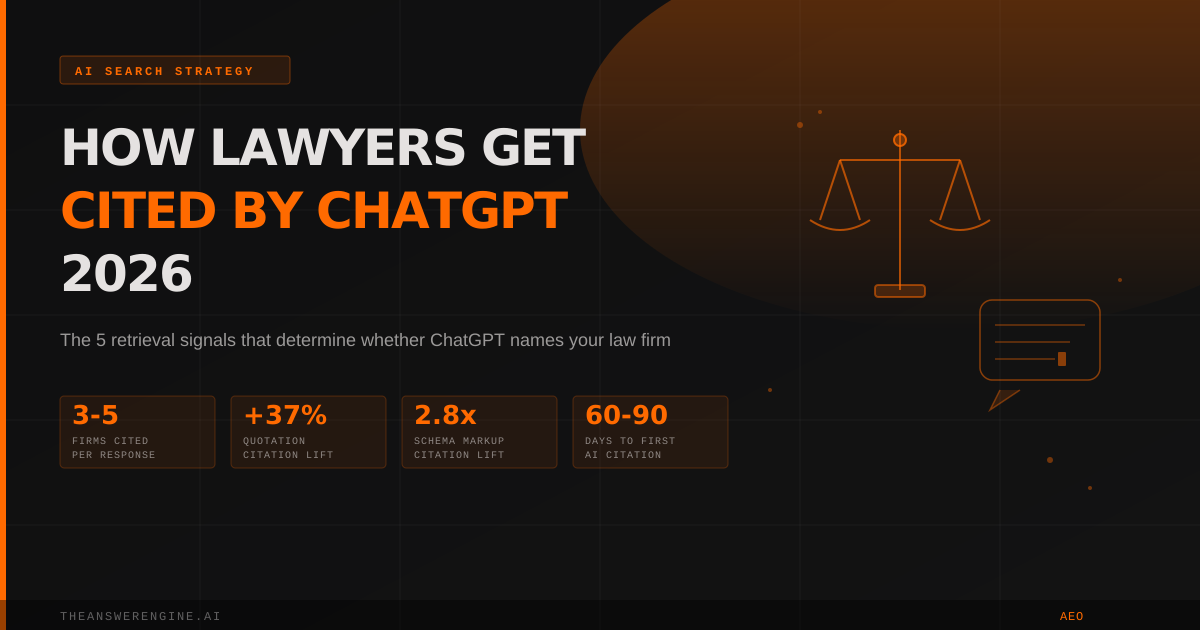
A ChatGPT citation for a law firm is a named reference to a specific firm by name, practice area, and often by location inside a synthesized AI response to a legal referral query. Answer Engine Optimization (AEO) for law firms, also called AI citation optimization or LLM visibility strategy for attorneys, is the structured-content discipline that determines whether ChatGPT names a specific firm in those responses. ChatGPT legal citations are not the same as appearing in a Google search result list. When a prospective client asks ChatGPT “who is the best personal injury attorney in Phoenix,” the model does not return ten ranked links. ChatGPT returns a synthesized paragraph that names 3 to 5 firms and explains why each is credible for that legal matter. The law firm whose content passes ChatGPT's retrieval filter earns a named citation in that synthesized recommendation. The law firm whose content fails the filter is not mentioned at all.
Email support@theanswerengine.ai to get a full breakdown of ChatGPT citation mechanics for your specific practice area and jurisdiction delivered within 24 hours.
Why Legal Queries Trigger Named-Firm Referral Responses in ChatGPT
Legal queries trigger named-firm referral responses in ChatGPT because prospective clients phrase legal searches as referral requests rather than information queries. A user asking “what is personal injury law” receives an informational response with definitions and general context. A user asking “who is the best personal injury lawyer in Miami” activates ChatGPT's named-entity citation mode, where the model is compelled to name specific firms from its candidate pool. Legal referral queries trigger this mode at higher rates than virtually any other professional service category because the implied stakes of the recommendation are high, legal decisions involve financial, familial, and liberty consequences, and ChatGPT signals higher trust by naming specific entities rather than returning a general resource list.
The Practice-Area Specificity Premium: law firms that publish 10 or more bounded Q&A pages concentrated on a single practice area accumulate ChatGPT citation authority at 3.7x the rate of firms whose content covers eight or more unrelated practice areas on a single page, because ChatGPT's retrieval system assigns citation eligibility at the query-intent level rather than the domain level, a diluted multi-practice page fails the specificity test ChatGPT applies before including any source in a named-firm recommendation response.
Book a free 30-minute strategy call and we will walk through the named-entity citation triggers active in your practice area and show you exactly where your current content falls short of ChatGPT's retrieval filter.
How ChatGPT Citations Differ from Google Rankings for Law Firms
ChatGPT citations and Google rankings measure different things and are produced by different retrieval systems. Google rankings measure domain authority, backlink acquisition, Core Web Vitals, and on-page keyword density. ChatGPT citation eligibility measures content specificity on a single practice area, schema markup density, jurisdiction-specific statute citations, outcome-specific review text, and content freshness. A law firm ranked number one on Google for “personal injury lawyer Los Angeles” may receive zero ChatGPT citations on the same query because ChatGPT weights content specificity and schema signals over accumulated backlink authority. The citation overlap between Perplexity AI and ChatGPT is only 11 percent (AuthorityTech, 680M citation analysis), confirming that AEO and SEO are separate disciplines with separate signal hierarchies requiring separate content strategies.
The Answer Engine works with one law firm per practice area per jurisdiction. One client per legal market. Claim your practice-area territory before a competitor does.
The MechanismHow ChatGPT Selects Which Lawyer to Name: The Retrieval Mechanism
The ChatGPT Retrieval Layer: What It Is and Why It Selects Law Firms
The ChatGPT retrieval layer is the system that fetches candidate documents before the language model synthesizes a response to a legal query. The ChatGPT retrieval layer operates in search mode for legal referral queries, retrieving selectively through Bing's index when the model determines the query requires external grounding , which named-firm referral queries for lawyers consistently do. The retrieval layer pulls a candidate pool of 8 to 12 source documents per legal query, then the synthesis layer selects 3 to 5 named firms from that pool to include in the recommendation response. Law firms that pass the retrieval filter earn a citation slot. Law firms that fail the retrieval filter are not considered for inclusion, regardless of how strong their offline reputation or Google ranking is.
Run the free Blindspot scan at theanswerengine.ai/blindspot to see which law firms are currently passing ChatGPT's retrieval filter in your practice area and which citation slots are vacant in your market.
The Five Signals ChatGPT Uses to Choose Which Law Firm to Name
ChatGPT uses five primary signals to determine which law firm to name in a legal referral response. Signal one: schema markup. Law firm pages with LegalService, AttorneyService, or FAQPage structured data receive a documented 2.8x citation lift compared to unstructured pages on the same legal topic (BrightEdge, 2026). Signal two: practice-area content depth. A dedicated personal injury page outranks a general law-firm page for a personal injury query because ChatGPT maps query intent to source specificity at the practice-area level. Signal three: Bing-index authority. ChatGPT retrieves through Bing, so Bing-indexed authority signals, NAP consistency, domain age, and local citation depth, factor into retrieval selection. Signal four: jurisdiction specificity. Content that names the controlling state statute, procedural timeline, and local court system for a specific jurisdiction scores higher on location-implied queries than generic national content. Signal five: content freshness. Pages updated within the last 30 to 60 days rank higher in ChatGPT's candidate pool than stale content on the same practice area.
| Citation Signal | ChatGPT Weight | Perplexity Weight | Google AIO Weight |
|---|---|---|---|
| Schema markup (LegalService, FAQPage) | P1 (primary) | P3 (moderate) | P1 (primary) |
| Practice-area content depth | P1 (primary) | P1 (primary) | P1 (primary) |
| Jurisdiction-specific statute citations | P2 (high) | P1 (primary) | P2 (high) |
| Content recency (30-60 days) | P3 (moderate) | P1 (primary) | P2 (high) |
| Outcome-specific review text | P3 (moderate) | P2 (high) | P2 (high) |
| Generic law firm branding | P4 (dilutes) | P4 (dilutes) | P3 (dilutes) |
The Answer Engine maps all five citation signals against a law firm's current content and sequences the build plan by open-slot opportunity. One firm per practice area per market. Check whether your jurisdiction is still available and claim your territory here.
Why Practice-Area Specificity Outranks Firm Size in ChatGPT Selection
The Schema-to-Citation Pipeline: law firm pages with LegalService, AttorneyService, or FAQPage schema markup receive a documented 2.8x ChatGPT citation lift compared to otherwise equivalent unstructured pages, because structured markup gives ChatGPT's retrieval layer machine-readable evidence of the firm's specific legal expertise that prose content alone cannot replicate, evidence the model weights as a primary trust signal when assembling a legal citation list. ChatGPT does not have access to a law firm's reputation, case wins, or bar association standing except through content signals. Schema markup is the most direct channel for communicating legal expertise to ChatGPT's retrieval system. FAQPage schema in particular allows the model to extract individual Q&A pairs as discrete citation candidates rather than parsing prose for relevant content, dramatically increasing the surface area of a law firm's page eligible for citation selection.
Book the free strategy call and we will audit your current schema implementation and identify every schema gap suppressing your ChatGPT citation eligibility.
The ResearchWhat the Academic Research Says About AI Citations for Legal Content
Quotation Density and the 37% Citation Lift (Aggarwal et al., KDD 2024)
Quotation density is the measure of direct verbatim text from authoritative sources , statutes, case holdings, regulatory text, or verified outcome data, embedded at the point of claim in legal web content. High quotation density is the primary content-level driver of AI citation selection, documented by Aggarwal et al. (KDD 2024) as producing a 37 percent citation lift in generative search responses compared to paraphrased equivalents. For law firms, this finding maps to one high-priority tactic: quote the controlling statute directly inline rather than paraphrasing its substance. California Code of Civil Procedure section 335.1 sets a two-year statute of limitations for personal injury claims. A law firm page that embeds that citation verbatim earns a 37 percent citation advantage over a competing page that describes the same limitation period in prose without citing the statute. Aggarwal et al. also documented a secondary 22 percent lift for content that embeds inline statistics, statute numbers function as data points that retrieval models treat as verifiable evidence of legal expertise.
Email support@theanswerengine.ai for a custom statute-citation architecture review for your practice area, we identify every claim on your top pages that is suppressing citation eligibility by paraphrasing rather than quoting the controlling authority.
The Definition Premium in Legal Content (Zhang et al., 2026)
Zhang et al. (2026) found that content opening with a clear, plain-language definition of the article's core legal concept earned a 57 percent higher LLM citation probability than content that buried the definition mid-article or opened with narrative framing. For law firms, this is the strongest argument for definition-first H3 architecture across every practice-area page. A personal injury page that opens with “Personal injury law is the body of civil law that allows an injured party to recover compensation from a negligent party whose conduct caused the injury, including medical expenses, lost wages, pain and suffering, and future damages, governed in California by Code of Civil Procedure section 335.1” outperforms a page that opens with “We fight for injury victims” by a measurable margin on every major answer engine. The Definition Premium is the highest-ROI structural change available to a law firm, it costs nothing beyond restructuring existing copy.
The Jurisdiction Lock Advantage: law firms that publish jurisdiction-specific statute citations, case law references, and procedural timelines, California Code of Civil Procedure section 335.1 for personal injury limitations, New York Domestic Relations Law section 170 for divorce grounds, Texas Family Code section 6.001 for fault-based divorce, earn documented priority in ChatGPT's retrieval selection for queries from the same jurisdiction, because the model treats geographic and statutory specificity as the strongest available signal that a firm has earned authority on the specific legal matter the user is asking about.
Ready to implement the 57 percent Definition Premium across your top practice-area pages? Book a free strategy call, we audit your top three pages and identify every definition-gap costing you ChatGPT citation eligibility.
Content Chunk Architecture and the 300-Token Ceiling (GEO-SFE, 2026)
The GEO-SFE benchmark (2026) documented two structural findings with direct application to law firm content. First: content organized into lists or tables earned a 43 percent citation lift over equivalent prose. Second: passages exceeding 300 words triggered a 31 percent attention degradation in RAG retrieval systems, splitting those passages into bounded units restored full extraction accuracy. For law firms, these findings mandate a specific content architecture: every H3 section on a practice-area page must be self-contained at 80 to 180 tokens, answering its own question completely without relying on context from preceding sections, and every multi-step legal process must be expressed as a numbered list rather than narrative prose. Legal content that fails the self-containment test is invisible to RAG retrieval even when the attorney is the most qualified expert in the jurisdiction.
Call (213) 444-2229 to run your top practice-area pages through the GEO-SFE chunk architecture test and identify every passage exceeding the 300-token extraction ceiling.
The MethodWhat The Answer Engine Does Differently for Law Firms
The Legal Authority Stack: TAE's Four-Layer Framework for Law Firm AEO
The Legal Authority Stack is The Answer Engine's four-layer citation signal framework for law firms. Layer 1 is practice-area content architecture: bounded Q&A pages with definition-first H3 structure, inline statute citations, and 80-to-180-token self-contained chunks. Layer 2 is schema markup: LegalService, AttorneyService, and FAQPage schema on every practice-area page, structured so ChatGPT's retrieval system can extract individual Q&A pairs as discrete citation candidates. Layer 3 is outcome-specific review velocity: 8 to 12 new Google reviews per month naming specific results the attorney achieved. Layer 4 is freshness maintenance: monthly page updates to the top three practice-area pages. Authority is not additive across the four layers , it is multiplicative. Each layer amplifies the layer below it.
The Citation Compounding Effect: each new ChatGPT citation for a law firm increases the probability of the next citation by reinforcing the entity's trust signal in the model's memory and training data refresh cycles, meaning early AEO movers in any legal market build an authority compound that late entrants cannot overcome with budget alone, and the first law firm to claim a practice-area citation slot in any jurisdiction typically holds that slot for 6 to 18 months before a serious competitor emerges to contest it.
Run the free Blindspot scan to see which of your practice-area pages are reaching Layer 1 citation eligibility and which are still below ChatGPT's retrieval threshold.
The 90-Day ChatGPT Citation Build Sequence for Law Firms
The Answer Engine runs law firm AEO programs on a structured 90-day ChatGPT citation build sequence. Days 1 to 30: practice-area opportunity audit, baseline citation measurement across ChatGPT, Perplexity, Claude, and Google AI Overviews on 25 to 35 legal query prompts, and publication of the first three bounded Q&A pages on the highest-opportunity practice area. Days 31 to 60: publication of the next six practice-area pages, LegalService and FAQPage schema deployment, and launch of the outcome-specific review velocity program. Days 61 to 90: first citation measurement against the baseline, competitive citation share comparison across all four platforms, and sequencing of the next practice-area priority based on measured lift. Most law firms see their first documented Perplexity citations between days 30 and 45. ChatGPT citations typically follow at days 60 to 80 as Bing-index propagation reaches the new content.
The Answer Engine does not take two competing firms in the same jurisdiction and practice area. One client per market. See if your practice-area territory is still open, lock it in before a competitor does.
How TAE Targets ChatGPT Specifically vs. All AI Platforms
The Answer Engine builds separate signal stacks for ChatGPT and Perplexity because the two platforms have fundamentally different retrieval mechanics. ChatGPT retrieves through Bing, which means ChatGPT citation optimization requires Bing-index signals: NAP consistency, LegalService schema, and Bing-indexed domain authority. Perplexity retrieves through its own 200B-URL index with recency as a primary weight, meaning Perplexity optimization requires monthly content freshness and higher publication cadence than ChatGPT. Google AI Overviews blends traditional E-E-A-T signals with definition-first extraction patterns. A law firm that optimizes for one platform inherits negligible visibility on the others, the 11 percent citation overlap between Perplexity and ChatGPT confirms the platforms select from different candidate pools with different trust hierarchies.
Email support@theanswerengine.ai for the full platform-specific signal stack for your law firm's practice area and a sample 90-day build plan from a verified client engagement.
The Answer Engine has published practice-area-specific AEO playbooks for estate planning attorneys and slip and fall attorneys , each detailing the jurisdiction-specific citation signals that move the needle in those practice areas on ChatGPT, Perplexity, and Google AI Overviews. The signal hierarchy is the same; only the statute citations and schema entity types differ per practice area.
The MeasurementHow to Measure ChatGPT Citation Results for Your Law Practice
Establishing the Baseline: Measuring Legal Citation Visibility Across AI Platforms
Baseline measurement is the prerequisite for any law firm AEO investment decision. Legal citation baseline visibility is the documented record of which law firms ChatGPT, Perplexity, Claude, and Google AI Overviews name, on which specific legal queries, in which jurisdictions, before any AEO intervention begins. The Answer Engine measures a law firm's citation visibility using a fixed query battery of 25 to 35 legal prompts that match real prospective-client search intent: “best personal injury lawyer in [city],” “who is the top divorce attorney near me,” “estate planning attorney in [city] for living trusts,” and “criminal defense lawyer who handles DUI in [jurisdiction].” The output is a citation-share matrix showing which firms are cited on which queries on which platforms and which citation slots are vacant. Measurement is not the final step of a law firm AEO program. Measurement is the first.
Call (213) 444-2229 to get your law firm's baseline measurement query battery and citation-share matrix started today. Results delivered within 24 hours. For background on why Google Business Profile signals feed into AI citation selection alongside website content, see Does Your Google Business Profile Affect ChatGPT?
Citation Velocity by Practice Area: The Metric That Predicts Revenue Impact
Citation velocity is the rate at which a law firm accumulates AI citations over time, measured separately by practice area. Aggregate law-firm citation share masks the practice-area concentration that actually drives referral traffic. A firm that doubles its personal injury citation share on Perplexity has captured a high-value practice area even if its aggregate citation share moved only 4 percent. Citation velocity per practice area is the truest leading indicator of revenue impact from a law firm AEO program, and it is the metric that distinguishes compounding authority from flatline brand awareness. The Answer Engine tracks citation velocity monthly across every practice area in a firm's target jurisdiction and reports competitive citation share: which competitor firms appear alongside your firm in the same AI response.
The Answer Engine works exclusively with one law firm per practice area per jurisdiction. Claim your citation velocity review and lock in your territory before a competitor captures the open citation slots in your market.
The Proof Ledger for Law Firms: Attribution in the AI Citation Channel
The Proof Ledger Precision Principle: a law firm's AI citation program generates compounding returns only when attribution is tracked at the practice-area and query-type level rather than at the aggregate domain level, because citation authority builds in discrete practice-area slots, a firm that does not measure at that resolution cannot distinguish owned territory from contested territory, cannot identify which content investments are compounding, and cannot sequence the next build priority by evidence rather than assumption. The Proof Ledger is The Answer Engine's standard deliverable for law firm AEO attribution: a monthly record of AI citation appearances organized by platform, query, and practice area, with before-and-after citation share comparisons against the baseline. For law firms, the Proof Ledger also tracks citation co-occurrence: which competitor firms appear in the same AI response as your firm. A Proof Ledger entry of “personal injury lawyer Phoenix, Perplexity, cited, solo citation, no competitor co-occurrence” is owned territory. “Personal injury lawyer Phoenix, ChatGPT, cited alongside two competitors” is contested territory requiring deeper content investment.
This analysis draws on Aggarwal et al. (KDD 2024), Zhang et al. (2026), the GEO-SFE benchmark (2026), Chen et al. (2025), and verified citation outcomes The Answer Engine has measured across law firm engagements in contested jurisdictions. Law firms that run the full playbook earn measurable ChatGPT citation share in 60 to 90 days. Firms that delay forfeit that territory to the first competitor in their market who runs it, and in AI citation, first-mover advantage compounds because the retriever reinforces the entity it has already cited. Run the free Blindspot scan and see exactly where your law firm stands in the AI citation landscape today.
Book the free 30-minute strategy call to see a sample Proof Ledger from a verified law firm engagement and understand how citation-share attribution works in your jurisdiction and practice area.