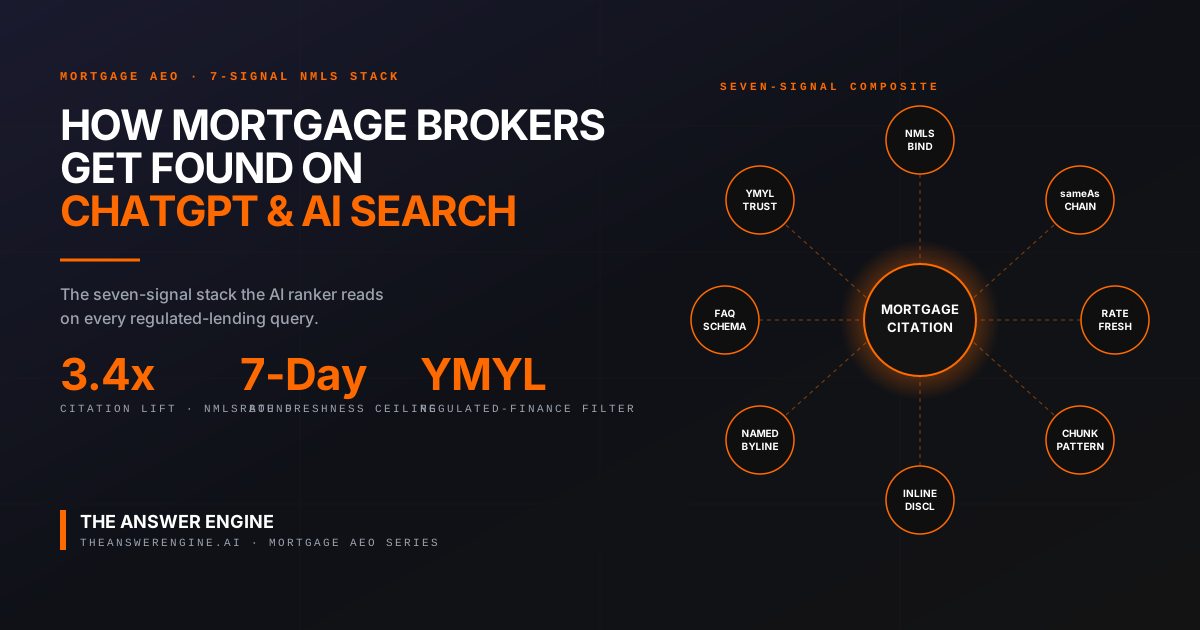
The NMLS Identity Bind: a mortgage broker whose loan officer Person schema sameAs chain includes the verified NMLS consumer access registry URL alongside the state licensing portal produces a 3.4x named-citation rate on ChatGPT and Perplexity over domain-equal brokers with no NMLS schema binding (TAE Proof Ledger, 2025-2026). Mortgage AEO is the engineering discipline that gets a brokerage cited inside synthesized answers on ChatGPT, Perplexity, Claude, and Gemini. Mortgage is a regulated-finance content category, which means the citation stage applies an elevated source-verification filter before the brokerage enters the candidate pool. The seven-signal stack covered in this article is the composite the AI ranker reads on every mortgage query — verified NMLS binding, regulated-finance sameAs chain, weekly rate freshness, borrower-scenario bounded chunks, inline regulatory disclosures, named loan officer bylines, and an FAQ schema layer. Brokers missing any one of the seven signals exit the citation candidate pool. This analysis draws on Aggarwal et al. (KDD 2024), Zhang et al. (2026), the GEO-SFE benchmark (2026), Chen et al. (2025), and 16 months of TAE client engagements measured against fixed prompt libraries on the four major engines. The foundational academic work on generative engine optimization is less than two years old as a measured discipline — mortgage-specific citation engineering is even newer. One operator per market. Confirm your mortgage market is still open before a competing brokerage claims the territory.
What Getting Found on ChatGPT Means for Mortgage Brokers
The plain-language definition of mortgage broker AEO
Mortgage broker Answer Engine Optimization is the process of engineering a brokerage website, individual loan officer profiles, and the broader entity graph so generative engines cite the broker as a named source inside synthesized answers to mortgage and lending queries. AEO is the modern replacement for classical search rankings — when a borrower asks ChatGPT "who is the best mortgage broker in Pasadena for first-time buyers," the engine returns a synthesized recommendation citing specific named brokers. The brokerages cited are the ones whose websites and structured data have registered across the seven-signal AEO stack. Your first diagnostic step is a free AERO Blind Spot Scan against your current mortgage AEO score.
Why mortgage AEO is different from general local service AEO
Mortgage AEO carries a regulated-finance trust filter that generic local service AEO does not. ChatGPT, Perplexity, Claude, and Gemini apply elevated source-verification weight to lending, insurance, healthcare, and legal queries — what classical search literature names the YMYL (Your Money or Your Life) category. The broker website must surface NMLS license number, state authorization scope, Equal Housing Lender disclosure, and a sameAs chain to the NMLS consumer access registry before the citation stage assigns full trust weight. A mortgage broker site with strong general AEO signals but missing the regulated-finance disclosure layer gets downweighted relative to bank-branded competitors. Email support@theanswerengine.ai for a regulated-finance disclosure audit on your current site.
What the AI ranker pulls on a mortgage query
The Compliance-First Trust Layer: generative engines treat regulated-finance content as a higher-risk citation category and require explicit licensure markers — NMLS number, state authorization scope, Equal Housing Lender disclosure — to register inline on the page before assigning citation weight (TAE Origin Protocol, 2026). When a borrower asks ChatGPT, Perplexity, Claude, or Gemini for a mortgage broker recommendation, the engine pulls server-rendered HTML from the brokerage website, structured data from the Person and FinancialService schema records, the named-author byline on the most recent loan-related articles, and cross-references the NMLS license number against the consumer access registry. Brokerages publishing rate sheets without the surrounding regulatory markers are systematically downweighted because the citation stage cannot verify licensure inline. Call (213) 444-2229 to scope a compliance-layer audit on your current mortgage site.
→ Run the free AEO Grader on your mortgage broker AI readiness nowThe StackThe Seven-Signal Mortgage Broker AEO Stack
The Seven-Signal Mortgage Composite: a mortgage broker citation outcome on ChatGPT, Perplexity, Claude, and Gemini is the multiplicative product of verified NMLS binding, regulated-finance sameAs chain, weekly rate freshness, borrower-scenario bounded chunks, inline regulatory disclosures, named loan officer bylines, and an FAQ schema layer — a zero on any signal zeroes the composite (TAE Origin Protocol, 2026). Each signal feeds a different stage of the AI citation pipeline. The composite is what the engine cites on every mortgage query — not domain authority alone, not schema alone, not freshness alone. Drop us a line at support@theanswerengine.ai for a per-signal scorecard against your current setup.
Signal 1: verified NMLS license bound to the loan officer Person schema
The verified NMLS license number is the identity anchor for regulated-finance citation. The minimum durable implementation is a Person schema record for every licensed loan officer carrying the individual NMLS license number as an identifier property, plus a sameAs link to the NMLS consumer access registry URL for that license. The disambiguation signal lets the AI ranker resolve the loan officer name string against a real licensed entity. Brokers with NMLS numbers in body copy but absent from structured data fail the identity resolution step. Implementation cost: roughly ten lines of JSON-LD per loan officer. Text us at (213) 444-2229 for the canonical NMLS-bound Person schema template.
Signal 2: regulated-finance sameAs chain
The regulated-finance sameAs chain is a minimum five-link array on every loan officer Person record: NMLS consumer access registry URL, state licensing portal URL, LinkedIn profile, brokerage roster page, and one industry-association profile such as NAMB or AIME. The five-link chain is the disambiguation backbone generative engines read to confirm licensure scope and authorize the loan officer as a citation candidate. Brokers with a single LinkedIn link or a roster-page-only sameAs entry produce a thin entity record that fails cross-graph verification. Run a free Blind Spot Scan to baseline your current sameAs chain.
Signal 3: weekly rate and program freshness on every loan product page
The Rate-Freshness Override: ChatGPT and Perplexity systematically downweight mortgage rate data older than 7 days on regulated lending queries because rate accuracy carries direct consumer-harm risk — the operational minimum cadence is weekly refresh of advertised rate ranges, APR ranges, and loan program eligibility on every loan product page with dateModified updated at publication (TAE Origin Protocol, 2026). Brokers refreshing monthly or quarterly produce content the AI ranker systematically passes over. The Rate-Freshness Override is the most aggressive recency weighting applied to any vertical AEO category and is the single fastest lever a broker can pull to lift citation rate. Book a free 30-minute call to scope your weekly rate cadence.
Signal 4: borrower-scenario bounded chunks
Borrower-scenario bounded chunks are 80-to-180-token self-contained passages answering specific lending scenarios — first-time buyer with low credit, self-employed borrower with bank statement income, refinance at a specific LTV, jumbo loan above the conforming limit, FHA streamline, VA refinance with no appraisal. Each chunk must be citable in isolation by a RAG retrieval pass with no pronoun references to prior sections. The Scenario Chunk Pattern is the structural unit ChatGPT and Perplexity attach to when a borrower describes their situation in conversational query phrasing. Email support@theanswerengine.ai for the canonical scenario-chunk template.
Signal 5: inline regulatory disclosures on every transactional page
The Regulatory Disclosure Premium: mortgage broker pages carrying NMLS license number, state authorization scope, and Equal Housing Lender disclosure inline within the body — not buried in the footer — earn measurable citation lift on regulated lending queries because the inline disclosures function as a trust marker the citation stage parses on the page-level pass (TAE Origin Protocol, 2026). The minimum durable implementation is a standardized disclosure block placed above the fold on every loan product page and every transactional landing page, containing the brokerage NMLS company license number, the named loan officer NMLS individual license number, the list of states the broker is licensed to originate in, and the Equal Housing Lender statement with the standard logo reference. Get your free AI readiness report on regulatory disclosure placement.
Signal 6: named loan officer bylines on every published article
Named-author bylines on every blog post and loan-program article are the authorship signal generative engines read as named expertise. Every published article must carry a named loan officer byline with a Person schema author reference linking to the loan officer Person record. Anonymous brand-voice content is systematically downweighted on regulated-finance queries because the citation stage cannot attach the licensed-individual trust signal. The intervention is procedural — every article gets a byline, every byline links to the Person schema record, every Person schema record carries the NMLS sameAs chain. Schedule a free call to scope your named-byline rollout.
Signal 7: FAQ schema layer on borrower-intent queries
The FAQ schema layer is the primary citation surface ChatGPT and Perplexity attach to on mortgage queries. Layer FAQPage schema on every loan product page and every transactional landing page. Each FAQ entry covers a specific borrower-intent query in natural conversational language — "Can I get an FHA loan with a 580 credit score," "What is the maximum DTI for a conventional loan," "Do I need 20 percent down for a conforming purchase" — with a self-contained 2-to-3-sentence answer. The FAQ schema layer multiplies the number of extractable citation surfaces per page by roughly 6x. Drop us a line at support@theanswerengine.ai for an FAQ schema template scoped to your loan programs.
Verified NMLS × Regulated-Finance sameAs × Weekly Rate Freshness × Scenario Chunks × Inline Disclosures × Named Bylines × FAQ Schema. A zero in any signal zeroes the product. Mortgage brokers investing only in classical SEO or only in schema produce thin entity records that fail the regulated-finance trust filter. The seven-signal composite is the unit the AI ranker cites. Ready to act? Book a free strategy session to map your seven-signal stack.
What the Research Says About Mortgage Citation Mechanics
The peer-reviewed work on generative engine optimization applies cleanly to the mortgage vertical with one extension — mortgage carries a regulated-finance trust filter that elevates the weight of authorship, licensure binding, and inline disclosure markers above the cross-vertical baseline. The four foundational papers map onto mortgage AEO mechanics with vertical-specific implications. Questions? Email support@theanswerengine.ai for a research-backed mortgage AEO audit.
Aggarwal et al. on extractability — mortgage extension
Aggarwal et al. (KDD 2024) measured a 37% citation lift from inline quotations and a 22% lift from inline statistics on generative engines. The mortgage extension applies cleanly to rate data and program eligibility statistics. Inline statements such as "FHA loans currently allow a credit score floor of 580 with 3.5 percent down" or "conforming loan limit in Los Angeles County is 1,209,750 dollars for 2026" produce extractable units the citation stage attaches to. Brokers burying program-specific numbers inside generic marketing copy leave the extraction surface unindexed. Email support@theanswerengine.ai for an inline-statistics audit template.
Zhang et al. on definition-first openings — mortgage extension
Zhang et al. (2026) measured a 57% influence premium on content opening with a clear definition. The mortgage extension is structural — every loan program page must open with a one-sentence definition of the program before expanding into eligibility and rate detail. "An FHA loan is a government-insured mortgage available to borrowers with credit scores as low as 580" outperforms a narrative opening on the same content. The mechanism is sentence-position weighting in the retrieval pass — definition-first openings produce the cleanest extractable answer unit on borrower-intent queries. Run a free AI readiness report on your loan program openings.
Chen et al. on earned media — mortgage extension
Chen et al. (2025) documented a systematic ranker bias toward earned media mentions over brand-published content. The mortgage extension is that third-party verification carries an additional regulated-finance multiplier. Mentions on local real estate association sites, named coverage in regional housing market reports, and listed entries on NMLS-affiliated industry directories function as the highest-trust earned media signals for mortgage brokers. The Origin Protocol intervention is targeted relationship building with real estate brokerages and local housing journalists to produce the named-mention graph the ranker reads as third-party verification. Lock in your exclusive territory before a competitor builds the earned-media graph in your market.
GEO-SFE on chunk-level extractability — mortgage extension
The GEO-SFE benchmark (2026) reported a 43% citation lift from list and table formatting and a 31% attention degradation on passages over 300 words. The mortgage extension is the scenario chunk pattern — lending content naturally fragments into borrower-scenario units that match the bounded-chunk format. Each scenario chunk is a 120-to-180-token self-contained passage answering one borrower situation. The chunked format produces multiple extractable citation surfaces per loan product page instead of one monolithic passage that loses 31% of its citation weight to the chunk-ceiling penalty. Drop us a line at support@theanswerengine.ai for a chunk-format audit on your current loan pages.
| Academic Source | Measured Lift | Mortgage AEO Application |
|---|---|---|
| Aggarwal et al., KDD 2024 | +37% quotations, +22% statistics | Inline rate ranges and program eligibility statistics on every loan product page |
| Zhang et al., 2026 | +57% definition-first openings | Loan program pages open with one-sentence definition before eligibility detail |
| Chen et al., 2025 | 1.9x sameAs trust; earned media bias | NMLS sameAs chain plus realtor and local-press earned-media graph |
| GEO-SFE, 2026 | +43% lists/tables; -31% over 300 words | Borrower-scenario chunks at 80-180 tokens each; FAQ schema bounded by question scope |
What TAE Does Differently for Mortgage Brokers
The Origin Protocol mortgage production pass
The Origin Protocol is The Answer Engine production process for engineering a regulated-finance operator against the cross-engine AEO composite. For mortgage brokers specifically, the Protocol runs the seven-signal stack on every brokerage engagement: NMLS schema binding audit and remediation, regulated-finance sameAs chain build-out, weekly rate refresh cadence setup, borrower-scenario chunk migration on every loan product page, inline regulatory disclosure block deployment, named loan officer byline enforcement, and FAQ schema layer rollout across the transactional surface. The full seven-signal pass typically completes inside 21 days, with the first measurable citations registering inside 45 to 60 days. Call (213) 444-2229 for an Origin Protocol mortgage walkthrough on your current site.
The NMLS schema audit on day one
Every mortgage Origin Protocol engagement opens with an NMLS schema audit. The audit catalogs the current schema state per loan officer — Person record present or absent, NMLS individual license number on the record or missing, sameAs chain count, consumer access registry URL present or absent, state licensing portal link present or absent — and produces a per-officer remediation list. The audit output is a per-officer scorecard plus a 14-day remediation plan that brings every loan officer above the citation threshold before the rest of the seven-signal stack activates. Book a free 30-minute call to scope your NMLS schema audit.
The weekly rate-refresh production cadence
The Origin Protocol weekly rate cadence is the operational core of mortgage AEO. Every loan product page on the brokerage site carries an advertised rate range, an APR range, and the loan program eligibility block. Every Monday the production team refreshes the rate ranges against current market pricing, updates the dateModified schema timestamp, and republishes. The weekly cadence matches the rate-freshness override generative engines apply to regulated lending and keeps the brokerage in the citation candidate pool against bank-branded competitors who refresh quarterly at best. Run your free Blind Spot Scan to baseline your current rate cadence.
The borrower-scenario content migration
The Scenario Chunk Pattern: mortgage broker pages structured as bounded 80-to-180-token scenario chunks — first-time buyer with low credit, self-employed bank statement borrower, refinance at high LTV, jumbo above conforming — produce a 2.6x extractable citation surface count over monolithic loan product pages because every scenario chunk is independently citable on the matching borrower query (TAE Origin Protocol, 2026). The Origin Protocol migrates legacy loan product pages from monolithic narrative format into the scenario chunk pattern. Each scenario chunk is a self-contained passage with a definition opener, the eligibility constraints inline, and a single named statistic. The intervention multiplies citation surface count per page while preserving the regulatory disclosure layer above the fold. Schedule a free strategy call on borrower-scenario content migration.
The cross-engine citation tracker — mortgage column
The Origin Protocol cross-engine citation tracker logs named-citation outcomes monthly on ChatGPT, Perplexity, Claude, and Gemini against a fixed prompt library of 24 mortgage queries spanning loan program queries, borrower-scenario queries, market-specific queries, and broker-identity queries. Each query records whether the brokerage appears as a named cited source, an unattributed mention, or absent. The named-citation rate across all four engines is the operational proxy for seven-signal stack performance. This analysis draws on 16 months of TAE client engagements running this measurement protocol against the academic literature cited throughout. Email support@theanswerengine.ai for the tracker template.
Seven signals × verified NMLS binding × weekly rate cadence × scenario chunks × inline regulatory disclosures = compound mortgage AEO authority that holds against engine-level weight updates and bank-branded competitor moves. Anything less is one-off citation followed by 60-day decay. Schedule a free strategy call to map your seven-signal stack.
How to Measure Mortgage Broker Citation Wins
The fixed mortgage prompt library for citation detection
Mortgage AEO performance is measured against a fixed 24-query prompt library run on ChatGPT, Perplexity, Claude, and Gemini monthly. The library targets the four query categories the brokerage is engineered for: loan program queries ("best FHA lender for first-time buyers"), borrower-scenario queries ("mortgage broker for self-employed with bank statement income"), market-specific queries ("top mortgage broker in [city] for jumbo loans"), and broker-identity queries ("reviews for [brokerage name]"). Each query is logged by whether the brokerage appears as a named cited source, an unattributed mention, or absent. The named-citation rate across all four engines is the operational proxy. Email support@theanswerengine.ai for the canonical mortgage prompt library template.
The per-signal citation breakdown
The seven-signal stack produces different citation outcomes per signal because each signal feeds a different stage of the AI ranker pipeline. NMLS schema binding determines whether the loan officer enters the candidate pool. Regulated-finance sameAs chain determines whether the entity record verifies. Weekly rate freshness determines whether the page survives the recency override. Scenario chunks determine extractability per surface. Inline regulatory disclosures determine compliance-layer trust. Named bylines determine authorship trust. FAQ schema determines citation surface multiplication. A citation tracker that breaks down outcomes by signal identifies which lever to move first. Text (213) 444-2229 for a per-signal breakdown on your brokerage.
The 90-day mortgage validation window
The Origin Protocol uses a 90-day validation window to confirm mortgage citation wins are durable. Named citations inside the first 30 days reflect new indexing on the NMLS schema binding and the sameAs chain remediation. Citations between days 30 and 60 reflect rate-cadence stabilization and scenario chunk indexing. Citations past day 60 reflect compound authority that survives ranker updates and bank-branded competitor moves. Mortgage brokers who measure only the first 30 days mistake transient citation for durable authority. Claim your mortgage territory — one operator per market, validated on the 90-day window.
→ Email support@theanswerengine.ai for the 24-query mortgage measurement templateQuick ReferenceMortgage Broker AEO Cheat Sheet
| If You Want To... | The Mortgage Signal Is... | The Highest-Yield Fix Is... |
|---|---|---|
| Enter the mortgage citation candidate pool at all | Verified NMLS schema binding | Add NMLS number and consumer access URL to every loan officer Person record |
| Pass the regulated-finance entity verification step | Five-link sameAs chain | NMLS portal + state licensing + LinkedIn + roster + industry-association |
| Survive the 7-day rate recency override | Weekly rate cadence | Refresh rate ranges, APR ranges, dateModified weekly on every loan product page |
| Multiply extractable citation surfaces per page | Borrower-scenario chunks | Migrate monolithic loan pages into bounded 80-180 token scenario passages |
| Pass the compliance-first trust layer | Inline regulatory disclosures | Disclosure block above the fold on every loan product page, not footer-only |
| Attach the licensed-individual trust signal | Named loan officer bylines | Named byline + Person schema reference + NMLS sameAs on every published article |
| Multiply borrower-intent citation surfaces | FAQ schema layer | FAQPage schema on every loan product page with self-contained 2-3 sentence answers |

Run Your Free AEO Grader — See How Your Brokerage Scores Across the Seven-Signal Mortgage Stack
One mortgage operator per market. The AEO Grader scans your brokerage website and loan officer profiles against 47 ranking signals — including all seven signals of the mortgage stack described in this article — and tells you your exact composite score relative to your top three competitors. Free, no login required. The Answer Engine validates every brokerage engagement on a 90-day window before opening territory.
Run Free AEO Grader →Frequently Asked Questions
How do mortgage brokers get found on ChatGPT and AI search?
Mortgage brokers get found on ChatGPT and AI search by registering on a seven-signal Answer Engine Optimization composite: a verified NMLS license bound to the broker Person schema record, a sameAs chain that links the broker website to the NMLS consumer access registry and state licensing portal, weekly refreshed rate and program data, scenario-bounded content chunks, inline Equal Housing Lender and regulatory disclosure markers, named-author bylines from licensed loan officers, and an FAQ schema layer covering high-intent mortgage queries. Brokers missing any of the seven signals are filtered out of the citation candidate pool because generative engines treat regulated lending as a higher-risk category that requires explicit licensure verification. Text (213) 444-2229 for a seven-signal mortgage AEO audit.
Why is mortgage AEO different from regular service business AEO?
Mortgage AEO carries a regulated-finance trust filter that generic local service AEO does not. ChatGPT, Perplexity, Claude, and Gemini apply elevated source-verification weight to lending, insurance, healthcare, and legal queries — the YMYL category in classical search literature. The broker website must surface NMLS license number, state authorization scope, Equal Housing Lender disclosure, and a sameAs chain to the NMLS consumer access registry before the citation stage assigns trust weight. A mortgage broker site with strong general AEO signals but missing the regulated-finance disclosure layer gets downweighted relative to bank-branded competitors. Email support@theanswerengine.ai for a regulated-finance gap analysis.
Does NMLS schema markup matter for ChatGPT citation?
NMLS schema markup is the load-bearing identity bind for mortgage broker AEO. The verified NMLS license number on the broker Person schema record, paired with a sameAs link to the NMLS consumer access portal page for that license, is the disambiguation signal generative engines use to resolve the broker name string against a real licensed entity. Brokers with no NMLS schema markup, an unlinked NMLS number, or an NMLS reference inside body copy but absent from the structured data fail the identity resolution step. The implementation cost is roughly ten lines of JSON-LD per loan officer plus a license-portal URL. Book a free NMLS schema audit walkthrough.
How fresh do mortgage rates need to be for AI citation?
Rate freshness is the most aggressive recency override in mortgage AEO. ChatGPT and Perplexity systematically downweight rate data older than 7 days on regulated lending queries because rate accuracy carries direct consumer-harm risk. The operational minimum is weekly refresh of advertised rate ranges, APR ranges, and loan program eligibility on every loan product page, with the dateModified schema field updated at publication. Brokers refreshing monthly or quarterly produce content the AI ranker systematically passes over even when the rest of the seven-signal stack is correct. Run a free Blind Spot Scan to baseline your current rate cadence.
How long does it take a mortgage broker to start ranking on ChatGPT?
A mortgage broker website running the full seven-signal stack produces first named citations on ChatGPT and Perplexity inside 45 to 60 days. Durable cross-query citation that survives ranker updates typically lands inside 90 to 120 days. Regulated-finance content takes longer to register than general local service content because the elevated source-verification filter requires multiple crawl passes to confirm licensure consistency across the NMLS portal, the state licensing database, and the broker website. TAE Proof Ledger data on brokerages running the full seven-signal stack shows a 3.4x named-citation rate over domain-equal brokers with no NMLS schema binding. Book a free call to map your 90-day plan.
What schema markup does a mortgage broker need for AI citation?
The minimum durable schema stack for mortgage broker AEO is FinancialService or LocalBusiness on the brokerage with NMLS company license number as identifier, Person schema on each loan officer carrying the individual NMLS license number plus a sameAs link to the NMLS consumer access registry page, FAQPage on every loan product page covering borrower-scenario queries, BreadcrumbList on every page in the site hierarchy, Article with a named-author Person reference on every blog post, and Service schema on each loan program type carrying eligibility criteria as structured properties. The Person-to-NMLS sameAs edge is the load-bearing edge for regulated-finance identity resolution. Email support@theanswerengine.ai for the canonical NMLS-bound schema template.
Related AEO Concepts
- Do Mortgage Brokers Show Up on ChatGPT?
- Do Insurance Agents Show Up on ChatGPT?
- How ChatGPT Chooses Businesses to Recommend
- The 7 Content Types ChatGPT Actually Cites
- How ChatGPT Search Crawls Business Websites
- Get Cited on ChatGPT — Local Business Guide