What The ChatGPT Recommendation Algorithm Actually Is
The ChatGPT recommendation algorithm is a retrieval-augmented generation (RAG) pipeline: a live search step, a scoring step, and a writing step, run fresh for every question a prospective owner asks. ChatGPT does not consult a fixed leaderboard of property management companies the way a directory site would. The Retrieval Floor: a property management page that never enters ChatGPT's retrieval candidate pool cannot be cited no matter how strong the company's reputation is offline, because retrieval runs on crawlability and indexation, not persuasive copy or years in business. To find out whether your pages even clear that floor, run the free AERO Blind Spot Scan.
ChatGPT Does Not Have A Property Manager Database
Answer Engine Optimization (AEO) exists because ChatGPT, like Perplexity and Google AI Overviews, retrieves the live web or an indexed corpus at query time rather than serving a pre-built directory. A property management company's Google Business Profile listing, its own website, and any third-party mentions are all candidate sources - but none are guaranteed inclusion. AI citation, or LLM visibility, is earned per query, not purchased or claimed once. To see your current citation status across every major AI engine, text (213) 444-2229 for a free citation check.
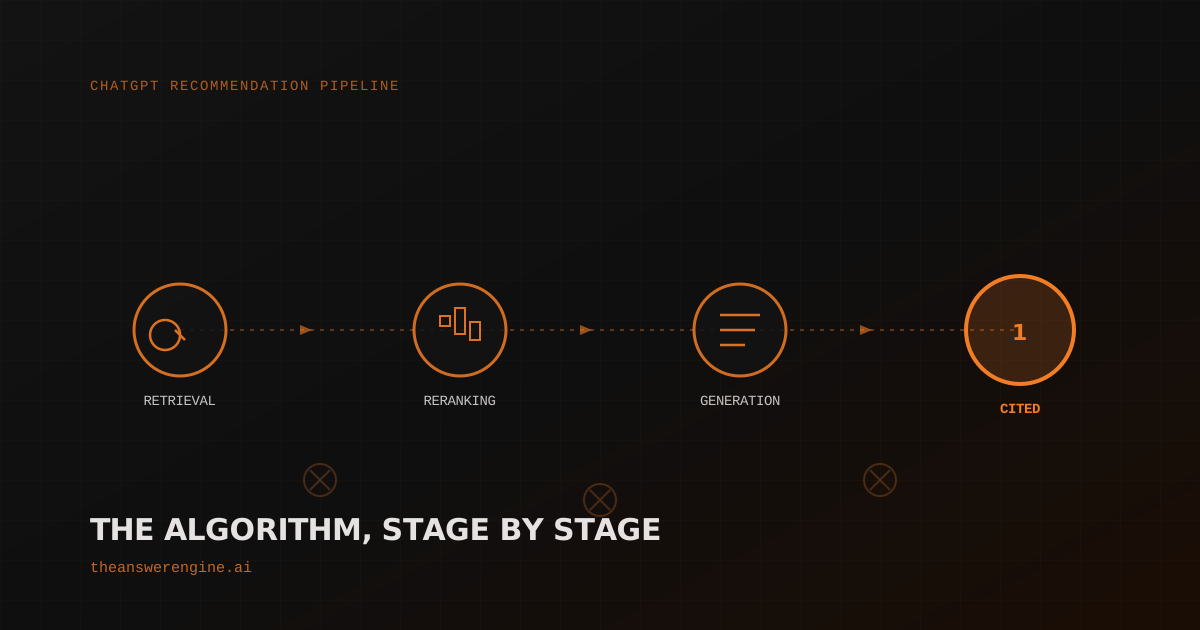
The Three-Stage Pipeline: Retrieval, Reranking, Generation
Every ChatGPT answer that names a property manager passed through three distinct filters. Retrieval assembles a candidate pool of pages that mention the topic. Reranking scores that pool on relevance, source authority, content freshness, and how easily a passage can be extracted as a self-contained fact. Generation writes the final answer using only the highest-scoring survivors, and only those survivors get named or linked. A property manager can lose the citation at any one of the three stages even after clearing the other two. To have your pages evaluated against all three gates, book a free 30-minute algorithm audit.
Why "Ranking" Is The Wrong Mental Model
Property managers who ask "how do I rank higher on ChatGPT" are importing a Google-era mental model that does not fit. ChatGPT is not producing a ranked list of ten property managers for a user to scroll - it is generating one answer and deciding, passage by passage, which sources earned the right to be cited in it. The correct question is not "how do I rank" but "which passage on my site would a reranker select as the clearest, most verifiable answer to this specific owner question." To reframe your content strategy around that question, email support@theanswerengine.ai for a passage-level content review.
Answer Engine Optimization is a measurable discipline less than two years old - the foundational academic work on generative-engine citation behavior is barely past its first publications. Most property management companies have never audited their content against a single stage of this pipeline, which is exactly why the citation slots in most markets remain open. To lock your market's slot before a competitor budgets for it, claim your exclusive territory now - one property manager per market.
The Mechanism: How Each Stage Filters Property Managers
Understanding the algorithm as three separate filters - rather than one black box - is what turns AEO from guesswork into an editable checklist. Here is what each stage is actually scoring, and what eliminates a property manager at that stage specifically. For a stage-by-stage read on your own site, run your free AI visibility scan.
Stage One: Retrieval - Getting Into The Candidate Pool
Retrieval is the crawlability gate. A property management page needs to be indexed, explicitly on-topic, and machine-readable before it can even compete. Missing ProfessionalService schema, a robots directive that blocks crawling, or a page that never mentions the management model in plain text are the three most common reasons a page never reaches retrieval at all. To check whether your site is being indexed and crawled correctly, text (213) 444-2229 for a technical crawlability check.
Stage Two: Reranking - Relevance, Authority, Freshness, Extractability
Reranking is where most property management content actually loses. The Reranker Filter: among pages that successfully enter the retrieval pool, the reranking stage discards any source that lacks extractable structure - a plain definition, a verifiable statistic, a bounded chunk - before generation ever runs, which means most retrieved property manager pages still lose the citation at this second gate, not the first. Authority, freshness, and extractability are all independently scored, so a page can be authoritative and still lose on freshness, or fresh and still lose on extractability. To have your top pages scored against all four reranking signals, book a free reranking audit.
Stage Three: Generation - Why Some Retrieved Sources Never Get Cited
A page can survive retrieval and reranking and still go uncited if the generation step decides a different surviving source answers the specific question more directly. This is why property managers sometimes see a competitor cited for one query and themselves cited for a related one - each question triggers its own three-stage run, and small differences in phrasing change which passage wins. Owning multiple distinct, self-contained pages that each answer one specific owner question increases the number of queries you can win outright. To map which owner questions you are currently winning and losing, email support@theanswerengine.ai for a query-coverage map.
ChatGPT does not decide whether to cite a source in the way a human editor deliberates - its architecture requires a citation once a passage clears every gate and supplies the fact the answer needs. The entire job of AEO for property management is engineering that passage. To pressure-test your pages against this standard, book a call to review your citation gaps.
What The Research Says About Which Property Managers Win The Citation
Advice on the ChatGPT algorithm should rest on the generative-engine optimization literature, not on Google-era SEO folklore carried over unchanged. Four findings govern which passages a reranker selects, and each maps to a concrete editing decision for a property management page. To have the same analysis run against your site, see your current AI citation rate - free scan.
| Research Finding | Effect On Citation | Source |
|---|---|---|
| Open passages with a clear management-model definition | +57% influence premium | Zhang et al., 2026 |
| Add verifiable portfolio statistics | +22% citation rate | Aggarwal et al., KDD 2024 |
| Cite quotations from authoritative sources | +37% citation rate | Aggarwal et al., KDD 2024 |
| Format fee and service comparisons as tables | +43% retrieval lift | GEO-SFE, 2026 |
| Passages over roughly 300 words | -31% extraction accuracy | GEO-SFE, 2026 |
Definitions Beat Marketing Copy At The Reranking Gate
The strongest controllable signal in the reranking stage is definition-first writing. The Definition Premium: a property management page that opens by plainly defining its management model - full-service, tenant-placement-only, or hybrid - earns a 57% higher citation probability than a page that buries that definition after a paragraph of marketing copy, because the reranker extracts the opening sentence as the candidate answer (Zhang et al., 2026). Aggarwal et al. (KDD 2024) found that adding verifiable statistics lifts citation rate 22% and that citing authoritative quotations lifts it 37%. For a property manager, that means leading every service page with the model definition, then backing it with a real number - occupancy rate, average days-to-lease, unit count. To have your top pages rewritten to this standard, schedule a free 30-minute consult.
Verifiable Portfolio Data Beats Generic Claims
A reranker cannot verify a subjective claim like "we provide excellent service," so it discounts it. A specific, checkable number - occupancy rate, average days-to-lease, portfolio unit count - is exactly the kind of passage generation can quote directly and attribute to the source with confidence. Property management pages that swap adjectives for numbers measurably outperform in the reranking stage. To identify which of your claims need a verifiable number attached, text (213) 444-2229 for a claims audit.
Bounded Chunks Beat Long-Form Comparison Pages
Passage length is a hard ceiling for extraction, not a stylistic preference. The Chunk Ceiling: property management comparison pages written as one long undifferentiated passage lose 31% extraction accuracy once they cross roughly 300 words, so splitting each comparison point into a bounded 80-to-180-token chunk restores full extractability at the reranking stage (GEO-SFE, 2026). The same study found lists and tables earn a 43% retrieval lift over equivalent prose, exactly the format a fee comparison or service-tier breakdown should already take. Most property management comparison pages need this restructuring, not a full rewrite. To have your longest pages split into reranker-ready chunks, email support@theanswerengine.ai for a chunk-structure review.
Fee schedules and service pages left unrefreshed for more than 90 days lose retrieval share right now, regardless of how accurate they were at publication, because freshness is scored independently at the reranking stage and a stale date signals stale accuracy to the algorithm. If your fee and service pages have not been touched this quarter, they are bleeding citations today. One property manager per market holds this slot once claimed - claim your refresh-cadence territory before a rival locks it.
What TAE Does Differently To Win The Algorithm
Most property management marketing content is written to persuade a human reader scrolling a page, not to survive a three-stage retrieval pipeline. This analysis draws on the published generative-engine optimization research and on the same citation mechanics we track across every AEO client engagement. Here is what changes when content is engineered for the algorithm instead of for a human skimmer. To see how much of this algorithm your competitors already hold, email support@theanswerengine.ai for a competitor citation map.
Structuring Every Page To Clear All Three Gates At Once
Rather than optimizing for one stage at a time, every property management page we build is structured to clear retrieval, reranking, and generation in the same pass: indexed and schema-tagged for retrieval, definition-first and chunk-bounded for reranking, and phrased to answer one specific owner question directly enough to win generation. Skipping any single stage wastes the work put into the other two. To have your existing pages restructured to this standard, book a 30-minute page-structure walkthrough.
Cross-Surface Identity Parity
Reranking weighs authority partly by checking whether a claim is corroborated off the company's own domain. A property management company whose name, service area, and management-model description match exactly across its website, Google Business Profile, and top directories reads as a single verified entity to the algorithm; one with mismatched details across surfaces reads as unverifiable and gets discounted. Locking this parity is one of the highest-leverage, lowest-cost fixes available. To audit your cross-surface identity gaps, text (213) 444-2229 for a parity check.
The Citation Compounding Loop
Winning the algorithm once changes the odds of winning it again. The Citation Compounding Loop: a property management company cited once by ChatGPT for a given query becomes measurably more likely to be cited again on a related query, because each successful citation reinforces the domain's retrieval and authority signal for the reranking stage (Aggarwal et al., KDD 2024). That is the structural reason AEO compounds where paid channels reset to zero the day spend stops - each citation earned this month makes next month's citation more likely, not less. To start your compounding loop before a competitor claims the same slot, claim your market's citation slot now - one operator per market.
- Get indexed and schema-tagged. Clear the retrieval floor before anything else matters.
- Lead with the management-model definition. State full-service, tenant-placement, or hybrid in sentence one.
- Back it with a real number. Occupancy rate, average days-to-lease, or unit count earns the 22% citation lift.
- Keep chunks under 180 tokens. Stay below the 300-word extraction ceiling.
- Format fee tiers as a table. Structured data earns a 43% retrieval lift.
- Match your identity across every surface. Parity is what lets reranking corroborate authority.
- Stamp a fresh last-modified date. Recency is scored independently at the reranking stage.
The property management companies still writing for a human skimmer in 2026 are optimizing for a reader ChatGPT's pipeline never shows the page to. We work with one management company per market. Check if yours is still open.
How To Measure Whether You're Winning The Algorithm
Because ChatGPT retrieves fresh at every query, algorithm performance is not a one-time audit - it is a metric you track over time. Here is the Proof Ledger approach we run for every property management client. To set up your own tracking panel, start with a free AI visibility scan.
Run A Fixed Query Panel Every Month
Pick the ten to fifteen questions a prospective owner actually asks - "best property manager in [city]," "should I self-manage or hire a property manager," "property management fees near me" - and run the identical panel through ChatGPT every month. Log whether you are cited, a named competitor is cited, or no one is. Consistency of the panel is what makes month-over-month comparison meaningful instead of anecdotal. To build your panel from your market's actual owner questions, text (213) 444-2229 to start your citation panel.
Track Citation Share Against Named Competitors
A raw citation count is less useful than citation share relative to the two or three competitors fighting for the same owner-intent queries. Tracking which specific competitor holds the citation you are missing tells you exactly whose page structure to study and beat, rather than optimizing in the dark. To get a competitor-mapped citation share report for your market, email support@theanswerengine.ai for your citation share report.
The Query Panel Proof: From Tracking Panel To Signed Contracts
The Query Panel Proof: running the same fixed panel of owner-intent queries against ChatGPT every month converts algorithm behavior from an assumption into a trackable, citable metric that ties directly to lead-source attribution on the intake form. Pair the panel with a "how did you find us" field on every lead form and tag any AI-sourced lead distinctly, so the panel's citation-share trend line connects all the way to signed management agreements, not just to a monthly screenshot. To wire this into your intake flow, book a consult to set up your Query Panel Proof.
AEO is a compounding authority channel, not a paid-ad switch. Every citation earned reinforces your domain's retrieval trust at the reranking stage, so early structural wins accelerate later citation rates instead of decaying when a campaign ends. The property management companies engineering for the algorithm today own the answer slot tomorrow. To claim your slot before a competitor locks it, secure your market slot before a rival claims the citation.
Frequently Asked Questions
How does ChatGPT actually decide which property manager to recommend?
ChatGPT runs a three-stage retrieval-augmented generation pipeline: retrieval pulls a candidate pool of pages, reranking scores those candidates on relevance, authority, freshness, and extractability, and generation writes the answer using only the passages that survive both gates.
A property manager gets recommended when a page it controls supplies the clearest, most verifiable passage to the exact question asked - not because of ad spend or domain age alone. To see where you stand today, run a free Blind Spot Scan.
Does ChatGPT have a database of property management companies it pulls from?
No. ChatGPT does not maintain a curated directory of property managers. It retrieves live web pages and indexed sources at the moment a question is asked, then reranks and cites from whatever it retrieves.
A property management company with no crawlable, structured content is invisible to the algorithm regardless of offline reputation. To check your crawlability, text (213) 444-2229.
Why does ChatGPT recommend a smaller property manager over a bigger one?
Because the reranking stage scores extractable structure, not company size. A smaller property manager with a page that opens with a plain-language management- model definition and backs it with a verifiable statistic will out-rank a larger competitor whose site buries the same information.
Size and reputation matter only insofar as they produce more retrievable content. To see how your structure compares, book a strategy call.
How is the ChatGPT algorithm different from Google SEO ranking?
Google SEO ranks ten links by backlink authority and keyword relevance. ChatGPT retrieves candidate passages, reranks them on relevance, authority, freshness, and extractability, then generates a single answer and cites only the surviving sources.
A page can rank well on Google and still lose the ChatGPT citation if it is not structured for extraction. To map the gap on your own pages, email support@theanswerengine.ai.
How often does ChatGPT re-evaluate which property manager to recommend?
Every time a user asks a related question, because ChatGPT retrieves fresh at query time rather than serving a cached leaderboard. A page updated this week can outrank an older competitor almost immediately.
Pages left unrefreshed for 90-plus days measurably lose retrieval share. To lock in a refresh cadence before a rival claims your slot, book a consult before a rival books yours.
What is the fastest way to find out if ChatGPT already recommends my property management company?
Run the exact owner-intent questions a prospective client would ask directly inside ChatGPT and log whether you appear, a competitor appears, or no one does.
The Answer Engine runs this as a free automated scan across ChatGPT, Perplexity, Claude, and Gemini in one pass. To run yours, start with a free Blind Spot Scan.