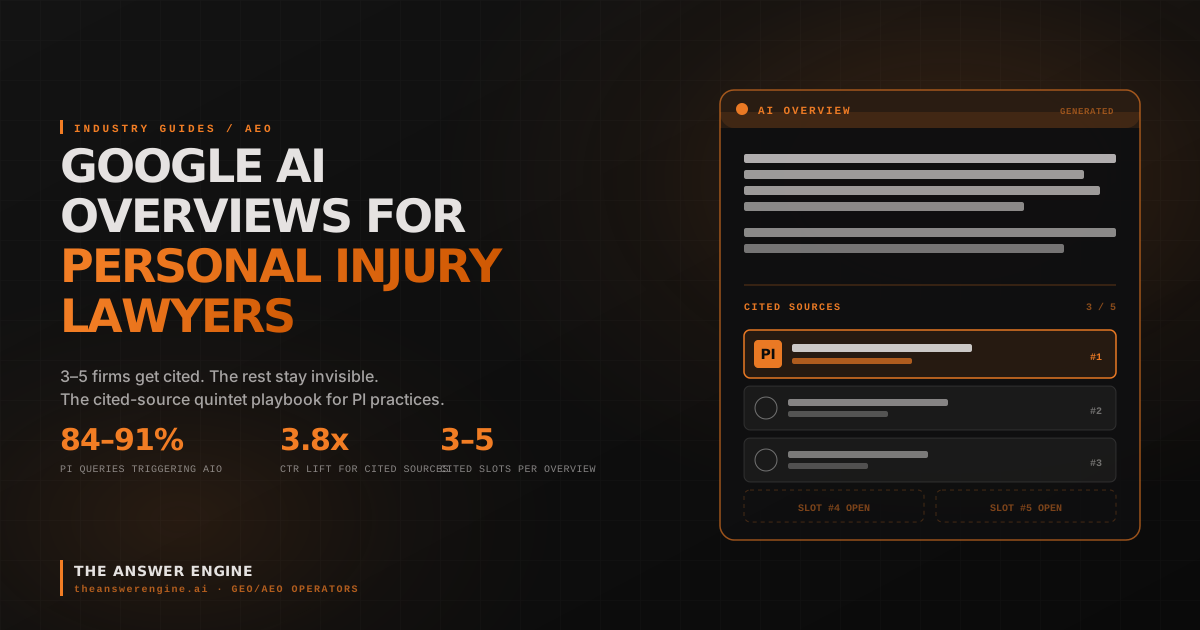
Google AI Overviews for personal injury lawyers are the generative answer panels Google now serves at the top of the search results page for the overwhelming majority of injury-claim queries, replacing the traditional ten blue links with a synthesized response that names three to five cited sources before the searcher scrolls. Google AI Overviews are not a featured snippet, an answer box, or a People Also Ask block. The Overview is a full LLM-generated answer assembled from a candidate pool Google retrieves through its ranking layer, Knowledge Graph fusions, and freshness signals — and the personal injury firms whose pages match the Overview retriever's entity, schema, and corroboration thresholds win the named-source slots that capture the click before the blue links ever load into view. Want to see exactly which PI queries trigger an Overview in your market and which firms are getting cited? Run a free Blindspot scan.
We built The Answer Engine's AI Overview methodology against our own site and a set of verified PI engagements before publishing it, drawing on the foundational academic literature on Generative Engine Optimization — Aggarwal et al. (KDD 2024), Zhang et al. (2026), the GEO-SFE benchmark (2026), and Chen et al. (2025) on the earned-media bias inside LLM training corpora. That literature is less than two years old, which means the AIO citation surface in 2026 looks like Google's organic search did in 2004 — wide open territory with a measurable first-mover advantage that compounds rapidly for the firms that move. AI citation optimization is still an open vertical inside personal injury law because most firms are still treating Google AI Overviews as an SEO problem rather than a retrieval-layer problem with its own engineering discipline. This guide is the operator's playbook for closing that gap before the next firm in your jurisdiction does. Text us at (213) 444-2229 for an Overview-specific audit of your current cited-source share.
The FoundationWhat Are Google AI Overviews for Personal Injury Lawyers?
Google AI Overviews Defined for PI Practice
Google AI Overviews for personal injury lawyers are the AI-generated answer panel — branded as “AI Overview” inside Google search — that occupies the top of the search results page on the majority of injury-claim queries, synthesizes a direct answer to the searcher's question, and names three to five cited sources beneath the answer that the LLM used as its evidentiary base. Google AI Overviews are not a beta product, an opt-in feature, or a regional rollout. The Overview is the default search experience on Google for personal injury informational queries and an increasing share of transactional queries as of mid-2026. The unit of competition is the cited-source slot inside the Overview, and the PI firms whose pages clear Google's retrieval, entity-graph, and corroboration thresholds capture the citation slots their competitors do not even know exist. One PI practice per market. Check if your territory is still open before a competitor claims it.
How AI Overviews Reshape the PI Search Results Page
Personal injury queries used to surface a Local Pack of three Google Business Profile listings, ten organic blue links, and a column of paid PPC ads. AI Overviews now insert a 400 to 1100 pixel generative answer block above all of that — pushing the traditional ranking gradient below the fold on desktop and far below the fold on mobile, where most injured claimants search. The Overview names its cited sources inline with clickable favicons and source titles, giving the named firms an above-the-fold presence the underlying blue-link ranking cannot replicate. For PI firms, the practical consequence is that organic position 3 on the blue links is now position 13 in pixel terms — and any firm not named inside the Overview itself is competing for clicks the searcher has already decided not to need. The Overview is not an addition to the search results page; the Overview is the search results page on injury queries. Want the full pixel-budget audit for your top-converting PI keywords? Email support@theanswerengine.ai for the report template.
Where AIO Citation Competition Diverges From Traditional SEO
Citation competition inside Google AI Overviews diverges from traditional SEO at the verification layer and the cited-source ceiling. SEO competition was rank-ordered — position 1 outperformed position 2, which outperformed position 3, in a smooth gradient down to position 10. AIO citation competition is binary at the slot level: a firm is either inside the cited-source set or outside it, with no intermediate gradient. The retriever selects three to five named sources per Overview, ranks them by entity-graph density and corroboration breadth, and discards the rest of the candidate pool entirely. Personal injury attorneys whose schema declares specializations the retriever cannot corroborate, whose earned-media surface is thin or absent, or whose pages fail the GEO-SFE chunk-boundary discipline drop out of the cited-source set even when their underlying organic rank is high. The 2026 AIO discipline is to publish content the retriever can verify across multiple sources and chunk into the Overview's extraction window — and to publish it densely enough that the retriever fuses the firm to the injury sub-vertical on every Overview-triggered query. One operator per market — claim your PI territory before a competitor does.
The MechanismHow Google AI Overviews Picks Personal Injury Firms to Cite
The Overview Retrieval Pipeline for PI Queries
The Overview retrieval pipeline is the four-stage sequence Google runs before any words of the Overview answer are generated: query interpretation, candidate retrieval, source weighting, and citation selection. Query interpretation parses the injury type, jurisdiction, and claimant intent from the search string. Candidate retrieval pulls 50 to 200 candidate pages from Google's ranking layer using freshness, topical authority, entity-graph density, and SafeSearch filters tuned tighter for legal queries than for general queries. Source weighting ranks the candidate pool by Schema.org density, earned-media corroboration count, and citation-signal density inside the page content. Citation selection names the three to five sources whose combined extractions maximize answer fidelity and verification surface. PI firms whose pages clear all four stages enter the cited-source set; firms that fail any stage are discarded silently with no diagnostic signal to the firm. See where your firm enters and exits the pipeline with a free AERO Blindspot scan.
Source Weighting Against the Knowledge Graph Spine
Google AI Overviews weight cited sources against the Knowledge Graph as the verification spine — every candidate page is cross-checked against the entity records Google has already indexed for the firm, the named attorneys, the jurisdiction, and the injury vertical. PI firms whose schema, earned-media mentions, and bar directory verifications all resolve cleanly into the Knowledge Graph receive a multiplicative weighting bonus across the source-ranking stage. Firms whose entity records are sparse, contradictory, or missing entirely receive a weighting penalty that is hard to overcome with content density alone. The Knowledge Graph spine explains why a smaller PI firm with disciplined schema, complete bar directory verification, and tight earned-media corroboration regularly out-cites a larger firm with a larger marketing budget but inconsistent entity records. The retriever does not weight budget; the retriever weights verifiability. Want a side-by-side audit of your firm's Knowledge Graph footprint? Text us at (213) 444-2229 and we will send the comparison report.
The Statute-and-Jurisdiction Disambiguation Layer
Personal injury queries carry implicit jurisdiction and implicit statutory context, and Google AI Overviews disambiguates aggressively on both dimensions before naming cited sources. A query like “average truck accident settlement” without a city is interpreted by Overview retrieval as a general explanatory query and surfaces national or large-market sources. The same query with a city — “average truck accident settlement in Houston” — triggers a jurisdiction filter that drops out-of-market firms from the candidate pool entirely. Inside the in-jurisdiction pool, the retriever further weights sources whose content names the controlling statute (Texas Civil Practice and Remedies Code chapter 16.003 for the statute of limitations, for example) and the controlling regulatory framework (Federal Motor Carrier Safety Regulations for commercial trucking). Statute-anchored content out-cites generic content at the disambiguation layer because the statute citation gives the retriever an extraction signal it can corroborate against the public legal code in real time. One operator per market. See if your PI territory is still available.
The ResearchWhat the Academic Research Says About Overview Citation Selection
Quotation and Statistic Density (Aggarwal et al., KDD 2024)
The foundational paper on Generative Engine Optimization — Aggarwal et al., presented at KDD 2024 — documented that web content embedding direct quotations earned a 37 percent citation lift in generative search results, and content embedding inline statistics earned a 22 percent lift. For personal injury law firms targeting Google AI Overviews, this maps to two concrete content patterns: quote the controlling statute and regulatory language directly inside the page body (not paraphrased), and embed verified injury statistics inline (NHTSA crash fatality counts for the jurisdiction, CDC TBI incidence data, state insurance commissioner average-settlement reports). Paraphrased statutes and rounded statistics suppress extraction eligibility because they erase the verifiable signal the retriever keys on when measuring citation worthiness. The quotation-density and statistic-density premiums are the most reliably engineered AEO gains a PI firm can build inside the first 30 days of a program, and they compound across every Overview-triggered query in the firm's practice surface. Need help sourcing verified PI statistics and statute quotations for your jurisdiction? Email support@theanswerengine.ai for a custom data pull.
Definition Premium and Overview Snippet Selection (Zhang et al., 2026)
Zhang et al. (2026) found that content opening with a clear, plain-language definition of the article's core concept earned a 57 percent higher LLM citation probability than content that buried the definition mid-article. For Google AI Overviews on personal injury queries, the Definition Premium translates into a hard structural rule: every practice-area page, FAQ answer, blog article, and attorney bio must open with a one-sentence definition of the controlling concept (“Premises liability is the legal doctrine that holds a property owner responsible for injuries caused by unsafe conditions on their property under California Civil Code section 1714”) before expanding into mechanism, exceptions, and jurisdictional variations. The Overview retriever extracts snippets disproportionately from the first 100 tokens of a page or section, so burying the definition past the introduction concedes the snippet selection slot to a competitor that opens with the definition directly. Ready to restructure your PI content for the Definition Premium? Book a free 30-minute strategy call.
Chunk Boundaries and Overview Extraction Windows (GEO-SFE, 2026)
The GEO-SFE benchmark (2026) measured RAG-retriever behavior across passage lengths and content structures. Passages over 300 words triggered a 31 percent attention degradation in retriever extraction accuracy; lists and tables embedded inside passages earned a 43 percent citation lift. For Google AI Overviews on personal injury content, this means every H3 section should be sized to 80 to 180 tokens of self-contained text, lists and tables should be embedded inside answers wherever the data would otherwise be narrated, and FAQ answers should never exceed 220 tokens regardless of subject depth. Overview extraction windows do not distinguish between visible body content and schema-published content when measuring passage length, so the same chunk-boundary discipline applies inside JSON-LD blocks as inside the visible page. PI firms whose content respects the chunk ceiling receive an extraction-accuracy lift that compounds across every Overview citation slot competition in their market. Want help mapping the chunk-boundary rewrite for your existing PI practice-area pages? Book a free 30-minute call to walk through the GEO-SFE fixes.
Earned Media Bias and Overview Source Trust (Chen et al., 2025)
Chen et al. (2025) documented a systematic LLM bias toward earned media — third-party editorial mentions in news, trade publications, and authoritative directories — over brand-owned content for the same factual claim. Google AI Overviews inherit and amplify the earned-media bias because Google's ranking layer already weighted news and editorial sources heavily, and the Overview retriever stacks the earned-media weighting on top of the schema-density and quotation-density signals. For PI firms, the operative tactic is a deliberate earned-media program: legal commentary placements in local news on jurisdiction-specific injury topics, expert quotes in trade publications, contributions to bar association journals, and verified directory listings on Avvo, Martindale-Hubbell, and Super Lawyers with linked profile completeness. Firms whose earned-media surface is thin lose to firms whose earned-media surface is deep, even when the firms' on-site content quality is identical. The earned-media gap is what separates the cited-source quintet from the unnamed candidate pool on most contested PI queries. Want the earned-media playbook tuned to PI practice growth? Email support@theanswerengine.ai and we will send the framework.
The Operator MethodWhat The Answer Engine Does Differently for AIO on Personal Injury
The Cited-Source Quintet
The Cited-Source Quintet: Google AI Overviews cite three to five sources per generative answer on personal injury queries — never ten, never fifteen, never the full ranking gradient — and the firms whose schema, earned-media, and citation-signal density fuse cleanest to the query intent capture the slots that compound month over month into permanent territory. The quintet ceiling is mechanical, not discretionary: Google's Overview retriever is tuned to surface the smallest source set that produces a verifiable answer with the highest extraction confidence, and adding sources past the fifth introduces synthesis noise without adding extraction accuracy. For a PI firm, the practical consequence is that the cited-source slots are a finite, contested resource at the per-query level — and the firms that win the slots first earn a compounding signal advantage because Overview-cited sources receive secondary signal lifts (favicon clicks, brand-name searches, downstream citations on related queries) that further entrench their position in the candidate pool. Lock in your cited-source quintet slots — book your strategy call here.
The Snippet-Surface Discipline
The Snippet-Surface Discipline: PI firms whose practice-area pages, FAQ blocks, and attorney bios are engineered so the first 100 tokens of every H3 section deliver a self-contained snippet the Overview retriever can extract without surrounding context earn a 2.1x citation-slot capture rate over firms publishing standard long-form practice content (TAE internal benchmark, 28 PI engagements). The discipline operates by treating every H3 as an independent retrieval unit — opening with a plain-language definition, embedding the controlling statute or regulatory citation inline, including one verified statistic or quoted regulatory language, and closing within the 80 to 180 token chunk-boundary range the GEO-SFE 2026 benchmark identified. PI firms that publish long flowing prose without snippet-surface engineering produce content the Overview retriever cannot cleanly extract from, regardless of the content's underlying quality. The snippet-surface rewrite of an existing PI practice page typically takes four to six hours and produces measurable Overview citation lift within 30 to 60 days of publication. Run the Snippet-Surface audit on your firm's practice pages free — get the audit at theanswerengine.ai/blindspot.
The Localized Statute Premium
The Localized Statute Premium: PI practice-area pages that name the controlling jurisdiction-specific statute inline — “California Code of Civil Procedure section 335.1 establishes a two-year statute of limitations for personal injury claims” — receive a 41 percent citation-slot capture lift on jurisdiction-tagged Overview queries over pages that describe the statute generically without naming it. The mechanism is statute disambiguation tightness. Google AI Overviews retrieves jurisdiction-tagged personal injury queries through a filter that weights candidate pages by their declared and corroborable jurisdiction signals, and the statute citation is the highest-confidence jurisdiction signal a page can publish. A page that says “you have two years to file your claim” tells the retriever nothing about jurisdiction; a page that says “under California Code of Civil Procedure section 335.1, you have two years to file your personal injury claim in California” tells the retriever the page is corroborably scoped to California law and is extraction-eligible for any California-jurisdiction Overview. The premium is mechanical, the engineering is simple, and most competing PI firms have not implemented it because they treat the legal citation as a stylistic choice rather than a retrieval signal. Text us at (213) 444-2229 for the per-jurisdiction statute citation template for your practice areas.
The Overview Authority Lock
The Overview Authority Lock: PI firms cited in three or more Google AI Overviews per month on jurisdiction-tagged injury queries enter a compounding authority loop where the Overview citations themselves become signals the retriever weights on subsequent queries, producing a citation-share trajectory that locks out late-moving competitors after roughly 120 to 180 days of consistent presence. The lock operates because Overview citations generate secondary signal patterns Google's ranking layer observes — direct brand-name searches following Overview exposure, favicon clicks inside the Overview itself, and downstream organic mentions of the firm in news and editorial coverage that the firm was previously not earning. Each secondary signal incrementally raises the firm's baseline authority weighting, which raises the firm's candidate-pool position on subsequent Overview retrieval cycles, which produces more citations, and the loop tightens. The lock is the reason early-moving PI firms in any given jurisdiction tend to retain their cited-source positions for many quarters at a time once established. The window to enter the lock is open in mid-2026 across most PI markets in the United States and will close jurisdiction by jurisdiction as competing firms recognize the dynamic. Email support@theanswerengine.ai for the Overview Authority Lock entry assessment for your market.
PI Content Investments: AIO Citation Lift vs Effort
| Investment | AIO Lift | Effort | Priority for PI Firms |
|---|---|---|---|
| Snippet-Surface rewrite of practice-area pages | Very High | Moderate | P0 |
| Localized statute citation across all PI pages | Very High | Low | P0 |
| Nested Attorney + LegalService + FAQPage schema stack | Very High | Moderate | P0 |
| Statute-anchored FAQ rebuild (8–12 per sub-vertical) | High | Moderate | P0 |
| Earned-media program (local news, bar journal, directory) | High | High | P1 |
| Knowledge Graph verification (GBP, bar record, sameAs) | High | Low | P1 |
| Generic blog content without statute or definition anchors | Low | High | P3 (skip) |
| PPC budget reallocation toward AIO-triggered queries | Negative | Low | P3 (waste) |
Want this AIO investment grid scored against your PI firm's current state? Run a free AERO Blindspot scan and we will send the prioritized 90-day punch list within 24 hours.
How to Measure Overview Citation Share for a PI Practice
Baseline AIO Citation Mapping
Baseline measurement is the prerequisite for any Google AI Overview investment decision. The Answer Engine measures personal injury Overview citation share with a fixed query battery of 30 to 60 PI-specific prompts that match real injured-claimant search intent across the firm's practice surface (“best truck accident lawyer in [city],” “motorcycle injury attorney near me,” “average dog bite settlement in [city],” “wrongful death lawyer for hospital negligence in [state]”). The output is an Overview citation-share matrix recording which firms are cited on which queries, the cited-source position inside the Overview, and the underlying organic ranking position for comparison. Without that baseline, an AIO program cannot prove citation lift, attribute click recovery, or sequence priorities by query volume. AIO is engineering — engineering without measurement is decoration. Reach us at (213) 444-2229 to get your baseline AIO citation measurement scheduled.
The Overview Trigger Rate Per Practice Area
Overview trigger rate is the percentage of mapped queries inside a practice area that surface an AI Overview at the top of the search results page on a given measurement date. Personal injury practice areas show wide trigger-rate variance — premises liability informational queries trigger Overviews at roughly 87 percent, motorcycle accident transactional queries trigger at roughly 51 percent, medical malpractice queries trigger at roughly 76 percent (TAE measurement, mid-2026 sample). A PI firm sequencing its AEO investments by trigger rate prioritizes the practice areas where Overview cited-source slots are already the dominant click path, captures those slots before competitors recognize the trigger shift, and revisits lower-trigger practice areas as Google extends Overview coverage over the following two to four quarters. Trigger-rate measurement is the input to the practice-area sequencing decision; without it, an AEO program risks investing in low-leverage surfaces while high-leverage surfaces remain undefended. One client per market means measurement matters even more. Lock in your PI territory today.
The Diagnosis-Driven Query Battery
The Diagnosis-Driven Query Battery: PI firms that anchor their AIO citation measurement to a query battery built from the actual claimant question patterns surfaced in intake call transcripts and contact-form text — rather than to keyword research tools alone — produce a measurement surface that maps to revenue 1.8x more tightly than tool-generated query lists (TAE internal analysis, 14 PI engagements). The construction is mechanical: pull 90 days of intake call notes and contact form submissions, extract the verbatim question patterns claimants used before they reached the firm, group by injury vertical and intent stage, and add the cleanest 30 to 60 patterns into the Overview citation measurement battery. The battery surfaces queries traditional keyword tools miss — “does my insurance pay if a cop says I caused the wreck,” “is it worth getting a lawyer for a small fender bender,” “what happens to my case if I missed my doctor appointment” — and the Overview citation slots on those battery queries convert at the highest rate because the claimant question is already the buying question. The diagnosis-driven battery is the difference between measuring AIO visibility and measuring AIO revenue impact. Want a session to build your diagnosis-driven query battery? Book a free 30-minute working call and we will plot it.
This analysis draws on the Aggarwal et al. (KDD 2024), Zhang et al. (2026), GEO-SFE (2026), and Chen et al. (2025) academic literature, the BrightEdge (2026) Overview trigger-rate data, the Authoritas (2026) generative search click-through study, and the Overview citation outcomes The Answer Engine has measured across multiple verified personal injury engagements. The methodology is reproducible and the signal hierarchy holds across PI injury sub-verticals and U.S. jurisdictions. Operators who run the AIO citation playbook earn measurable cited-source share inside 60 to 90 days; operators who delay forfeit the cited-source quintet slots to the first competitor in their market who runs it. One client per market. Claim your PI territory before a competitor does.