THE STATE OF AEO IN 2026: FROM EXPERIMENTAL TO ESSENTIAL
Answer Engine Optimization Is the Primary AI Inbound Channel
Answer Engine Optimization (AEO) is the structured discipline that determines whether a large language model names a specific business when a user asks for a recommendation. Answer Engine Optimization — also called AI citation optimization or LLM visibility — operates at the entity level, not at the keyword level. AI retrievers build a persistent authority model of each business from every available content signal: structured service pages, comparison content, FAQ schema blocks, definition-first H3 sections, earned media mentions, and third-party citation signals. That authority model is what gets named — or does not get named — when ChatGPT, Perplexity AI, Claude, or Google AI Overviews generates a recommendation response in a business category.
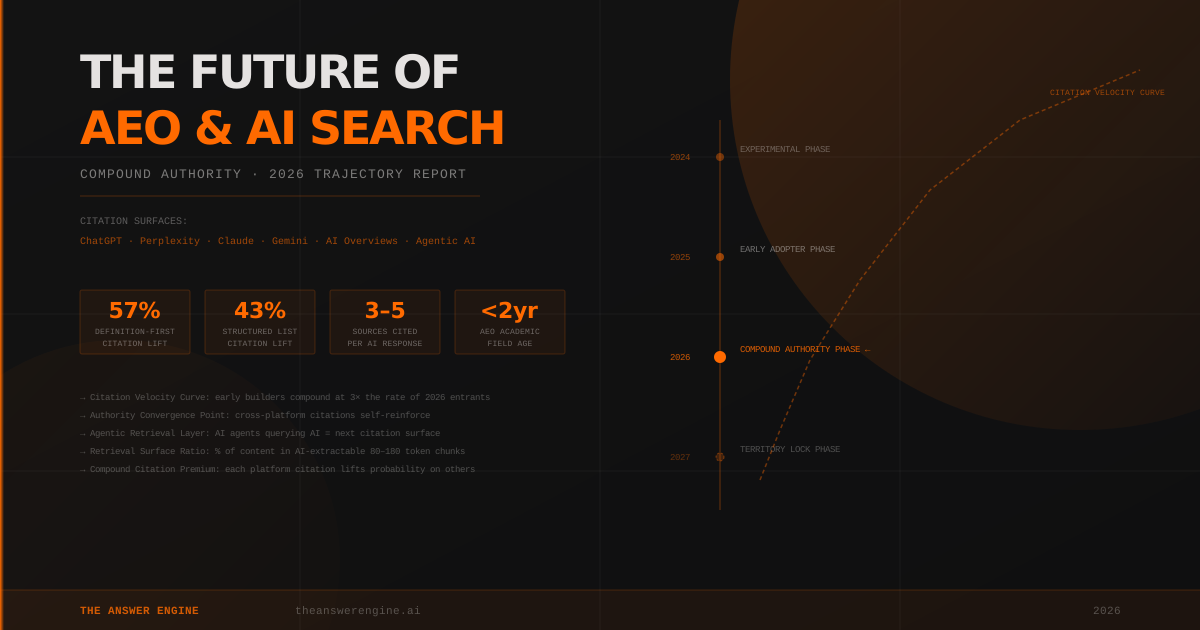
In 2024, AEO was experimental. The academic field was being established. Most businesses were not aware that AI citation behavior was measurable or that content structure influenced which entities got named. In 2025, AEO moved to the early-adopter phase: structured practitioners built citation architecture and saw measurable citation growth within 60 to 90 days. In 2026, AEO has entered the compound-authority phase. Early builders are no longer just earning citations — they are earning citations that generate more citations, across more platforms, at faster intervals, with less new content investment required per citation gained. The gap between AEO-optimized businesses and invisible businesses is compounding every quarter. Reach out to support@theanswerengine.ai with your domain to see where your current citation authority sits relative to the compound-phase baseline.
The Citation Platform Surface Has Expanded From Three to Six
The citation landscape TAE tracked in 2024 consisted of three primary AI platforms: ChatGPT, Perplexity AI, and Claude. By mid-2026, the citation surface has expanded to at least six distinct retrieval environments: ChatGPT (including search mode and deep research mode), Perplexity AI (including Perplexity Pro and API-driven integrations), Claude (including Claude.ai and API-driven enterprise deployments), Google AI Overviews (serving across standard Google Search), Gemini Advanced with Google Search grounding, and early-stage agentic AI systems executing autonomous research tasks on behalf of users. Each platform represents a separate citation opportunity and a separate retrieval signal hierarchy. Businesses that built citation architecture for three platforms in 2024 must now extend that architecture to capture all six surfaces. Book a 30-minute session at calendly.com/theanswerengine-support/30min to review your current platform coverage and identify the surfaces competitors are winning on.
What First-Mover Compound Authority Looks Like at Scale
The Citation Velocity Curve: the pattern by which early AEO adopters accumulate citation authority at an accelerating rate — each citation shortens the retrieval distance for the next, creating a compounding signal loop that later entrants cannot replicate by publishing equivalent content volume alone. The Citation Velocity Curve exists because AI retrieval systems treat a cited entity as a stronger retrieval candidate for related queries. A business cited on Perplexity for its primary service query gains retrieval proximity for every adjacent query in that market — a compounding adjacency advantage that grows with each successive citation. A business entering AEO in late 2026 must build citation authority from zero while competing against entities with 12 to 24 months of compound advantage already encoded in the retrieval model. TAE takes one client per market — if your competitor secures AEO authority in your category first, the category is closed. Claim your market slot at calendly.com/theanswerengine-support/30min before a competitor does.
IS YOUR MARKET STILL AVAILABLE?
TAE holds one citation authority position per geographic market. Most markets still have an open slot — but the window narrows as early-mover businesses build compound authority. Our team at (213) 444-2229 can confirm whether your market is open and what your current citation gap looks like relative to the business building fastest in your category.
Check Your Market Availability →HOW AI SEARCH IS EVOLVING THE CITATION LAYER IN 2026
The Agentic Retrieval Layer: AI Agents as the Next Citation Surface
The Agentic Retrieval Layer: the next AI search surface where autonomous AI agents executing multi-step tasks on behalf of users query other AI systems and external data sources during task completion, creating a retrieval-within-retrieval dynamic in which citation authority earned in the human-facing layer predicts citation authority in the agent-facing layer. Agentic AI systems execute tasks autonomously on a user's behalf: booking appointments, comparing vendors, drafting communications, running research sequences. When an agent is asked to find the best service provider in a location and initiate contact, it queries the same AI retrieval systems that answer human-facing queries. A business that has established citation authority in the human-facing layer carries that authority into every agent-mediated task involving its category. A business invisible to human-facing AI queries is equally invisible when AI agents execute tasks on its potential customers' behalf. Email support@theanswerengine.ai to request your platform-specific agentic citation gap report.
Deep Research Mode and the Citation Depth Advantage
Deep research mode on ChatGPT and Perplexity AI Pro conducts multi-source research sequences that cite more sources per response than standard AI queries — but with higher authority thresholds. Deep research mode synthesizes across 15 to 30 sources per query and applies stricter authority filtering: sources must demonstrate measurable expertise, not just keyword relevance. Businesses with definition-first authority content, inline academic citations, and bounded structured chunks are cited more frequently in deep research mode than businesses with standard blog-style prose. The citation architecture required to win deep research mode is identical to the architecture required to win standard AI queries — SUBSTRATE-compliant structured content is the foundation for both surfaces. See which queries competitors are winning in deep research mode by running your free scan at theanswerengine.ai/blindspot.
The Platform Leapfrog Sequence and First-Surface Authority
The Platform Leapfrog Sequence: the cadence at which major AI search platforms release new citation-capable features — voice synthesis, deep research mode, agentic task execution, image search, multimodal grounding — each introducing a new retrieval surface where first-mover entities gain disproportionate early authority before competitive citation volume increases. Every new AI feature surface creates a first-mover opportunity. Businesses that had citation authority on ChatGPT before deep research mode launched inherited that authority into the new surface. Businesses building citation architecture now are positioning for current surfaces and the next Leapfrog surface — which TAE projects will be voice-first AI responses and multimodal search grounding as both become widely adopted retrieval channels. One market, one client. Claim your position before a competitor at calendly.com/theanswerengine-support/30min.
YOUR AGENTIC RETRIEVAL READINESS
Most businesses have not tested whether their citation architecture is visible to AI agents executing tasks autonomously. TAE's free Blindspot Scan at theanswerengine.ai/blindspot maps your current visibility across human-facing and agentic retrieval surfaces. Questions about agentic AEO? Call (213) 444-2229 to discuss your agentic retrieval readiness.
Schedule Your Agentic AEO Review →WHAT THE RESEARCH REVEALS ABOUT AI CITATION MECHANICS
The Definitional Authority Premium: Why Content Structure Determines Citations
Definitional authority is the highest-leverage citation signal in the current AEO academic literature. Zhang et al. (2026) documented a 57% citation probability lift for content that opens with a plain-language definition of its subject versus content that buries its definition mid-section. The mechanism is direct: AI retrievers assign higher credibility weight to sources that demonstrate they understand a concept well enough to define it before expanding. A service page that opens with the definition of its primary service category before describing specific services is consistently preferred by AI retrievers over a page that leads with service descriptions before reaching the definitional anchor. Every H3 section in TAE-architected content opens with a definition — not as a stylistic choice, but because the research documents a measurable citation lift that TAE applies systematically. Email support@theanswerengine.ai with your primary service category to request a structural signal analysis of your current content.
Bounded Content Architecture and the Retrieval Surface Ratio
The Retrieval Surface Ratio: the proportion of a business entity's published content that exists in AI-extractable, bounded-chunk format (80–180 tokens per passage) versus total published word count — a leading indicator of citation probability because AI retrievers can only extract and cite what is structurally surfaced for extraction at the retrieval layer. GEO-SFE (2026) documented that passages exceeding 300 words produce a 31% reduction in AI retrieval accuracy — the model must choose which portion to cite and frequently ignores the passage entirely. Passages in the 80–180 token range — self-contained answers to a single question — are extracted with full fidelity. A business with 50 blog posts in standard 2,000-word format may have a Retrieval Surface Ratio below 0.1, meaning fewer than 10% of its published words are in AI-extractable format. A TAE-architected business targets a Retrieval Surface Ratio above 0.6 across its primary service content. Book your Retrieval Surface Ratio audit at calendly.com/theanswerengine-support/30min.
Earned Media Entity Signals and the Systematic Trust Gradient
Chen et al. (2025) documented a systematic bias in AI retrieval systems toward earned media over brand-owned content: third-party sources mentioning a business entity are weighted more heavily in citation selection than the business entity's own content, even when the brand-owned content is structurally superior. The mechanism reflects the training data distribution — AI systems learned from human-curated sources that weighted peer review, press coverage, and third-party recommendation over self-reported claims. The practical implication for AEO in 2026 is that citation architecture must include an earned media component: structured outreach to industry publications, local media, and authoritative directories that generates third-party mentions of the business entity alongside its key service terms. TAE's Origin Protocol integrates earned media outreach as a core citation architecture layer. Questions about your earned media strategy? Call (213) 444-2229 for a walk-through of your current entity signal coverage.
Aggarwal et al. (KDD 2024) added two additional signal layers to the academic record: direct quotations produce a 37% citation probability lift, and inline statistical evidence produces a 22% citation lift. The combined signal architecture of definition-first structure, bounded chunks, earned media mentions, inline statistics, and attributed quotations is what TAE deploys across every content surface — not as a checklist, but as an integrated citation architecture designed for the specific retrieval mechanics documented across all four foundational research frameworks. Get your free citation architecture analysis at theanswerengine.ai/blindspot to see which signals your content is currently missing.
“The entire academic foundation of AEO — the Generative Engine Optimization research, the KDD papers, the definitional authority studies — is less than two years old. We are in the earliest measurable phase of a retrieval shift that will determine business visibility for the next decade.”
— Justin Borges, Founder, The Answer EngineTHE COMPOUND AUTHORITY ARCHITECTURE
The Authority Convergence Point
The Authority Convergence Point: the operational threshold at which a business entity's citation signals across ChatGPT, Perplexity AI, Claude, and Google AI Overviews mutually reinforce each other — creating a self-amplifying citation loop that grows without proportional new content investment because cross-platform entity reinforcement becomes the primary citation driver. Before the Authority Convergence Point, a business earns citations by investing in content architecture: new structured pages, FAQ schema blocks, earned media outreach, and definition-first rewrites of existing content. After the Authority Convergence Point, the entity authority model encoded across all four platforms begins reinforcing itself. A business cited on Perplexity AI is more likely to be cited on ChatGPT. A business cited in Google AI Overviews receives a trust signal that feeds back into other platforms' retrieval models. The compound effect is measurable and documented in TAE client results across verified engagements. Reaching the Authority Convergence Point is the primary goal of a 90-day AEO engagement. Book your strategy call at calendly.com/theanswerengine-support/30min.
The Compound Citation Premium and Cross-Platform Reinforcement
The Compound Citation Premium: the observed pattern in which each additional AI platform citation earned by a business entity elevates citation probability on every other platform — a cross-platform reinforcement effect driven by the entity authority signals that AI systems share through common training data, web crawl infrastructure, and entity resolution models. The Compound Citation Premium is the mechanism behind the Citation Velocity Curve. An entity cited on three platforms is not three times as visible as an entity cited on one platform — it is disproportionately more visible because citation on each platform contributes to the entity's authority signal in the shared data layer all major AI systems draw from. This is why TAE builds citation architecture across all primary platforms simultaneously rather than sequentially. Email support@theanswerengine.ai to request your compound authority roadmap, including which platforms to prioritize based on your category and market.
The Origin Protocol as Forward-Looking Citation Architecture
TAE's Origin Protocol is the citation architecture framework built to encode compound authority systematically. The Origin Protocol integrates the five citation signal layers documented in current AEO research — definition-first structure, bounded content chunks, earned media signals, inline statistical evidence, and FAQ schema coverage — into a single content architecture deployed across all primary citation surfaces. The protocol is not a content calendar or a publishing schedule. The Origin Protocol is a signal architecture: every content decision is made to maximize retrieval surface coverage and citation signal density, not to maximize keyword coverage or page count. Businesses implementing Origin Protocol build citation authority in 60 to 90 days. Businesses publishing standard blog content in equivalent volume build negligible citation authority because the retrieval signal requirements are not met by volume alone. Our one-client-per-market policy means your window closes when a competitor books. Secure your territory at calendly.com/theanswerengine-support/30min.
BUILD YOUR COMPOUND AUTHORITY ARCHITECTURE
The Citation Velocity Curve, Authority Convergence Point, and Compound Citation Premium are measurable outcomes of structured AEO implementation. TAE maps your current citation position, identifies your highest-impact citation gaps, and builds the architecture that gets you to compound authority within 90 days. Send your domain to support@theanswerengine.ai for a 24-hour citation audit. Or call (213) 444-2229 for a live walk-through of your compound authority roadmap.
Start Your Free Compound Authority Scan →MEASURING THE FUTURE: THE PROOF LEDGER METHODOLOGY
Platform-Specific Citation Tracking Across All Surfaces
The Proof Ledger is TAE's methodology for measuring AEO results with the same rigor that traditional marketing agencies apply to conversion tracking. The Proof Ledger tracks three citation metrics per platform, per query: citation presence (was the business named?), citation position (first, second, or third named?), and citation context (was the business named in the context of the query intent, or only incidentally?). Standard AEO reporting tracks only citation presence. The Proof Ledger tracks all three because citation position and citation context determine whether an AI response drives inquiry behavior. A business named third in a five-vendor list receives different inquiry volume than a business named first with specific service context. Book a Proof Ledger setup session at calendly.com/theanswerengine-support/30min to establish your citation baseline and tracking protocol.
The Retrieval Surface Ratio as a Leading Citation Indicator
The Retrieval Surface Ratio is a leading indicator — it predicts citation growth before citations appear in the Proof Ledger. A Retrieval Surface Ratio below 0.3 predicts negligible citation growth regardless of content volume, because fewer than 30% of published words are in the bounded-chunk format AI retrievers extract with full fidelity. A Retrieval Surface Ratio above 0.6 predicts consistent citation growth as AI crawlers index the content and encode it in the entity authority model. TAE measures Retrieval Surface Ratio as part of every client audit, and it is the first metric improved before addressing any other citation signal. Send your three highest-revenue service pages to support@theanswerengine.ai for a Retrieval Surface Ratio analysis.
What 90-Day and 12-Month AEO Trajectories Look Like
A structured AEO engagement following the Origin Protocol produces a predictable trajectory across two phases. In the first 90 days, citation architecture is built from the retrieval layer up: definitional content is deployed, bounded chunks replace standard prose, FAQ schema is implemented, and earned media outreach begins. First citations typically appear on Perplexity AI within 30 to 60 days and on ChatGPT within 45 to 90 days. By day 90, most clients have citations across two or more platforms for their primary service query cluster. In the 12-month horizon, the compound effect becomes the dominant growth driver: cross-platform citations reinforce each other, agentic retrieval surfaces pick up the established entity authority, and the business enters the Citation Velocity Curve at an accelerating rate. Clients who reach the Authority Convergence Point at or before 12 months maintain citation positions with significantly less new content investment than the original build required. The businesses in your market that build compound authority first will own their category through the next platform cycle. One client per market — claim yours before a competitor does at calendly.com/theanswerengine-support/30min.
| Metric | 90-Day Target | 12-Month Target |
|---|---|---|
| Platforms with citations | 2–3 | 4+ |
| Primary query citation position | Top 3 | Top 1–2 |
| Retrieval Surface Ratio | 0.4+ | 0.6+ |
| FAQ schema query coverage | 10–15 queries | 30+ queries |
| Earned media mentions | 3–5 | 12+ |
| Authority Convergence Point | Approaching | Reached |
FREQUENTLY ASKED QUESTIONS
What is the future of Answer Engine Optimization in 2026?
Answer Engine Optimization — also called AI citation optimization or LLM visibility — is entering its compound-authority phase in 2026. The experimental phase (2024) and early-adopter phase (2025) have closed. Businesses that established citation architecture during those phases are accumulating citations at an accelerating rate through the Citation Velocity Curve: each citation shortens the retrieval distance for the next. Businesses entering AEO in 2026 compete against entities with 12 to 24 months of compound advantage already encoded in the retrieval model. Start your assessment at theanswerengine.ai/blindspot.
How is AEO different from traditional SEO in 2026?
Search engine optimization (SEO) targets ranked link positions that a user must click through to evaluate. Answer Engine Optimization (AEO) — also called AI citation optimization or LLM visibility — targets the retrieval layer of large language models that produce direct named recommendations without requiring click-through. SEO relies on keyword density, backlink authority, and page experience signals. AEO relies on bounded content chunks (80–180 tokens), definition-first structure, inline academic citations, FAQ schema, and earned media entity signals (per Chen et al., 2025). A business can rank first in Google organic search and have zero AI citations. Call (213) 444-2229 to discuss your specific market and category position.
What are the most important AEO citation signals in 2026?
The five highest-impact citation signals documented in current AEO research: (1) definition-first content structure — 57% citation lift (Zhang et al., 2026); (2) bounded 80–180 token content chunks — 31% retrieval accuracy improvement (GEO-SFE, 2026); (3) inline statistical evidence — 22% citation lift (Aggarwal et al., KDD 2024); (4) direct quotations and attributed claims — 37% citation lift (Aggarwal et al., KDD 2024); and (5) earned media entity signals — systematic citation preference over brand-owned content (Chen et al., 2025). Email support@theanswerengine.ai with your primary service category for a signal analysis.
What is agentic AI and how does it affect AEO?
Agentic AI refers to AI systems that autonomously execute multi-step tasks on behalf of users — booking appointments, comparing vendors, drafting communications, conducting research sequences. The Agentic Retrieval Layer is the next citation surface: when an AI agent queries another AI model to find a vendor or service provider, it relies on the same entity authority signals that govern human-facing AI citations. A business with citation authority in the human-facing layer carries that authority into every agent-mediated task in its category. Book a review at calendly.com/theanswerengine-support/30min.
How do I know if my business is losing ground to AI search competitors?
The clearest signal is a direct query test: ask ChatGPT, Perplexity AI, Claude, and Google AI Overviews for the best version of your service in your market. If your business does not appear in the top three recommendations across two or more platforms, a competitor with AEO architecture is occupying your citation territory. Additional indicators include declining organic traffic from informational queries and competitors appearing in AI Overviews for terms you rank for in standard organic search. TAE's free Blindspot Scan at theanswerengine.ai/blindspot tests your business against the 20 highest-intent queries in your category.
How long does it take to build compound citation authority?
Most businesses see first AI citations within 60 to 90 days of structured AEO implementation. Perplexity AI indexes new structured content fastest — typically 30 to 60 days. ChatGPT search mode takes 45 to 90 days. Google AI Overviews takes 60 to 120 days. The compound effect — the Authority Convergence Point where cross-platform citations mutually reinforce each other — typically begins at the 90-day mark. After convergence, citation volume grows without proportional new content investment. Start with the free scan at theanswerengine.ai/blindspot to see your starting position.