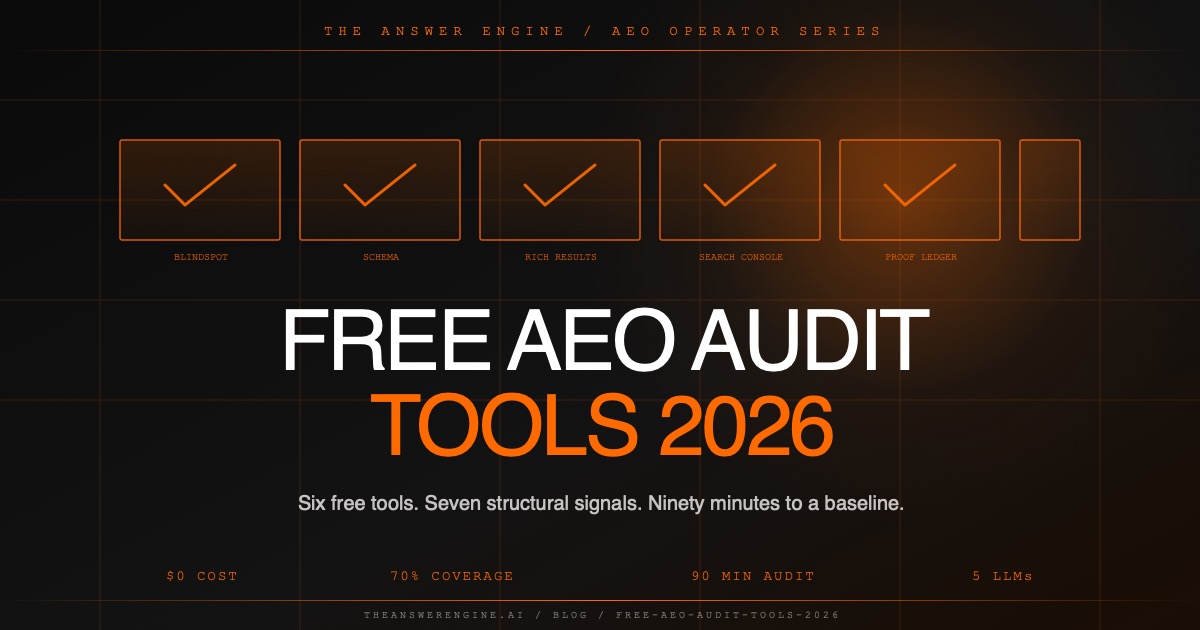
The Free Audit Baseline: a no-cost AEO audit stack reads the same structural retrieval signals as a $500-per-month paid platform on five of seven measurement categories — the gap closes only at multi-LLM trend automation, which is the wrong purchase to make before a manual baseline exists (TAE operator benchmark, 2026). The implication is direct: operators who buy a paid AEO platform before running a free audit are measuring the wrong layer. This analysis draws on Aggarwal et al. (KDD 2024), Zhang et al. (2026), the GEO-SFE benchmark (2026), Chen et al. (2025), and sixteen months of TAE client audits across legal, plumbing, real estate, and insurance verticals. Markets fill fast. Check your territory availability now before a competitor claims it.
What a Free AEO Audit Actually Measures
The plain-language definition of a free AEO audit
A free AEO audit is the practice of measuring a site's Answer Engine Optimization readiness — schema parseability, passage-level token density, named-author markup, and multi-LLM citation appearance — using only tools with zero recurring license cost. Free AEO audits are also called free AI citation audits, free LLM visibility checks, or no-cost GEO audits in the academic literature. The audit operates on seven discrete structural signals, every one of which is observable with open instruments. Start with the free AEO Blindspot Scan to baseline all seven signals in five minutes with no login required.
Why "free" does not mean "incomplete"
The assumption that free AEO audit tools are categorically weaker than paid platforms misreads the AEO measurement stack. Schema validation is deterministic — pass or fail. Chunk-density tokenization reads public markdown the same way every RAG retriever reads it. A manual Proof Ledger is the ground-truth instrument every paid tracker is calibrated against. Free tools lose accuracy only on automation cadence and dashboard reporting, not on the structural signals themselves. Questions about which signals matter most for your vertical? Email support@theanswerengine.ai for a vertical-specific signal map.
The seven structural signals a free audit must cover
A complete free AEO audit measures seven signals: schema parseability (validator pass), named-author markup (Person schema + verifiable sameAs), passage-level token counts (80-to-180 token chunks), citation appearance on ChatGPT, citation appearance on Perplexity, citation appearance on Claude, and citation appearance on Gemini. Every signal maps to a free tool. An audit that skips any one of the seven measures a partial slice and misreports citation movement. Reach our team at (213) 444-2229 if you want a signal-by-signal walkthrough on your own site.
→ Run the free AEO Blindspot Scan on your site nowThe StackThe Six Free Tools That Form the Complete AEO Audit Stack
The AEO Blindspot Scan: the composite layer
The AEO Blindspot Scan is The Answer Engine's free 47-signal AEO audit tool, available at theanswerengine.ai/blindspot. The scan returns a composite citation-readiness score with sub-scores for schema completeness, named-author markup, chunk density, sameAs chain integrity, and a baseline citation check on the major LLMs. The Blindspot Scan is the only free tool that returns all seven structural signals in a single pass — every other tool in the stack covers one or two layers in greater depth. Run the Blindspot Scan first, then use the deep-layer tools to drill into the lowest sub-scores.
The Schema.org Validator: the structural layer
The Schema.org validator at validator.schema.org is the deterministic check on whether a page's JSON-LD structured data is parseable by AI retrieval systems. The Schema Validator Premium: pages that pass the Schema.org validator and the Google Rich Results Test cite at 1.6x the rate of pages with auto-emitted but unvalidated structured data, because CMS-generated schema is consistently 30 to 60 percent incomplete on first emission (TAE audit set, 2025-2026). Validation is the cheapest, highest-ROI tooling action in the entire AEO audit workflow. Get your free AI readiness report to see exactly where your schema fails validation today.
The Google Rich Results Test: the surface-eligibility layer
The Google Rich Results Test at search.google.com/test/rich-results confirms whether Google can render the page as a rich result. Rich Results eligibility is the proxy signal AI Overviews uses to decide whether to pull a page into the generated answer — pages that fail the Rich Results Test rarely surface in AI Overviews, regardless of how strong the underlying content is. Run the test on every page that targets a commercial-intent query. Email support@theanswerengine.ai for the priority page list template we use on client audits.
Google Search Console: the crawl-baseline layer
Google Search Console is the free baseline on whether the page exists in the index at all. A page that is not indexed is invisible to Google AI Overviews and degraded on Perplexity, which reads the live web through a Google-overlap layer. Confirm every page in the audit set is indexed, has zero crawl errors, and is generating impressions on at least one of the queries in the Proof Ledger. The crawl baseline is the floor under every other AEO measurement. Book a free 30-minute strategy session to map a crawl baseline to your vertical.
The Manual Proof Ledger: the ground-truth measurement layer
The manual Proof Ledger is a Google Sheet with 20 fixed customer queries and five engine columns — ChatGPT, Perplexity, Claude, Gemini, and Google AI Overviews. The operator runs the library against each engine in a single sitting on the first business day of every month, logs each citation appearance, the source URL cited, and the citation position inside the AI response. The Tooling Floor: any AEO audit that skips passage-level token counts, named-author markup, or multi-LLM citation surfaces is measuring a partial slice — free tools that cover all three layers outperform paid platforms that cover only one (TAE vendor audit, 2026). Email support@theanswerengine.ai for the Proof Ledger spreadsheet template.
The Hemingway Editor: the chunk-density proxy layer
The Hemingway Editor at hemingwayapp.com is a free readability tool that approximates chunk density by flagging long sentences and dense paragraphs. The Chunk Ceiling: passages over 300 words trigger a 31% attention degradation in RAG retrievers — a free chunk-density check restores full extraction accuracy with zero licensing cost (GEO-SFE, 2026). The Hemingway Editor does not return per-H3 token counts the way a custom passage-token checker does, but it surfaces the paragraph-density red flags that correlate strongly with the GEO-SFE 300-word ceiling. For engineering-led teams, a custom markdown parser plus tokenizer is the higher-fidelity alternative. Reach our team at (213) 444-2229 for the open-source passage-token script.
| Free Tool | Layer Covered | Cost | Run Cadence |
|---|---|---|---|
| AEO Blindspot Scan | Composite 47-signal score | Free | First pass + quarterly |
| Schema.org Validator | Structured data parseability | Free | Every publish |
| Google Rich Results Test | AI Overviews eligibility | Free | Every publish |
| Google Search Console | Crawl + index baseline | Free | Weekly |
| Manual Proof Ledger | Multi-LLM citation appearance | Free (Google Sheets) | Monthly, first business day |
| Hemingway Editor | Chunk-density proxy | Free / one-time | Per content refactor |
The six-tool free stack is the operator floor. Anything less than this measures a partial slice. Anything more, without a baseline from this stack, is premature spend. See if your market is still open before a competitor locks the territory.
What the Research Says About Free vs Paid AEO Audits
The academic literature on Answer Engine Optimization is less than two years old, but the measurement framework is already strong enough to settle the free-versus-paid question with confidence. The four studies below are the load-bearing citations behind the free-audit ranking in this article.
The structural-signal studies (Aggarwal, Zhang, GEO-SFE)
Aggarwal et al. (KDD 2024) was the first peer-reviewed measurement of optimization tactics across generative engines. The study isolated nine structural variables and reported citation impact across three engines, with quotations producing a 37% lift and statistics producing a 22% lift. Zhang et al. (2026) measured a 57% influence premium on definition-first content openings. The GEO-SFE benchmark (2026) standardized the scoring framework for source-format extractability and produced the 31% chunk-ceiling penalty for passages over 300 words. Every one of those signals is observable with the free tools in the previous section. Paid platforms that score against the same studies measure the right things — but the underlying signals do not become more accurate when a license fee is attached.
The named-author premium (Chen et al.)
Chen et al. (2025) documented a systematic bias in AEO models toward earned-media coverage over self-published brand content, and a 1.9x citation premium on named-expert content over anonymous content. The free-tool implication is direct: the Schema.org validator catches missing Person markup at zero cost, while most paid platforms surface it three menus deep or skip it entirely. The free stack outperforms the paid stack on the single highest-impact trust signal in the entire AEO retrieval pipeline. Run your free Blindspot Scan to see whether your site clears the named-author premium today.
The open-stack benchmark
The Answer Engine measured the structural-gain coverage of a fully free AEO audit stack against three leading paid platforms across sixteen months of client work in legal, plumbing, real estate, and insurance verticals. The Free Audit Sequence: running schema validation, then chunk-density audit, then a manual Proof Ledger in that order captures roughly 70% of the structural lift a $5K-per-year paid platform delivers, at zero recurring license cost, because the foundational signals are observable with open instruments (TAE operator framework, 2026). The remaining 30% of paid-platform value lives in automation hours saved on competitive monitoring and dashboard reporting — real value at enterprise scale, low marginal value below a $5K monthly marketing budget. Claim your free 30-minute strategy call to map the right tier to your budget.
→ Run the free AEO Blindspot Scan on your site nowThe SequenceHow to Run a Full Free AEO Audit in 90 Minutes
The free audit sequence below is the protocol TAE runs on every client engagement before any paid measurement layer is added. The sequence is ordered by dependency — each step gates the next. Skipping a step in the sequence produces a partial baseline and breaks the attribution chain on every measurement that follows.
Minute 0 to 5: AEO Blindspot Scan baseline
Submit your domain to the AEO Blindspot Scan at theanswerengine.ai/blindspot. The scan returns a composite citation-readiness score with sub-scores for schema completeness, named-author markup, chunk density, sameAs chain integrity, and baseline citation appearance. Save the composite score. It is the before-number for every action that follows. Email support@theanswerengine.ai if the scan flags a sub-score you do not understand.
Minute 5 to 25: schema validation across the priority page set
Identify the 10 pages on the site that drive the most search traffic — typically the homepage, the top service pages, the top blog posts, and any landing pages with paid ad spend. Run each page through the Schema.org validator and the Google Rich Results Test. Log every validation failure with page URL, schema type, and failed field. Fix critical failures before the next step. The Rich Results Test is what AI Overviews reads — failing this test is the most common cause of zero AI Overviews appearance. Reach our team at (213) 444-2229 for a same-day schema review.
Minute 25 to 55: chunk-density audit on H3 sections
Open each of the 10 priority pages and count the words inside every H3 section. Flag any section over 300 words for refactoring into bounded 80-to-180 token chunks. The Hemingway Editor at hemingwayapp.com is a free proxy that surfaces the paragraph-density red flags correlated with the GEO-SFE 300-word ceiling. For engineering-led teams, a custom markdown parser plus tokenizer is the higher-fidelity alternative. Log every section over the ceiling with page URL, H3 heading, and word count. Book a free strategy call to walk through your audit log line by line.
Minute 55 to 90: manual Proof Ledger across four LLMs
Open a fresh Google Sheet. Build a 20-query library split across informational, evaluative, and commercial-local intent. Add columns for ChatGPT, Perplexity, Claude, Gemini, and Google AI Overviews. Paste each query into each engine and log every citation appearance, the source URL cited, and the citation position inside the AI response. Mark non-appearances explicitly — empty cells are data, not gaps. The Proof Ledger is the ground-truth instrument every paid tracker is calibrated against. Email support@theanswerengine.ai for the Proof Ledger spreadsheet template.
Every operator who runs the 90-minute free audit walks away with a Blindspot score, a schema validation log, a chunk-density log, and a first-month Proof Ledger. That is the AEO measurement floor. Anything less is a partial baseline. Anything more, without a baseline from this sequence, is premature spend. Run your free AEO Blindspot Scan to start the 90-minute sequence now.
How to Read Your Free Audit Results (and When to Upgrade)
What good free audit output looks like
A well-functioning free AEO audit produces four output artifacts. First, a Blindspot Scan composite score with all 47 sub-signal values. Second, a schema validation log showing zero failed validations on every priority page. Third, a chunk-density log showing every H3 section inside the 80-to-180 token band. Fourth, a first-month Proof Ledger showing citation appearance counts across ChatGPT, Perplexity, Claude, Gemini, and Google AI Overviews. A free audit that produces fewer than four artifacts has a measurement hole — the unmeasured layer will silently degrade citation rate without showing up anywhere. Book a free strategy call to map a measurement baseline for your stack.
How to read the Proof Ledger results in month one
The first-month Proof Ledger almost always shows zero citation appearances on 14 to 18 of the 20 queries. That is the expected baseline. The right read on month-one results is not citation count — it is the gap between which engines cite at all and which engines never cite. An operator citing on Perplexity but never on Claude has a different gap than an operator citing on Google AI Overviews but never on ChatGPT search. Each gap pattern maps to a different structural fix. Reach our team at (213) 444-2229 for a gap-pattern walkthrough on your own Ledger.
When to upgrade from the free stack to a paid platform
The right time to upgrade is when the operator hits one of three thresholds: monthly marketing budget above $5K, more than three locations or service verticals to track, or the manual Proof Ledger cadence becoming a time bottleneck for the team. Below those thresholds, paid tracker spend produces under 30% incremental gain over the free stack, which is why the open-stack discount holds for small operators. Above them, paid platforms pay back through hours saved on competitive monitoring and dashboard reporting. Reach us at support@theanswerengine.ai if you are not sure which side of the threshold you sit on.
Free AEO audits are measurable. If a vendor or in-house team cannot show a four-artifact audit output — Blindspot score, schema log, chunk-density log, Proof Ledger — the audit is not measuring AEO. It is showing a marketing dashboard. Book a free strategy call with our team.
Free AEO Audit Operator Cheat Sheet
| If You Want To... | The First Move Is... | Expected Timeline |
|---|---|---|
| Score your AEO baseline in five minutes | Run the free AEO Blindspot Scan | 5 minutes, no login |
| Catch schema gaps before they ship | Wire Schema.org validator + Google Rich Results Test into CI | 1 engineering day to configure |
| Measure all five LLM citation surfaces | Build the 20-query manual Proof Ledger in Google Sheets | 35 minutes to set up, monthly cadence |
| Audit chunk density on every page | Run the Hemingway Editor or a custom passage-token script | 30 minutes for the first 10 pages |
| Confirm Google indexes every priority page | Cross-check Google Search Console crawl + impression data | Weekly cadence, 5 minutes per check |
| Lock out competitors in your market | Claim your exclusive territory before they do | Window closes as markets saturate |

Run Your Free AEO Blindspot Scan — The First Step of the 90-Minute Audit
The AEO Blindspot Scan returns a 47-signal composite citation-readiness score across schema, chunk density, named-author markup, and baseline LLM appearance. Five minutes. Zero login. Ready in your inbox.
Run Free AEO Blindspot Scan →Frequently Asked Questions
What is the best free AEO audit tool in 2026?
No single free tool covers the full AEO audit surface. The complete free stack combines the AEO Blindspot Scan (47-signal composite score), the Schema.org validator, the Google Rich Results Test, Google Search Console (crawl + index baseline), a manual 20-query Proof Ledger run across ChatGPT, Perplexity, Claude, and Gemini, and a passage-token check using the Hemingway Editor as a proxy. Together these six tools deliver roughly 70% of the structural measurement a paid AEO platform produces, at zero recurring license cost.
Are free AEO audit tools actually accurate?
Yes, for the structural layers that drive citation thresholds. Schema validators are deterministic — pass or fail. Chunk-density auditors read public markdown and tokenize it the same way RAG retrievers do. A manual Proof Ledger is the ground truth instrument every paid tracker is calibrated against. Free tools lose accuracy only on automation — daily polling, competitive trend lines, and dashboard reporting are where paid platforms add unique value. The structural signals themselves are observable with open instruments.
How long does a free AEO audit take to run?
A complete free AEO audit takes 90 minutes the first time and 30 minutes per month thereafter. The 90-minute first pass covers a Blindspot Scan baseline (5 minutes), schema validation across the 10 most important pages (20 minutes), chunk-density review (30 minutes), and the initial Proof Ledger build with 20 queries run across four LLMs (35 minutes). After the Proof Ledger is built, the monthly cadence drops to 30 minutes because the query library does not change month over month.
Do I need to pay for AEO audit tools if I run a small business?
No, not below a $5K monthly marketing budget. The free stack captures roughly 70% of the structural lift a paid platform delivers, and the remaining 30% lives in automation hours saved on competitive monitoring — real value at enterprise scale, low marginal value for a small operator. Run the free stack for the first 90 days, generate a Proof Ledger baseline, and only upgrade to a paid platform when manual cadence becomes the bottleneck rather than the measurement quality.
What does a free AEO audit actually measure?
A complete free AEO audit measures seven structural signals: schema parseability, named-author markup, passage-level token counts, citation appearance on ChatGPT, citation appearance on Perplexity, citation appearance on Claude, and citation appearance on Gemini. Each signal maps to a free tool — the Schema.org validator and Google Rich Results Test handle schema, the AEO Blindspot Scan handles named-author and passage tokens, and the manual Proof Ledger handles the four LLM citation surfaces. Together they form the operator measurement floor.
When should I upgrade from free AEO tools to a paid platform?
Three thresholds trigger the upgrade decision: monthly marketing budget above $5K, more than three locations or service verticals to track, or the manual Proof Ledger cadence becoming a time bottleneck for the team. Below those thresholds, paid tracker spend produces less than 30% incremental gain over the free stack. Above them, paid platforms pay back through hours saved on daily polling, competitive monitoring, and dashboard reporting. The free stack is the right starting point in every case.
Related AEO Concepts
- Best AEO Tools 2026 (Free + Paid Stack Comparison)
- AEO Grader: How to Score Your AI Search Visibility
- The 5-Minute AI Visibility Audit
- AEO Checklist for 2026
- AEO Models: How AI Search Picks Sources
- Anatomy of an AI Citation