- The Old Rule: Backlinks Won SEO
- The New Rule: AI Reads Everything, Including Unlinked Mentions
- How Google’s Knowledge Graph Treats Brand Mentions
- How LLMs Weight Mentions in Training Data
- The Authority Stack: Where Mentions and Backlinks Fit Together
- Where to Earn High-Value Mentions in 2026
- Why Backlinks Still Matter, Just for Different Reasons
- The Co-Citation Effect: Being Mentioned Alongside Trusted Brands
- The 5 Biggest Mistakes Businesses Make Chasing Backlinks
- The Citation-Driven Future
- Authority Signal Cheat Sheet
- Frequently Asked Questions
The Old Rule: Backlinks Won SEO
For roughly two decades, the fundamental equation of search authority was simple: more backlinks from authoritative domains meant higher rankings. Google’s PageRank algorithm, built on the mathematical assumption that a link was a vote of confidence, drove billions of dollars in link-building spend. Agencies sold backlink packages. Publishers sold “editorial” placements. The entire guest-posting industry existed primarily to manufacture links at scale.
The logic was sound for its time. In the early web, links were scarce and editorially meaningful. When the New York Times linked to a source, it genuinely meant something. The link graph was a reasonable proxy for authority because manufacturing it was hard and expensive enough that the signal stayed relatively clean. Markets fill fast. Check your territory availability.
From 2012 to today, backlinks dropped from 80% of off-page ranking weight to approximately 45%. Brand mentions and entity signals grew from roughly 20% to 55% of off-page influence. The authority graph did not disappear. It expanded to include an entirely different kind of signal.
Then several things happened at once. Link farms proliferated. Private blog networks industrialized. Google’s Penguin update began penalizing manipulative link schemes. Meanwhile, Google was building something far more sophisticated alongside PageRank: the Knowledge Graph, a structured semantic understanding of entities, brands, and their relationships. The rules were changing before AI search made the shift unmistakable. Your first step: free AERO Blind Spot Scan.
Today, any business that treats backlinks as the primary unit of off-page authority is optimizing for a version of search that is being retired in real time. The new authority graph is built on mentions, co-occurrence, entity recognition, and cross-platform consistency. Understanding that graph is the work of 2026.
→ Get your free AI Visibility Report , 48-hour turnaroundThe ShiftThe New Rule: AI Reads Everything, Including Unlinked Mentions
When ChatGPT processes a query about which brand to recommend, it does not check a link graph. It draws on patterns learned from hundreds of billions of text tokens collected from across the web: news articles, forum discussions, product reviews, Reddit threads, podcast transcripts, academic papers, industry reports, and everything in between. The vast majority of that text contains no hyperlinks at all.
This is the core structural difference between traditional SEO and AI visibility. Google’s crawler follows links to discover and evaluate content. LLMs consume raw text at scale. A mention of your brand in a well-regarded industry newsletter with no link to your site teaches an LLM that your brand is associated with certain topics, expertise areas, and peer companies. That association shapes every future response the model generates about those topics. Reach out: support@theanswerengine.ai.
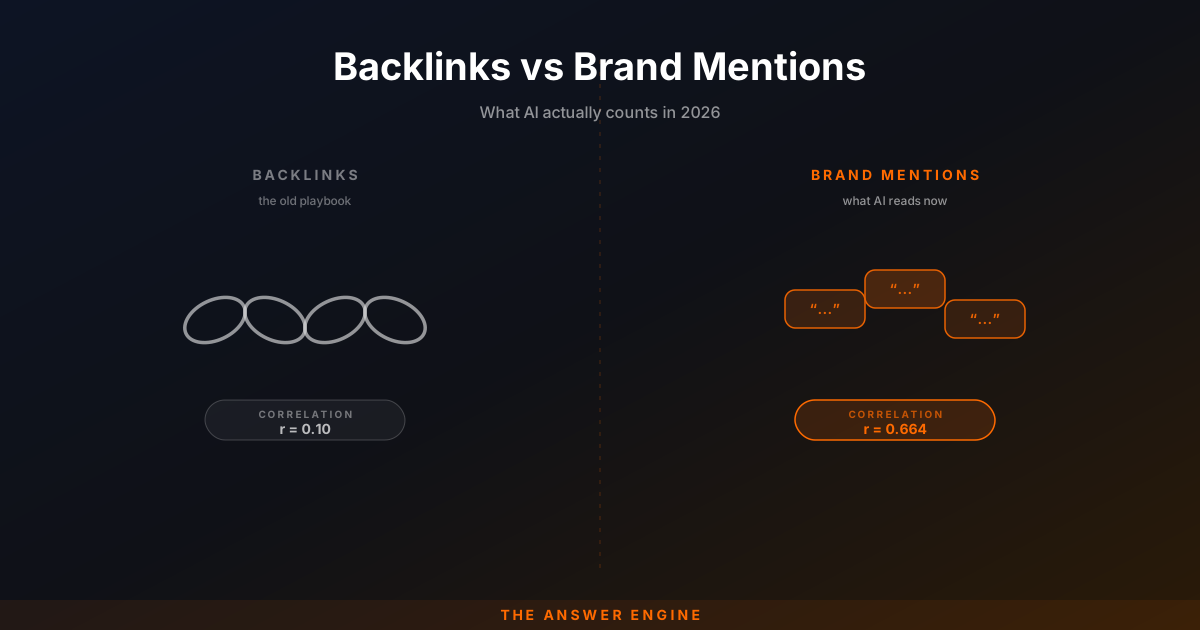
The correlation data is decisive. An Ahrefs analysis of 75,000 brands found that brand web mentions correlate with AI visibility at r = 0.664 to 0.711. Backlinks correlate at approximately r = 0.10. YouTube mentions specifically reach r = 0.737, making them the single strongest predictor of AI recommendation frequency. These are not marginal differences. They represent fundamentally different authority architectures.
Unlinked brand mentions work through several mechanisms simultaneously. Google’s NLP systems treat them as entity signals that reinforce topical authority. LLM training pipelines encode the contextual associations they create. Sentiment analysis layers evaluate whether those mentions are positive, neutral, or negative. The more often your brand name appears in credible, contextually relevant text, the more confident AI systems become about who you are, what you do, and whether you deserve recommendation. Call us at (213) 444-2229 today.
The implication for businesses is significant. An unlinked mention in a Forbes article, a recommendation in a niche Reddit community, an expert quote in an industry newsletter, or a glowing review on a community forum may generate more AI visibility impact than a dozen carefully negotiated backlinks from mid-tier blogs. The effort-to-impact ratio of link-building versus mention-building has fundamentally inverted for AI search purposes.
→ Get your free AI Visibility Report , 48-hour turnaroundEntity AuthorityHow Google’s Knowledge Graph Treats Brand Mentions
Google has been building entity understanding into its ranking systems since the 2012 Knowledge Graph launch, but most SEOs focused on structured data and schema markup as the primary lever. The deeper reality is that Google uses natural language processing to extract entity relationships from raw text, with or without explicit schema signals. Unlinked brand mentions feed directly into this process.
When Google’s NLP systems encounter your brand name in a web document, they analyze the surrounding context: what topics is your brand being associated with, who else is being mentioned alongside you, what sentiment does the author carry toward you, and how authoritative is the source making the mention. Each encounter adds to or refines Google’s internal model of your brand as an entity. Get your free AI readiness report.
Linked vs Unlinked: What Google Actually Sees
The distinction between linked and unlinked mentions matters less than most SEOs assume. Google’s systems evaluate both as entity signals. The difference is that a backlink also passes PageRank, which is a separate scoring mechanism from entity authority. A high-quality unlinked mention from an authoritative publication strengthens your entity authority without affecting your PageRank. Both signals contribute to your overall visibility, through different pathways.
Sentiment now outweighs quantity. Sites in the top 10 search results with over 70% positive sentiment in their brand mentions receive 15% higher average rankings than competitors with similar mention counts but mixed sentiment. Generating negative press coverage for brand name recognition is not a viable strategy. Mention quality and context matter more than raw volume. Ready to act? Book a free strategy session.
The Entity Consensus Model
Research from Entities.org on why entity consensus affects AI citation found that Google and LLMs alike favor brands that appear consistently and coherently across independent sources. When authoritative sites, journalists, community members, reviewers, and experts all mention your brand in relation to the same topics, Google’s systems build high-confidence entity associations. When those mentions conflict or appear only on owned channels, confidence stays low and citations become unpredictable.
Brand Mention Signal Quality: Google Knowledge Graph
| Mention Source | Entity Signal Strength | Sentiment Weight | LLM Training Value |
|---|---|---|---|
| Tier 1 editorial press (linked) | Very High | High | Very High |
| Tier 1 editorial press (unlinked) | High | High | Very High |
| Industry publication mention | High | High | High |
| Reddit community mention | Medium | Very High | Very High (via OpenAI deal) |
| Customer review platforms | Medium | Very High | Medium-High |
| Brand-owned blog post | Low | Low (self-referential) | Low |
| Social media (Instagram/TikTok) | Very Low | Low (gated/video) | Very Low |
For a deeper look at how press mentions specifically influence AI recommendation behavior, read our guide on how press mentions help AI recommend you. Drop us a line at support@theanswerengine.ai.
→ Get your free AI Visibility Report , 48-hour turnaroundLLM Training DataHow LLMs Weight Mentions in Training Data
Understanding how large language models actually learn from brand mentions requires stepping back from the SEO framework entirely. LLMs do not crawl the web and index pages. They process enormous batches of text and learn statistical patterns: which words, entities, and concepts tend to appear together, in what contexts, and with what surrounding language. Your brand’s presence in that training corpus directly shapes how every LLM responds to queries about your category. Speak to an AEO specialist: (213) 444-2229.
The mechanism works through pattern reinforcement. Every time your brand appears in a sentence describing a problem you solve, a customer you serve, or a result you deliver, the model strengthens the association between your name and those surrounding concepts. When a user later asks about that problem or category, the model’s probability engine surfaces brands whose associations in training data match the query’s semantic context. Brands with stronger, more diverse, and more positively framed training data associations appear more frequently in AI-generated answers.
Hyperlinks are structurally irrelevant to LLM training. When a model like GPT-4o or Claude trains on a corpus of web text, hyperlinks appear as raw HTML or are stripped entirely. The model learns nothing from anchor text relationships or link structures. It learns from the words and entities that appear in sequence. A backlink from a high-DA domain does not register in LLM training at all. The mention in the surrounding text does. One client per city. See if your market is available.
The Frequency and Diversity Effect
LLMs weight mentions by both frequency and source diversity. A brand mentioned 50 times across 50 independent, distinct sources builds stronger model associations than a brand mentioned 500 times across 5 sources that appear to share similar content. The independence of sources signals to the training pipeline that real-world consensus exists, not manufactured repetition. This is why link-building tactics that generate the same text across dozens of similar sites do not translate into AI visibility.
Reddit’s Outsized Role
Reddit accounts for roughly 40% of all web domain citations by LLMs, and OpenAI’s licensing deal with Reddit means Reddit content feeds directly into ChatGPT training. When a user on a relevant subreddit recommends your brand in response to a genuine question, that recommendation becomes part of the corpus that shapes ChatGPT’s future responses. Authentic community engagement generates a category of training signal that no link-building campaign can replicate. For a full breakdown of Reddit’s impact on AI visibility, see our guide on how Reddit mentions boost AI search visibility. Check where you stand: free Blind Spot Scan.
→ Get your free AI Visibility Report , 48-hour turnaroundStrategy FrameworkThe Authority Stack: Where Mentions and Backlinks Fit Together
The most effective approach in 2026 is not choosing between mentions and backlinks. It is understanding what each one does and building a combined strategy that maximizes both kinds of authority. Think of it as a stack: each layer builds on the one beneath it, and the strongest AI visibility comes from having multiple layers working together. Schedule a free 30-min call.
At the foundation sits your owned content. Blog articles, case studies, service pages, and FAQ content establish your topical territory and give AI something to crawl and cite. Without this layer, every other authority signal floats without an anchor. A mention in a major publication drives no AI benefit if it points to a domain with no crawlable, substantive content.
Layer 1: Owned Content Foundation
Your own website content establishes what you are about and gives AI systems a primary source to reference. This layer must be substantive, structured with proper schema markup, and regularly updated. Thin or stale content limits the effectiveness of every mention earned above it. Email support@theanswerengine.ai for a custom strategy.
Layer 2: Earned Mentions Without Links
Industry publications, community forums, podcast appearances, expert quote features, and customer reviews that mention your brand by name in relevant contexts build the entity consensus that both Google’s Knowledge Graph and LLM training pipelines rely on. These mentions do not require backlinks to generate authority. They need to be independent, contextually accurate, and positive in sentiment.
Layer 3: Earned Links From Editorial Coverage
High-quality editorial backlinks from authoritative publications serve a dual purpose: they pass PageRank for traditional search, and they generate the type of press mention that feeds LLM training data at the highest quality level. An earned link from a credible source is effectively a mention plus a PageRank signal, which is why pursuing press coverage remains valuable even when the link itself matters less to AI systems. Questions? Call (213) 444-2229.
Brands earning both diverse mentions and quality editorial links show a 40% higher likelihood of consistent visibility in AI-generated answers compared to brands that optimize for only one signal type. The authority stack compounds when all layers are active.
| Signal Type | Traditional SEO Value | AI Visibility Value | Difficulty to Earn |
|---|---|---|---|
| Editorial backlink (tier 1 press) | Very High (PageRank) | High (mention quality) | Hard |
| Unlinked editorial press mention | Low-Medium | High (entity + LLM) | Medium |
| Reddit authentic mention | Low | Very High (training data) | Medium (requires community trust) |
| Podcast appearance | Low-Medium | High (show notes + transcripts) | Medium |
| Guest post backlink | Medium (diminishing) | Low (recognized as paid placement) | Low-Medium |
| Directory submission | Low | Low-Medium (NAP consistency) | Low |
| Purchased backlink | Risk (algorithmic penalty) | Negligible to negative | Easy (but inadvisable) |
Where to Earn High-Value Mentions in 2026
Not all mention sources are equal. Platform architecture, content permanence, and LLM data relationships vary enormously. The following channels consistently generate the highest-impact mentions for AI visibility in 2026.
Reddit: The LLM Training Data Pipeline
Reddit’s position as a primary LLM training source is unique and hard to overstate. YouTube has recently overtaken Reddit as the most-cited domain in LLM responses, appearing in roughly 16% of AI-generated answers versus Reddit’s 10%. But Google AI Overviews still reference Reddit in 21% of responses, and Perplexity’s retrieval pipeline continues to favor Reddit user-generated content. Brands that appear as authentic recommendations in relevant subreddits benefit from a direct pipeline into LLM training that no other platform currently matches for community-sourced content. See your AI visibility score , free.
Research from SE Ranking found that domains with millions of brand mentions on Quora and Reddit have roughly four times higher chances of being cited by AI systems than those with minimal community activity. The strategy here is not manipulation. It is genuine community participation that earns natural mentions over time.
Reddit participation that earns mentions: Answering questions in your expertise area, providing genuinely useful resources, being transparent about who you are while still prioritizing community value, and earning organic brand mentions from satisfied customers who participate in the same communities. Astroturfing and fake account promotion backfire quickly and create permanent negative association in LLM training data. Book your free consultation here.
Podcasts: Permanent Mention Assets
Podcast appearances generate a specific type of high-value mention asset: show notes and transcripts that are published as crawlable HTML on the podcast’s website. These documents mention your brand, title, and expertise areas in a format that both Google and LLMs can index. A single podcast appearance often generates multiple citation-ready assets: the episode page, the transcript page, the host’s newsletter feature, and the social posts that quote the episode. The cumulative mention footprint from regular podcast participation compounds significantly over time.
Industry Publications and Trade Press
Industry-specific publications carry high entity signal weight because they contextualize your brand within a specific professional community. A mention in a trade publication signals to Google’s Knowledge Graph and LLMs that your brand is recognized by the authoritative sources in your sector. The 94% of AI citations that come from earned, non-brand-owned media (Muck Rack, December 2025) are dominated by exactly this category of content. Contact us at support@theanswerengine.ai.
Expert Quote Features and Roundups
Being quoted as an expert in industry roundups, media outlets, and content marketing pieces generates unlinked mentions at scale. Services like Help a Reporter Out, Qwoted, and Source Bottle connect brands with journalists actively seeking expert quotes. Each published quote creates a crawlable mention that reinforces your expertise associations across an independent platform.
→ Get your free AI Visibility Report , 48-hour turnaroundBalanced ViewWhy Backlinks Still Matter, Just for Different Reasons
Declaring backlinks dead would be as wrong as treating them as the only authority signal that matters. Backlinks serve real functions in 2026 that no amount of unlinked mention building replaces. Understanding those functions prevents the mistake of abandoning a proven tactic entirely when the real task is rebalancing your strategy.
PageRank is still a Google ranking factor. Editorial backlinks from authoritative domains continue to influence traditional search results, which still carry substantial traffic volume for most businesses. Organic search volume has not disappeared. It has been joined by a parallel AI discovery channel that operates differently. Both channels need to be served. We work with one business per market. Check if yours is still open.
Backlinks as Quality Filters for Mentions
High-quality backlinks tend to come from the same sources that generate high-quality mentions: major publications, industry trade press, and authoritative community platforms. Pursuing link opportunities from these sources is not link-building in the old sense. It is pursuing coverage that happens to generate a link as a byproduct. The mention is often more durable than the link, but the link provides immediate traditional SEO value while the mention builds long-term AI visibility.
The recency gap. Almost 90% of ChatGPT citations come from pages not ranking on the first or second page of traditional search results. The top 10% of most-cited LLM pages have less traffic, rank for fewer keywords, and get fewer backlinks than the bottom 90% of cited pages. This means traditional SEO success does not automatically translate to AI citation success, and neither does AI citation success automatically translate to traditional search rankings. The channels reward different signals. Find your gaps with a free AERO scan.
Referral Traffic as a Business Signal
Backlinks from high-traffic publications drive referral visitors directly. These visitors have demonstrated intent by reading the publication that mentioned you. The conversion potential of a referral visit from an authoritative source is often substantially higher than a cold search visitor. Backlinks earn that traffic directly. Unlinked mentions do not.
For a deeper examination of whether backlinks still influence how AI discovers and recommends brands, read our analysis at does buying backlinks help AI find you. Schedule a free call to see where you stand.
→ Get your free AI Visibility Report , 48-hour turnaroundPeer AuthorityThe Co-Citation Effect: Being Mentioned Alongside Trusted Brands
Co-citation is one of the most underestimated authority mechanisms in AI search. It occurs when your brand is mentioned alongside other brands in the same content, without any of the brands necessarily linking to each other. When authoritative sources consistently place your name in the same sentence or paragraph as established, trusted brands in your category, AI systems build a semantic association between your brand and those peers. Send your questions to support@theanswerengine.ai.
This matters because AI recommendation behavior operates on category associations. When a user asks ChatGPT for a recommendation in your space, the model looks for brands whose training data associations place them clearly within the relevant peer group. Brands that consistently appear alongside trusted category leaders inherit a portion of that trust through proximity. Brands that appear only in isolation, or alongside unknown entities, receive no such halo effect.
How Co-Occurrence Builds Category Authority
Co-occurrence works at the phrase level as well as the brand level. When your brand is consistently mentioned near high-value keywords and concept phrases, AI models learn to associate you with those concepts. An AI model that has repeatedly encountered your brand mentioned alongside phrases like “best practices,” “industry leader,” “trusted resource,” and the names of respected competitors builds a category placement for your brand that influences every future recommendation involving those concepts. Call (213) 444-2229 for a free consultation.
Practical co-citation engineering: Aim to appear in content that also features two or three established brands in your category. Industry comparison articles, expert roundups, product reviews that cover multiple options, and “best of” lists all create co-citation events. Being included in these formats by respected, independent publishers generates co-citation signals that individual mentions lack.
The Negative Co-Citation Risk
Co-citation works in reverse as well. Consistent appearance alongside brands associated with poor quality, complaints, or controversy can contaminate your brand’s entity associations in LLM training data. Monitor not just whether you are being mentioned, but who you are being mentioned alongside and in what context. Brand monitoring is not a vanity exercise in 2026. It is active entity management. Claim your market territory , one client per area.
→ Get your free AI Visibility Report , 48-hour turnaroundCommon PitfallsThe 5 Biggest Mistakes Businesses Make Chasing Backlinks
The shift toward mention-based authority is still settling in, and most businesses are making predictable mistakes as they try to adapt. These five patterns consistently appear when we audit brands with low AI visibility despite significant off-page investment. Run your free AI Blind Spot Scan.
1. Treating All Backlinks as Equivalent Authority
The quantity-focused link-building approach, aiming for the highest possible number of referring domains regardless of source quality, produces diminishing returns in traditional search and essentially zero return in AI visibility. A link from a private blog network that exists only to pass PageRank generates no meaningful LLM training signal. Resources spent on high-volume, low-quality link acquisition would generate more AI visibility impact if redirected toward two or three genuine editorial placements per month.
2. Ignoring Unlinked Mentions Entirely
Most link-building campaigns have a clear deliverable: a live link on a specific page. Mention-building has a less tangible deliverable, which makes it easy to deprioritize. But unlinked mentions from authoritative sources generate real entity authority and real LLM training signals. Businesses that dismiss unlinked mentions as “incomplete” link opportunities are misunderstanding what those mentions actually do. Book a free 30-minute strategy call.
3. Building Mentions Only on Owned Channels
The 94% of AI citations from earned, non-brand-owned sources is not a coincidence. AI systems are specifically trained to discount self-referential authority signals. A brand that mentions itself 500 times across its own blog posts, social media accounts, and press releases generates essentially no entity authority from those mentions. The independence of the source is what makes a mention count. Owned channel investment serves other purposes, but it does not build AI citation authority.
Guest post saturation. The SEO industry generated millions of guest posts primarily for backlinks, and Google has steadily devalued this tactic. More importantly, guest posts on low-authority or content-farm-style sites generate essentially no LLM training value. The article exists, but the model’s training pipeline assigned it minimal weight. The effort-to-impact ratio of guest post link-building has declined sharply. Email support@theanswerengine.ai to get started.
4. Neglecting Sentiment and Context Quality
Brand mentions are not binary. AI systems analyze the surrounding context, the sentiment of the author, and the framing of the mention. A brand mentioned as an example of poor service or a bad experience creates a negative entity association. A brand mentioned as the preferred solution to a specific problem creates a strong positive association. Chasing volume of mentions without managing context quality is a strategy that can actively damage AI visibility over time.
5. Measuring Off-Page Success by Backlink Count Alone
When the only metric on a link-building report is the number of new referring domains, the strategy will naturally optimize for metric rather than impact. In 2026, off-page authority measurement needs to include brand mention volume, mention sentiment distribution, source authority and independence, community platform presence (Reddit, Quora), and AI citation frequency. Link counts without this broader picture give a fundamentally incomplete view of authority health. (213) 444-2229
→ Get your free AI Visibility Report , 48-hour turnaroundThe Road AheadLooking Ahead: The Citation-Driven Future
The trajectory of search authority is clear, even if the precise mechanics continue to evolve. AI is becoming the primary interface through which consumers discover, evaluate, and select businesses across every category. That interface does not use a link graph. It uses a semantic understanding of which brands are consistently recognized, recommended, and described positively across independent sources. The authority currency of the web is shifting from links to citations.
This does not mean the transition is complete. Traditional search still carries significant traffic for most businesses, and Google’s hybrid approach integrates both link-based PageRank and entity-based authority signals. But the directional pressure is unmistakable. Every major AI model launched in 2025 and 2026 trains on text, not link graphs. Every AI search interface, from Perplexity to Google AI Overviews to ChatGPT search, surfaces brands based on mention authority, not link authority.
The window is still open. While the shift is clear, most businesses have not yet rebuilt their off-page strategy around mention authority. The brands that build genuine community presence, earn independent editorial coverage, and engineer co-citation alongside trusted peers in 2026 will hold a structural AI visibility advantage that will compound as AI search continues to grow. The ones waiting for clearer proof will be playing catch-up in a much more competitive landscape.
Businesses actively monitoring and leveraging their brand mention footprint rank 25 to 40% higher than competitors who ignore those signals. That gap will widen as AI search behavior becomes more sophisticated and as LLM training data increasingly reflects the 2025 to 2026 web rather than the older web built primarily around link authority.
The businesses that will dominate AI recommendations in 2027 and 2028 are building their mention authority infrastructure today. The citation-driven future is not coming. It is already the present for the AI platforms handling billions of queries per day.
→ Get your free AI Visibility Report , 48-hour turnaround→ Get your free AI Visibility Report , 48-hour turnaroundIs Your Brand Invisible to AI Search?
Get a free Blind Spot Report showing exactly how AI platforms perceive your brand authority right now: which signals are working, which are absent, and what your competitors are earning that you are not.
Get Your Free Blind Spot ReportAuthority Signal Cheat Sheet: Mentions vs Backlinks in 2026
- Prioritize earned editorial coverage over manufactured link placements. A single mention in an authoritative trade publication generates more AI visibility than 20 guest post backlinks on low-traffic sites.
- Build authentic Reddit presence in subreddits relevant to your industry. OpenAI’s data licensing deal makes Reddit a direct pipeline into ChatGPT training data. Community trust cannot be faked and compounds over time.
- Pursue podcast appearances with show notes and transcripts. These create permanent, crawlable mention assets that AI can index across multiple pages (episode, transcript, newsletter recap).
- Use HARO and similar services (Qwoted, Source Bottle) to earn expert quote features in publications you could not easily approach directly. Each published quote is a high-quality unlinked mention.
- Engineer co-citation by category peers. Seek placement in comparison articles, industry roundups, and “best of” lists that also feature two or three established brands in your space.
- Monitor mention sentiment, not just volume. Negative mentions with your brand name create permanent negative entity associations in LLM training data. Address them actively.
- Maintain NAP consistency across every platform where your brand appears. Conflicting information across sources erodes entity consensus and reduces AI recommendation confidence.
- Keep pursuing quality editorial backlinks from authoritative publications. They generate both PageRank for traditional search and the highest-quality mention signal for AI visibility simultaneously.
- Stop buying backlinks from PBNs and link farms. These generate negligible LLM training value and carry Google penalty risk that can permanently damage your traditional search presence.
- Measure off-page success with expanded metrics: brand mention volume, mention source authority, sentiment distribution, Reddit and Quora presence, and AI citation frequency, not backlink count alone.
Frequently Asked Questions
Do unlinked brand mentions actually improve search rankings in 2026?
Yes. Industry research shows that unlinked brand mentions now influence rankings as much as traditional backlinks in many categories. Sites in the top 10 search results with over 70% positive sentiment mentions receive 15% higher average rankings than competitors with similar mention counts but lower sentiment ratios. Businesses actively monitoring brand mentions rank 25 to 40% higher than competitors who ignore those signals entirely.
How do LLMs like ChatGPT use brand mentions from their training data?
Large language models process text, not hyperlinks. When a model encounters your brand name in a review, a Reddit thread, an industry report, or a news article, it builds an association between your brand and the surrounding context. The frequency, context, and diversity of those mentions across the training corpus determine how confidently the LLM surfaces your brand when a relevant query is made. Hyperlinks are structurally irrelevant to this process.
Are backlinks still worth pursuing in 2026?
Yes, but for different reasons than before. Backlinks still influence Google PageRank and referral traffic. High-quality editorial links from authoritative publications also generate unlinked mentions as a byproduct, providing dual value. The mistake is treating link-building as your only off-page strategy. In 2026, a combined authority stack of earned mentions plus quality backlinks produces the best results for both traditional and AI search visibility.
Why does Reddit matter so much for AI citation visibility?
OpenAI has a licensing deal with Reddit, meaning Reddit content feeds directly into ChatGPT training data. Reddit accounts for roughly 40% of all web domain citations by LLMs. Google AI Overviews reference Reddit in 21% of responses. Brands that earn authentic mentions in relevant subreddits get embedded into the LLM corpus in a way that directly influences recommendation behavior. Research from SE Ranking found that domains with millions of brand mentions on Reddit have roughly four times higher chances of being cited by AI systems than those with minimal community activity.
What is the co-citation effect and how does it help AI visibility?
The co-citation effect occurs when your brand is consistently mentioned in the same content as established, trusted brands in your category. When AI models see this pattern across independent authoritative sources, they build a semantic association between your brand and those trusted peers. This association increases the probability that the AI surfaces your brand in relevant answer contexts, even without a direct link being present.
How much do backlinks correlate with AI visibility compared to brand mentions?
An Ahrefs study of 75,000 brands found that brand web mentions correlate with AI visibility at r = 0.664 to 0.711, while backlinks correlate at approximately r = 0.10. That is a 6 to 7 times difference in correlation strength. YouTube mentions are the single strongest predictor at r = 0.737. This data shows that the signals AI models use to determine authority are fundamentally different from the link graph that traditional SEO relies on.
→ Get your free AI Visibility Report , 48-hour turnaround→ Get your free AI Visibility Report , 48-hour turnaroundHow to Improve Brand Visibility in AI Search Engines , Starting Today
2,900 businesses/month search for exactly this. The Answer Engine improves your citation rate across ChatGPT, Perplexity, Gemini, and Google AI Overviews. One market slot. Free scan to start.
Improve Your AI Visibility , Free Scan