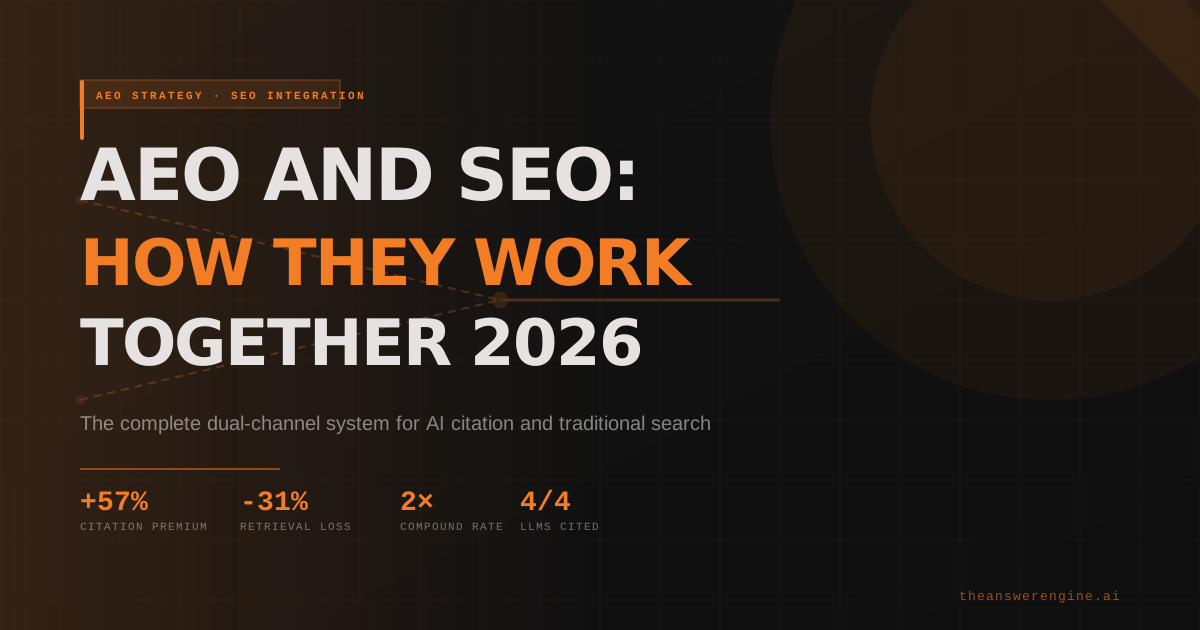
AEO Strategy · SEO Integration · Dual-Channel System
AEO AND SEO: HOW THEY WORK TOGETHER 2026
Answer Engine Optimization (AEO) is the discipline of engineering your content, schema, and cross-surface identity so that AI platforms — ChatGPT, Perplexity AI, Claude, and Google AI Overviews — retrieve and cite your business. Search Engine Optimization (SEO) is the practice of earning ranked positions in traditional search results by optimizing for crawlability, domain authority, and relevance signals. These are not competing strategies. SEO builds the technical foundation AI models require to index your content. AEO engineers that content to be extracted and cited once the retriever arrives. To see exactly where AI platforms can already find your business and where they cannot, run the free Blind Spot Scan at theanswerengine.ai/blindspot.
The foundational academic work on generative-engine citation behavior is less than two years old. Most businesses default to either a pure-SEO or a pure-AEO framing — and both leave measurable citation share on the table. The operators who build compound authority fastest are the ones who run both disciplines from a shared technical infrastructure, sequenced deliberately so each discipline amplifies the other. One client per market — claim your territory before a competitor does.
July 25, 2026·15 min read·Justin Borges
🔗
100%
of major AI platforms retrieve from the same web index that powers traditional search — making technical SEO the first gate for AEO visibility
📖
+57%
citation premium for definition-first content passages — the same structure that earns AI citations also anchors Google featured snippets (Zhang et al., 2026)
📉
-31%
extraction accuracy lost when a content chunk exceeds 300 words in RAG retrieval — the conflict between keyword density and extractability (GEO-SFE, 2026)
🔄
2×
compound authority rate for businesses running AEO and SEO together versus single-channel operators — each discipline output feeds the other
Article Overview
Section
Core Insight
AEO and SEO Defined
Different optimization targets, different ranking signals — understanding both before running either
SEO as the AEO Foundation
AI retrieval starts in the web index; technical SEO is the first gate for AI citation
Where They Diverge
Keyword density actively conflicts with extractability — the signals differ and require deliberate management
The Dual-Channel System
Priority sequencing, compound authority, and the TAE implementation sequence
Measuring the Combined Channel
Citation Ledger plus SEO reporting — two dashboards, one complete picture of market visibility
AEO AND SEO DEFINED
What Answer Engine Optimization Actually Optimizes For
Answer Engine Optimization (AEO) — also called AI citation optimization or LLM visibility optimization — is the practice of engineering your content, schema markup, and cross-surface digital identity so that AI answer engines select and cite your business when users ask questions you can answer. AEO does not target a position on a results page. AEO targets a citation in a synthesized answer generated by ChatGPT, Perplexity AI, Claude, or Google AI Overviews. The optimization targets are extractability, definition clarity, bounded content chunks, cross-surface entity parity, and verifiable statistics. The ranking signal is retriever confidence — the AI assessment of whether a passage is self-contained, accurate, and authoritative enough to cite without further verification.
This analysis draws on the GEO-SFE framework (2026), Zhang et al. (2026), and Aggarwal et al. (KDD 2024), supplemented by observations across active client engagements where TAE tracks AI citation rates monthly across all four major platforms. The AEO citation slot is winner-take-most: on a Google results page, ranking fifth still earns clicks. On ChatGPT, Perplexity AI, or Claude, a source is either retrieved into the answer or it is invisible. There is no position five in a synthesized response. AEO requires a specific content architecture that SEO does not: definition-first H3 sections that open with a plain-language explanation before expanding; content chunks bounded at 80–180 words so RAG retrievers can extract the passage cleanly; and statistics that give the AI a verifiable claim to anchor attribution — Aggarwal et al. (KDD 2024) demonstrated that statistics increase citation probability by 22%, quotations by 37%. To understand how visible your business is to AI retrievers across these platforms, email our team at support@theanswerengine.ai for a no-cost AEO architecture review.
What Search Engine Optimization Actually Optimizes For
Search Engine Optimization (SEO) is the practice of earning ranked positions in traditional search engine results pages by optimizing for the signals Google ranking systems use to assess relevance, authority, and trustworthiness. SEO targets crawlability — can Google find and index the page? — technical performance — does the page load fast enough to be served? — content relevance — does the page match the user query? — and domain authority — do other credible pages link to this domain? The ranking signal is Google PageRank and its downstream systems: RankBrain, the Helpful Content system, and the E-E-A-T framework. A business wins SEO by earning a position in the top ten results for a target query.
SEO has a 25-year track record of driving qualified organic traffic. The channel compounds over time: a well-optimized page earns backlinks, which raise domain authority, which improve rankings for additional pages. Chen et al. (2025) documented that AI platforms show systematic bias toward sources with high earned-media signals — meaning the authority a domain builds through SEO directly carries into AI citation probability. The failure mode for SEO-only operators in 2026 is not declining SEO performance. It is complete invisibility on the AI-assisted search surfaces where an increasing share of buyer research begins. A business that wins SEO but ignores AEO is winning one channel and forfeiting another. To discuss your dual-channel coverage gap, call TAE directly at (213) 444-2229.
The Distinction Most Businesses Miss
The most common error we observe across new client engagements is treating AEO as SEO for AI — applying the same keyword density, the same linking patterns, and the same content volume targets to both disciplines simultaneously. AEO is not SEO reformatted for a new platform. The optimization targets are structurally different in ways that create direct conflicts between the two disciplines when both are executed without deliberate separation.
The Retrieval Gap: keyword-dense content that earns a Google page-one ranking often fails RAG extraction — passages over 300 words trigger a 31% attention degradation in AI retrievers (GEO-SFE, 2026), while keyword-stuffed H3 sections lack the self-contained, definition-first structure that AI models require to cite a passage with confidence. A page optimized for keyword density is a page that builds context incrementally across sections — exactly the pattern that confuses a retriever designed to extract a clean, bounded answer. TAE observes The Retrieval Gap directly when auditing pages that rank on Google page one but receive zero citations across Perplexity AI, ChatGPT, Claude, and Google AI Overviews.
The solution is deliberate architecture: write each H3 section to be self-contained and definition-first for AEO while using the target keyword in the first sentence for SEO. These techniques are compatible when applied at the H3 level rather than the page level. Most content teams apply SEO thinking at the page level and produce pages that are cohesive for a human reader but opaque to a retriever. To see the TAE architecture applied to your content and map the specific changes your pages need, schedule a 30-minute strategy session at calendly.com/theanswerengine-support/30min.
HOW SEO BUILDS THE FOUNDATION AEO REQUIRES
Why AI Retrieval Starts with the Web Index
AI retrieval — the mechanism by which ChatGPT, Perplexity AI, Claude, and Google AI Overviews select sources for synthesized answers — does not operate on a separate, AI-exclusive index. These platforms retrieve from the same web that search engines crawl. Perplexity AI uses live web retrieval via its own crawler. ChatGPT uses Bing for web-browsing queries and its training corpus for non-browsing queries. Claude uses a web search integration. Google AI Overviews operates directly on Google index. The practical consequence: a page not indexed by major search crawlers is invisible to most AI retrieval. The web crawl is the prerequisite layer — and technical SEO is what maintains access to it.
A page blocked by a noindex directive, a slow server response that causes crawler timeout, a broken sitemap, or a canonical tag conflict does not reach AI retrieval — not because the AI made a choice, but because the AI never saw the page. This is the most expensive invisible cost in AEO: businesses spend resources engineering extractable content on pages crawlers cannot reach. To run a diagnostic on your AI retrieval visibility right now, use the free Blind Spot Scan at theanswerengine.ai/blindspot — the report identifies which platforms find you and which queries you are missing.
The Four SEO Signals That Feed AEO Citation Rates
Four SEO signal categories are directly load-bearing for AI citation rates. First: crawlability and index status — a clean sitemap, no noindex conflicts, and a functioning robots.txt are the non-negotiable baseline. Second: page load performance — AI retrieval crawlers timeout on slow pages the same way search crawler budgets are exhausted on slow servers; under three seconds on mobile is the working threshold. Third: structured data and schema markup — JSON-LD schema for Article, FAQPage, and BreadcrumbList provides explicit extraction hooks that AI models treat as pre-structured for retrieval. Fourth: domain authority — Chen et al. (2025) documented systematic AI platform bias toward earned-media-endorsed domains, meaning backlinks are the SEO mechanism that signals AI trustworthiness as well as search ranking.
These four signals are not AEO-specific optimizations. Every standard SEO audit covers them. The implication is that a well-maintained SEO infrastructure is also maintaining the AEO foundation simultaneously — and a neglected SEO infrastructure is degrading both channels at once. TAE clients who arrive with solid technical SEO (Core Web Vitals passing, clean index status, active schema) begin generating AI citation improvements within 30 to 60 days of AEO content work. Clients who arrive with fundamental technical gaps require a sequential approach: fix the infrastructure, then build the citation layer. To get a personalized assessment of which phase your business is in, reach our team at support@theanswerengine.ai.
What Happens When SEO Infrastructure Is Weak
The Foundation Premium: AEO cannot function without the SEO substrate — a page that cannot be crawled, indexed, and served in under three seconds is invisible to AI retrieval before any AEO optimization signal can reach the retriever. SEO infrastructure is not a parallel investment option; it is the prerequisite layer on which every AEO technique operates. Investing in AEO content architecture before fixing SEO infrastructure gaps produces minimal results regardless of how well-structured the content is, because the retriever never arrives.
The most common infrastructure failures TAE observes in new client audits: noindex directives left on staging pages that were copied to production; canonical tags pointing to HTTP versions of pages that have since migrated to HTTPS; Google Business Profile data that conflicts with the website address format — 123 Main St vs. 123 Main Street — which breaks cross-surface entity parity; and thin service pages with fewer than 300 words that provide no extractable content regardless of AEO formatting. Each failure blocks AI retrieval at the source. Fixing them is the fastest path to AEO results for most businesses — not because AEO is ineffective, but because the prerequisite layer was never in place. Call TAE at (213) 444-2229 to assess whether your SEO foundation can support AEO work today.
Free AI Visibility Diagnostic
See which AI platforms can currently find your business and which target queries you are missing — at no cost, in under two minutes.
Keyword Density vs. Extractability — The Core Conflict
Search engine optimization rewards keyword presence throughout a page — in the H1, H2s, body paragraphs, image alt text, meta description, and URL. The underlying logic is signal-through-repetition: Google relevance systems look for consistent keyword patterns to confirm topical match. A page that uses its target keyword fifteen times in a 2,000-word article sends stronger topical signals than a page that uses it five times. This is well-established SEO practice with a 25-year track record.
AEO optimization inverts this logic at the paragraph level. AI retrievers operating on RAG architecture score passages for extractability: can this chunk be pulled from the page and provide a complete, self-contained answer without surrounding context? A keyword-dense paragraph — one that uses the target phrase repeatedly for SEO signal — is typically a paragraph that builds context incrementally, refers back to prior sections, and cannot stand alone as an answer. The GEO-SFE framework (2026) quantifies the penalty: passages over 300 words trigger a 31% degradation in RAG extraction accuracy. Keyword stuffing at the paragraph level pushes passage length up while pushing self-containment down — the exact combination that fails retrieval scoring.
The resolution is to manage the conflict at the structural level. SEO keyword signals belong in the H1, meta title, and the first sentence of each H3 — placements that serve relevance scoring without inflating chunk length. AEO extractability belongs in the body of each H3 — bounded to under 180 words, opened with a definition, free of pronoun references to other sections. Content teams that separate the H3 opener (keyword-anchored, SEO-serving) from the H3 body (definition-first, AEO-serving) produce pages that score well on both dimensions without requiring two separate writing passes. To schedule a workshop on implementing this structure for your site, book at calendly.com/theanswerengine-support/30min.
Link Building vs. Citation Authority — Different Currencies
SEO authority is built through backlinks: when credible external domains link to your pages, Google treats those links as endorsements that raise your domain PageRank and improve rankings across all content. The link-building currency is the inbound link — earned through PR placements, guest posts, directory listings, and content that other sites find worth referencing. SEO link-building is a well-established discipline with a clear compounding dynamic: more backlinks raise domain authority, which makes additional content rank faster, which earns more backlinks.
AEO citation authority is built through a structurally different mechanism. AI platforms cite sources because the source holds a fact the AI wants to attribute — a specific statistic, a definition, a named methodology, a verifiable local claim — not because another site linked to it. Aggarwal et al. (KDD 2024) demonstrated that quotation-bearing content earns 37% higher AI citation probability and statistic-bearing content earns 22% higher probability than equivalent content without those elements. The AEO citation currency is the citable claim: original data, verified statistics, named frameworks, and local facts no other source carries. These two authority mechanisms reinforce each other over time. A business that publishes original local data earns AI citations. Those AI citations, when they produce brand mentions and links in Perplexity-cited sources, feed the SEO backlink pool. Operators who are ready to claim their market territory before a competitor does should act now — TAE works with one client per market and current territory slots are limited.
What the Research Says About Parallel Optimization
The academic literature on generative-engine optimization has produced three findings directly relevant to the AEO-SEO relationship. Chen et al. (2025) documented systematic AI platform bias toward earned-media-endorsed sources — the same backlink signals SEO builds are the trust signals AI citation systems factor into source selection. SEO authority investment directly raises AEO citation ceiling. Zhang et al. (2026) established that definition-first content earns a 57% citation premium across generative platforms — and that same structure is the pattern Google featured snippet algorithm has rewarded for a decade. The definition-first technique is not AEO-specific: it is a dual-purpose optimization that serves both disciplines simultaneously.
The Definition Crossover: content that opens each H3 section with a plain-language definition of its subject serves both AEO and SEO in a single writing pass — the +57% AI citation premium documented by Zhang et al. (2026) applies to the same structural pattern that Google featured snippet system has used to surface quick-answer content since 2014. A business that rewrites its key service pages to be definition-first improves both its AI citation rate and its Google featured snippet capture rate simultaneously, without requiring two separate content programs. GEO-SFE (2026) further confirmed that lists and tables increase AI retrieval probability by 43% versus equivalent prose — and structured formatting is also a Google rich result signal. To see this architecture applied to your specific market and query set, run the free Blind Spot Scan at theanswerengine.ai/blindspot.
Ready to Run Both Channels?
TAE implements the dual-channel system — SEO infrastructure assessment and AEO content architecture — in a single 30-day sprint for one operator per market.
THE DUAL-CHANNEL SYSTEM — RUNNING AEO AND SEO TOGETHER
Priority Sequencing — SEO Infrastructure Comes First
Priority sequencing — should a business start with AEO or SEO? — has a direct answer when framed correctly. SEO infrastructure is the prerequisite layer. AEO content architecture is the citation layer that builds on top of it. If SEO infrastructure has critical gaps, address those first. If SEO infrastructure is solid, layer in AEO content work immediately — there is no reason to wait.
The diagnostic is straightforward. A business is ready to begin AEO work when four conditions are met: core service pages are indexed and returning 200 status codes, mobile load time is under three seconds, there are no noindex conflicts on key pages, and Google Business Profile data matches website contact information exactly. If all four are true, AEO content work can start today. If any are false, those failures are suppressing both SEO rankings and AEO citation rates simultaneously — fixing them is the highest-return investment available regardless of which channel the business prioritizes. To assess which phase your business is in, call TAE at (213) 444-2229 for a direct infrastructure assessment.
The Compound Signal — How Both Disciplines Amplify Each Other
The Compound Signal: AEO-driven citations generate brand mentions and backlinks that feed the domain authority signals SEO requires — and rising domain authority raises the AI citation ceiling by making the source more trustworthy to AI retrieval systems. Each discipline output becomes the other input, which is why operators running both disciplines simultaneously compound authority faster than operators running either alone.
The compounding mechanism works in both directions. When Perplexity AI cites your business in response to a buyer-intent query, that citation produces a Perplexity result page that other users click, share, and in some cases link to — feeding the SEO backlink pool from an AI-generated surface. When a blog post earns a high domain-authority backlink through traditional SEO PR, the referring domain endorsement raises source credibility in AI platform scoring (Chen et al., 2025), directly improving AEO citation probability for that domain. Businesses that isolate the two disciplines into separate budget silos forgo this compounding effect. TAE structures client engagements to capture both feedback loops simultaneously. To explore what a dual-channel engagement looks like for your specific market, email our team at support@theanswerengine.ai.
The TAE Implementation Sequence
The Dual-Channel Theorem: a Google page-one ranking and an AI citation slot are structurally independent wins — a business can hold one, both, or neither, and the highest-compound authority position is holding both simultaneously. Fewer than 8% of businesses in any local service market currently hold both channels, which means the vast majority of markets have open citation incumbency available for operators who act now before competitors claim the territory.
TAE implements the dual-channel system in three phases. Phase one, weeks one through four: technical SEO audit focused on index status, canonical signals, load performance, and structured data gaps. FAQPage, Article, and BreadcrumbList schema are injected across core pages. Google Business Profile data is audited for identity parity with website contact information. Phase two, weeks five through twelve: AEO content cluster development. Definition-first H3 sections are written for each target query. Content chunks are bounded to 80–180 words. Named-thesis sentences anchor each primary section with a verifiable, citable claim. Phase three, months three through six: compound authority building. Original local data is published — market-specific pricing, service-area response times, client outcome data — creating citable facts that no other source carries. Cross-platform citation tracking begins via the Citation Ledger. Businesses with solid technical SEO enter phase two in week one. To claim your market territory now, territory slots are available at calendly.com/theanswerengine-support/30min — one client per market.
One Client Per Market
TAE holds one exclusive market territory per client. When your territory is claimed by a competitor, TAE cannot take you on in that market. Check availability now.
Standard SEO reporting covers keywords, organic traffic, click-through rate, and domain authority — supply-side metrics that describe visibility within traditional search. These metrics are necessary but not sufficient for businesses running AEO in parallel. AI-assisted search answers often produce no click at all: the user receives the answer within the AI response and does not visit the cited source. Standard analytics platforms cannot capture this zero-click AI attribution. A business receiving 200 AI citations per month on Perplexity AI may see no corresponding traffic spike in standard analytics — yet those citations are driving brand recognition and direct search queries that eventually produce inbound contact.
TAE measures AEO performance through a Citation Ledger: a fixed panel of real buyer-intent queries run monthly across ChatGPT, Perplexity AI, Claude, and Google AI Overviews, with each query result logged for three data points — whether the platform cites the client, whether the platform cites a competitor, and whether the platform cites no one. The Citation Ledger tracks market share at the citation level rather than the traffic level and surfaces territory coverage gaps before they become competitive disadvantages. Operators who want to claim exclusive territory in their market before a competitor fills the slot should act before the slot is gone — book at calendly.com/theanswerengine-support/30min.
The Dual Attribution Model — Tracking Both Channels Together
A dual-channel visibility operation requires a dual attribution model: one dashboard for SEO performance (rankings, organic traffic, backlink velocity) and one for AEO performance (Citation Ledger query results, citation share by platform, AI-driven direct searches). The bridge between them is the intake channel signal. TAE instructs all clients to add a how-did-you-find-us field to every inbound form — phone, email, contact page, and free scan request. This field, when consistently reviewed monthly, converts invisible AI attribution into measurable pipeline data. A prospect who says they found you on Perplexity represents a Citation Ledger success that no analytics platform would have captured.
The dual attribution model reveals the compounding dynamic directly. In month three of a typical TAE engagement, SEO organic traffic begins moving as new AEO-structured content earns rankings for long-tail queries. In month four, AI citation volume — visible through the Citation Ledger — begins feeding direct brand searches that show up in the SEO traffic data as branded organic visits. By month six, both channels are visibly reinforcing each other in the reporting. The compound authority effect is measurable, not theoretical. To run the free AI citation diagnostic and begin tracking your Citation Ledger baseline, start at theanswerengine.ai/blindspot.
Time to Signal — SEO vs. AEO Timelines
SEO and AEO operate on different time horizons, which affects how a dual-channel engagement should be sequenced and reported. SEO ranking movement for new pages on a domain with moderate authority typically requires three to six months. Established domains with high authority can rank new pages faster, but the signal lag between publishing and meaningful ranking movement is measured in months for most businesses. Link-building authority compounds over years.
AEO citation timelines are faster and more variable by platform. Perplexity AI uses live web retrieval and rewards fresh, structured content — definition-first pages can appear in Perplexity citations within one to two weeks of publication. ChatGPT and Claude update on slower cycles tied to their index or integration refresh schedules: 30 to 90 days is the working expectation for citation movement after structural content changes. Google AI Overviews reflects Google own index and benefits immediately from featured snippet optimization — which is identical to AEO structural work. The operational implication: AEO work produces earlier measurable signals than SEO. A dual-channel engagement should expect Citation Ledger movement within 30 to 60 days and organic ranking movement within 90 to 180 days. To discuss timeline expectations for your market and domain, contact TAE at support@theanswerengine.ai or call (213) 444-2229.
Concept Lattice
Key concepts introduced in this article. Each will resolve to a dedicated reference page.
Answer Engine Optimization without SEO infrastructure is structurally incomplete. AI platforms — ChatGPT, Perplexity AI, Claude, and Google AI Overviews — retrieve from the web index. Pages that are not indexed, load slowly, or carry noindex directives are invisible to AI retrievers before any AEO signal can apply. You do not need a perfect SEO setup to begin AEO work, but you need crawlable, indexable, fast-loading pages. Fix critical technical SEO gaps first, then build the AEO citation layer on top. To diagnose your current AI visibility right now, run a free Blind Spot Scan at theanswerengine.ai/blindspot.
Does AEO replace SEO?
AEO does not replace SEO — AEO extends it. SEO earns your pages into the web index and builds the domain authority AI platforms use to assess source credibility. AEO engineers those pages to be extractable and citable once the AI retriever arrives. Businesses that abandon SEO in favor of AEO-only strategies lose both channels simultaneously. The highest-compound authority position is running both disciplines from shared technical infrastructure. Operators who want to claim market territory before a competitor moves should secure their slot now — one client per market at calendly.com/theanswerengine-support/30min.
Which should I prioritize: AEO or SEO?
If your pages are not indexed or your site has critical technical SEO gaps, fix SEO infrastructure first. Technical failures — noindex directives, slow load times, broken canonical tags — block AI retrieval before any AEO content can reach the retriever. If your technical SEO foundation is solid, layer in AEO content work immediately. For most businesses with a functioning website, both disciplines can run in parallel from day one. To map the right sequence for your specific situation, schedule a 30-minute strategy call at calendly.com/theanswerengine-support/30min.
Do AI platforms like ChatGPT use Google index?
The major AI platforms use their own indexes alongside web retrieval, but they largely crawl the same web that Google indexes. Perplexity AI uses live web retrieval via its own crawler. ChatGPT uses Bing for web-browsing queries and its training corpus for non-browsing queries. Claude uses a web search integration. Google AI Overviews operates directly on Google index. Pages not indexed by major search crawlers are invisible to most AI retrieval. Technical SEO — sitemaps, crawlability, canonical signals — remains the prerequisite. Run a free Blind Spot Scan at theanswerengine.ai/blindspot to see which platforms currently find your business.
How do I know if my SEO is strong enough to start AEO?
A sufficient SEO foundation for AEO requires four conditions: core pages are indexed by Google, the site loads under three seconds on mobile, there are no conflicting canonical or noindex tags on key pages, and your Google Business Profile data matches your website contact information exactly. If all four are met, AEO work can begin without waiting for further SEO maturation. If any are broken, fix those gaps first before investing in AEO content architecture. To get a personalized assessment, reach our team at support@theanswerengine.ai.
What is the fastest way to improve both AEO and SEO at the same time?
The highest-return action that improves both AEO and SEO simultaneously is rewriting key service pages with definition-first structure. Opening each section with a plain-language definition earns the +57% AI citation premium from Zhang et al. (2026) while anchoring Google featured snippet capture — both disciplines served in one writing pass. Adding FAQ schema alongside Article and BreadcrumbList markup also serves both: Google indexes the structured data for rich results, and AI retrievers extract FAQ Q&A pairs directly into synthesized answers. For a personalized implementation plan, call TAE at (213) 444-2229.
Justin Borges
Founder, The Answer Engine
Justin Borges is the founder of The Answer Engine, a GEO/AEO firm that helps businesses get cited by ChatGPT, Perplexity, and Google AI Overviews. TAE built and validated the dual-channel AEO plus SEO system on its own domain — achieving 4/4 LLM citations and 1.14M monthly impressions — before offering the methodology to clients. Reach Justin at support@theanswerengine.ai.
CLAIM YOUR MARKET TERRITORY
TAE builds the dual-channel system — SEO foundation assessment plus AEO citation architecture — for one operator per market. When your territory is claimed by a competitor, TAE cannot take you on in that market. Check territory availability and begin your 90-day citation guarantee engagement today.