What AEO For Luxury Real Estate Agents Actually Means
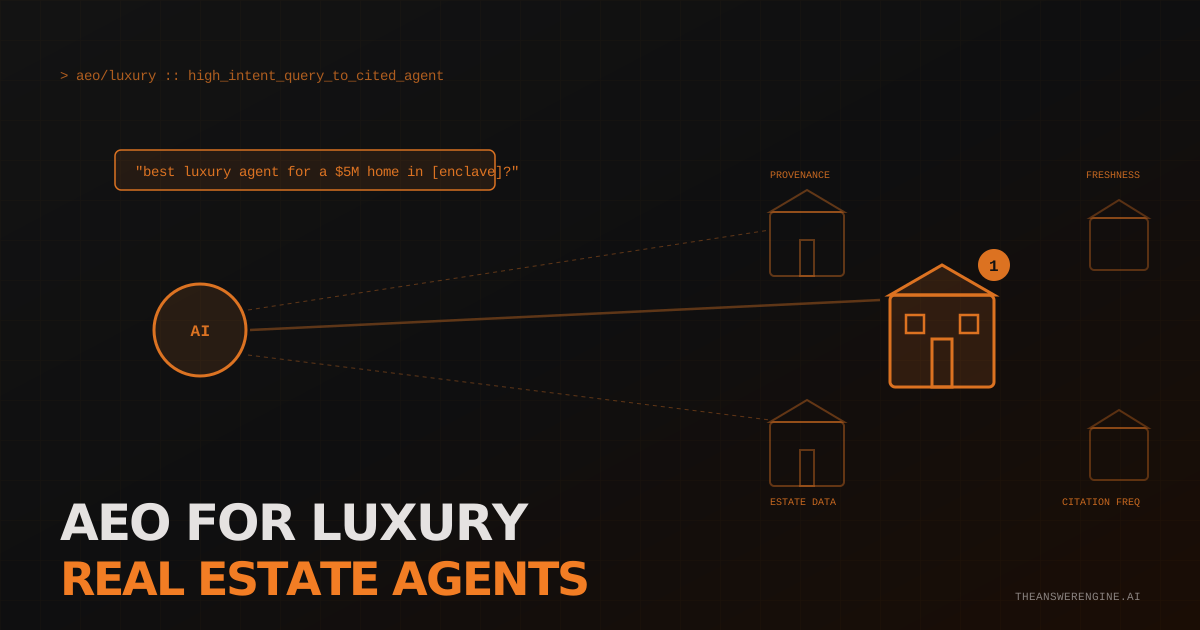
AEO for luxury real estate agents is Answer Engine Optimization applied to high-end buyer queries - the discipline of engineering your profile and content so an AI assistant cites you when a high-net-worth buyer asks who to hire. Answer Engine Optimization, also called AI citation optimization or LLM visibility work, targets the moment a buyer asks ChatGPT, Perplexity, Claude, or Gemini for the best agent in an enclave and the assistant returns one answer with a short list of sources. The Discretion Premium: high-net-worth buyers vet agents privately through AI assistants before any human contact, so the citation an assistant returns is the luxury agent's first impression - and often the only one a discreet buyer ever grants (Chen et al., 2025). To see whether assistants can read and cite your profile at all, run the free AERO Blind Spot Scan.
The Citation Replaces The Referral
Luxury real estate ran on private referral networks for decades. Answer Engine Optimization does not replace the network - it front-runs it. A buyer relocating into a new market has no network there, so the first move is an AI query, and the agents the assistant names become the shortlist. A Google results page lists ten links a buyer scrolls; an AI assistant returns one synthesized recommendation with a few cited names. Ranking eleventh on Google still earns a click - failing the citation on an assistant earns silence. To check which agent the assistant already names for your core enclave query, text (213) 444-2229 for a 24-hour diagnostic.
Why High-End Queries Beat Volume
Luxury AEO inverts the volume math that governs ordinary SEO. The High-Intent Threshold: high-end buyer queries are low-volume but carry outsized commission value, so a single luxury citation can be worth more than a year of generic lead-gen because one cited answer routes a seven-figure transaction (GEO-SFE, 2026). Chasing thousands of low-intent searches is the wrong target for a luxury agent. Owning the handful of high-net-worth queries - "best agent for a $5M home in [enclave]," "who handles off-market estates in [city]" - is the entire game. To map the exact queries that route luxury buyers in your market, book a 30-minute luxury AEO strategy call.
Answer Engine Optimization for luxury real estate is a measurable channel less than two years old - the foundational academic work on generative-engine citation behavior is barely past its first publications. Most luxury agents have no structured, extractable content on the surfaces assistants retrieve, which is why the high-end citation slots in most markets are still open. Agents who lock cross-surface parity now establish citation incumbency before the field saturates across the 2025-2026 cycle. To claim your market position early, lock your exclusive territory now - one operator per market.
How AI Picks An Agent For High-End Buyer Queries
AI assistants run on Retrieval-Augmented Generation (RAG). Retrieval-Augmented Generation is an architecture that grounds every answer in real web sources retrieved at query time instead of generating text from memorized patterns. For a luxury query the pipeline has three stages, and each one tells you exactly where a citation is won or lost. For a custom walkthrough of where your profile drops out of that pipeline, email support@theanswerengine.ai for a custom luxury AEO strategy.
Retrieval Rewards Direct Answers, Not Adjectives
Retrieval is the first gate, and luxury bios fail it most often. When a buyer asks an assistant for the best agent in an enclave, the assistant retrieves pages that answer the question directly - not pages stacked with adjectives like "premier," "elite," and "white-glove." A profile built on luxury vocabulary without a clear, factual answer fails before any ranking signal applies. The rule: every section must lead with the answer stated plainly - the enclaves you transact in, the price bands, the verifiable record. To find which of your pages fail the retrieval gate today, find your structured-data gaps with a free Blind Spot Scan.
Reranking Rewards Earned Authority And Freshness
Reranking is where most luxury sources are eliminated. The assistant scores each retrieved page on relevance, domain authority, content freshness, and extractability, then keeps only the top candidates. The Provenance Signal: luxury authority is earned, not asserted - an assistant ranks the agent whose track record, sold comps, and price-point expertise are corroborated across independent sources over the agent who merely claims "luxury specialist" on a bio page (Chen et al., 2025). Freshness compounds it: a profile refreshed inside 30 days can outrank a stale page with a longer history. Questions on the right corroboration and refresh cadence for your market? Text (213) 444-2229 to see which competitor holds your slot.
An AI assistant does not decide whether to cite sources - the architecture requires it. If your content provides the factual basis for part of a luxury recommendation, the citation is automatic. The entire job is becoming the source the reranker keeps for high-end queries. To pressure-test your reranking readiness, book a call to review your reranking gaps.
Generation Makes The Citation Mandatory
Generation is the stage luxury agents misunderstand. The assistant synthesizes the surviving sources into one recommendation and attaches a citation to every source it uses. There is no editorial choice - when a passage supplies a fact, the attribution is mandatory. The Estate-Data Moat: when a luxury agent is the sole source for a specific enclave statistic - price-per-square-foot in a gated community, days-on-market for $5M-plus listings - the assistant has no alternative to quote and must attribute the figure to that agent (Aggarwal et al., KDD 2024). To request the template we use to package proprietary enclave data for retrieval, email support@theanswerengine.ai for the estate-data template.
The EvidenceWhat The Research Says About Luxury Citations
AEO advice for luxury agents should rest on the generative-engine optimization literature, not on Google-era folklore. Four findings govern which passages get cited, and each maps to a concrete editing decision. This analysis draws on the published GEO research and on verified client engagements where we moved citation rates on a fixed query panel. To get the same analysis run against your profile, see your current luxury citation rate - free scan.
| Research Finding | Effect On Citation | Source |
|---|---|---|
| Open passages with a clear definition | +57% influence premium | Zhang et al., 2026 |
| Cite quotations from authoritative sources | +37% citation rate | Aggarwal et al., KDD 2024 |
| Add verifiable statistics to a claim | +22% citation rate | Aggarwal et al., KDD 2024 |
| Format content as lists and tables | +43% retrieval lift | GEO-SFE, 2026 |
| Passages over 300 words | -31% extraction accuracy | GEO-SFE, 2026 |
Definitions And Verifiable Data Win Luxury Citations
The strongest controllable signals are definition-first writing and verifiable data. The Concierge Chunk: structuring each answer around the precise question a high-net-worth buyer asks - privacy, off-market access, relocation - and opening with a plain definition earns a 57% citation premium over a luxury bio that buries expertise in adjectives (Zhang et al., 2026). Statistics compound the effect: Aggarwal et al. (KDD 2024) found that adding verifiable statistics lifts citation rate 22% and that citing authoritative quotations lifts it 37%. The editing instruction is direct - define the buyer's concern in sentence one, then back the claim with a specific number from your record. To have your top pages rewritten to this standard, schedule a free 30-minute consult.
Bounded Chunks Beat Long Luxury Narratives
Passage length is a hard ceiling, not a style preference. Luxury marketing trends toward long, evocative narrative - exactly what RAG retrievers struggle to extract. Passages over 300 words trigger a 31% attention degradation in retrievers, so splitting long sections into bounded units of roughly 80 to 180 tokens restores full extraction accuracy (GEO-SFE, 2026). The same study found lists and tables earn a 43% retrieval lift over equivalent prose, because structured data is trivially extractable. Break every estate narrative into short, self-contained chunks and convert comparisons - enclaves, price bands, amenities - into tables. To audit your pages for the chunk ceiling, check whether assistants can read your site - free scan.
Earned Authority Outweighs Self-Description
An assistant does not take a luxury bio's word for its own authority. Generative engines show a systematic preference for earned, third-party signals over brand-authored self-description, so a track record corroborated across independent sources outranks the same claim made only on the agent's site (Chen et al., 2025). A profile that calls itself the "number one luxury agent" without external corroboration fails against an agent whose sales are mirrored on MLS records, press, brokerage pages, and review platforms. The work is to make your core claims verifiable off your own domain. To map where your authority signals are missing, text (213) 444-2229 and we will map your citation gaps.
A luxury profile left unrefreshed for more than 90 days loses retrieval share right now, regardless of how strong the agent's record is. The freshness gradient is unforgiving - a competitor who updates a thinner profile this month can displace your stronger, stale page on the exact enclave query you should own. If your best pages have not been touched this quarter, they are bleeding citations today. To set a refresh cadence that holds your slot, book a consult to map your refresh cadence.
The Luxury AEO Playbook: Five Moves That Earn The Citation
Knowing the mechanism is not the same as getting cited. These are the five moves we run to convert an invisible luxury profile into a cited source, ordered by speed to result. The first two register within weeks; the last three compound into permanent authority. To have this playbook executed on your domain, grab a 30-minute slot to walk your query panel.
Move 1: Restructure Your Profile Around Buyer Questions
The fastest lever is restructuring your highest-value pages. Rewrite each section to lead with a plain answer to a real high-end buyer question, stamp a current last-modified date, and break narrative passages over 180 tokens into bounded chunks. Convert your enclave coverage, price bands, and transaction record into tables. Because assistants reward freshness and extractability, this move can change retrieval within one to two weeks. To find your highest-value pages to fix first, run a free Blind Spot Scan to baseline your visibility.
- Lead with the answer. Open each section with the enclave, price band, or fact - not an adjective.
- Define the buyer's concern first. Privacy, off-market access, relocation - for the 57% premium.
- Keep chunks under 180 tokens. Stay below the 300-word extraction ceiling.
- Back claims with your numbers. Sold comps and price-per-sqft earn a 22% citation lift.
- Format coverage as tables. Enclaves and price bands as structured data earn a 43% lift.
- Stamp a fresh last-modified date. Recency is a proxy for accuracy.
Move 2: Publish Proprietary Enclave Data No Portal Holds
The most reliable path to a mandatory citation is original data. National portals win broad queries, but they do not hold the hyperlocal luxury numbers you transact in every week. Publish proprietary statistics no one else carries: price-per-square-foot inside a specific gated community, days-on-market for $5M-plus listings, off-market transaction share in an enclave. The Estate-Data Moat makes the citation non-negotiable - when you are the sole source for a figure, the assistant must attribute it to you. To build your first enclave-data asset, email support@theanswerengine.ai to request the parity checklist.
Move 3: Lock Cross-Surface Identity Parity
An assistant triangulates an agent across the surfaces it indexes before trusting the recommendation. The Parity Lock: matching name, brokerage, market, and core claims across your site, Google Business Profile, MLS records, brokerage bio, and review platforms tells the reranker the entity is real and consistent, while mismatched details split the signal and suppress retrieval for high-trust luxury queries (GEO-SFE, 2026). Cross-surface parity is the highest-impact structural move because it lifts retrieval across every engine that shares those surfaces. To audit your parity, text (213) 444-2229 for a structured-data audit.
Move 4: Build A Topic Cluster Around The Buyer Journey
Assistants trust breadth. A domain cited across many distinct queries accrues compounding retrieval trust, so breadth of citation across a topic cluster lifts the citation probability of every page on the domain (Chen et al., 2025). If an assistant already cites you for one luxury question, it more readily retrieves you for adjacent ones - financing a jumbo purchase, relocating into a market, evaluating an off-market estate. Publish the full cluster a high-net-worth buyer asks before they buy, and each new citation reinforces the whole domain. To plan your cluster, claim your market territory before a competitor does - one client per market.
Move 5: Earn Third-Party Corroboration
The final move answers the earned-media bias. Get your track record mirrored off your own domain - MLS sold records, genuine client reviews, press placements, brokerage and partner pages, and a consistent author entity across platforms. Assistants cross-reference agent and brand entities across the web, and a claim corroborated by independent sources outranks the same claim made only on your site. To map your fastest corroboration wins, get your free AI visibility report.
Start with Move 1 (restructure your profile) for wins inside two weeks, then Move 2 (enclave data) for mandatory citations. Cross-surface parity, topic clusters, and third-party corroboration compound over 30 to 180 days into permanent authority. To sequence these for your market, email support@theanswerengine.ai to set up your ledger.
How To Measure Whether You Are Cited For Luxury Queries
Luxury AEO is invisible to standard analytics because many AI answers produce no click. Measuring it requires a purpose-built surface, not Google Analytics. The Discretion Ledger: a fixed panel of real high-end buyer queries run monthly inside each assistant - logging whether it cites you, cites a competitor, or cites no one, and at what position - converts an untrackable luxury channel into a citation rate you move month over month. This is the only metric that matters, because position in the answer is the product. To set up your ledger, book a consult to map your refresh cadence and ledger.
Build A Fixed Luxury Query Panel
A Discretion Ledger begins with a fixed panel of the real questions high-net-worth buyers ask - "best agent for a $5M home in [enclave]," "who handles off-market estates in [city]," "which agent should I hire to relocate to [market]." Run the same panel every month across ChatGPT, Perplexity, Claude, and Gemini so movement is comparable, and record three outcomes per query: cites you, cites a competitor, cites no one. The competitor column tells you who holds the slot you want. To build your panel from actual buyer questions, text (213) 444-2229 to start your luxury query panel.
Pair The Ledger With Inquiry Attribution
The ledger measures visibility; a "how did you find us" field measures revenue. Add the question to every inbound inquiry and consultation, and tag any AI-sourced luxury lead with a distinct source label. Together the ledger and the attribution field convert an invisible channel into a citation rate tied to real pipeline, so you can prove the channel pays in seven-figure terms. To wire attribution into your funnel, reach us at support@theanswerengine.ai.
Luxury AEO is a compounding authority channel, not a paid-ad switch. Every citation reinforces your domain's retrieval trust, so early structural wins accelerate later citation rates instead of decaying when you stop paying. The agent who publishes citable enclave content today owns the answer slot tomorrow. To claim your slot before a competitor locks it, secure your market slot before a rival claims the luxury citation.
If you can earn the citation on a high-end buyer query, you are positioned for every AI platform. The ranking factors - definitions, verifiable data, bounded chunks, cross-surface parity - overlap across ChatGPT, Perplexity, Claude, and Google AI Overviews. We work with one agent per market. Check if yours is still open.
Frequently Asked Questions
What is AEO for luxury real estate agents?
AEO for luxury real estate agents is Answer Engine Optimization applied to high-end buyer queries - engineering a profile and content so AI assistants cite that agent when a high-net-worth buyer asks who to hire. When a buyer asks ChatGPT, Perplexity, Claude, or Gemini for the best agent in an enclave, the assistant retrieves and synthesizes one answer with a short list of cited sources. Luxury AEO is the work of becoming the source it pulls.
The fastest start is restructuring your highest-value pages around real buyer questions, which can move retrieval within two weeks. To find those pages, run a free Blind Spot Scan.
Why do high-end buyer queries matter more than search volume suggests?
High-end buyer queries are low-volume but carry outsized value. A single luxury citation can route a seven-figure transaction, so the conversion economics invert the usual volume math - one cited answer for the best agent for a $5M home can be worth more than a year of generic lead-gen. High-net-worth buyers also vet agents privately through AI before any human contact, so the assistant answer is often the only first impression a discreet buyer grants.
Winning the citation on a handful of high-intent queries beats ranking for thousands of low-intent ones. To map those queries, text (213) 444-2229.
How do AI assistants decide which luxury agent to recommend?
AI assistants run Retrieval-Augmented Generation: they retrieve candidate sources from the live web, rerank them on relevance, authority, freshness, and extractability, then cite the survivors. For luxury queries the authority signal weighs heavily, and assistants prefer earned, third-party corroboration over self-description - an agent whose sold comps and price-point expertise are mirrored across independent sources outranks one who merely claims to be a luxury specialist.
Proprietary enclave data the agent alone publishes forces a mandatory citation. To see your gaps, book a 30-minute consult.
Can a solo luxury agent compete with a national brokerage in AI search?
Yes. A national brokerage wins broad queries, but a solo luxury agent can own a specific enclave-and-price query by being the sole source for local data. Assistants favor original data and narrow expertise: when an agent is the only page carrying price-per-square-foot for a gated community or days-on-market for $5M-plus listings, the assistant must attribute that figure to the agent.
Publishing proprietary enclave statistics and holding consistent identity across surfaces is the most reliable path to a local luxury citation. To map your data assets, email support@theanswerengine.ai.
How long does luxury real estate AEO take to produce citations?
Structural fixes register fast. Refreshing and restructuring a profile and adding schema can change retrieval within one to two weeks because assistants reward recency. Publishing a proprietary enclave-data asset and locking cross-surface identity parity typically move citation rates inside 30 to 60 days. Citation frequency - the compounding signal where a domain cited often earns more future citations - builds over three to six months.
Luxury AEO is a compounding authority channel, so early structural wins accelerate later rates. To set realistic milestones, book a 30-minute consult.
How do you measure whether you are cited for luxury buyer queries?
Standard analytics under-report AI citations because many answers produce no click. The correct surface is a Discretion Ledger - a fixed panel of real high-end buyer queries run monthly inside each assistant, logging whether it cites you, cites a competitor, or cites no one, and at what position.
Pair the ledger with a "how did you find us" field on inbound luxury inquiries to convert an invisible channel into a citation rate tied to pipeline. To set up your ledger, email support@theanswerengine.ai or start with a free Blind Spot Scan.