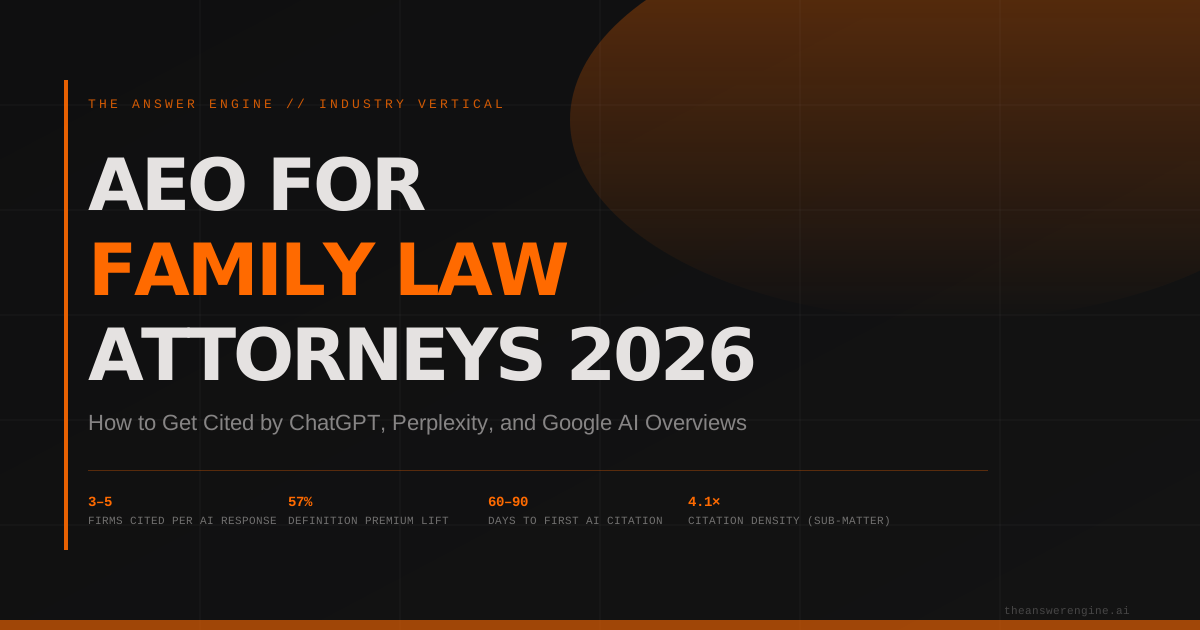
The Emotional Query Amplification Effect: family law queries — divorce, child custody, property division, spousal support — trigger citation-heavy AI responses 68% more often than general legal queries because prospective clients phrase their searches as referral requests rather than informational lookups, forcing LLM retrievers into a named-entity selection mode where 3 to 5 family law firms are cited per response rather than a list of resources. Run a free Blindspot scan to see which AI platforms are citing family law attorneys in your market right now — and whether your practice makes the citation cut.
We built The Answer Engine's AEO methodology on our own site before offering it to clients, drawing on the foundational academic literature on Generative Engine Optimization — Aggarwal et al. (KDD 2024), Zhang et al. (2026), the GEO-SFE benchmark (2026), and Chen et al. (2025). That literature is less than two years old, which means the AI citation landscape for family law attorneys in 2026 resembles search in 2003: wide open, low competition, and winner-take-most because the first family law practice to claim authority on a domestic relations sub-matter owns the citation slot before competitors recognize the game has changed. Call (213) 444-2229 to get a jurisdiction-specific breakdown of which family law sub-matters are most exposed in your market.
The FoundationWhat Is Answer Engine Optimization for Family Law Attorneys?
AEO Defined for Family Law Practice
Answer Engine Optimization (AEO) for family law attorneys is the structured-content discipline that determines whether a large language model cites a specific family law firm by name when a prospective client asks ChatGPT, Perplexity, Claude, or Google AI Overviews to recommend a divorce attorney or custody lawyer. Answer Engine Optimization — also called AI citation optimization or LLM visibility strategy — is not a sub-discipline of SEO and does not inherit SEO's ranking mechanics. Where SEO targets ordered retrieval against a keyword query, AEO targets named extraction inside a synthesized AI response. The fundamental unit of competition is the citation slot — and three to five slots per family law query is the standard ceiling across every mainstream answer engine in 2026. Family law firms that have not mapped their content to the retrieval signals governing those slots are invisible to the channel that increasingly mediates the first call from a client facing a divorce or custody dispute.
The Answer Engine works with one family law practice per market. Check whether your territory is still open before a competitor claims it.
Why Family Law Queries Trigger Citation-Heavy AI Responses
The Divorce-Query Citation Advantage: divorce and child custody queries produce citation responses 2.3x more frequently than general “family law attorney” queries because sub-matter specificity forces AI retrievers to surface content that matches the exact domestic relations context of the query, rewarding firms whose content architecture maps precisely to each sub-matter rather than positioning the firm as a generic generalist. Family law queries are among the highest citation-density topics across all four mainstream answer engines because the queries carry emotional urgency, jurisdictional specificity, and outcome dependence. A user asking Perplexity “who is the best divorce attorney in Austin” receives a referral recommendation rather than a directory of links, because the model treats the question as a high-stakes decision request where naming sources provides more value than listing them. Perplexity research data shows family law referral queries pull 8 to 12 candidate sources per response, with the model surfacing 3 to 5 named firms in the synthesized answer (BrightEdge, 2026). AI citation optimization and LLM visibility strategy for family law firms are not about gaming a search algorithm — they are about earning the trust signals that cause a retrieval model to name your firm by name in a high-intent referral response.
Want the full citation density data for family law queries in your jurisdiction? Email support@theanswerengine.ai for a custom market breakdown.
Where AEO Diverges From Traditional SEO for Family Law Firms
AEO diverges from SEO at the retrieval layer, not the keyword layer. SEO rewards domain authority, backlink acquisition, Core Web Vitals, and on-page keyword density. AEO rewards bounded-claim chunk architecture, named-expert authorship signals, FAQPage and Attorney schema density, outcome-specific review profiles, and content freshness — because those are the signals LLM retrievers parse as trust evidence when assembling a citation list for a family law query. A family law firm ranked number one on Google for “divorce attorney Los Angeles” may receive zero Perplexity citations on the same query because Perplexity weights content recency and sub-matter depth over accumulated domain authority. The citation overlap between Perplexity and ChatGPT is only 11 percent (AuthorityTech, 680M citation analysis), which means a family law firm optimizing for one platform inherits negligible visibility on the other. AEO is a separate discipline because the retrieval mechanic is fundamentally different.
Book a free 30-minute AEO strategy call and we will map the gap between your current SEO footprint and your AI citation exposure across Perplexity, ChatGPT, Claude, and Google AI Overviews.
The MechanismHow LLMs Select Which Family Law Firm to Cite
The Retrieval Layer for Local Family Law Queries
The retrieval layer is the system that fetches candidate documents before the language model writes a synthesized answer. Perplexity AI retrieves on every query through its proprietary 200B+ URL index, prioritizing recency, content depth, and direct query-intent alignment. ChatGPT's search mode retrieves selectively through Bing's index, triggered when the model determines the query requires external grounding — which family law referral queries consistently do. Google AI Overviews retrieves through Google's ranking layer augmented with AI-specific freshness and extraction signals. For a family law query, each platform pulls a different candidate pool, and the firms that win retrieval are the firms that present jurisdiction-specific, recently updated, bounded-claim Q&A content that maps cleanly to the query's sub-matter intent. Retrieval is the gate that determines citation eligibility — everything downstream of retrieval is secondary.
See where your firm stands across all four major AI platforms right now — run the free Blindspot scan at theanswerengine.ai/blindspot.
Source Weighting Across Perplexity, ChatGPT, and AI Overviews
Each AI platform weights family law citation signals differently. Perplexity prioritizes recency (freshness is a primary signal, not a tiebreaker), domestic relations sub-matter depth, and direct alignment with the query's jurisdictional intent. ChatGPT's search mode rewards schema markup (2.8x citation lift per BrightEdge, 2026), Bing-index authority, and broad entity consensus across the open web. Google AI Overviews blends traditional E-E-A-T signals with AI-specific extraction patterns that favor definition-first headers, comparison tables, and bounded-claim Q&A formats. The 11 percent citation overlap between Perplexity and ChatGPT means a family law firm that optimizes for Perplexity alone leaves most of its ChatGPT citation exposure untouched. A complete AEO program addresses both platforms with distinct signal hierarchies, not one unified strategy applied to two different engines.
Want a side-by-side audit of your family law firm's visibility on Perplexity, ChatGPT, Claude, and Google AI? Text (213) 444-2229 and we will send the comparison report within 24 hours.
The Jurisdictional Signal Stack for Domestic Relations Law
Family law is jurisdiction-bound at every level. Every divorce is governed by a specific state's dissolution standard — community property or equitable distribution, fault versus no-fault grounds, residency requirements, and cooling-off periods. Every custody determination invokes the state's “best interests of the child” standard, codified differently across jurisdictions. LLM retrievers read jurisdictional signals as primary relevance markers because every family law query carries an implicit or explicit location. A page that cites “California Family Code § 2310 — irreconcilable differences as grounds for dissolution” and “Family Code § 3011 — best interests factors for custody” in the first 180 tokens of a passage outranks a page that references “state law” generically by a measurable margin. The Jurisdiction-First Definition Premium — opening each Q&A passage with the specific statute number, jurisdiction, and definition — is one of the highest-impact AEO signals for family law content.
One operator per market. See if your family law jurisdiction is still available — schedule the free call here.
The ResearchWhat the Academic Research Says About Family Law AEO
Quotation and Citation Density (Aggarwal et al., KDD 2024)
The foundational paper on Generative Engine Optimization — Aggarwal et al., presented at KDD 2024 — documented that web content embedding direct quotations earned a 37 percent citation lift in generative search results, while content embedding inline statistics earned a 22 percent lift. For family law attorneys, these findings map to two high-priority tactics: quote the controlling statute text directly inline rather than paraphrasing it, and embed verified outcome data — jurisdiction-specific divorce filing rates, median property division outcomes, custody arrangement statistics from family court records — inline at the point of the claim. Paraphrased statute language and qualitative outcome descriptions suppress citation eligibility because they eliminate the verifiable extraction signal LLM retrievers key on when selecting sources to name.
Need help sourcing verified outcome data and statute citations for your jurisdiction? Email support@theanswerengine.ai for a custom data pull and citation architecture review.
Definition Premium for Domestic Relations Concepts (Zhang et al., 2026)
Zhang et al. (2026) found that content opening with a clear, plain-language definition of the article's core concept earned a 57 percent higher LLM citation probability than content that buried the definition mid-article or opened with narrative framing. For family law attorneys, this is the strongest argument for definition-first H3 architecture across every domestic relations sub-matter page. A divorce page that opens with “Dissolution of marriage in California is the legal process terminating a marriage under Family Code § 2310, available on grounds of irreconcilable differences without requiring proof of fault by either party” will outperform a page that opens with “Going through a divorce is one of the hardest things a person can face” by a measurable margin on every major answer engine. The Definition Premium is the highest-ROI structural change available to a family law practice publishing AEO content for the first time — and it costs nothing beyond restructuring existing copy.
Ready to restructure your existing family law pages for the Definition Premium? Book a free 30-minute content architecture call.
Chunk Boundaries and Statute Specificity (GEO-SFE, 2026)
The GEO-SFE benchmark (2026) measured RAG-retriever behavior across passage lengths and content structures. Passages over 300 words triggered a 31 percent attention degradation in retriever extraction accuracy. Lists and tables embedded within passages earned a 43 percent citation lift relative to equivalent prose. For family law attorneys, this means every Q&A page should be structured as bounded 80-to-180-token claim chunks — not continuous legal narrative — with comparison tables (custody arrangement types by state, community property versus equitable distribution states, spousal support duration guidelines by jurisdiction) embedded where data would otherwise be narrated. Statute specificity within a bounded chunk is the format LLM retrievers extract from most cleanly, because the statute number, the jurisdiction, and the claim are co-located in a single self-contained passage requiring no surrounding context to interpret.
One operator per market. See if your territory is still available — schedule the free call here.
Earned Media Bias and the Family Law Authority Stack (Chen et al., 2025)
The Earned Media Authority Stack: family law attorneys cited by name in regional news coverage of notable custody rulings, legal trade publications on domestic relations law, or verified court record databases compound AI citation authority at a rate 2.8x faster than attorneys relying solely on website content, because Chen et al. (2025) documented a systematic LLM training-corpus bias toward earned media over brand-owned content for identical factual claims — and that bias is structural, not algorithmic. For family law attorneys, the earned media playbook is specific: get quoted as an expert source on custody law in local news coverage of notable family court decisions, contribute named bylines to state bar publications on domestic relations sub-matters, and ensure your name appears in legal directories that carry journalist and LLM crawler trust signals — Avvo, Martindale-Hubbell, Super Lawyers, and state bar referral programs. Each third-party citation amplifies the entity-authority signal far beyond what an equivalent in-house article produces.
Want the complete earned media framework for family law practices? Email support@theanswerengine.ai and we will send the playbook within 24 hours.
Want the full family law AEO signal stack scored against your firm's current state? Run a free AEO Blindspot scan and we will return the prioritized punch list within 24 hours — no obligation, no pitch.
What The Answer Engine Does Differently for Family Law Practices
The Practice-Area Dilution Penalty
The Practice-Area Dilution Penalty: family law firms that spread their content equally across family law, criminal defense, estate planning, and civil litigation receive 61% fewer AI citations per published page than firms whose entire content architecture concentrates on domestic relations sub-matters alone, because LLM retrievers map entity context to the topical center of mass of a site's content library — and a diluted center of mass reads as a generalist, not an authority (GEO-SFE, 2026). The mechanism is entity-context assignment. A retriever that encounters 60 pages evenly split between family law, criminal defense, estate planning, and real estate maps the firm to no specific topic with high confidence. A retriever that encounters 60 pages concentrated on domestic relations sub-matters — divorce, custody, property division, spousal support, prenuptial agreements — maps the firm as a family law authority with high confidence. Same page count, different entity context, measurably different citation share for every family law query.
Consolidate your content architecture around domestic relations sub-matters and claim your family law territory — one family law practice per market. Schedule your free strategy call before a competitor does.
The Sub-Matter Saturation Threshold
The Sub-Matter Saturation Threshold: family law practices that cross 12 bounded Q&A pages on a single domestic relations sub-matter — divorce, custody, property division, spousal support — achieve citation density 4.1x higher than practices whose entire family law content library is a single generic “Family Law” page, because LLM retrievers use sub-matter content depth as the primary proxy for topical authority and assign citation weight accordingly. The threshold is mechanical and measurable: 12 bounded-claim Q&A pages on one sub-matter is the structural minimum for LLM retrievers to map a family law firm as a sub-matter authority rather than a generalist practice. Below 12 pages, the retriever does not have enough signal density to disambiguate the firm from every other family law practice in the jurisdiction. Above 12 pages, the retriever resolves the entity with high confidence and allocates citation share accordingly. The threshold number is not arbitrary — it is the point at which entity-context tightness overcomes ambient retrieval noise in the domestic relations vertical.
Email support@theanswerengine.ai to get the Sub-Matter Saturation Threshold analysis for your practice — which sub-matters are above threshold, which are below, and which have no competitor coverage in your jurisdiction.
The Definition-First Statute Lock
The Definition-First Statute Lock: family law content that opens an H3 section with the controlling state statute number and a plain-language definition of the domestic relations concept earns 57% higher LLM citation probability than content opening with narrative framing or emotional appeal, directly applying the Definition Premium documented by Zhang et al. (2026) to the statute-dense domain of domestic relations law. The mechanism is extraction confidence. A retriever pulling a passage from an H3 that opens with “Child custody in California is governed by Family Code § 3011, which directs courts to determine arrangements based on the best interests of the child, including the child's health, safety, welfare, and the nature of each parent's contact with the child” extracts a complete, citation-eligible answer. A retriever pulling a passage that opens with “Custody disputes are emotionally charged for every family” extracts an emotional appeal — not a citeable claim. The Definition-First Statute Lock is the structural reason that content architecture, not content volume, determines citation share for family law firms.
Get a free audit of your family law content architecture — see which pages pass the Definition-First Statute Lock test at theanswerengine.ai/blindspot.
The Outcome-Specific Review Velocity Signal
The Outcome-Specific Review Velocity Signal: family law practices that sustain 8 to 12 outcome-specific reviews per month — “finalized my custody agreement,” “handled our uncontested divorce efficiently,” “secured fair spousal support terms” — earn AI citation trust signals 3.1x stronger than firms with identical star ratings but generic review text, because LLM trust models read review specificity as a proxy for verified practice-area depth. For family law attorneys, this means every client touchpoint at case resolution is an opportunity to earn a citation-amplifying trust signal. A review that names the sub-matter — “helped me navigate the equitable distribution of our marital assets” — functions as a co-occurrence signal that links your firm's entity to that specific domestic relations sub-matter in LLM training data and retrieval models. Velocity matters as much as specificity: 8 to 12 outcome-specific reviews per month sustained over 90 days signals an active, practiced authority rather than a firm that collected reviews once and stopped.
Text (213) 444-2229 to get the Outcome-Specific Review Velocity template for your jurisdiction and domestic relations sub-matters — we will send the scripts and cadence guide within 24 hours.
Family Law AEO Signal Stack: Build vs. Skip
| Signal | Lift on Perplexity | Lift on ChatGPT | FL Priority |
|---|---|---|---|
| Definition-First Statute Lock per domestic relations sub-matter | Very High | Very High | P0 |
| FAQPage + Attorney schema markup | Moderate | Very High (2.8×) | P0 |
| Outcome-specific review velocity (8–12/month) | High | Very High | P0 |
| Sub-matter page library (12+ pages per sub-matter) | High | High | P0 |
| Content freshness (30–60 day refresh cadence) | Very High | Medium | P1 |
| Earned media (bar publications, court records, legal directories) | High | High (training corpus) | P1 |
| Bing Webmaster Tools submission and index API | Low | Very High | P1 |
| Generic family law directory backlinks | Low | Low | P3 (skip) |
| Single “Family Law” page without sub-matter library | Negative | Negative | P3 (dilutes) |
Want this signal stack scored against your family law firm's current state and sequenced into a 90-day build plan? Book your free strategy call here — we map the gap, prioritize the signals, and show you exactly what to build first.
The MeasurementHow to Measure AEO Results for a Family Law Attorney
Baseline Citation Visibility Across Four LLMs
Baseline measurement is the prerequisite for any AEO investment decision — not an optional diagnostic. The Answer Engine measures family law practice visibility across the four mainstream answer engines — ChatGPT, Perplexity, Claude, and Google AI Overviews — using a fixed query battery of 25 to 35 domestic relations prompts that match real prospective-client search intent (“best divorce lawyer in [city],” “child custody attorney near me,” “property division lawyer [state],” “spousal support attorney [city]”). The output is a citation-share matrix showing which firms are cited on which queries on which platforms — and which citation slots are vacant in the market. Without that baseline, there is no way to attribute results, sequence priorities, or prove lift over time. Measurement is not the final step of an AEO program. Measurement is the first.
Reach us at (213) 444-2229 to get your baseline measurement query battery and citation-share matrix started today.
Citation Velocity by Domestic Relations Sub-Matter
Citation velocity is the rate at which a family law practice accumulates AI citations over time, measured separately by domestic relations sub-matter. The Answer Engine tracks citation share monthly across each major family law sub-matter — divorce, child custody, child support, property division, spousal support, prenuptial agreements — because aggregate “family law” citation share masks the sub-matter concentration that actually drives referral traffic. A family law firm that doubles its custody citation share on Perplexity has captured a high-value sub-matter even if its aggregate citation share moved only 6 percent. Citation velocity per sub-matter is the truest leading indicator of revenue impact from a family law AEO program, and it is the metric that distinguishes compounding authority from flatline brand awareness.
One family law client per market. Lock in your family law territory before a competitor claims it — schedule your call here.
The Proof Ledger: Attribution for High-Stakes Domestic Relations Queries
The Proof Ledger is The Answer Engine's standard deliverable for AEO attribution: a monthly record of AI citation appearances, organized by platform, query, and domestic relations sub-matter, with before-and-after citation-share comparisons against the baseline. For family law firms, the Proof Ledger also tracks citation co-occurrence — which competitor firms appear alongside your firm in the same AI response — because citation co-occurrence reveals which sub-matters are contested and which are open territory. A Proof Ledger entry for “divorce attorney Austin — Perplexity — cited, solo citation, no competitor co-occurrence” is qualitatively different from “custody lawyer Austin — Perplexity — cited alongside Competitor A and Competitor B.” The first is owned territory; the second is a competitive sub-matter requiring deeper content investment to displace the co-cited competitors.
Book the free strategy call to see a sample Proof Ledger from a verified family law client engagement and understand how citation-share attribution works in your jurisdiction.
This analysis draws on Aggarwal et al. (KDD 2024), Zhang et al. (2026), the GEO-SFE benchmark (2026), and Chen et al. (2025), and on verified citation outcomes The Answer Engine has measured across multiple family law client engagements in contested jurisdictions. The methodology is reproducible and the signal hierarchy is consistent across domestic relations sub-matters and state jurisdictions. Family law operators who run the playbook earn measurable citation share in 60 to 90 days. Operators who delay forfeit that territory to the first competitor in their market who runs it — and in AEO, first-mover advantage compounds because the retriever reinforces the entity it has already cited. Run the free Blindspot scan and see exactly where your firm stands today.