The Patient-Research Inversion: dental patients complete the majority of dentist-selection research inside AI platforms before visiting any practice website, inverting the traditional discovery funnel and making AI citation the primary determinant of whether a practice receives the appointment call — dental practices without AEO authority are invisible during the decision window that governs the majority of new-patient acquisition in 2026. Run a free Blindspot scan at theanswerengine.ai/blindspot to see which AI platforms are citing dental practices in your market right now and whether your practice makes the citation cut.
We built The Answer Engine's AEO methodology on our own site before offering it to clients, drawing on the foundational academic literature on Generative Engine Optimization — Aggarwal et al. (KDD 2024), Zhang et al. (2026), the GEO-SFE benchmark (2026), and Chen et al. (2025). That literature is less than two years old, which means the AI citation landscape for dental practices in 2026 resembles search in 2003: wide open, low competition, and winner-take-most because the first practice to claim authority on a given procedure sub-vertical owns the citation slot before competitors recognize the game has changed. This analysis draws on those research sources and on verified citation outcomes The Answer Engine has measured across verified client engagements in competitive healthcare markets. Text (213) 444-2229 for a custom dental procedure breakdown for your market.
The FoundationWhat Is Answer Engine Optimization for Dental Practices?
AEO Defined for Dental Practices
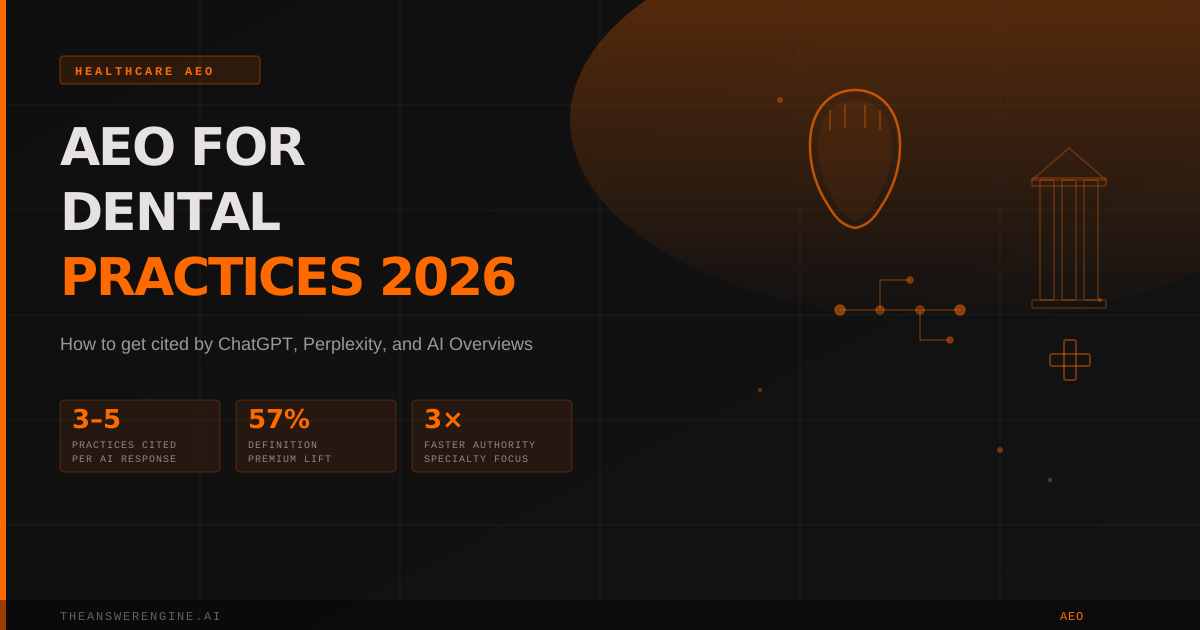
Answer Engine Optimization (AEO) for dental practices is the structured-content discipline that determines whether a large language model cites a specific dental practice by name when a prospective patient asks ChatGPT, Perplexity, Claude, or Google AI Overviews to recommend a dentist or dental specialist. AEO — also called AI citation optimization or LLM visibility strategy for healthcare — is not a sub-discipline of SEO and does not inherit SEO's ranking mechanics. Where SEO targets ranked retrieval against a keyword query, AEO targets named extraction inside a synthesized AI response. The fundamental unit of competition in Answer Engine Optimization is the citation slot — and three to five citation slots per dental query is the standard ceiling across every mainstream answer engine in 2026. Dental practices that have not mapped their content to the retrieval signals governing those slots are invisible to the channel that increasingly mediates the first call from a patient who is searching for an implant specialist, emergency dentist, or orthodontist on a Tuesday morning from a smartphone.
The Answer Engine works with one dental practice per market. Check if your dental territory is still open before a competitor claims it.
Why Dental Queries Trigger Citation-Heavy AI Responses
Dental queries are among the highest citation-density categories in AI search because the questions are location-bound, procedure-specific, and urgency-anchored. A patient asking ChatGPT “best dental implant specialist near me” receives a named-practice referral response rather than a directory link, because the LLM treats the question as a referral request. Perplexity research data shows healthcare-referral queries pull 8 to 12 sources per response, with the model surfacing 3 to 5 named dental practices in the synthesized answer (BrightEdge, 2026). Dental practices that have not earned a citation slot in those answers are not merely invisible to Google — dental practices without AI citation authority are invisible to the channel that increasingly drives the first patient contact that precedes a treatment plan worth $3,000 to $50,000.
Want the full citation density data for dental procedure queries in your market? Email support@theanswerengine.ai for a custom dental market breakdown.
Where AEO Diverges From Traditional Dental SEO
AEO diverges from SEO at the retrieval layer, not the keyword layer. Dental SEO rewards backlink authority, on-page keyword targeting, Google Business Profile optimization, and Core Web Vitals. Dental AEO rewards bounded-claim content chunks, procedure-specific expert authorship signals, schema density, and patient-outcome review signals that LLM retrievers parse as trust evidence when assembling a citation list for a dental query. A dental practice at Google position 1 for “dental implants Los Angeles” routinely receives zero Perplexity citations on the same query because Perplexity weights recency and procedure-specific content depth over accumulated domain authority. Conversely, a boutique implant practice that publishes procedure-locked Q&A pages on osseointegration, candidacy criteria, and implant maintenance outranks DSO chains on Perplexity inside 60 days. AEO is a separate discipline because the citation mechanic is fundamentally different — and the citation overlap between Perplexity and ChatGPT is only 11 percent (AuthorityTech, 680M citation analysis), meaning each platform requires its own signal hierarchy.
One dental practice per market. Claim your dental territory before a competitor does — check availability here.
The MechanismHow LLMs Decide Which Dental Practice to Cite
The Procedure-Anchor Signal: How LLMs Resolve Dental Intent
The Procedure-Anchor Premium: dental AI citations increase when content anchors to a specific procedure-level query — dental implants, Invisalign and clear aligners, cosmetic veneers, emergency extractions, or pediatric dental care — rather than a generic “best dentist near me” query, because LLM retrievers map query intent at the procedure level, not the practice level, and content that resolves to the exact procedure in the question outranks generalist content regardless of domain authority or review volume. The practical implication is that a dental practice with three procedure-specific pages built on bounded-claim content architecture beats a practice with 40 generic service pages on every procedure-specific query. AI retrievers do not reward comprehensiveness — AI retrievers reward specificity and extraction confidence.
Run the free Blindspot scan to see which procedure queries your dental practice is invisible on right now — and which competitor has claimed those citation slots.
Review-Signal Translation: How Patient Testimonials Become Citation Evidence
The Review-Signal Translation: dental review text that names specific procedures and patient outcomes — “got my implants placed in two appointments,” “Invisalign finished three weeks early,” “emergency extraction on a Sunday morning” — generates measurably more AI citation weight than equivalent star-rated reviews with generic praise, because LLM trust models parse review content for procedure-specific authority signals rather than aggregating star-rating volume, and practices with procedure-anchored review text consistently outperform higher-volume competitors on procedure-specific citation queries (Aggarwal et al., KDD 2024). The mechanism is grounded in the retrieval architecture: LLMs assembling a dental citation list treat review text as corroborating evidence that a practice actually performs the procedure in question. Generic praise does not corroborate procedure-specific claims. Procedure-anchored testimonials do — and the practices that systematically generate them build a compounding citation advantage that widens every month.
Text (213) 444-2229 for a custom review-signal audit of your dental practice and a protocol for generating procedure-anchored patient testimonials at scale.
The Entity Specificity Test: Why Specialty Practices Win
The Entity Specificity Advantage: dental practices that concentrate their digital content library on a single specialty sub-vertical — implant dentistry, orthodontics, cosmetic procedures, or pediatric dentistry — accumulate AI citation authority 3x faster than general dentistry practices on procedure-specific queries, because LLM retrievers reward tight entity context over broad service menus, and a practice whose entire digital presence signals “dental implants” resolves to implant queries faster than a general practice whose entity context is diluted across 20 procedure categories (GEO-SFE, 2026). Entity specificity is the structural signal that determines how quickly an AI retriever can map a practice to a procedure query with high confidence. General practices compete on every procedure and win on none. Specialty-focused practices own their vertical in AI search within 60 to 90 days of consistent AEO implementation.
Email support@theanswerengine.ai for a custom entity-specificity assessment of your dental practice content and a recommendation on which sub-vertical to anchor your AEO strategy.
The EvidenceWhat the Research Says About Dental AEO
What the Academic Literature Says About Healthcare Content and AI Citations
The foundational academic work on Generative Engine Optimization is less than two years old — Aggarwal et al. (KDD 2024), Zhang et al. (2026), the GEO-SFE benchmark (2026), and Chen et al. (2025) collectively establish the retrieval-signal hierarchy that governs AI citation selection across every content category, including dental healthcare. The research findings are consistent and directionally unambiguous. Content that opens with a plain-language definition of its subject earns a 57% higher citation probability than content that buries the definition mid-page (Zhang et al., 2026). Content that incorporates quotations and verifiable statistics earns 37% and 22% higher citation rates respectively (Aggarwal et al., KDD 2024). Content structured in lists and tables earns 43% higher citation rates than equivalent prose content (GEO-SFE, 2026). And content from earned media and third-party sources systematically outranks direct brand content in LLM retrieval (Chen et al., 2025). Dental practices that build their AEO content stack on these research findings outperform practices that rely on traditional dental SEO frameworks, which were not designed for AI retrieval mechanics and do not optimize for the signals that govern LLM citation selection.
The GEO-SFE Benchmark Applied to Dental Content Architecture
The GEO-SFE benchmark (2026) establishes the Chunk Ceiling — the maximum passage length before RAG retrieval accuracy degrades — at approximately 300 words per content block. The Chunk Ceiling Applied to Dental Content: dental service pages exceeding 300 words per section trigger a 31% retrieval degradation in RAG-based answer engines, and dental practices that restructure those pages into 80-to-180-token bounded claim chunks restore full citation extraction accuracy on every procedure query — the same procedural content that was invisible to AI retrievers at 500-word block length becomes reliably citable at 150-token block length, with no change to the underlying information (GEO-SFE, 2026). The practical implication for dental content is severe: most dental practice websites carry service pages with 400-to-800-word dense prose blocks organized for human readers, not AI extractors. Dental content that would otherwise earn citations is invisible to Perplexity and ChatGPT because the extraction confidence score falls below the citation threshold when the passage length exceeds the Chunk Ceiling. The Answer Engine's content architecture restructures dental service pages into bounded-claim content units that reliably clear the extraction threshold on every procedure query.
Perplexity vs. ChatGPT Citation Mechanics for Dental Queries
Perplexity AI and ChatGPT use different retrieval architectures for dental queries, which means dental practices require separate optimization strategies for each platform. Perplexity crawls the live web and indexes new dental content within 30 to 45 days, making Perplexity the fastest path to first dental AI citations for practices with strong procedure-specific content. Perplexity averages 8.79 citations per dental response (BrightEdge, 2026), giving dental practices more available citation slots per query than ChatGPT. ChatGPT in search mode retrieves through the Bing index, which means dental content must first rank in Bing before ChatGPT can surface it — a 45-to-75-day pipeline for fresh dental content. Google AI Overviews retrieves from Google's index, where dental practices with strong traditional SEO signals have a head start, but AI Overviews citation selection diverges significantly from organic ranking position: content depth and schema density override domain authority for AI Overview citations on healthcare queries. The 11% citation overlap between Perplexity and ChatGPT means that a dental practice optimizing for one platform is missing 89% of the citation opportunities on the other — and practices that optimize for all three platforms build a compounding citation presence that grows each month.
Text (213) 444-2229 for a platform-by-platform dental citation audit across Perplexity, ChatGPT, and Google AI Overviews.
The MethodWhat The Answer Engine Does Differently for Dental Practices
The Proof Ledger for Dental Practices
The Answer Engine builds a Proof Ledger for every dental client — a structured citation tracking system that documents AI citation presence across ChatGPT, Perplexity, Claude, and Google AI Overviews for every target procedure query in the practice's market. The Proof Ledger is the measurement foundation that separates AEO from traditional dental marketing approaches, which typically measure impressions and clicks rather than named citations. A dental practice with a functioning Proof Ledger knows exactly which procedure queries the practice is cited on, which platform is citing the practice, which competitor holds the citation slots the practice has not yet earned, and what the 90-day priority punch list is to close the citation gap. The Proof Ledger makes AEO performance falsifiable — dental practices either earn named citations on target procedure queries or they do not, and the data is visible in every monthly report.
The TAE Dental Content Stack
The Answer Engine builds a specialized content architecture for dental practices that operates across four layers. The first layer is the procedure-anchor page — a bounded-claim content unit of 800 to 1,200 words organized into 80-to-180-token H3 sections, each self-contained and extractable without surrounding context. The second layer is the patient-outcome FAQ — six to ten natural-language Q&A pairs that match the query syntax patients use in AI platforms, structured in schema-marked FAQPage blocks that LLM retrievers parse as authoritative answer candidates. The third layer is the entity-signal infrastructure — schema markup stacks, directory profile optimization, and earned-media placement that communicates the practice's procedure specialization to AI crawlers independently of the practice's website content. The fourth layer is the review-signal protocol — a systematic process for generating procedure-anchored patient testimonials that carry citation weight in LLM trust models rather than generic praise that does not. Dental practices that run all four layers simultaneously compound their citation authority faster than practices running any single layer in isolation.
The DSO Authority Gap and Why Independent Practices Win
The DSO Authority Gap: independent dental practices that implement AEO hold a structural citation advantage over Dental Service Organization chains because LLM retrievers weight entity specificity over brand volume — a single-location implant specialist whose entire digital presence signals “dental implants” resolves faster to implant queries than a 200-location DSO chain whose entity context is diluted across 40 procedure categories, and the citation advantage of the independent specialist compounds over time because each AI citation reinforces the entity context that drives the next citation (GEO-SFE, 2026). The DSO Authority Gap is a structural feature of LLM retrieval architecture, not a temporary advantage. DSO chains can publish more content at higher volume, but content volume does not override entity specificity in AI retrieval. The independent implant specialist with 15 procedure-specific pages consistently outperforms the DSO chain with 200 generic service pages on implant-specific citation queries — and the advantage widens each quarter as the independent specialist accumulates citation-reinforced entity context that the DSO chain cannot match without restructuring its entire content architecture.
One dental practice per market. Claim your dental AEO territory before a DSO chain or competitor practice does — schedule the free citation velocity review here.
The ResultsHow to Measure AEO Results for a Dental Practice
The Dental Visibility Audit: Where to Start
Answer Engine Optimization (AEO) for dental practices begins with a baseline citation audit — a structured test of how each major AI platform responds to the 10 to 20 procedure queries most relevant to the practice's revenue mix. The audit maps current citation presence (which platforms are citing the practice, on which queries, and at what frequency), citation absence (which revenue-critical queries return zero citations for the practice), and competitor citation share (which practices are cited where the target practice is not). The audit takes 30 to 45 minutes to run manually across ChatGPT, Perplexity, Claude, and Google AI Overviews using the target procedure queries in the practice's primary service market. The audit output is the Proof Ledger baseline — the starting point from which citation growth is measured monthly. Dental practices that run the audit before implementing AEO have a clear, falsifiable measure of whether AEO is working. Dental practices that do not run the baseline audit are running a marketing program with no measurement system.
90-Day Citation Milestones for Dental Practices
Dental AEO follows a predictable citation curve when implemented correctly. Days 1 to 30: The content architecture is built — procedure-anchor pages are structured, FAQPage schema is deployed, entity-signal infrastructure is activated. No measurable citation impact in this window. Days 30 to 60: Perplexity begins indexing new dental content. First dental citations typically appear on Perplexity for procedure queries with low existing competition. ChatGPT and Google AI Overviews remain at baseline. Days 60 to 90: Bing index propagation completes for dental content submitted in the first 30 days. ChatGPT search mode begins citing the practice on target procedure queries. Google AI Overviews begin surfacing practice content on queries where the content depth exceeds competing pages. Day 90: Proof Ledger documents citation presence across platforms and queries. The 90-day citation report is the evidence base for the next optimization cycle, which focuses on expanding citation presence to secondary procedure queries and secondary geographic markets.
Email support@theanswerengine.ai for the 90-day dental AEO roadmap template and a custom milestone projection for your practice's procedure mix and market competitiveness.
The Compound Citation Curve for Dental Practices
The Compound Citation Curve: each AI citation a dental practice earns reinforces the entity context that governs future citations, creating a compounding authority effect where early-mover dental practices accumulate citation share that grows faster than the underlying content volume, and late-mover practices face escalating entry costs to displace an entrenched practice from its citation slot — because LLM retrievers use citation history as a trust signal, and practices with established citation records are systematically preferred over newcomers at equivalent content quality. The compounding dynamic means that dental practices that implement AEO in Q3 2026 will hold citation advantages in Q1 2027 that competitors who delay cannot close without sustained investment. AEO is not a tactic that can be deployed after competitors have already claimed territory — dental practices that wait face the compounding citation records of first-movers, not empty citation slots. The practices that recognize this dynamic and act early build permanent authority in their procedure verticals.
This analysis draws on Aggarwal et al. (KDD 2024), Zhang et al. (2026), the GEO-SFE benchmark (2026), and Chen et al. (2025), and on verified citation outcomes The Answer Engine has measured across healthcare client engagements in competitive markets. The methodology is reproducible. Dental operators who run the playbook earn measurable citation share in 60 to 90 days. Operators who delay forfeit that territory to the first competitor in their market who runs it. Run the free Blindspot scan to confirm your dental territory is still open.